Dalt Vila Walls & Bastions: Ibiza's Renaissance Fortress Explained
The Murallas de Dalt Vila are the 16th-century Renaissance fortification walls encircling Ibiza Town's historic upper quarter. Free to enter at any hour, they form the architectural backbone of a UNESCO World Heritage Site and offer the island's most commanding views of the harbour and open sea.
Quick Facts
- Location
- Zona Dalt Vila, 07800 Eivissa, Ibiza, Balearic Islands, Spain
- Getting There
- Walk uphill from Ibiza Port through the old quarter to Portal de Ses Taules; taxis drop at Plaza de la Reina Sofía
- Time Needed
- 1.5–3 hours to circuit the walls and explore the bastions
- Cost
- Free — walls and bastions are open public space; individual museums inside charge separately
- Best for
- History, photography, sunset views, slow walkers who want context beyond the beach
- Official website
- www.spain.info/en/places-of-interest/walls-dalt-vila
What Are the Dalt Vila Walls?
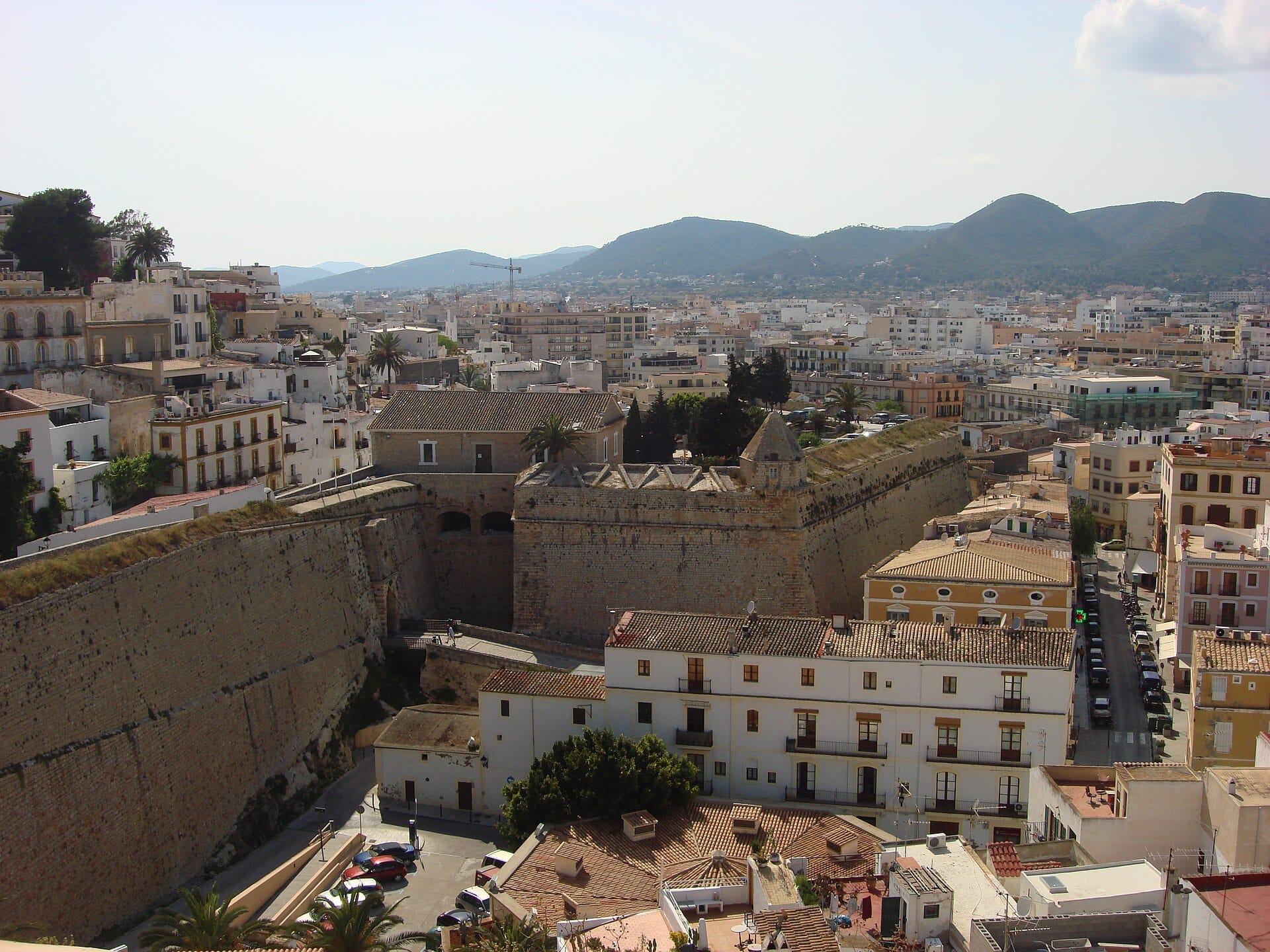
The Dalt Vila Walls and Bastions, officially the Murallas de Dalt Vila, are a system of Renaissance military fortifications encircling the hilltop old town of Ibiza (Eivissa). Commissioned in the 16th century and taking roughly forty years to complete, they were engineered to repel Ottoman and other naval threats in the western Mediterranean. The result is a nearly intact irregular heptagon of stone, anchored at each corner by one of seven bastions, rising steeply above the harbour and visible from most of Ibiza Town.
In 1999, UNESCO designated the area as a World Heritage Site under the title 'Ibiza, Biodiversity and Culture', recognising both the fortifications and the archaeological layers beneath them. The walls share that designation with the Phoenician settlement of Sa Caleta, the Puig des Molins necropolis, and the Posidonia seagrass meadows offshore. That breadth of recognition reflects how the walls are understood not as a single monument but as the visible edge of thousands of years of continuous habitation on this hill.
ℹ️ Good to know
Access to the walls, bastions, and streets of Dalt Vila is free, and practical visiting hours generally follow the municipality’s posted schedule; there is no ticket required to walk the perimeter or the internal streets.
Arriving: The Portal de Ses Taules and First Impressions
The primary entrance to the walled enclosure is the Portal de Ses Taules, a Roman-arched gateway flanked by two classical statues and a carved coat of arms above the arch. Approaching from the lower town, the portal appears at the top of a worn stone ramp. The change in atmosphere is immediate: the noise of traffic and restaurants drops away, and the temperature drops a degree or two in the shade of the gateway. The pavement under your feet shifts from modern tarmac to large irregular cobblestones that have absorbed centuries of foot traffic.
There are several other access points. Portal Nou, on the northern side, is used more by locals on foot. The Es Soto Fosc tunnel cuts through the hillside and is useful if you are coming from the eastern side of the lower town. Sa Portella, the last surviving medieval access, also connects into the walled enclosure. Each entrance has a slightly different character, but Portal de Ses Taules remains the most architecturally impressive and the one most worth seeking out on a first visit.
💡 Local tip
Wear proper walking shoes. The cobblestones inside Dalt Vila are beautiful but uneven, and the slopes to the upper bastions are genuinely steep. Smooth-soled sandals are a liability, especially if it has rained.
Tickets & tours
Hand-picked options from our booking partner. Prices are indicative; availability and final rates are confirmed when you complete your booking.
Sunset boat tour with tapas, open bar and water sports in Ibiza
From 70 €Instant confirmationFree cancellationEscape Tour self-guided, interactive city challenge in Ibiza
From 30 €Instant confirmationPrivate Sunset Cruise on a Maritime Classic in Ibiza
From 750 €Instant confirmationFree cancellationIbiza to Formentera boat trip with open bar and water sports
From 69 €Instant confirmationFree cancellation
Walking the Bastions: What You Actually See
The seven bastions are the structural and visual highlights of the fortification. Each one projects outward from the wall at an angle, a classic feature of Renaissance military engineering designed to eliminate blind spots and allow defenders to cover adjacent wall sections with flanking fire. In peacetime, they function as the best viewpoints on the island.
The Baluard de Sant Bernat and the Baluard de Santa Llúcia face south and east respectively, offering direct sightlines over the harbour, the ferry terminals, and on clear days toward Formentera. The Baluard de Sant Jordi, at the highest point, looks northwest toward the open sea and on calm mornings the water takes on colours that photographers spend days trying to capture. Early morning light, roughly an hour after sunrise, hits the stone walls at a low angle and brings out the texture of the limestone in a way that midday sun completely flattens.
In peak summer, these bastions fill quickly after 9am. By 11am on a July morning, the most photogenic angles are occupied by tour groups. The same spots at 7am are nearly empty, and the air is still cool enough to make the walk genuinely comfortable. Conversely, the sunset view from the upper bastions is well established and deliberately sought out: expect company, but also expect the sky to deliver.
If sunsets are a priority during your stay, the bastions of Dalt Vila pair naturally with the Sunset Strip in San Antonio for a very different vantage. The Dalt Vila angle looks out over the old harbour, which adds layered foreground detail that the open-sea view from San Antonio lacks.
The History Behind the Stone
The decision to fortify Ibiza Town with Renaissance walls reflected the strategic anxiety of 16th-century Mediterranean Spain. The island's position, roughly 150 kilometres from the Spanish mainland near Valencia, made it a plausible target for Ottoman naval power, which was actively contesting control of the western Mediterranean at the time. Spanish military engineers designed the fortifications according to the trace italienne system, a method developed in Italy that favoured lower, thicker walls able to absorb cannon fire, combined with angled bastions that maximised artillery coverage.
The hilltop these walls enclose had already been inhabited for more than two thousand years before the Renaissance engineers arrived. Phoenician traders established a presence here in the 7th century BCE, and their burial ground at Puig des Molins remains one of the most significant Phoenician-Punic necropolises in the western Mediterranean. The Romans came later, then the Moors, then the Aragonese Crown. The walls that visitors walk today were built over this entire accumulated history, and excavations inside Dalt Vila continue to produce archaeological finds.
Construction of the current fortifications took approximately forty years. That timeline reflects both the scale of the project and the practical challenges of quarrying, transporting, and cutting limestone on a relatively small island. The walls were never seriously tested in battle, which is partly why they survive in such complete condition.
Inside the Walls: Beyond the Fortifications Themselves
The enclosed area of Dalt Vila contains far more than the walls. The Ibiza Cathedral occupies the highest point within the enclosure, its Gothic tower visible from the harbour. Streets inside are narrow, steep, and shaded for much of the day, lined with whitewashed buildings whose shuttered windows and flowering pots feel unchanged in character even if not always in age. The Ibiza Museum of Contemporary Art is housed within the walls and charges a separate admission.
Restaurant terraces at the upper levels offer views that justify prices markedly higher than those at the port below. Spending an hour at a table with a coffee or a glass of local wine while watching the light change over the harbour is one of the more civilised ways to experience Dalt Vila, and it requires no particular planning. Outside summer, the restaurants thin out and the streets inside the walls take on a quieter character that is harder to find between June and September.
⚠️ What to skip
Dalt Vila's steep cobbled streets are largely inaccessible to wheelchair users and anyone with significant mobility limitations. There is no step-free route to the upper bastions. If mobility is a concern, the lower sections near Portal de Ses Taules are reachable, but the full circuit is not.
Practical Details: When to Go and How to Plan
The walls and bastions are accessible at all hours and in all seasons. In summer (June to August), the combination of heat and crowds makes early morning the most practical window: the light is good, the stone is cool, and the alleys inside the walls are quiet enough to hear your own footsteps. The full circuit of the bastions, walking at a moderate pace and pausing at the main viewpoints, takes between 90 minutes and three hours depending on how much time you spend inside the walls themselves.
September and October bring noticeably fewer visitors while temperatures remain warm enough for comfortable walking. Ibiza in September and October is underrated for this kind of heritage visit: the light in autumn is softer and more directional than the hard summer glare, which makes the bastion stonework photograph much better.
Winter visits are quiet and occasionally atmospheric, especially on overcast days when cloud shadow moves across the walls. The island is genuinely calm between November and March, and Dalt Vila on a cool weekday morning with mist over the harbour is a completely different experience from a peak-summer evening. Neither is the definitive version; they are just different attractions wearing the same address.
Most visitors to Dalt Vila approach on foot from the port area of Ibiza Town, a walk of roughly 10 to 15 minutes uphill from the waterfront. Taxis can drop passengers at Plaza de la Reina Sofía near the main entrance. There is no parking inside the walled area, and driving within is restricted.
Photography Notes and Sensory Details
The walls are made of honey-coloured limestone that shifts from pale cream in strong midday sun to deep amber in the last hour of afternoon light. The texture of the stone is visibly worn in places, particularly along the base of the bastions where centuries of weather and human contact have smoothed the original cut marks. Up close, the walls smell faintly mineral, the way old stone does when it has been absorbing heat all day.
For photography, the best external angle for the walls is from the lower town looking up, particularly from the area near the port in early morning. For views from the bastions outward, a wide-angle lens handles the harbour panoramas well, while a longer focal length compresses the layered rooflines of the lower town into something more graphic. Drone regulations apply in this area as it falls within protected airspace near the port; check current Spanish civil aviation authority rules before flying.
Insider Tips
- Walk the external perimeter of the walls from the outside before entering. The best photographs of the fortifications themselves are taken from below, not from inside where the walls disappear into the surrounding buildings.
- The Es Soto Fosc tunnel entrance, on the eastern side of the hill, is used mainly by locals and is almost always free of the crowds that gather at Portal de Ses Taules in peak season. It opens onto the interior streets directly without any queue or bottleneck.
- If you want to visit the cathedral and any museums inside Dalt Vila, plan for Tuesday through Saturday and check current individual opening hours before arriving. Museums inside the walls keep shorter hours than the walls themselves and are closed on different days.
- The bastions are exposed and offer no shade. In July and August, visiting after 5pm lets you combine the cooling late afternoon with golden-hour light on the harbour and avoids the worst of the midday heat. Bring water regardless of the season.
- Look down as well as out. The cobblestone surface of the alleyways inside Dalt Vila includes sections of older paving visible beneath the later stones, particularly near the upper streets toward the cathedral. Most visitors walk straight past them.
Who Is Dalt Vila Walls & Bastions For?
- First-time visitors to Ibiza who want historical context beyond beaches and clubs
- Photographers who plan around golden-hour light and want elevated vantage points
- Couples looking for a slow, scenic afternoon walk with good restaurants at the top
- Travellers visiting in shoulder season (September to October or May) who want the full circuit without summer crowds
- Anyone with a genuine interest in Renaissance military architecture or Mediterranean history
Nearby Attractions
Other things to see while in Dalt Vila:
- Castle of Ibiza (Castell d'Eivissa)
Perched at the summit of Ibiza Town's UNESCO-listed old city, the Castle of Ibiza (Castell d'Eivissa) is the island's oldest continuously occupied defensive site. Visitors today explore the exterior, two free bastions, and sweeping views over the harbour and open sea — the main castle building itself remains closed to the public.
- Ibiza Cathedral (Catedral de Santa Maria d'Eivissa)
Perched near the highest point of Ibiza's UNESCO-listed Old Town, the Catedral de Santa Maria d'Eivissa is a Gothic tower wrapped in Baroque stone, with sweeping views over the harbour and the Mediterranean beyond. Entry is free, the climb is steep, and the reward is genuine.
- Ibiza Museum of Contemporary Art (MACE)
The Ibiza Museum of Contemporary Art, known as MACE, sits inside a 1727 Hall of Arms and Prova military storehouse in Dalt Vila's UNESCO-listed old town. Free to enter and often overlooked by visitors focused on beaches and nightlife, it offers a quiet, layered experience that combines modern Ibizan art with underground archaeology reaching back to the Phoenician era.
- Museu Puget
Tucked inside a centuries-old manor house in Dalt Vila, Museu Puget holds around 130 paintings and drawings by Narcís Puget Viñas and his son Narcís Puget Riquer. It is free to enter, small enough to visit in under an hour, and offers a rare, unhurried window into how Ibiza looked before the tourists arrived.