Portal de ses Taules: The Gate That Opens Ibiza's Ancient World
Portal de ses Taules is the principal entrance to Dalt Vila, Ibiza Town's UNESCO-listed walled old city. Built between 1584 and 1585, this Renaissance gateway frames a Roman past and a Baroque present, offering one of the most striking architectural moments on the island, at no cost and at any hour.
Quick Facts
- Location
- Zona Dalt Vila, 07800 Eivissa (Ibiza), Spain
- Getting There
- On foot from Ibiza Port or Ibiza Town centre; follow signs to Dalt Vila. No bus stop directly at the gate.
- Time Needed
- 10–20 minutes at the gate itself; pair with a Dalt Vila walk for 2–3 hours total
- Cost
- Free. No ticket required to pass through the gate or enter Dalt Vila.
- Best for
- History lovers, architecture enthusiasts, photographers, first-time Ibiza visitors
What Is Portal de ses Taules?
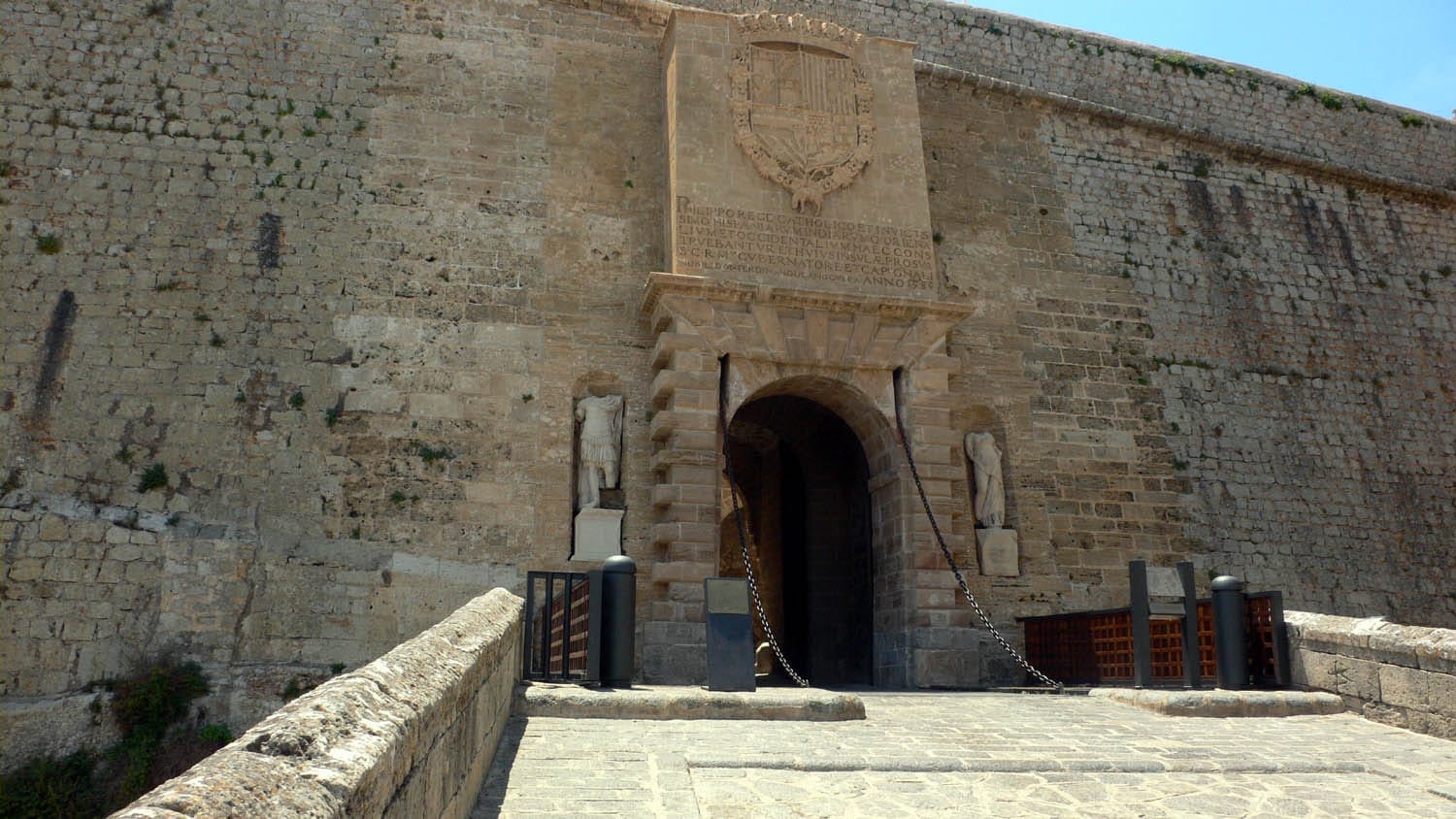
Portal de ses Taules is the ceremonial main gate through which visitors have entered the fortified old city of Ibiza, known as Dalt Vila, for over four centuries. Positioned between the bastions of Sant Joan and Santa Llúcia, at the edge of Plaza de la Constitución, it is the single most dramatic architectural threshold on the island. Passing through it is not optional if you are serious about understanding what Ibiza actually is beneath the nightlife reputation.
The gate was built between 1584 and 1585 under the reign of King Philip II of Spain, as part of a major Renaissance-era fortification project designed to protect the island from pirate raids. You can still see the royal coat of arms of Philip II carved prominently above the arch, a reminder that this entrance was built as a statement of power as much as a practical military structure. The walls at this point are approximately two metres thick.
ℹ️ Good to know
Entry through Portal de ses Taules into Dalt Vila is completely free. The gate is accessible at all hours, day and night, as it functions as a live city entrance rather than a ticketed attraction.
The Architecture Up Close
The archway itself follows a Renaissance design language: clean, proportioned, and deliberately imposing. The stone is warm ochre in direct sun, deepening to amber at dusk, and you will notice the texture of centuries of wear in the joints and corbels. Two marble statues flank the entrance on pedestals. These are replicas; the originals, which date to Roman antiquity, were moved to the Ibiza Archaeological Museum for preservation. Even as reproductions, they give the gate a ceremonial formality that sets the tone for the old city beyond.
To reach the gate, you cross a bridge. Originally the entrance was protected by a moat and a drawbridge, making it a genuine defensive bottleneck. Wooden planks replaced the drawbridge from 1888, and a permanent stone bridge was installed in the early twentieth century. The arch you walk beneath still carries the original voussoirs, and the scale of the opening is calibrated to feel significant without being overwhelming. It is wide enough for a carriage, tight enough to concentrate your attention.
The full defensive ensemble around the gate is part of the Dalt Vila walls and bastions, a UNESCO World Heritage site designated in 1999. The fortifications here represent some of the finest Renaissance military architecture in the western Mediterranean, and Portal de ses Taules is their public face.
Tickets & tours
Hand-picked options from our booking partner. Prices are indicative; availability and final rates are confirmed when you complete your booking.
Sunset boat tour with tapas, open bar and water sports in Ibiza
From 70 €Instant confirmationFree cancellationEscape Tour self-guided, interactive city challenge in Ibiza
From 30 €Instant confirmationPrivate Sunset Cruise on a Maritime Classic in Ibiza
From 750 €Instant confirmationFree cancellationIbiza to Formentera boat trip with open bar and water sports
From 69 €Instant confirmationFree cancellation
How the Experience Changes by Time of Day
Morning is the most photogenic window, particularly between 8:00 and 10:00. The low eastern light hits the stone face of the gate directly, bringing out the carved details of the Philip II coat of arms and the grain of the stonework. At this hour, foot traffic is light: local residents passing through, the odd cyclist, a handful of early-rising visitors. The Plaza de la Constitución behind you is quiet, and the narrow passage through the gate gives a genuine sense of arrival.
By midday in summer, the plaza fills with tour groups and day visitors. The gate becomes a pinch point and the atmosphere shifts to something more transactional. Heat reflects sharply off the pale stone. If your only goal is to photograph the arch without crowds, midday is the time to avoid.
Evening, especially in the 45 minutes before and after sunset, offers a third version of the experience. Warm light bathes the facade, the tourist volume drops as people head to dinner, and the old market building opposite takes on a golden cast. The gate is also lit after dark, making it striking from the plaza side for nighttime photography. Walking through it at 22:00, with the cobblestones of Dalt Vila quiet above, feels like a genuinely different city from the one below.
💡 Local tip
For the best photographs, arrive before 9:30 AM or return around 30 minutes before sunset. Both windows offer soft directional light and minimal crowds. Bring a wide-angle lens or use your phone in portrait orientation to capture the full height of the arch from across the bridge.
Historical and Cultural Context
To understand Portal de ses Taules, you need to understand what Ibiza faced in the sixteenth century. The western Mediterranean was contested territory, with Ottoman-allied corsairs regularly raiding coastal settlements. Philip II commissioned an ambitious fortification of the island, and the walls of Dalt Vila, completed in the late sixteenth century, were the result. The gate was the controlled point of entry, the place where the city could be sealed at a moment's notice.
The old city the gate protects is one of the best-preserved walled Renaissance settlements in Spain. Inside, streets climb steeply toward the Ibiza Cathedral and the Castle of Ibiza at the summit, passing whitewashed houses, small squares, and the Archaeological Museum. The gate is not a destination in isolation; it is a starting point.
The Roman statues that once stood at the gate are a detail worth pausing on. Their presence at a sixteenth-century Spanish fortification speaks to Ibiza's layered history: Phoenician traders, Roman colonists, Moorish rule, and Aragonese reconquest all left marks on this island before Philip II's engineers arrived. The gate itself sits on top of that accumulated past, both literally and architecturally.
Practical Walkthrough: Getting There and What to Do
The gate is a ten to fifteen minute walk from Ibiza Port and the main marina area. From the port, walk inland toward the old market building at Plaza de la Constitución. The gate is visible ahead of you, at the top of a short rise. There are no buses that stop directly at the gate; the walk from town is the standard approach, and it is straightforward.
Once through the gate, you are immediately inside the UNESCO-listed walled city. The cobblestoned incline begins at once. Shoes matter here: sandals with grip or comfortable walking shoes are sensible. Flip-flops on the steeper sections of Dalt Vila are a common mistake. The streets are uneven, the gradients are genuine, and the upper parts of the old city require a reasonable level of mobility.
⚠️ What to skip
Accessibility is limited. The approach bridge has a ramp, but once inside Dalt Vila the streets are steep, narrow, and cobbled throughout. Visitors using wheelchairs or pushchairs will find most of the interior old city difficult to navigate. There is no dedicated accessible entrance to the walled city listed in official tourism information.
Plan at least two to three hours if you intend to walk through Dalt Vila after entering. The gate is just the beginning. Most visitors make their way up to the cathedral square for the panoramic view over the port and the island, which alone justifies the climb. Allow extra time in summer heat; the ascent is short but real.
Is It Worth Your Time?
Portal de ses Taules is not a museum or a ticketed experience. It is a functioning city gate, and that is part of what makes it interesting. Unlike many heritage monuments that exist behind barriers, this one is woven into daily life. Local residents, food delivery workers, and tourists all pass through the same arch. That continuity across four centuries of use is something you feel rather than read about. For anyone visiting Ibiza Town for the first time, walking through this gate should be the starting point of any exploration of the old city.
If you are in Ibiza purely for the beaches and nightlife, this is an easy stop to skip. It takes ten minutes to look at the gate itself, and the Dalt Vila walk above is more demanding. But if you have even a passing interest in how this island accumulated its character before the clubs arrived, Portal de ses Taules is the most economical way to begin understanding that. Free, permanent, and open at any hour.
For a broader orientation to the historic quarter, the Ibiza Dalt Vila guide covers the full walk from this gate to the castle at the top, including what to see along the route.
Insider Tips
- Stand at the far end of the bridge before you cross and look back toward the plaza and old market building. This is the widest framing of the gate from the outside and the angle most guidebooks do not feature.
- The coat of arms of Philip II above the arch is easy to miss if you walk straight through. Stop in the archway itself, look up, and let your eyes adjust to the shade. The carving is detailed and in good condition.
- The original Roman marble statues that stood here are now in the Ibiza Archaeological Museum, which is located inside Dalt Vila close to the gate. If the history of the gate interests you, the museum is a ten-minute walk up the hill and gives the statues proper context.
- Weekday mornings between mid-September and October offer a near-empty gate and pleasant temperatures. The tourist season has wound down but the weather remains warm and dry.
- The gate is equally worthwhile after dark. Dalt Vila is lit at night, the plaza is lively with diners from the surrounding restaurants, and the arch has a solidity after dark that the bright midday light actually flattens.
Who Is Portal de ses Taules For?
- First-time visitors to Ibiza who want to understand the island beyond its nightlife identity
- Architecture and history enthusiasts interested in Renaissance military design
- Photographers looking for strong morning or golden-hour light on historic stonework
- Walkers using the gate as the starting point for a full Dalt Vila circuit
- Travellers on a tight budget: this is one of the most historically significant sites on the island, and it costs nothing
Nearby Attractions
Other things to see while in Dalt Vila:
- Castle of Ibiza (Castell d'Eivissa)
Perched at the summit of Ibiza Town's UNESCO-listed old city, the Castle of Ibiza (Castell d'Eivissa) is the island's oldest continuously occupied defensive site. Visitors today explore the exterior, two free bastions, and sweeping views over the harbour and open sea — the main castle building itself remains closed to the public.
- Dalt Vila Walls & Bastions
The Murallas de Dalt Vila are the 16th-century Renaissance fortification walls encircling Ibiza Town's historic upper quarter. Free to enter at any hour, they form the architectural backbone of a UNESCO World Heritage Site and offer the island's most commanding views of the harbour and open sea.
- Ibiza Cathedral (Catedral de Santa Maria d'Eivissa)
Perched near the highest point of Ibiza's UNESCO-listed Old Town, the Catedral de Santa Maria d'Eivissa is a Gothic tower wrapped in Baroque stone, with sweeping views over the harbour and the Mediterranean beyond. Entry is free, the climb is steep, and the reward is genuine.
- Ibiza Museum of Contemporary Art (MACE)
The Ibiza Museum of Contemporary Art, known as MACE, sits inside a 1727 Hall of Arms and Prova military storehouse in Dalt Vila's UNESCO-listed old town. Free to enter and often overlooked by visitors focused on beaches and nightlife, it offers a quiet, layered experience that combines modern Ibizan art with underground archaeology reaching back to the Phoenician era.