Ibiza Museum of Contemporary Art (MACE): What to Know Before You Visit
The Ibiza Museum of Contemporary Art, known as MACE, sits inside a 1727 Hall of Arms and Prova military storehouse in Dalt Vila's UNESCO-listed old town. Free to enter and often overlooked by visitors focused on beaches and nightlife, it offers a quiet, layered experience that combines modern Ibizan art with underground archaeology reaching back to the Phoenician era.
Quick Facts
- Location
- Ronda de Narcís Puget s/n, Dalt Vila, Ibiza Town (Eivissa)
- Getting There
- On foot from Ibiza port — walk uphill through Dalt Vila's gates. No car access inside the walls.
- Time Needed
- 45–90 minutes for the museum; allow extra time to explore Dalt Vila before or after
- Cost
- Free entry
- Best for
- Art lovers, history enthusiasts, and anyone wanting a slow morning inside the old town
- Official website
- http://www.mace.eivissa.es
What MACE Actually Is (and Why It Surprises Most Visitors)
The Ibiza Museum of Contemporary Art, MACE, is one of the oldest contemporary art museums in Spain, inaugurated in 1969 following the island's first Biennial of Art in 1964. That context matters: Ibiza had already attracted a serious community of international artists by the mid-20th century, and the museum was built to document and preserve that creative legacy, not to chase tourism trends. It is operated by Ibiza City Hall and housed in a former military storehouse designed by architect Simón Poulet in 1727, within the Dalt Vila historic quarter, a UNESCO World Heritage site.
The building itself is part of the story. After a major renovation that lasted five years, the museum reopened in spring 2012 following the discovery of significant archaeological remains during construction. What had been planned as a straightforward refurbishment became something more complex and ultimately more interesting: the finished museum now spans three levels, with the ground floor given over to contemporary exhibitions and two underground floors revealing Phoenician (6th century BC), Roman, and Islamic remains that were uncovered and preserved in place rather than removed.
ℹ️ Good to know
Entry is free. Hours are seasonal: May 1–September 30, Tuesday–Sunday 10:00–13:30, plus Tuesday–Friday 17:00–20:00. October 1–April 30, Tuesday–Sunday 10:00–13:30, plus Tuesday–Friday 16:00–18:00. Closed Mondays and public holidays. Verify current hours directly with the museum before your visit, as schedules can change.
The Building: Three Centuries of Layers
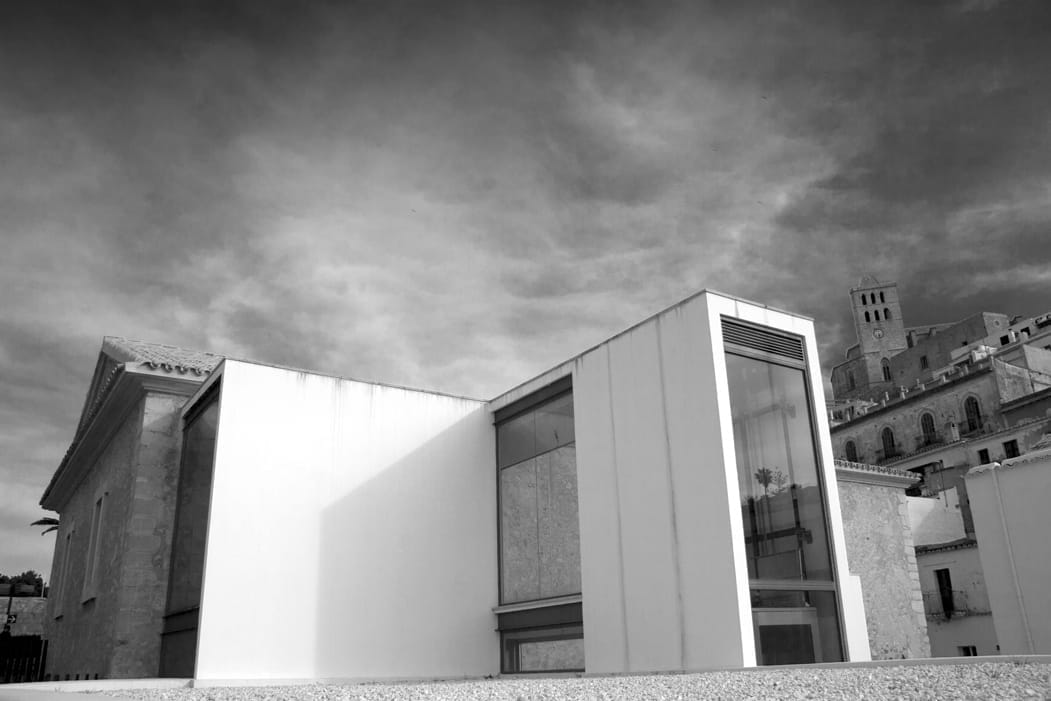
Standing in front of MACE, the 18th-century military architecture reads clearly: thick stone walls, a restrained facade, the kind of building designed for function rather than ornament. It sits within the fortified perimeter of Dalt Vila, where the stone is worn smooth in places and the air carries the particular stillness of a walled town that has been largely insulated from development for decades.
Inside, the renovation work from the 2012 reopening is well-executed. The ground floor is clean and contemporary, with exhibition spaces that manage to feel both modest in scale and properly curated. The real architectural surprise comes when you descend to the lower levels. The underground floors expose the archaeological finds behind glass and low barriers, integrated into the structure rather than cordoned off as an afterthought. Walking past exposed Phoenician stonework while heading toward a gallery showing 20th-century Ibizan painting is exactly the kind of layered experience that the island's history, dense with cultures from the Mediterranean world, makes possible.
The facility also includes an auditorium, a small shop, and a documentation and reading centre. For visitors who want to dig deeper into the art history of the Balearic Islands, the documentation centre is worth knowing about. If Phoenician heritage is your primary interest, the nearby Necropolis of Puig des Molins offers a more focused archaeological experience.
Tickets & tours
Hand-picked options from our booking partner. Prices are indicative; availability and final rates are confirmed when you complete your booking.
Sunset boat tour with tapas, open bar and water sports in Ibiza
From 70 €Instant confirmationFree cancellationEscape Tour self-guided, interactive city challenge in Ibiza
From 30 €Instant confirmationPrivate Sunset Cruise on a Maritime Classic in Ibiza
From 750 €Instant confirmationFree cancellationIbiza to Formentera boat trip with open bar and water sports
From 69 €Instant confirmationFree cancellation
The Collection: Ibiza's Artistic Identity
The permanent collection at MACE focuses primarily on work created in or connected to Ibiza from the mid-20th century onward. The island drew an unusually concentrated group of artists from the 1950s through the 1970s, attracted by the light, the cost of living, and a sense of creative freedom that was rare in Europe at the time. Work by figures from that period forms the backbone of the collection, giving the museum a specific character rather than the generic international survey you find at many regional contemporary art institutions.
Temporary exhibitions rotate through the ground floor spaces and can range considerably in medium and approach. The programming tends toward Spanish and Mediterranean artists, though it occasionally extends further. Before visiting, check the museum's official website or the Ajuntament d'Eivissa's MACE section for current exhibition information, since what's on display changes and can meaningfully affect the experience.
How the Visit Actually Feels: Time of Day and Atmosphere
Mornings, particularly in the first hour after opening, are quiet to the point of feeling private. The narrow streets of Dalt Vila are still cool, the light angled low through the stone archways, and foot traffic is minimal. This is when the museum works best. The galleries are small enough that even a handful of other visitors shifts the mood noticeably, and a quiet morning visit allows you to spend real time in front of individual works without feeling rushed or crowded.
By late morning in high season (July and August), tour groups passing through Dalt Vila begin filtering into the museum. The experience remains manageable, but it loses some of its reflective quality. The afternoon session (opening again at 17:00 in summer, 16:00 in winter) brings a different kind of visitor: people who have spent the day at the beach and are wandering the old town before dinner. This slot can be surprisingly pleasant, with cooler temperatures inside the thick-walled building and softer light entering through the windows.
💡 Local tip
Tuesday through Friday morning, ideally before 11:00, gives you the best combination of open galleries and minimal crowds. Weekends see more foot traffic even in shoulder season.
Getting There: Walking Dalt Vila
MACE is only reachable on foot. Private cars cannot access the immediate surroundings of the museum, and the narrow cobblestone streets near it are designed for pedestrians. From the port area of Ibiza Town, the walk uphill to the museum takes roughly 10–15 minutes depending on your pace and how much you stop along the way. The most direct route passes through the Portal de ses Taules, the main Renaissance gateway into the old town, which is worth slowing down to examine on your way through.
The ascent involves uneven cobblestones and some steep sections. Comfortable shoes matter more than you might expect, especially in summer heat. Visitors with significant mobility limitations should be aware that both the approach streets and parts of the museum's interior (particularly the lower underground levels) may present challenges. Contact the museum directly to ask about current accessibility provisions, as these details are not fully documented in publicly available sources.
Combining MACE with a broader exploration of Dalt Vila makes sense logistically and experientially. The Ibiza Cathedral sits at the highest point of the old town, a short walk further uphill from the museum. The Dalt Vila walls and bastions offer some of the best elevated views over the port and surrounding coastline and are accessible without entering any ticketed site.
Photography and Practical Details
Photography policies inside the museum should be confirmed at the entrance, as they can vary depending on whether temporary exhibition agreements restrict photography. The building's exterior and the surrounding streets photograph well throughout the day, but the warm, raking light of early morning and late afternoon in summer gives the stone walls a depth that midday light flattens entirely.
The museum has no dedicated café, but Dalt Vila has several small bars and restaurants within a few minutes' walk. In summer, carrying water is advisable for the uphill approach, and light clothing is sensible given both the heat and the fact that the museum's interior is relatively compact. The underground floors can feel notably cooler than the ground level, which is a relief on a hot afternoon.
Who Should Think Twice
MACE is a small regional contemporary art museum. If you have no particular interest in 20th-century Ibizan or Spanish art and are primarily visiting Ibiza for beaches, clubs, or scenery, the museum is unlikely to be a highlight. The collection is specific rather than encyclopedic, and the temporary exhibitions, while often thoughtfully curated, operate at a scale and budget that reflects a municipal institution on a Mediterranean island rather than a major international art venue.
Visitors who expect something comparable to major contemporary art institutions in Barcelona or Madrid will find the scale modest. That said, the free entry and the quality of the building make this a low-stakes stop that rewards those who approach it with the right expectations. If cultural depth is what draws you to Ibiza, read our full guide to Dalt Vila to plan a morning that takes in the museum alongside the wider historic quarter.
Insider Tips
- The museum's documentation and reading centre is rarely mentioned in travel guides but holds reference material on Ibizan art history — useful if you want context for the collection before walking through the galleries.
- Check the official website (mace.eivissa.es) before visiting to see what's currently in the temporary exhibition space. A strong show makes the visit significantly more worthwhile; a between-shows period can feel sparse.
- The two underground archaeological floors are the most unusual part of the museum and easy to miss if you assume the ground level is all there is. Ask at the entrance to confirm the lower levels are open.
- Combine your visit with the nearby Museu Puget, which focuses on traditional Ibizan painting and is also free. The two together give a more complete picture of the island's visual art history without adding much time or cost.
- Arrive within the first 30 minutes of opening on a weekday for the best chance of having the galleries almost to yourself, particularly in July and August when Dalt Vila sees steady tourist traffic from mid-morning onward.
Who Is Ibiza Museum of Contemporary Art (MACE) For?
- Art and culture travelers who want context for Ibiza's 20th-century creative history
- Architecture enthusiasts interested in adaptive reuse of historic military buildings
- Anyone visiting Dalt Vila who wants to extend a morning in the old town meaningfully
- Travelers on a tight budget looking for a quality cultural experience at no cost
- Those interested in Mediterranean archaeology who want to complement a visit to the Necropolis of Puig des Molins
Nearby Attractions
Other things to see while in Dalt Vila:
- Castle of Ibiza (Castell d'Eivissa)
Perched at the summit of Ibiza Town's UNESCO-listed old city, the Castle of Ibiza (Castell d'Eivissa) is the island's oldest continuously occupied defensive site. Visitors today explore the exterior, two free bastions, and sweeping views over the harbour and open sea — the main castle building itself remains closed to the public.
- Dalt Vila Walls & Bastions
The Murallas de Dalt Vila are the 16th-century Renaissance fortification walls encircling Ibiza Town's historic upper quarter. Free to enter at any hour, they form the architectural backbone of a UNESCO World Heritage Site and offer the island's most commanding views of the harbour and open sea.
- Ibiza Cathedral (Catedral de Santa Maria d'Eivissa)
Perched near the highest point of Ibiza's UNESCO-listed Old Town, the Catedral de Santa Maria d'Eivissa is a Gothic tower wrapped in Baroque stone, with sweeping views over the harbour and the Mediterranean beyond. Entry is free, the climb is steep, and the reward is genuine.
- Museu Puget
Tucked inside a centuries-old manor house in Dalt Vila, Museu Puget holds around 130 paintings and drawings by Narcís Puget Viñas and his son Narcís Puget Riquer. It is free to enter, small enough to visit in under an hour, and offers a rare, unhurried window into how Ibiza looked before the tourists arrived.