Ibiza Cathedral (Catedral de Santa Maria d'Eivissa): The Summit of Dalt Vila
Perched near the highest point of Ibiza's UNESCO-listed Old Town, the Catedral de Santa Maria d'Eivissa is a Gothic tower wrapped in Baroque stone, with sweeping views over the harbour and the Mediterranean beyond. Entry is free, the climb is steep, and the reward is genuine.
Quick Facts
- Location
- Plaza de la Catedral, s/n, 07800 Eivissa (Dalt Vila, Ibiza Town)
- Getting There
- Walk uphill from Ibiza Port through the Portal de ses Taules gate; no vehicle access inside Dalt Vila walls
- Time Needed
- 30–60 minutes at the cathedral; add 20–30 minutes each way for the climb through Dalt Vila
- Cost
- Free entry (verify locally, as hours and access policies are seasonal)
- Best for
- History lovers, architecture enthusiasts, photographers, and anyone who wants Ibiza's best hilltop panorama
What the Catedral de Santa Maria d'Eivissa Actually Is
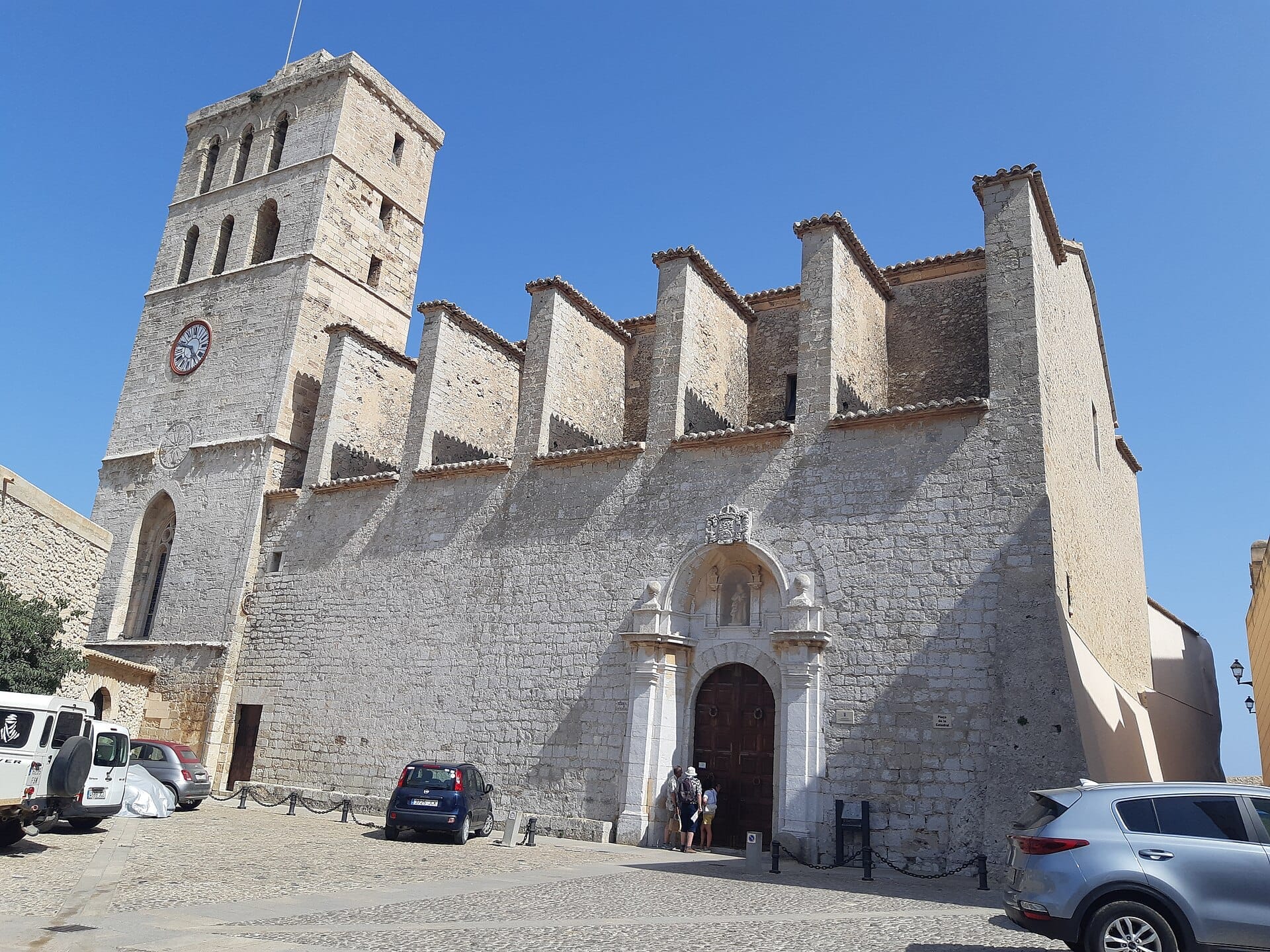
The Ibiza Cathedral, formally known as the Catedral de Santa María de la Neu de Vila d'Eivissa (Cathedral of Our Lady of the Snows), sits at the absolute apex of Dalt Vila, the fortified old town that has dominated the island's skyline for centuries. It is not a grand cathedral by the standards of Seville or Barcelona. What it is, is something rarer: a building that carries eight centuries of island history in its stones, from a mosque cleared after the Christian conquest of 1235 to a Gothic parish church begun in the 14th century, later structural work in the 16th century, and an 18th-century Baroque remodelling carried out around the time it was elevated to cathedral status.
The resulting architecture is a study in contrasts that somehow holds together. The original Gothic bell tower rises above everything else on the hill, its medieval proportions giving the skyline a silhouette that is visible from the port far below. The side chapels along the nave, however, are firmly Baroque, their interior warmth and decorated altarpieces softening what might otherwise be a severe space. Stand outside and the tower tells one story; step inside and the century shifts.
ℹ️ Good to know
Opening hours are seasonal and have not been standardised across official sources. Visitor information commonly notes morning and early-afternoon opening, with Sunday Mass at 10:30 year-round, and visitor access generally running April through October. Always confirm locally or with the parish before planning your visit around specific times.
The Climb: Getting Up There Is Part of the Experience
You cannot arrive at the cathedral without walking through Dalt Vila first, and that walk is not incidental. From Ibiza Port, the route leads through the Portal de ses Taules, the main Renaissance gateway into the old town, flanked by carved stone figures and a heraldic shield. Beyond it, the streets narrow and the gradient sharpens. Pale limestone walls press in on both sides, broken occasionally by doorways, potted geraniums, and glimpses of the harbour dropping away below you.
The surface underfoot is cobblestone throughout. Sections are genuinely steep and uneven, and the final approach to the cathedral square involves steps. Visitors with reduced mobility should be aware that there is no practical workaround: Dalt Vila's topography is what it is, and the cathedral sits at the top of it. Wear shoes with grip; sandals with thin flat soles will punish you on the descent, especially in summer heat when the stone becomes slick.
On busy summer mornings, the lanes fill with tour groups, and the narrow passages can become slow and loud. Earlier visits (before 10:00, if hours permit) mean cooler temperatures and far fewer people. By late morning in July and August, the uphill walk becomes a shuffle in places. In the shoulder months of May and September, the same route feels entirely different: quieter, cooler, and with occasional breezes carrying the faint smell of the sea.
Tickets & tours
Hand-picked options from our booking partner. Prices are indicative; availability and final rates are confirmed when you complete your booking.
Sunset boat tour with tapas, open bar and water sports in Ibiza
From 70 €Instant confirmationFree cancellationEscape Tour self-guided, interactive city challenge in Ibiza
From 30 €Instant confirmationPrivate Sunset Cruise on a Maritime Classic in Ibiza
From 750 €Instant confirmationFree cancellationIbiza to Formentera boat trip with open bar and water sports
From 69 €Instant confirmationFree cancellation
Inside the Cathedral: What to Look For
The interior is compact but layered. Light enters through modest windows, which keeps the nave noticeably cooler than the exposed square outside. The side chapels run along both aisles and contain a mix of devotional paintings, carved altarpieces, and sacred objects accumulated over several centuries. None of it is labelled in a way that would satisfy a serious art historian, but the cumulative effect of so many centuries of local religious life in one room is genuinely affecting.
The sacristy holds a small museum collection, and it is worth checking whether it is open on the day you visit. The collection includes liturgical pieces and artwork that trace the building's history more concretely than the nave itself. This is not a major museum by any definition, but it adds context that the main space alone does not provide.
The Gothic tower is not accessible to visitors for climbing. Its presence is external: a vertical punctuation mark against the sky that anchors the cathedral's profile from every approach to the hill.
The Square Outside: Ibiza's Best Vantage Point
The plaza fronting the cathedral is the reason many visitors make the climb even if they have no particular interest in religious architecture. The views from this level are the broadest available anywhere in Dalt Vila. To the south and east, Ibiza Town spreads below you, the port cranes and ferry terminals sitting at the waterline, with the apartment blocks and hotel towers of Figueretas and Playa d'en Bossa stretching along the coast. On clear days, the outline of Formentera is unmistakable on the horizon.
At dusk, the light changes everything. The warm late-afternoon sun turns the cathedral's limestone gold, and the sea shifts through shades of copper and rose. This is not the same sunset experience as the Sunset Strip in San Antonio, which has a dedicated crowd and soundtracked atmosphere, but it is quieter and arguably more rewarding. A handful of people usually gather on the cathedral steps at golden hour, some with cameras, most simply watching. The whole scene is unhurried in a way that contrasts sharply with Ibiza's reputation.
💡 Local tip
Photography tip: The best exterior shot of the cathedral is from below, looking up from the Via Romana or the lower bastions. From the square itself, the building is too close for a full frame. Bring a wide-angle lens if you want the facade and tower together.
Historical Context: Eight Centuries at the Island's Highest Point
The cathedral's location is not accidental. High ground on a Mediterranean island meant military advantage, religious authority, and civic prestige simultaneously. Before the Catalan-Aragonese / Christian conquest under James I on 8 August 1235, the site held a mosque serving the island's Muslim community. The conquering forces built a Christian parish dedicated to Saint Mary almost immediately, establishing a line of continuity through the site's sacred use while marking the political break with the previous era.
The 14th-century Gothic construction that followed remained the primary place of worship through the island's medieval period. Later centuries saw further work on the main structure, and in the 18th century major restoration reshaped the nave into the Baroque form visible today, around the same era in which the church was elevated to cathedral status. This layering of styles reflects broader patterns across Ibiza's history, a place repeatedly absorbed into larger political and cultural frameworks while its physical fabric adapted slowly and incompletely. That history is well explored through a walk around Dalt Vila's walls and bastions, which were built across the same centuries and are inseparable from the cathedral's context.
The old town as a whole, including the cathedral, became part of the UNESCO World Heritage listing in 1999, recognised as part of the mixed "Ibiza, Biodiversity and Culture" site alongside the Phoenician remains at Puig des Molins and the Posidonia seagrass meadows. If you want to understand the full arc of the island's history, the Necropolis of Puig des Molins and the Ibiza Museum of Contemporary Art are natural companions to the cathedral visit, both sitting at lower elevations within or near the old town.
Practical Walkthrough: How a Visit Typically Goes
Most visitors spend between 30 and 60 minutes at the cathedral itself, with the total excursion from the port level running two to three hours if you walk slowly and stop along the ramparts on the way up or down. The square fills with people around mid-morning and empties slightly in the early afternoon when the heat peaks. If you visit at midday in summer, bring water, as there are no facilities immediately adjacent to the cathedral, and the climb back down without shade is genuinely tiring.
The surrounding streets of Dalt Vila reward slow exploration. Several small restaurants and cafes operate within the old town walls, and the streets between the Portal de ses Taules and the cathedral pass through residential blocks where locals actually live, far removed from the tourist strip below. This is one of the more unusual qualities of Dalt Vila: it functions as a real neighbourhood despite being a major heritage site.
⚠️ What to skip
The cathedral is an active place of worship. Sunday Mass is held at 10:30 year-round, and other services may occur at short notice. Dress modestly (shoulders and knees covered), keep voices low, and avoid touring during active services. Photography inside may be restricted during liturgical events.
Who Might Not Enjoy This Visit
Visitors who struggle with steep inclines, cobblestone surfaces, or prolonged sun exposure on unshaded streets will find the approach genuinely difficult. The cathedral itself is relatively modest in scale and collection compared to major Spanish cathedrals, so travellers primarily interested in grand ecclesiastical architecture may find it underwhelming on that level alone. The real value here is cumulative: the building makes most sense as part of a wider exploration of Dalt Vila rather than as a standalone destination.
Anyone expecting an immersive audio guide, on-site cafe, or gift shop will not find those things here. The experience is quiet and self-directed. That is precisely what makes it worthwhile for the right kind of visitor, and precisely what makes it unsatisfying for someone expecting a fully packaged heritage attraction.
Insider Tips
- Visit on a weekday morning in April, May, or October, before the summer crowds arrive and while the temperature is still manageable. The climb feels like a walk rather than an endurance test, and the square is often nearly empty.
- Look up at the Gothic tower from the cathedral square rather than trying to photograph the full facade head-on. The angle from the far corner of the plaza, looking diagonally across, gives you both the tower and the Baroque body in a single frame.
- The walk down from the cathedral toward the southern bastions passes through quieter streets than the main tourist route. Take the lower rampart path if it is open; the views over the salt flats and the sea on that side are less photographed and genuinely striking.
- Sunday Mass at 10:30 is open to all respectful visitors and provides a completely different experience of the interior, with the building used as intended rather than treated as a viewing gallery. Arrive a few minutes early.
- Check whether the sacristy museum is open before you leave the square. It is not always accessible, but when it is, the liturgical collection adds detail to the building's history that the nave alone cannot communicate.
Who Is Ibiza Cathedral (Catedral de Santa Maria d'Eivissa) For?
- Architecture and history travellers who want depth beyond beach days
- Photographers looking for Ibiza Town panoramas without the crowds of the main viewpoints
- First-time visitors to the island who want to understand Ibiza before the 1960s
- Couples looking for a quiet early-morning or late-afternoon walk with a rewarding endpoint
- Travellers combining a cultural half-day with the wider Dalt Vila heritage circuit
Nearby Attractions
Other things to see while in Dalt Vila:
- Castle of Ibiza (Castell d'Eivissa)
Perched at the summit of Ibiza Town's UNESCO-listed old city, the Castle of Ibiza (Castell d'Eivissa) is the island's oldest continuously occupied defensive site. Visitors today explore the exterior, two free bastions, and sweeping views over the harbour and open sea — the main castle building itself remains closed to the public.
- Dalt Vila Walls & Bastions
The Murallas de Dalt Vila are the 16th-century Renaissance fortification walls encircling Ibiza Town's historic upper quarter. Free to enter at any hour, they form the architectural backbone of a UNESCO World Heritage Site and offer the island's most commanding views of the harbour and open sea.
- Ibiza Museum of Contemporary Art (MACE)
The Ibiza Museum of Contemporary Art, known as MACE, sits inside a 1727 Hall of Arms and Prova military storehouse in Dalt Vila's UNESCO-listed old town. Free to enter and often overlooked by visitors focused on beaches and nightlife, it offers a quiet, layered experience that combines modern Ibizan art with underground archaeology reaching back to the Phoenician era.
- Museu Puget
Tucked inside a centuries-old manor house in Dalt Vila, Museu Puget holds around 130 paintings and drawings by Narcís Puget Viñas and his son Narcís Puget Riquer. It is free to enter, small enough to visit in under an hour, and offers a rare, unhurried window into how Ibiza looked before the tourists arrived.