National Taiwan Museum – Railway Department Park: Taipei's Best Heritage Site
Housed in the former headquarters of Taiwan's colonial-era railway administration, the National Taiwan Museum – Railway Department Park is a rare pocket of preserved industrial history at the edge of central Taipei. For NT$100, you get access to a complex of Japanese-era buildings and exhibitions tracing 130 years of Taiwanese rail culture.
Quick Facts
- Location
- No. 2, Section 1, Yanping North Road, Datong District, Taipei
- Getting There
- Beimen Station (Songshan-Xindian Line / Green Line), ~3 min walk
- Time Needed
- 1.5 to 2.5 hours
- Cost
- NT$100 full / NT$50 concession; NT$130 for 4-branch NTM combo ticket
- Best for
- History enthusiasts, architecture lovers, families, and anyone looking for a low-cost indoor break near Taipei Main Station
- Official website
- www.ntm.gov.tw/en/cl.aspx?n=5718
What Is the Railway Department Park?
The National Taiwan Museum – Railway Department Park occupies one of Taipei's most significant surviving colonial complexes. The site was originally developed on the grounds of the Qing-dynasty Taipei Machinery Bureau, then transformed under Japanese rule into the Railway Department of the Government-General of Taiwan, effectively the administrative and technical nerve center for rail operations across the entire island. For decades it processed everything from locomotive repairs to route scheduling, making it Taiwan's first modern railway industrial park.
When Taipei's new main station opened in 1989, the Taiwan Railways Administration shifted its headquarters, and the complex quietly fell idle. A joint restoration project between the National Taiwan Museum and Taiwan Railways Administration began in 2006 and eventually opened to the public in 2020. The result is one of Taipei's most coherent examples of adaptive heritage reuse: the buildings look lived-in rather than sanitized, and the scale of the site feels genuinely surprising given how close it sits to one of Asia's busiest rail interchanges.
ℹ️ Good to know
The Railway Department Park is one of four branches of the National Taiwan Museum. If you plan to visit two or more NTM sites, the four-branch combo ticket (The Railway Department Park is one of four branches of the National Taiwan Museum. If you plan to visit two or more NTM sites, the four-branch combo ticket (NT$130 full / NT$65 concession) offers better value than buying individual tickets.) offers better value than buying individual tickets.
The Architecture: What You're Actually Looking At
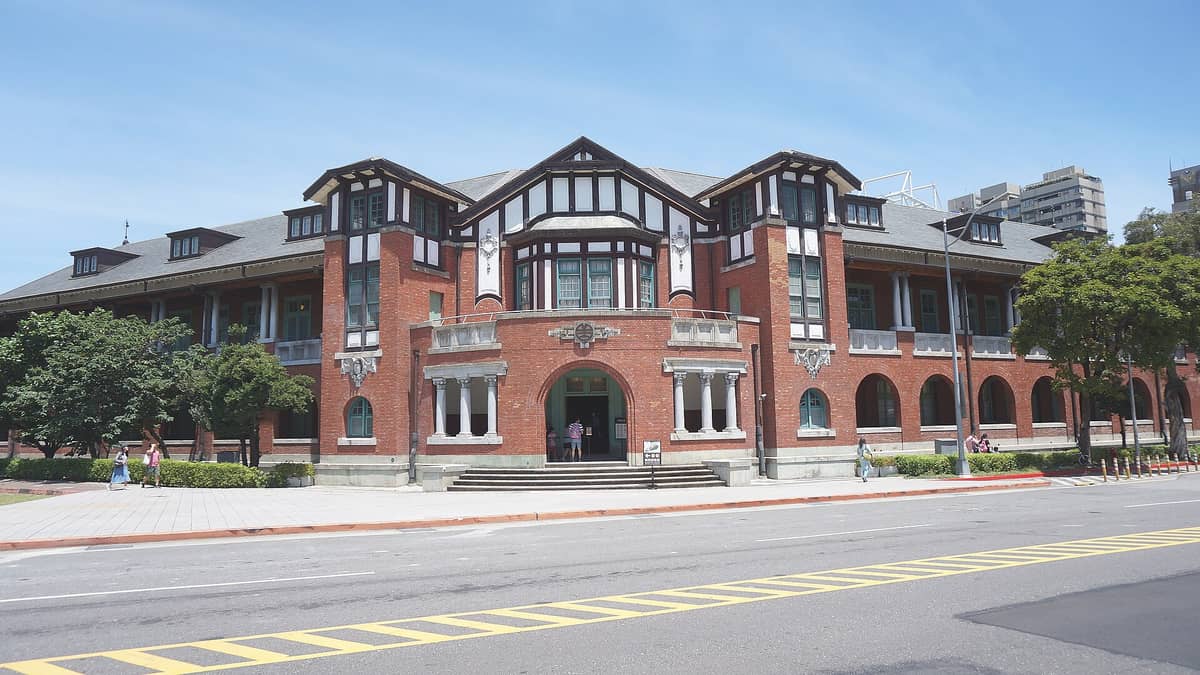
The complex is anchored by the main Department Building, a two-story brick and plaster structure built in a style characteristic of late Meiji and Taisho-era Japanese colonial institutional architecture. The facade is composed, deliberate, and notably restrained compared to the more ornate colonial buildings elsewhere in central Taipei. Walking up to it from Yanping North Road, the proportions hit you before the details do: this was a building designed to convey administrative permanence.
Beyond the main building, the grounds include a telegraph room, a workshop (now partially converted into an exhibition space), a steam locomotive roundhouse fragment, and several ancillary structures. The brick detailing on the workshop walls is particularly striking up close: the mortar is uneven in the way that machine production never quite replicates, and in places the brickwork transitions between repair eras in ways that tell their own story. Outdoor pathways connect the structures across a compact yard, and the site is shaded enough in most weather to make the between-building walks comfortable.
The park occupies a zone bounded by Zhongxiao West Road, Tacheng Street, Zhengzhou Road, and Yanping North Road, putting it within the historical Beimen district. The North Gate (Beimen) itself is visible a short walk away, and the spatial relationship between the two sites is not accidental: this entire corner of Zhongzheng and Datong was the institutional infrastructure of the city under Japanese rule.
Inside the Exhibitions
The permanent exhibitions are organized across multiple buildings and levels, covering everything from the mechanics of steam locomotion to the social history of train travel in Taiwan. Exhibits on early ticketing systems, station architecture, and the labor of railway workers are mixed with hardware: track sections, signal equipment, and preserved cab interiors that visitors can approach closely.
One of the more absorbing sections is the underground space beneath the main building, where original foundations and infrastructure have been partially exposed and incorporated into the display. The temperature drops noticeably here, the air smells faintly of old concrete, and sound from above cuts out almost entirely. It is the kind of exhibit space that photography does not fully capture.
Temporary exhibitions rotate through the secondary gallery spaces and tend to address specific episodes in Taiwanese transport history or broader themes in industrial heritage. Signage throughout the permanent collection is provided in both Mandarin and English, though the English translations are functional rather than literary. The depth of content rewards visitors who read the panels rather than treating the space as a photographic backdrop.
💡 Local tip
Pick up the English floor plan at the entrance desk. The spatial layout is not immediately intuitive, and it is easy to miss the underground section or the rear workshop building without a map.
How the Experience Changes by Time of Day
Morning visits, particularly on weekdays, are noticeably quieter. By 10:00 the entrance area is calm, school group arrivals tend to come in mid-morning, and the interior spaces allow for the kind of unhurried reading and looking that the exhibitions reward. The light through the tall windows of the main hall in the earlier part of the day is also considerably better for photography than the flat afternoon light.
Weekend afternoons bring more families with children, and the volume in the lower exhibition levels rises accordingly. That is not necessarily a drawback: the railway theme appeals strongly to younger visitors, and the energy of a busy Saturday afternoon has its own character. If your priority is quiet, aim for a Tuesday or Wednesday morning. If you enjoy observing how Taiwanese families interact with public museums, the weekend visit offers that in full.
The outdoor courtyard is pleasant in cooler months, specifically from October through March, when temperatures sit between roughly 15 and 22 degrees Celsius and the air is dry enough to make sitting outside comfortable. In Taipei's summer months, June through September, the humidity and heat make the courtyard less appealing, and the air-conditioned interior becomes the natural focus of the visit.
Getting There and Practical Details
The most direct MRT option is Beimen Station on the Songshan-Xindian Line (Green Line). The park is a short walk from Exit 2 on Yanping North Road.
Opening hours are Tuesday through Sunday, 09:30 to 17:00. The last ticket sale is at 16:30, so a late arrival will compress your time. The museum is closed Mondays, Lunar New Year's Eve, and the first day of Lunar New Year. For broader context on how this site fits into a Taipei itinerary, the Taipei museums guide covers the city's full range of museum options across different districts and budgets.
Barrier-free access is provided throughout the museum park. Visitors with disabilities and one accompanying person are admitted free at National Taiwan Museum sites; confirm this policy at the entrance desk on the day of your visit, as exhibition-specific arrangements can vary.
⚠️ What to skip
Ticket sales close at 16:30, thirty minutes before the museum closes. If you arrive after 16:00, you will have limited time inside and may not reach all areas of the complex before closing.
Honest Assessment: Is It Worth Your Time?
At NT$100, this is one of the better-value museum experiences in central Taipei. The architecture alone justifies the entry price for anyone interested in colonial-era buildings, and the exhibitions add substantive depth rather than acting as a pretext for a building tour. The site is compact enough to complete without fatigue but layered enough that engaged visitors will not feel shortchanged by 90 minutes to two hours of attention.
That said, visitors primarily motivated by interactive spectacle may find the experience too text-heavy. The Railway Department Park rewards curiosity and patience more than it delivers audiovisual stimulation. For context on other Zhongzheng heritage sites nearby, the National Taiwan Museum main branch in the botanical garden area covers natural history and complements the railway park's industrial focus. The 3-day Taipei itinerary also suggests ways to combine both sites efficiently.
Visitors who should consider skipping: those with very limited time in Taipei who have not yet covered the headline sites, children under six who may find the exhibition content difficult to engage with, and anyone primarily seeking outdoor experiences. The park has courtyard space, but it is fundamentally an indoor museum.
Photography and What to Look For
The most photographed element of the site is the main Department Building facade, best captured from the inner courtyard side in morning light. The brick workshop walls with their repair-era variation make for better close-up shots than wide-angle compositions. The underground section is dimly lit by design, and a camera that handles low light without flash will serve you better than a smartphone in standard mode.
For wider context on Taipei's photogenic historic architecture, the Beimen (North Gate) is a two-minute walk away and pairs well with the railway park as a single late-morning outing. Bopiliao Historic Block in Wanhua offers a different texture of colonial streetscape if you want to extend a heritage-focused day.
Insider Tips
- The four-branch National Taiwan Museum combo ticket costs only NT$30 more than a single Railway Department Park ticket and also covers the main NTM building, The four-branch National Taiwan Museum combo ticket costs only NT$30 more than a single Railway Department Park ticket and also covers the main NTM building, the Nanmen Branch, and the Beimen Branch. If you have a second afternoon free, it pays for itself immediately.. If you have a second afternoon free, it pays for itself immediately.
- The underground foundation exhibition fills up noticeably during peak weekend hours. If you are visiting on a Saturday, go underground first before the mid-morning school groups arrive.
- The courtyard between buildings is one of the quieter spots in this part of Taipei on weekday mornings. It is a genuinely comfortable place to stop and decompress if you have been moving through the city center at pace.
- Bring a light jacket regardless of the season. The main building and especially the underground section are air-conditioned to museum conservation standards, which means noticeably cool even in summer.
- The gift shop near the exit stocks a small but well-curated selection of railway-themed prints, postcards, and notebooks that are specific to the NTM and not widely available elsewhere in Taipei.
Who Is National Taiwan Museum – Railway Department Park For?
- History and heritage travelers who want context behind Taiwan's modernization under Japanese rule
- Architecture enthusiasts drawn to preserved colonial industrial buildings
- Families with school-age children interested in trains and hands-on history
- Budget travelers: NT$100 for a 90-minute quality museum visit is hard to beat in central Taipei
- Anyone with a few hours near Taipei Main Station looking for a substantive indoor experience
Nearby Attractions
Other things to see while in Zhongzheng District:
- 228 Peace Memorial Park
228 Peace Memorial Park is one of Taipei's oldest and most significant public spaces, blending formal gardens with a powerful memorial to Taiwan's defining political tragedy. Free to enter and open around the clock, it rewards visitors who come prepared to read the landscape carefully.
- Chiang Kai-shek Memorial Hall
Standing 70 metres tall at the heart of Zhongzheng District, the National Chiang Kai-shek Memorial Hall is one of Taipei's most recognizable structures. Free to enter and open daily from 9:00 AM to 6:00 PM (with the surrounding park open 5:00 AM–midnight), it draws history seekers, architecture admirers, and locals who use the surrounding park as their morning exercise ground.
- Huashan 1914 Creative Park
A former Japanese-era winery turned open-air cultural campus, Huashan 1914 Creative Park draws a steady stream of Taipei's artists, designers, film lovers, and weekend wanderers. Admission to the grounds is free, but the real pull is what fills the space: independent exhibitions, pop-up markets, live performances, and some of the most interesting cafes in central Taipei.
- Liberty Square
Liberty Square is one of the largest public plazas in Taiwan, anchoring the Chiang Kai-shek Memorial Hall complex in central Taipei. Free to enter at any hour, it draws joggers at dawn, school groups by mid-morning, and photographers chasing the golden-hour glow on its white marble archway by evening. This guide covers what to see, when to go, and what most visitors overlook.