National Palace Museum: Taipei's Greatest Collection
The National Palace Museum in Shilin houses one of the largest and most significant collections of Chinese imperial art in the world. From jade carvings to ancient bronzes and delicate ceramics, a visit here offers a depth of history few museums anywhere can match.
Quick Facts
- Location
- No. 221, Sec. 2, Zhishan Rd., Shilin District, Taipei City 111001, Taiwan
- Getting There
- Take the Red Line (Danshui-Xinyi Line) to Shilin Station, then Bus R30, 255, or 304 to the museum entrance
- Time Needed
- 2 to 4 hours minimum; dedicated visitors can spend a full day
- Cost
- Paid admission; free entry for all on Jan. 1, Lantern Festival, May 18, Sept. 27, and Oct. 10. Verify current ticket prices on the official website before visiting.
- Best for
- History enthusiasts, art lovers, first-time visitors to Taiwan, families with older children
- Official website
- www.npm.gov.tw/?l=2
What the National Palace Museum Actually Is
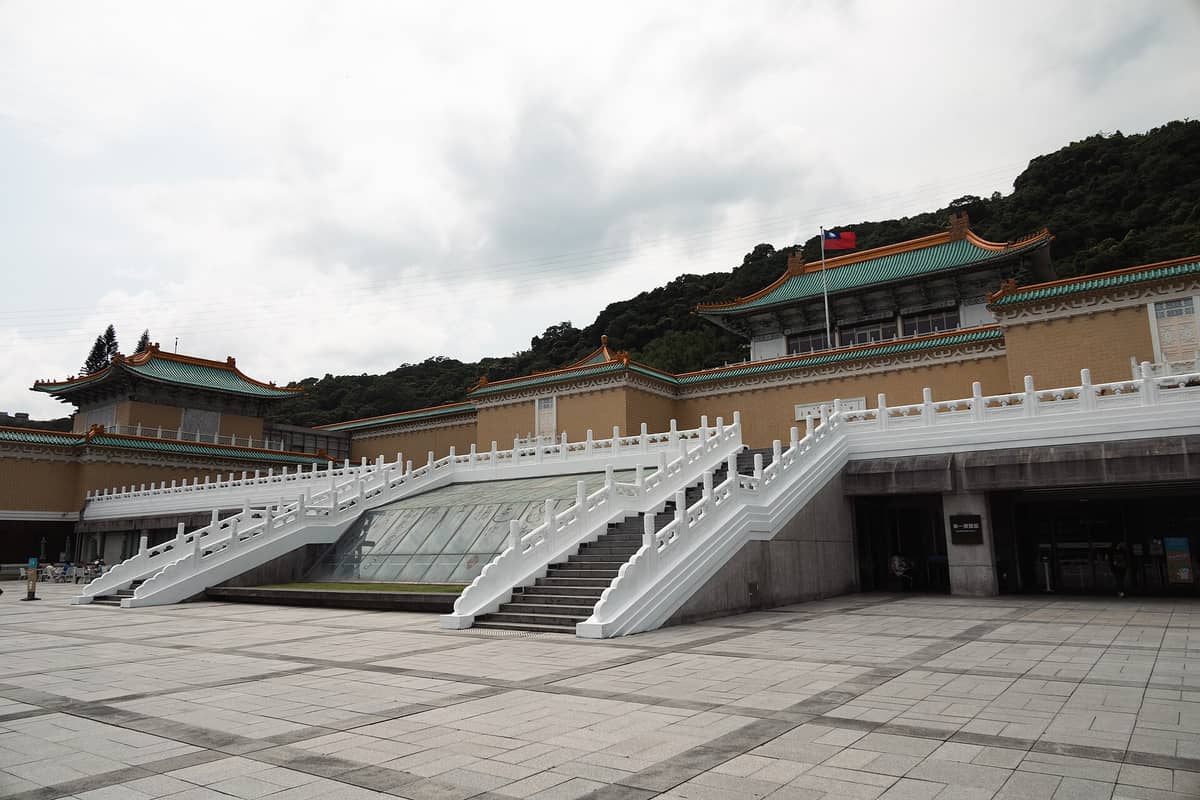
The National Palace Museum (國立故宮博物院, Guólì Gùgōng Bówùyuàn) sits in the Waishuangxi area of Shilin District, set back against a hillside that frames its pale blue-green glazed roof tiles in a sweep of green. The collection spans approximately 700,000 artifacts accumulated by Chinese emperors over centuries, including bronzes from the Shang Dynasty, Song and Ming Dynasty ceramics, imperial jade carvings, and one of the world's finest archives of Chinese calligraphy and painting. The holdings are so large that only a rotating selection is on display at any given time.
The collection's unusual history explains why it is in Taipei rather than Beijing. As civil war between the Nationalist government and Communist forces intensified in the late 1940s, the Republic of China government transported hundreds of thousands of artifacts from the Palace Museum in Beijing to Taiwan. The Taipei institution formally opened in its current building in 1965. That backstory gives the museum a layer of geopolitical and cultural significance that visitors often find adds to the experience.
ℹ️ Good to know
Opening hours: Tuesday to Sunday, 09:00 to 17:00. Ticket sales and exchange end at 16:30. On some public holidays, special Monday opening days may apply; confirm the schedule on the official website before visiting.
The Collection: What You Will Actually See
Most visitors come for two objects above all others: the Jadeite Cabbage (翠玉白菜) and the Meat-shaped Stone (肉形石). Both are small enough to surprise first-time visitors who expect something monumental. The Jadeite Cabbage, carved from a single piece of partially green, partially white jade to resemble a Chinese cabbage with two insects perched on its leaves, is displayed in a darkened case under focused lighting. The crowd around it is typically dense regardless of the hour. The Meat-shaped Stone, a piece of layered jasper that mimics a braised pork belly with uncanny precision down to the pores in the skin, draws similar attention. Arrive early to view both without pressing through a crowd.
Beyond these marquee pieces, the real depth of the collection lies in areas that receive less foot traffic. The bronze vessels from the Zhou Dynasty are substantial, heavy objects covered in intricate geometric patterns and inscriptions that survive from roughly 3,000 years ago. The calligraphy galleries hold scrolls by scholars and emperors whose writing was itself considered an art form at the highest level. The ceramics wing traces Chinese porcelain from rough Han Dynasty earthenware through the refined blue-and-white and famille rose pieces of the Qing Dynasty. Each section has enough material to anchor a full hour of careful looking.
The museum also holds a significant collection of rare books and documents. Those with an interest in Chinese literature, religious texts, or imperial administrative records will find material here that exists nowhere else in the same concentration. For visitors who want to situate this collection alongside Taipei's broader cultural landscape, the Taipei museums guide provides useful context on how the National Palace Museum fits relative to the city's other major institutions.
How the Experience Changes by Time of Day
The museum opens at 09:00 and the first hour is consistently the quietest. Tour groups, which arrive largely from mainland China, Japan, South Korea, and Southeast Asia, tend to enter after 10:00 when coaches have completed the drive from central Taipei hotels. If you are visiting on a weekend or a public holiday, arriving at opening time makes a meaningful difference to your experience of the most popular galleries.
By early afternoon the main halls around the Jadeite Cabbage can feel genuinely crowded, with guided groups moving in clusters and audio guides creating a low background hum throughout the space. The upper floors and the calligraphy and painting galleries see far fewer visitors at any hour, so they offer a quieter alternative when the main floor is at peak capacity. Late afternoon, roughly after 15:30, sees a gradual thinning as tour groups depart. The final hour before 17:00 closing is calm and pleasant, particularly in the permanent galleries.
💡 Local tip
Weekday mornings between Tuesday and Thursday are reliably less crowded than weekends. If your schedule allows, Tuesday or Wednesday at opening offers the most comfortable pace for careful looking.
Getting There from Central Taipei
The museum is in Shilin District, roughly 20 to 30 minutes from central Taipei depending on your starting point. The most reliable approach is the Taipei MRT Red Line (Danshui-Xinyi Line) to Shilin Station. From there, several bus routes serve the museum directly: Bus R30, 255, 304, 300, 815, S19, S18, and M1 all stop at or near the museum. Journey time from Shilin Station by bus is typically about 15 minutes.
Taxis and ride-hailing services via Uber are a practical alternative if you are traveling in a group or carrying bags. The museum's address for navigation is No. 221, Sec. 2, Zhishan Road, Shilin District. Those combining the visit with nearby Shilin attractions, including the Shilin Night Market, will find the two can be paired in a single half-day or evening itinerary with modest effort.
Navigating the Building
The main building is organized across multiple floors in Exhibition Area I, with the newer Southern Branch in Chiayi handling overflow and specific thematic exhibitions. In Taipei, the ground floor (1F) handles ticketing, the coat check, and the introductory galleries. The core permanent collection spreads across the floors above, with signage in Mandarin, English, and Japanese. Audio guides are available for rent in multiple languages at the information desk near the entrance and are worth the cost if you want to move through the collection at your own pace with context. In Taipei, the ground floor (1F) handles ticketing, the coat check, and the introductory galleries. The core permanent collection spreads across the floors above, with signage in Mandarin, English, and Japanese. Audio guides are available for rent in multiple languages at the information desk near the entrance and are worth the cost if you want to move through the collection at your own pace with context.
The building itself is designed in a Chinese palace style with a series of formal courtyards at the approach. The exterior is more impressive from a distance, framed against the forested hillside, than it is close up. Inside, the galleries are cool and moderately lit, which is necessary for artifact preservation but means the experience is interior and contemplative rather than dramatic. Wear a light layer regardless of the season outside, as the air conditioning is maintained at a consistent chill.
Accessibility is reasonably well provided for. Wheelchairs are available at the 1F checkroom in Exhibition Area I at no charge. Accessible elevators serve all floors in multiple wings, and accessible restrooms are located on 1F and B1. Visitors with specific mobility requirements are advised to contact the museum in advance to confirm current arrangements.
Practical Details: Photography, Food, and Expectations
Photography is permitted in most permanent galleries without flash. Tripods are generally not allowed in the galleries. The most photographed objects, including the Jadeite Cabbage, are typically in display cases with glass that creates reflection challenges in bright conditions, so positioning matters more than equipment. For the bronzes and larger ceramic pieces displayed in open cases or under directional lighting, results are considerably better.
The museum has an on-site restaurant and a cafe, both of which are serviceable rather than exceptional. The restaurant serves dishes loosely tied to imperial Chinese cuisine traditions and is popular enough that waits at lunchtime are common. The museum shop near the exit is genuinely good, with a range of reproductions, books, and design objects that go beyond the generic souvenir. The Jadeite Cabbage appears on everything from keychains to tote bags, but there are also quality art books, ceramic replicas, and prints that make for thoughtful purchases.
Visitors planning a full day in the area should note that the Taipei Confucius Temple and the Dalongdong Baoan Temple are accessible within Shilin and Datong districts and offer a useful counterpoint to the museum's indoor intensity.
Is It Worth Your Time?
The National Palace Museum is not a casual drop-in. The scale of the collection is large enough that visitors who arrive without any orientation often walk through galleries quickly and leave without a clear sense of what they saw. The reward is proportional to preparation: reading briefly about the key pieces, the historical context of the collection's transfer to Taiwan, or the specific dynasties represented will transform the visit from confusing to genuinely absorbing.
For travelers on tight schedules, a focused 90-minute visit targeting the Jadeite Cabbage, the Meat-shaped Stone, the bronze collection, and one other gallery of personal interest is more satisfying than an unfocused three hours. Those who want to build a coherent day around culture and history in Taipei will find the museum works well as part of a broader itinerary. The 3-day Taipei itinerary and the things to do in Taipei guide both position the museum within a practical sequence of stops.
Who should skip it: visitors with no interest in Chinese art or dynastic history may find the experience long and undifferentiated. Those traveling with young children under eight will likely find the museum difficult to manage, as the galleries require quiet attention and the objects that appeal most to adults are small and behind glass. The museum is also a full trip from many central Taipei neighborhoods, so it takes a conscious commitment to schedule.
⚠️ What to skip
The museum is closed on most Mondays. It also closes on certain days for exhibitions or maintenance. Check the official website at www.npm.gov.tw before your visit, especially around major public holidays.
Insider Tips
- The bus from Shilin MRT Station saves time and is clearly marked at the station exit, but if you miss one, any of the numbered buses heading up Zhishan Road will drop you near the entrance in under 15 minutes.
- Free admission days (January 1, Lantern Festival, May 18, September 27, and October 10) draw significantly larger crowds. Unless you are on a tight budget, a regular admission day with fewer visitors is a better choice.
- The audio guide is available in multiple languages and covers the key objects and provides enough context to make the permanent collection coherent for first-time visitors. Renting one at the information desk near the entrance is worth the extra cost.
- The upper floor galleries devoted to calligraphy and painting receive a fraction of the foot traffic that the jade and ceramics floors see. If those disciplines interest you at all, you will have space to look carefully without the crowd pressure that defines the lower galleries.
- The museum shop sells a well-designed line of products based on the collection, and it is accessible without a ticket if you only want to browse.
Who Is National Palace Museum For?
- First-time visitors to Taiwan wanting to understand the depth of Chinese imperial history and material culture
- Art and history enthusiasts who want to spend several hours with a world-class collection
- Travelers combining a cultural day with a Shilin Night Market evening
- Families with older children or teenagers who have some background in Chinese history
- Visitors on a longer stay in Taipei looking for a half-day away from the city center
Nearby Attractions
Other things to see while in Shilin District:
- Qixing Mountain (Seven Star Mountain) Trail
The Qixing Mountain Trail (七星山步道) leads to the highest point in Taipei City at 1,120 metres, passing volcanic fumaroles, alpine meadows, and stone-paved ridges inside Yangmingshan National Park. The 4.5 km route is free, well-marked, and achievable in a half-day, making it one of the most rewarding hikes accessible by public bus from central Taipei.
- Shilin Night Market
Shilin Night Market is the largest and most visited night market in Taiwan, with over 500 stalls spread across several streets in Taipei's Shilin District. Free to enter and officially open every day from around 4 PM to midnight, it draws visitors with iconic street food, games, and an atmosphere that builds from early evening to full intensity after 8 PM.
- Shung Ye Museum of Formosan Aborigines
Located steps from the National Palace Museum in Shilin, the Shung Ye Museum of Formosan Aborigines is Taipei's most focused institution for understanding Taiwan's Indigenous peoples. Opened on June 9, 1994, it covers the traditions, material culture, and histories of Taiwan's 16 recognized Indigenous groups across four floors of carefully curated displays.
- Taipei Astronomical Museum
The Taipei Astronomical Museum in Shilin District is home to one of Asia's largest planetariums, plus IMAX and 3D theaters, hands-on exhibits, and a public observatory. Main-hall admission starts at just NT$40, which makes it a strong-value stop for families, students, and anyone curious about the cosmos.