Taipei Astronomical Museum: Stars, Domes, and Deep Space in Shilin
The Taipei Astronomical Museum in Shilin District is home to one of Asia's largest planetariums, plus IMAX and 3D theaters, hands-on exhibits, and a public observatory. Main-hall admission starts at just NT$40, which makes it a strong-value stop for families, students, and anyone curious about the cosmos.
Quick Facts
- Location
- No. 363, Jihe Rd., Shilin District, Taipei City 111013, Taiwan
- Getting There
- Shilin or Jiantan MRT stations (Red Line), then a short walk or local bus along Jihe Road
- Time Needed
- 2–4 hours depending on shows attended
- Cost
- Exhibits Hall from NT$40 (adults); IMAX/Dome shows NT$100; Cosmic Adventure NT$70
- Best for
- Families, school groups, science enthusiasts, rainy-day visitors
- Official website
- en.tam.gov.taipei
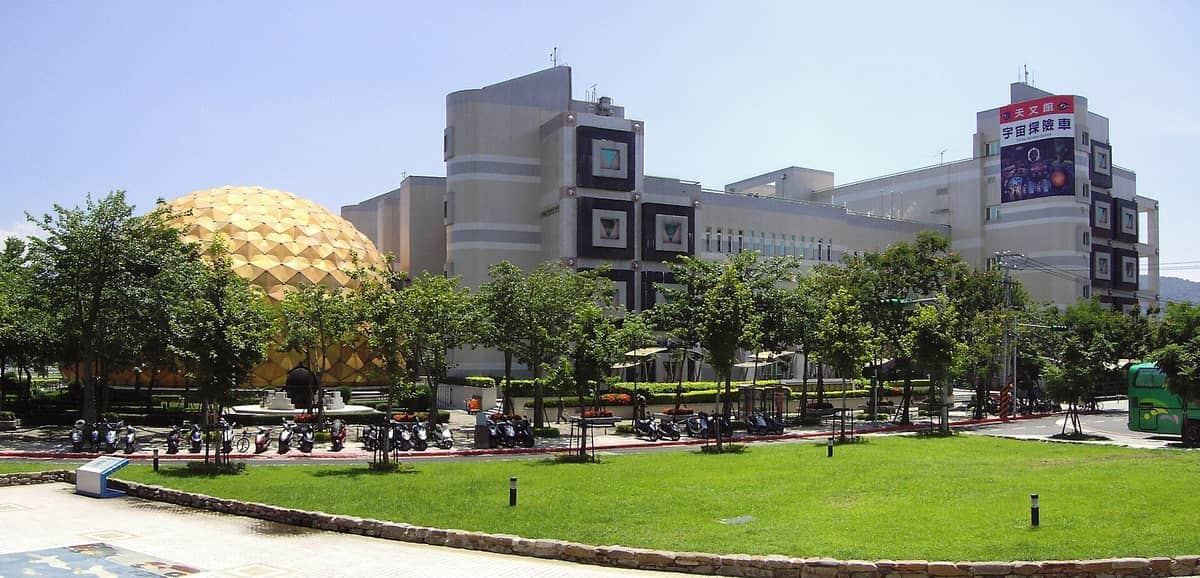
What the Taipei Astronomical Museum Actually Is
The Taipei Astronomical Museum, officially the Taipei City Astronomical Science Education Center (臺北市立天文科學教育館), opened on 7 November 1996 and has since grown into one of the most substantive science attractions in the city. It is not a passive display case of static models. The museum is built around active programming: giant-screen dome films, 3D theater shows, rotating exhibits on cosmology and space exploration, and a working public observatory. The planetarium inside is cited as Asia's biggest, which matters when you actually sit under it and realize the projection system covers a field of view that makes most European or North American planetariums feel cramped by comparison.
The building itself is a late-1990s municipal science center with a functional rather than glamorous architectural sensibility. It occupies a generous footprint on Jihe Road in Shilin District, a part of northern Taipei where large cultural institutions sit alongside residential neighborhoods. Planetarium domes and theater wings are visible from the approach road, so there is no difficulty identifying the complex from a distance.
💡 Local tip
The museum is closed on Mondays, except when Monday falls on a public holiday. Always check the official site before planning your visit, especially around national holidays. Show schedules fill quickly on weekends, so arrive early or book specific screenings as soon as you enter.
The Experience Floor by Floor
The main Exhibits Hall is the backbone of the museum. Admission here costs NT$40 for adults and NT$20 for discounted categories, making it one of the more affordable science museum entrances in Taipei. The displays cover the solar system, stellar evolution, cosmological timescales, and the history of astronomical observation from ancient calendars to modern space telescopes. Labeling is available in both Chinese and English, though the depth of English-language explanatory text varies by section. Some panels are richly translated; others offer only minimal captions.
Interactive stations are distributed throughout the hall and tend to attract school groups during weekday mornings. By early afternoon on a weekday, the exhibits thin out and you can move through them at your own pace. Weekends are a different story: the museum draws families with young children, and certain popular interactive stations develop informal queues. If you are visiting primarily for the exhibits rather than the theater shows, a Tuesday-to-Friday morning visit is noticeably quieter.
Theater Shows: Dome, IMAX, and 3D
The theaters are the reason many visitors come specifically to this museum rather than treating it as a secondary stop. The Dome Theater is the centerpiece: it uses the full curved ceiling to project astronomy and space content that genuinely justifies the reclining seats. Shows cover topics like deep-space imaging, black holes, and the formation of galaxies. The experience is immersive in a way that a flat-screen documentary cannot replicate. Dome and IMAX show tickets cost NT$100 for adults and NT$50 for concessions.
The 3D Theater runs shorter-format programs and is a good complement to the dome show rather than a substitute. On Saturday evenings, when the museum stays open until 20:00, the theaters often run additional evening screenings, giving the visit a different atmosphere than a midday slot. The Saturday extended hours are the one time when the museum's indoor environment feels genuinely different: lower ambient light, fewer children, and a slightly older audience that tends to settle into the shows more attentively.
ℹ️ Good to know
Opening hours vary by section. The main museum runs Tuesday to Friday and Sunday 09:00–17:00, and Saturday 09:00–20:00. The Observatory operates Tuesday to Friday 10:00–12:00 and 14:00–16:00, with additional 19:00–21:00 sessions on weekends. Cosmic Adventure runs Tuesday to Sunday 09:30–16:00. Plan accordingly if you want to see more than one section.
Cosmic Adventure and the Observatory
Cosmic Adventure is a separate ticketed area aimed at younger visitors, with a more kinesthetic approach to learning about astronomy. Think climbing structures, physical simulations of space concepts, and age-appropriate interactive stations. Admission is NT$70 for adults and NT$35 for concessions. It is primarily designed for children up to early primary school age, and adults visiting without children will likely spend no more than 20 minutes here. Families with kids under ten, however, tend to find it one of the stickiest parts of the complex.
The Observatory is a genuinely underappreciated part of the museum, partly because its regular daytime weekday hours are so narrow. It operates during daytime windows on Tuesday to Friday, with additional evening sessions on weekends during which trained staff explain the equipment and facilitate solar or other observation, which is far more accessible than nighttime telescope viewing and considerably safer for children. If your visit falls on a Tuesday through Friday and you arrive before midday, the Observatory is worth factoring into your schedule specifically.
Getting There and Navigating the Area
The museum sits in Shilin District, accessible from both Shilin and Jiantan stations on the MRT Red Line (Danshui-Xinyi Line). From either station, the walk to the museum takes around 10 to 15 minutes along Jihe Road, or you can take a local bus that runs along the same corridor. The approach from Jiantan is slightly more direct for most visitors arriving from central Taipei.
The museum's location makes it a natural pairing with other Shilin attractions. The Shilin Night Market is within easy walking distance, which means a late afternoon visit to the museum followed by an evening at the market is a straightforward itinerary for families. The National Palace Museum is also in Shilin and can be combined on the same day, though doing both institutions justice takes the better part of a full day.
Shilin itself is worth understanding as a district context. It is larger and less tourist-dense than central Taipei districts like Xinyi or Zhongzheng, which means the surrounding streets are quieter, more residential, and less oriented toward English-speaking visitors. For logistics on navigating the wider city, getting around Taipei by MRT and bus is the practical foundation worth reviewing before your trip.
Practical Details Worth Knowing
The museum is an indoor venue, which makes it a practical choice during Taipei's rainy season or in the heat of summer. Taipei's climate is humid subtropical, with hot and muggy conditions from June through September and frequent afternoon rain. A museum day works particularly well in those months when outdoor sightseeing becomes uncomfortable by midday.
Accessibility is generally handled well for a building of this era. Elevator access is available throughout, and the admission policy includes free or discounted entry for visitors with disabilities across several sections. For precise current arrangements, confirm with the museum directly before visiting. For visitors weighing broader activity planning around weather and season, the best time to visit Taipei breaks down the seasonal trade-offs in detail.
Photography inside the exhibits hall is generally permitted, but flash and tripods are typically restricted in the theater spaces. The dome ceiling before a show begins makes for an unusual photograph if you can capture it in the low light before projection starts. Phone cameras handle the ambient lighting in the exhibits hall adequately; the deeper display alcoves can be dim enough that slower shutter speeds help.
⚠️ What to skip
Ticket prices listed here are based on information available through mid-2026. Prices and hours, especially for theater shows and Cosmic Adventure, can change without much notice. Always verify on the official site at https://en.tam.gov.taipei/ before your visit.
Who Will Get the Most Out of This Museum (and Who Might Not)
The Taipei Astronomical Museum is genuinely well-suited to families with children aged roughly four to fourteen, school groups, and adults with a specific interest in astronomy or space science. The price-to-content ratio is unusually favorable compared to similar institutions in Tokyo or Seoul. For NT$200 to NT$250 per person covering the exhibits hall plus a dome show, you are getting close to two hours of substantive programming.
Visitors without a particular interest in science or astronomy, or those on a tight itinerary focused on Taipei's food culture, temple circuit, or street-level urban experience, may find the museum less compelling than the alternatives nearby. If your Taipei priorities lean toward cultural immersion, sensory street food experiences, or historical architecture, a visit to Dalongdong Baoan Temple or an evening at the night market will likely leave a stronger impression than this one. The museum rewards curiosity and patience rather than spectacle-seeking.
For visitors traveling with children and looking for a structured full day in northern Taipei, the museum is an anchor that works well alongside Taipei Zoo or the night market circuit. The Taipei with kids guide covers how to structure multi-stop family days across the city.
Insider Tips
- Saturday evening is the most underused visit window. The museum stays open until 20:00, theater audiences are more adult-oriented, and the building is significantly less crowded than weekend afternoons. If you want the dome experience without the noise of a full school group, this is your slot.
- Buy tickets for the dome or IMAX show before exploring the exhibits hall. Show times fill up, and if you browse first, you may find the next available screening is 90 minutes away. Sequence your visit around show times, not the other way around.
- The Observatory operates on weekdays during limited morning and afternoon windows, with extra 19:00–21:00 sessions on weekends. If it is a weekday and you arrive before noon, add 20 to 30 minutes for solar observation. It is free to enter as part of the museum visit and offers a hands-on dimension that the exhibits alone cannot replicate.
- The Cosmic Adventure section closes at 16:00, earlier than the main museum. Families who leave it for last often find it shut. Go there first if you have young children, then work backward through the exhibits hall.
- The area between Jiantan and Shilin MRT stations along Jihe Road has a handful of small local lunch spots and bubble tea shops. Grab something before entering if you plan a long visit: the museum's internal food options are limited.
Who Is Taipei Astronomical Museum For?
- Families with children aged 4 to 14 looking for a structured half-day or full-day indoor activity
- Travelers visiting on a rainy day or during Taipei's hot, humid summer months
- Astronomy and space-science enthusiasts who want to experience one of Asia's largest planetarium domes
- Budget-conscious visitors: the main hall entry is among the most affordable museum admissions in Taipei
- School-age groups and educators seeking curriculum-linked science content with English-language signage
Nearby Attractions
Other things to see while in Shilin District:
- National Palace Museum
The National Palace Museum in Shilin houses one of the largest and most significant collections of Chinese imperial art in the world. From jade carvings to ancient bronzes and delicate ceramics, a visit here offers a depth of history few museums anywhere can match.
- Qixing Mountain (Seven Star Mountain) Trail
The Qixing Mountain Trail (七星山步道) leads to the highest point in Taipei City at 1,120 metres, passing volcanic fumaroles, alpine meadows, and stone-paved ridges inside Yangmingshan National Park. The 4.5 km route is free, well-marked, and achievable in a half-day, making it one of the most rewarding hikes accessible by public bus from central Taipei.
- Shilin Night Market
Shilin Night Market is the largest and most visited night market in Taiwan, with over 500 stalls spread across several streets in Taipei's Shilin District. Free to enter and officially open every day from around 4 PM to midnight, it draws visitors with iconic street food, games, and an atmosphere that builds from early evening to full intensity after 8 PM.
- Shung Ye Museum of Formosan Aborigines
Located steps from the National Palace Museum in Shilin, the Shung Ye Museum of Formosan Aborigines is Taipei's most focused institution for understanding Taiwan's Indigenous peoples. Opened on June 9, 1994, it covers the traditions, material culture, and histories of Taiwan's 16 recognized Indigenous groups across four floors of carefully curated displays.