Shilin Night Market: What to Eat, When to Go, and How to Navigate Taipei's Biggest Night Market
Shilin Night Market is the largest and most visited night market in Taiwan, with over 500 stalls spread across several streets in Taipei's Shilin District. Free to enter and officially open every day from around 4 PM to midnight, it draws visitors with iconic street food, games, and an atmosphere that builds from early evening to full intensity after 8 PM.
Quick Facts
- Location
- Around Jihe Road, Dadong Road, Danan Road, and Wenlin Road in Shilin District, Taipei City
- Getting There
- Jiantan Station (Exit 1), Tamsui–Xinyi Line (5–10 min walk north along Wenlin Road)
- Time Needed
- 2–3 hours for a thorough visit
- Cost
- Free entry; individual food items typically 50–200 NTD
- Best for
- Street food lovers, first-time visitors to Taiwan, families, budget travelers
- Official website
- www.travel.taipei/en/attraction/details/1692
What Shilin Night Market Actually Is
Shilin Night Market (士林夜市, Shìlín Yèshì) is the largest night market in Taiwan, and probably the most internationally recognized. Spread across the streets around Jihe Road, Dadong Road, Danan Road, and Wenlin Road in Shilin District, it has a footprint that surprises most first-time visitors. This is not a single row of stalls you can survey in 20 minutes. It is a loosely organized network of streets, covered lanes, outdoor plazas, and a dedicated underground food hall, with around 500 stalls operating across the area.
The market has roots going back over a century, evolving from a simple neighborhood food street near Cixian Temple into the sprawling destination it is today. Cixian Temple and the former Yangming Theater area remain cultural anchors of the market's identity, even as the surrounding streets have layered on decades of commercial stalls. That history gives Shilin a lived-in quality that newer, more curated markets lack.
ℹ️ Good to know
Entrance to Shilin Night Market is free. You pay only for what you eat, drink, or play. Budget around 300–600 NTD for a solid food tour of the market, with most individual food items typically 50–150 NTD.
How It Changes From 4 PM to Midnight
The official opening window is 16:00 to 00:00 daily, but the market does not transform instantly at 4 PM. Arrive between 16:00 and 17:30 and you will find roughly half the stalls setting up, streets passable without nudging strangers, and the best light for photography. The smell of frying scallion pancakes and grilling corn drifts down otherwise quiet lanes. It is the calmest window to eat without competition for seating.
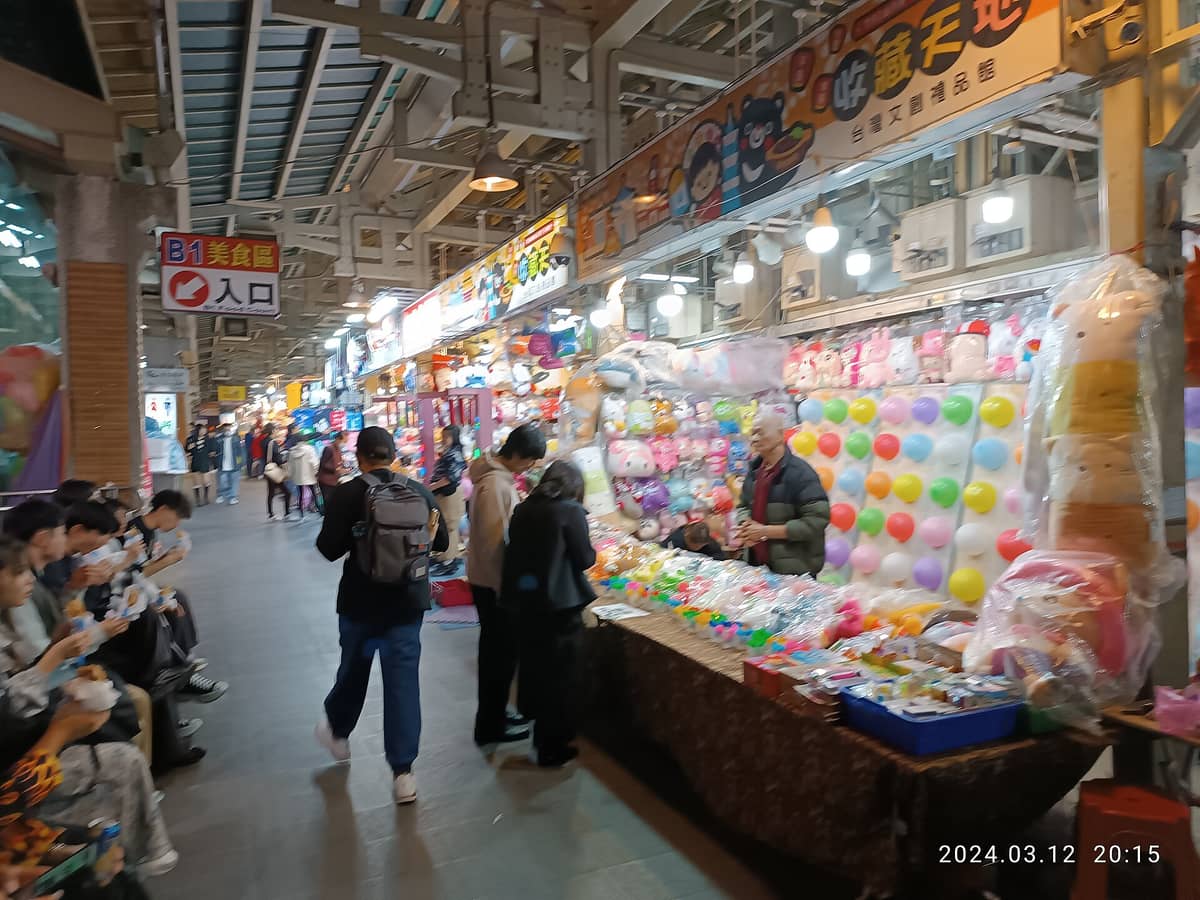
From around 18:30 onward, the character shifts. The MRT delivers waves of visitors after work and school. By 20:00 the main arteries near Wenlin Road are packed tightly enough that walking at your own pace becomes an act of negotiation. Stall operators shout specials, the underground food hall hums with conversation, and the game stalls light up with their fluorescent draw. This is peak Shilin, and it is genuinely impressive, but first-time visitors who arrive at 20:00 expecting a relaxed meal will find the experience chaotic rather than charming.
After 22:30, the character shifts again. Families filter out, and a younger crowd takes over. Some food stalls begin wrapping up by 23:00, so if there is a specific dish on your list, arriving late risks a closed window. The last half hour before midnight is worth experiencing for the winding-down atmosphere, but serious eaters should aim for the 17:00–19:30 window.
💡 Local tip
Best visiting window: 17:00–19:30 on weekdays. You get most stalls open, manageable crowd density, and comfortable walking temperatures in the evening months.
Navigating the Market: Streets vs. Underground Hall
Shilin Night Market divides roughly into two zones. The outdoor street market covers the perimeter roads and several covered lanes where you find clothing, accessories, games, and snack stalls. Wenlin Road functions as a main spine, with side lanes branching off into areas dedicated to specific categories. Clothing stalls cluster in the covered lanes near the northern end. Game stalls, including the classic ring-toss and claw machines, concentrate in the southeastern pocket. The temple forecourt area along Danan Road tends to have some of the older, more established food vendors.
The underground food court, located beneath what was historically the outdoor food area near the main plaza off Jihe Road, is a separate world. It runs under a wide square and contains dedicated food stalls in a more structured, tiled environment. This is where you find the famous oyster vermicelli, large fried chicken cutlets (雞排), and stinky tofu alongside dozens of other hot food options. The underground area is brighter, slightly more organized, and easier to sit down in. During rainy nights, it also serves as a dry refuge.
Knowing where you are relative to these two zones saves significant time. The MRT Jiantan Station Exit 1 deposits you on the northern edge of the market. Walk south on Wenlin Road and you are immediately in the street market. To reach the underground hall, walk through toward the central plaza area. If this is your first time navigating Taipei's night markets and you want to compare styles, the Raohe Street Night Market is significantly smaller and easier to navigate linearly, which makes it a useful point of comparison.
What to Eat: The Dishes Worth Seeking Out
Shilin is primarily a food destination. The non-food stalls are fine for browsing, but the market's reputation rests on specific dishes that have been refined over decades of competition between vendors.
The large fried chicken cutlet (大雞排) is the most photogenic. Pounded flat and deep-fried to a golden crunch, it is dusted with basil and chili powder and handed over in a paper bag large enough that eating it without looking absurd takes commitment. Oyster vermicelli (蚵仔麵線) is a slow-cooked dish: thin wheat noodles in a thick, slightly gelatinous broth with oysters and often pork intestine, served with a slash of garlic and chili sauce from a squeeze bottle. Stinky tofu (臭豆腐) announces itself by smell from 50 meters away. The fermented odor is aggressive but the fried version, often served with pickled cabbage, is mild enough on the palate that many skeptics convert.
Beyond the marquee dishes, look for sesame noodles, grilled corn with soy butter, tang yuan (glutinous rice balls in syrup), and fresh-cut fruit. Taro balls in sweet soup are a reliable dessert anchor. Bubble tea and fresh fruit juice stalls are everywhere and excellent.
⚠️ What to skip
Food allergies are difficult to communicate at busy stalls. Many dishes contain shellfish, pork, or gluten as default ingredients. Carry a written allergy card in Mandarin if you have dietary restrictions.
Getting There and Getting Around
The easiest approach is the Taipei Metro (MRT) Tamsui–Xinyi Line to Jiantan Station (捷運劍潭站). Take Exit 1 and walk north roughly 5–10 minutes along Wenlin Road. The market surrounds you before you reach the main plaza. An alternative is Shilin Station (Exit 2), also on the Tamsui–Xinyi Line, which puts you about 10–15 minutes from the market's southern edge. Jiantan is generally preferred for a first visit.
For context on the broader transit network in Taipei, the getting around Taipei guide covers MRT, bus, and YouBike options in detail. YouBike docking stations are available near the market if you prefer cycling from nearby neighborhoods. Taxis and ride-hailing through Uber are also options, though traffic on market nights in the surrounding streets can slow arrival significantly.
The main pathways through Shilin Night Market are generally wide enough for wheelchair users, and ramps exist at several entrances, including access to the underground food hall. Uneven pavement exists in some of the older lane sections, so cautious navigation applies for those with mobility considerations.
Honest Assessment: Is Shilin Night Market Worth It?
For first-time visitors to Taiwan, Shilin Night Market is worth visiting at least once, but not because it is the best food in Taipei. It is worth visiting because it is a complete experience: the scale, the noise, the density of choices, the sensory overload of smells from a dozen different frying oils and grilling meats. There is no other single location in Taipei that delivers this concentration of Taiwanese street food culture.
That said, the market leans heavily toward the tourist circuit. Prices for some items run slightly higher than equivalent dishes at smaller neighborhood markets. Vendor quality varies considerably, and the sheer number of stalls means mediocre products exist alongside excellent ones. Experienced visitors to Taiwan often find the smaller, less-publicized markets more satisfying for quality and authenticity. If you have already visited Shilin and want something different, the Ningxia Night Market in Datong District is smaller and more locally oriented.
Shilin fits naturally into a broader exploration of Taipei's food culture. The comprehensive Taipei night markets guide covers how Shilin compares to Raohe, Ningxia, and Tonghua, which is useful if you are deciding how to allocate evenings across a multi-day trip.
Who Should Skip Shilin Night Market
Travelers with severe crowd sensitivity will find peak hours (19:00–22:00) genuinely uncomfortable. If you are visiting Taipei for a single evening and want the most authentic experience rather than the most famous one, a smaller market may serve you better. Visitors with significant food allergies requiring careful ingredient checks will also find the communication barrier at busy stalls stressful. Finally, anyone visiting purely for shopping will find the clothing and accessory stalls at Shilin adequate but not exceptional compared to dedicated shopping areas.
The Surrounding Shilin District
Shilin District extends well beyond the night market. The National Palace Museum is located nearby in the district's northern section, making a combined daytime museum visit and evening market visit a natural pairing for a single day in Shilin. The museum closes in the early evening, so the sequencing works well: museum from mid-morning to mid-afternoon, then make your way to Jiantan Station for the market from 17:00 onward.
Further north in the district, Beitou's hot spring area is accessible by MRT and provides a calming contrast to the night market's intensity. Some visitors split a Taipei day with Beitou in the afternoon and Shilin Night Market in the evening, both accessible on the same MRT line.
Insider Tips
- Arrive at 17:00 on a weekday. Half the stalls are open, the lanes are walkable, and you can actually stop and look at food before deciding rather than getting swept along by the crowd.
- The underground food hall has fixed seating, which is rare and valuable. If you want to eat sitting down without fighting for a plastic stool on the street, head underground first.
- Prices are rarely posted in English. Use your phone's camera translation function on menu boards — most have clear Chinese characters. Asking stall operators to point at items works just as well.
- Avoid the stalls immediately adjacent to the main Jiantan Station exit on Wenlin Road for your first purchase. These catch the highest foot traffic and are sometimes priced above the market average. Walk two blocks deeper before committing to anything.
- Bring cash in small denominations (50 NTD and 100 NTD coins and notes). While some larger stalls accept card payment or LINE Pay, the majority are cash-only, and many do not carry change for 500 NTD notes.
Who Is Shilin Night Market For?
- First-time visitors to Taiwan wanting an overview of street food culture in one location
- Families with children, who enjoy the game stalls, sweet snacks, and safe, walkable environment
- Budget travelers, as it is possible to eat well for under 300 NTD with strategic choices
- Visitors with only one or two evenings in Taipei who want the full night market experience efficiently
- Food photographers working in the 17:00–19:00 window when light and crowd density are both manageable
Nearby Attractions
Other things to see while in Shilin District:
- National Palace Museum
The National Palace Museum in Shilin houses one of the largest and most significant collections of Chinese imperial art in the world. From jade carvings to ancient bronzes and delicate ceramics, a visit here offers a depth of history few museums anywhere can match.
- Qixing Mountain (Seven Star Mountain) Trail
The Qixing Mountain Trail (七星山步道) leads to the highest point in Taipei City at 1,120 metres, passing volcanic fumaroles, alpine meadows, and stone-paved ridges inside Yangmingshan National Park. The 4.5 km route is free, well-marked, and achievable in a half-day, making it one of the most rewarding hikes accessible by public bus from central Taipei.
- Shung Ye Museum of Formosan Aborigines
Located steps from the National Palace Museum in Shilin, the Shung Ye Museum of Formosan Aborigines is Taipei's most focused institution for understanding Taiwan's Indigenous peoples. Opened on June 9, 1994, it covers the traditions, material culture, and histories of Taiwan's 16 recognized Indigenous groups across four floors of carefully curated displays.
- Taipei Astronomical Museum
The Taipei Astronomical Museum in Shilin District is home to one of Asia's largest planetariums, plus IMAX and 3D theaters, hands-on exhibits, and a public observatory. Main-hall admission starts at just NT$40, which makes it a strong-value stop for families, students, and anyone curious about the cosmos.