National Museum of China: What to Expect, How to Visit, and Whether It's Worth Your Time
The National Museum of China sits on the east side of Tiananmen Square and holds one of the largest collections of historical artifacts in the world. Free to enter, overwhelming in scale, and rarely fully appreciated by visitors in a single trip — here is how to approach it with purpose.
Quick Facts
- Location
- No. 16 East Chang'an Street, Dongcheng District — east side of Tiananmen Square
- Getting There
- Tiananmen East Station, Line 1 (Exits C or D)
- Time Needed
- 3–5 hours minimum; half a day for serious visitors
- Cost
- Free (advance reservation required; some special exhibitions charge separately)
- Best for
- History enthusiasts, architecture fans, first-time visitors to Beijing
- Official website
- en.chnmuseum.cn
What the National Museum of China Actually Is
The National Museum of China (中国国家博物馆, Zhōngguó Guójiā Bówùguǎn) is one of the largest museum buildings in the world. Its permanent exhibitions include Ancient China, The Road to Rejuvenation, and The Road to Rejuvenation: New Era.
The museum as it stands today reopened on March 1, 2011, after the former National Museum of Chinese History and the National Museum of Chinese Revolution were merged into a single institution. The result is enormous almost to a fault: on your first visit, it is easy to spend two hours on a single floor and still not see everything on it.
ℹ️ Good to know
General admission is free, but you must book in advance through the official website (en.chnmuseum.cn). Reservations open up to seven days in advance and are often fully claimed for weekends. Book as early as you can, particularly during Chinese public holidays.
The museum sits in the heart of Beijing's most historically charged district. If you are visitingTiananmen Square or theForbidden City on the same day, the proximity is a genuine advantage — all three can be approached on foot from Tiananmen East station. That said, trying to absorb all three in a single day will leave you doing none of them justice.
The Building Itself
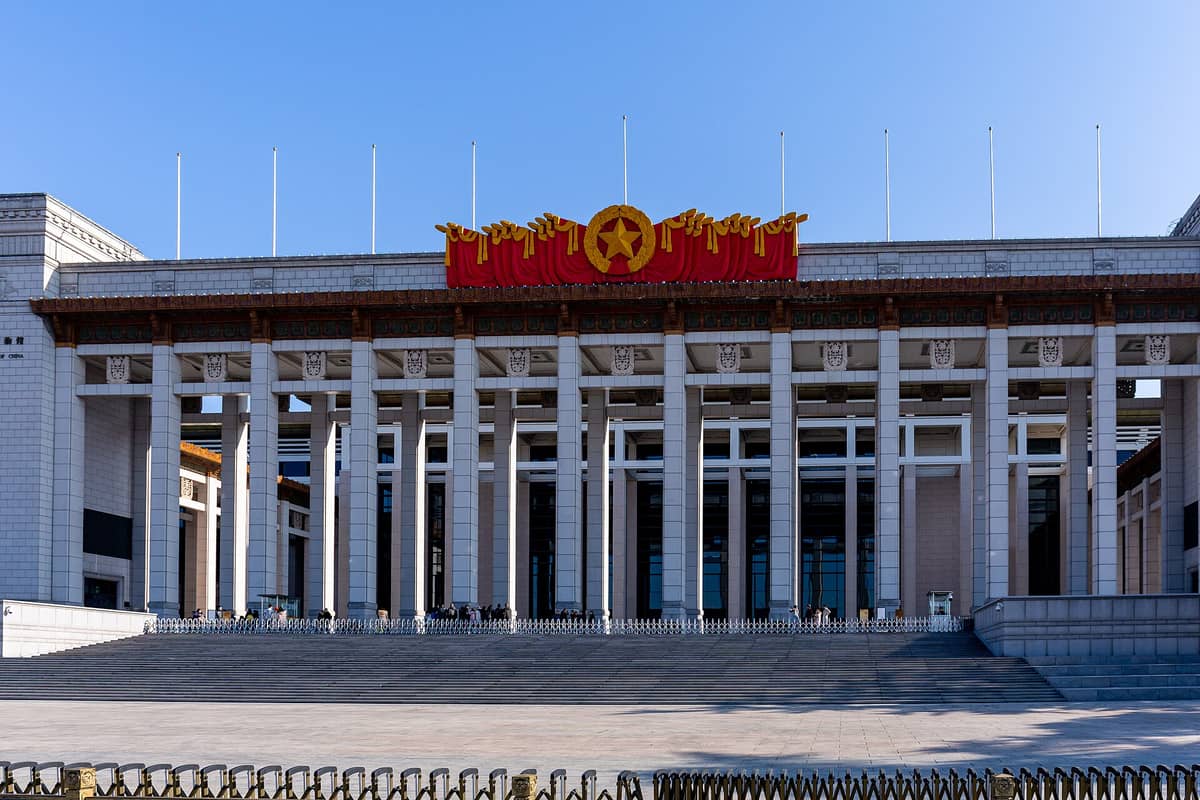
Before you even step inside, the exterior makes an impression. The colonnaded facade is deliberately vast, designed to project civic permanence. The stone steps leading to the north entrance feel ceremonial, and when the square is lit in the early morning, the whole east wing glows with a grey-gold quality that rewards photographers.
Inside, the scale does not let up. The central atrium is a cavernous hall of pale stone, with natural light filtering in from above and the noise of foot traffic echoing across hard surfaces. It is not a quiet, contemplative museum in the way that smaller institutions can be. On busy days, particularly weekend mornings, visitor density in the main halls is significant and the ambient noise level is high.
💡 Local tip
Photography tip: The colonnade on the west-facing side of the building photographs best in the late afternoon, when the light catches the pillars from the side. Tripods are not permitted inside, but the atrium and the large bronze replicas near the entrance are well-lit enough for handheld shots.
Tickets & tours
Hand-picked options from our booking partner. Prices are indicative; availability and final rates are confirmed when you complete your booking.
Early start guided tour to the Great Wall at Mutianyu
From 355 €Instant confirmationFree cancellationIndependent tour to Jinshanling Great Wall with digital guidebook
From 237 €Instant confirmationFree cancellationOriginal section of Great Wall at Jinshanling full day tour
From 361 €Instant confirmationFree cancellationJuyongguan Great Wall and in-depth tour of Ming Tombs
From 331 €Instant confirmationFree cancellation
What to See: The Core Permanent Exhibitions
The museum's most important permanent exhibition is 'Ancient China', which traces Chinese civilization from prehistoric sites through the Qing Dynasty. It is where many of the museum's most significant archaeological artifacts are concentrated, including bronzeware, ceramic funerary figures, metalwork, and ceramics. The labeling is bilingual in Chinese and English throughout, though the English translations vary in quality from highly informative to awkward.
A second major permanent exhibition, 'The Road to Rejuvenation', documents modern Chinese history from the mid-19th century onward, and the permanent exhibitions also include 'The Road to Rejuvenation: New Era'. This is the most politically explicit section of the museum. Whether or not visitors share its interpretive framework, it offers a clear and detailed account of how the Chinese government presents its own modern history, which is itself informative for any visitor trying to understand contemporary China.
Temporary exhibitions rotate regularly and occupy several upper-floor galleries. These are often excellent and draw on loans from other major institutions internationally. Some carry a separate admission fee, which will be communicated when you make your reservation. Check the official website for current listings before your visit.
If your time in Beijing is limited and you are trying to prioritize, a good approach is to treat the National Museum of China as a dedicated half-day rather than a quick stop. For a broader plan of what to do in the city, the3 days in Beijing itinerary includes a practical sequencing of the Tiananmen area attractions.
How It Feels at Different Times of Day
Arrive at opening (09:00) and the building is noticeably quieter. The atrium feels larger and more imposing without the crowd noise. The lower-level galleries, particularly those housing the ancient bronzeware, are dim enough to feel appropriately atmospheric, with the objects illuminated against dark backgrounds. This first hour is the most pleasant time to move through the densest exhibitions.
By mid-morning, school groups begin arriving in volume. Chinese student groups move through with their own guides, often in formations that can make narrow gallery corridors feel congested. If you are sensitive to crowd density, plan to have completed the basement galleries before 10:30 and move to the upper floors, which tend to remain less crowded throughout the day.
Midday sees the highest overall visitor count, particularly on weekends and national holidays. The cafeteria on the lower level becomes genuinely difficult to navigate between 11:30 and 13:30. Consider eating before you arrive, or plan to eat after 14:00.
⚠️ What to skip
The museum is closed every Monday, except when Monday falls on a Chinese national public holiday. During peak season (June 1 to October 31), last admission extends to 16:30 and the museum closes at 17:30. Outside this period, last admission is 16:00 and closing time is 17:00. Always verify hours on the official website before your visit.
Practical Walkthrough: Getting In and Getting Around
Arriving at Tiananmen East station (Line 1), use Exit C for the square approach or Exit D if you prefer to walk along Chang'an Street directly to the north gate. Security screening at the entrance is thorough and can take 10–15 minutes on busy days. Have your passport (or the identification document used to make your reservation) ready along with the reservation confirmation on your phone.
Visitors with disabilities may access the museum via Priority Access at the North Gate during their reserved time slot, presenting the original reservation identification, confirmation message, and valid disability documentation.
The museum's layout is not intuitive. Pick up a printed floor map at the entrance, or screenshot the digital map from the official website before you arrive — mobile data can be inconsistent in the security zone around Tiananmen. The numbering of galleries does not follow a strict floor-by-floor sequence, and first-time visitors often find themselves doubling back. Allow extra time for navigation.
If you are arriving by bus, routes 1, 2, 52, 82, 120, Sightseeing Bus 2, Tourist Bus 1, and Tourist Bus 2 all serve Tiananmen East. Taxi and ride-hailing drop-off points near Tiananmen Square require navigating pedestrian barriers; confirm your exact drop-off point with the driver in advance.
Who This Museum Is For — and Who Might Leave Disappointed
The National Museum of China rewards visitors who arrive with specific interests or a plan. If you have a genuine curiosity about Chinese history, archaeology, or decorative arts, the collection is extraordinary and the curation of the ancient galleries is among the best you will find anywhere in the world for East Asian artifacts.
If you are visiting because it seems like the right thing to do given its location next to Tiananmen Square, you may find the scale overwhelming and the experience tiring without sufficient context. The museum does not tell you where to start, and without a clear objective, it is easy to spend a lot of time in corridors and lobbies without seeing its best material.
Visitors primarily interested in imperial-era Beijing architecture and decorative arts may find theForbidden City more immediately compelling, while those focused on religious and cultural heritage may get more from a morning at theLama Temple or theConfucius Temple and Guozijian. The National Museum of China is best approached as a standalone destination, not as a quick addition to a packed sightseeing day.
For a broader picture of Beijing's museum landscape, thebest museums in Beijing guide gives a sense of how the National Museum compares to smaller, more specialized institutions across the city.
Insider Tips
- Book your reservation as early as possible — slots for Saturday and Sunday mornings, and for dates around Chinese national holidays, fill up days in advance. The reservation system at en.chnmuseum.cn opens seven days ahead.
- The 'Ancient China' exhibition in the lower-level galleries is the museum's most significant achievement. If your time is limited, prioritize this section first, before crowds build up after 10:00.
- The museum's north gate is significantly less congested than the main entrance approach from the square. If your reservation is for the north gate, you can bypass much of the security queue that forms on the square side.
- Bring a portable phone charger. The galleries are extensive, you will use maps and translations on your phone throughout, and there are very few charging points visible in the public areas.
- The basement-level cafeteria is functional but unremarkable. The museum is within easy walking distance of Wangfujing, where you will find far better options for lunch or an afternoon snack.
Who Is National Museum of China For?
- Visitors with a serious interest in Chinese history and archaeology, particularly those who want depth on ancient dynasties
- Architecture and heritage travelers who appreciate the civic grandeur of the building alongside its contents
- First-time visitors to Beijing who want grounding in the historical arc of Chinese civilization before visiting other imperial-era sites
- Travelers combining a Tiananmen Square and Forbidden City visit who want to understand how the Chinese government contextualizes its own modern history
- Families with older children (roughly 10 and up) who can engage with bilingual exhibit text and sustained gallery visits
Nearby Attractions
Other things to see while in Dongcheng District:
- Ancient Observatory (Guguanxiangtai)
Built in 1442 during the Ming dynasty, it holds a remarkable collection of Qing-era bronze instruments and offers a rare window into imperial Chinese astronomy in central Beijing.
- Bell Tower and Drum Tower
Standing at the northern end of Beijing's ancient central axis, the Bell Tower and Drum Tower have marked time for the city since the Ming dynasty. This guide covers what to see, when to go, how to get there, and whether the climb is worth your while.
- Confucius Temple and Guozijian
The Confucius Temple and Guozijian Museum preserves two of Beijing's most historically significant sites: a Yuan dynasty Confucian temple and the Imperial College that trained China's governing elite for six centuries. Quieter than most major attractions, it rewards visitors who want genuine historical depth alongside calm, tree-shaded courtyards.
- Forbidden City (Palace Museum)
The Forbidden City, officially the Palace Museum, is the world's largest surviving imperial palace complex and Beijing's most significant cultural landmark. Built between 1406 and 1420 under Ming emperor Zhu Di, it served as the ceremonial and political heart of China for nearly five centuries. This guide covers everything you need to visit confidently.