National Museum of African American Music: Nashville's Most Immersive Cultural Experience
The National Museum of African American Music (NMAAM) in downtown Nashville is the only institution in the United States dedicated exclusively to preserving and celebrating music created, influenced, and inspired by African Americans. Spread across more than 50 genres and decades of history, it offers a depth of cultural storytelling that few music museums anywhere can match.
Quick Facts
- Location
- 510 Broadway, Nashville, TN 37203 (Fifth + Broadway complex, Downtown Nashville)
- Getting There
- Walkable from most downtown hotels. WeGo bus routes serve Broadway. Paid parking at 598 Broadway (directly beneath the museum via Metropolis garage).
- Time Needed
- 2 to 3.5 hours for a thorough visit; last entry is 4:15 PM
- Cost
- Adults $33.33 online ($35 at door) | Seniors/Military $31.33 in person | Students/Educators $29.33 in person | Youth (5–17) $29.33 in person | Ages 4 and under free. Discounts applied in-person with valid ID.
- Best for
- Music history lovers, families with older children, first-time Nashville visitors, and anyone interested in American cultural history
- Official website
- www.nmaam.org
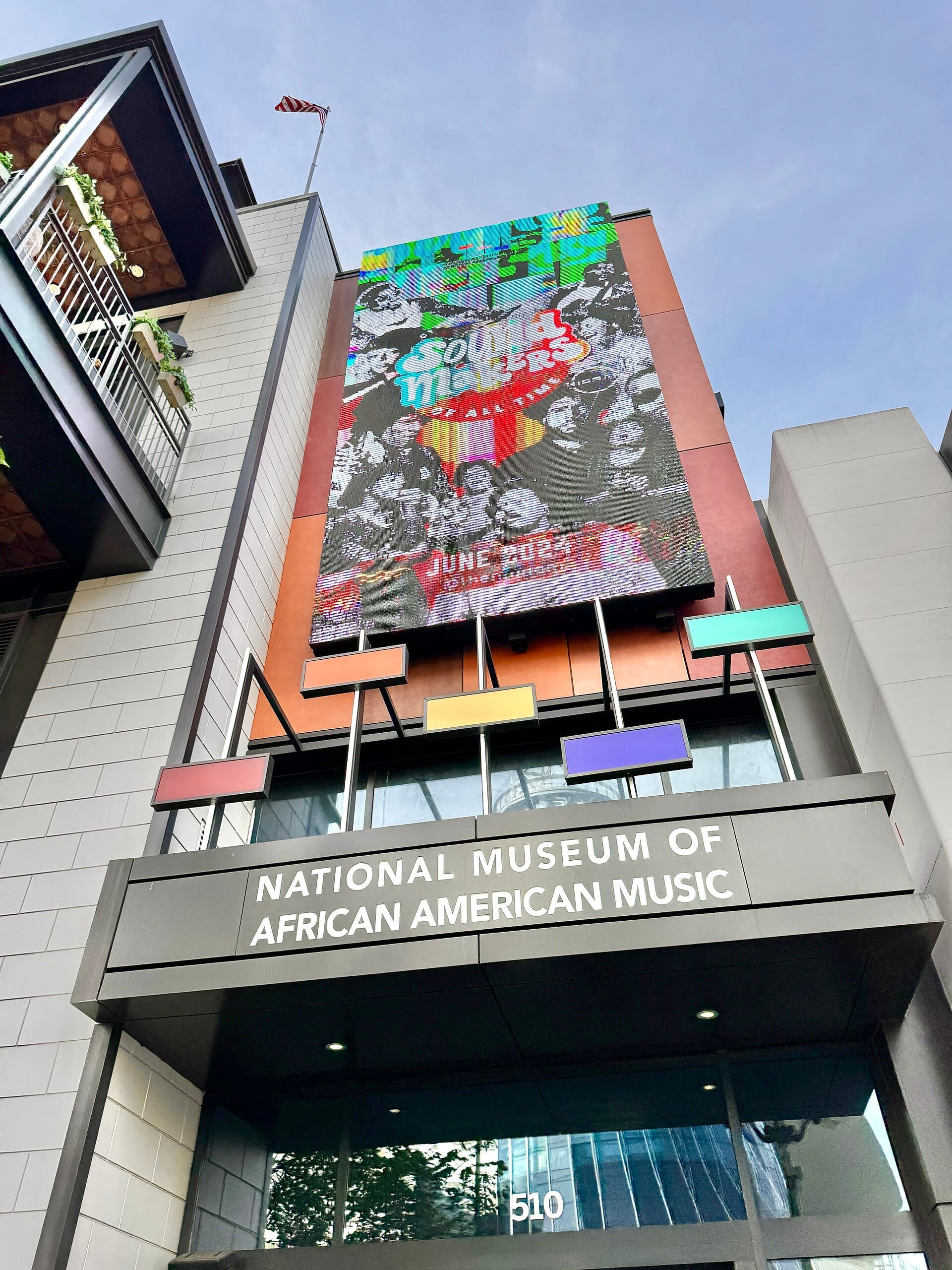
What the National Museum of African American Music Actually Is
The National Museum of African American Music, known widely as NMAAM, opened on Martin Luther King Jr. Day, January 18, 2021, with public tours beginning January 30, 2021, after nearly two decades of development. It occupies a prominent position inside the Fifth + Broadway mixed-use complex at 510 Broadway, placing it squarely in the middle of one of Nashville's most visited corridors. The location is deliberate: this is a city synonymous with music, and NMAAM roots itself in that identity while expanding the story far beyond country and bluegrass.
The museum's founding premise is straightforward and historically significant. African Americans created or fundamentally shaped more than 50 musical genres, from gospel and the blues to jazz, soul, R&B, hip-hop, and beyond. No other institution in the United States is dedicated solely to documenting, preserving, and presenting that legacy. That singular focus gives NMAAM a clarity of purpose that many larger museums lack.
If you are building a Nashville itinerary around cultural depth rather than bar-hopping, NMAAM pairs naturally with the Country Music Hall of Fame and the Musicians Hall of Fame to form a serious music history day. All three are within walking distance of each other in downtown Nashville.
Inside the Museum: What You Will See and Hear
NMAAM is organized around a series of themed galleries that trace the arc of African American music from its roots in African rhythms and the spirituals of enslaved people through to contemporary hip-hop and beyond. The experience is intentionally immersive. This is not a museum of static display cases and framed photographs, though those elements exist. The design emphasizes sound, interactivity, and personal connection.
One of the most talked-about features is the Rivers of Music installation, which visualizes the tributaries of African American musical genres flowing into and influencing one another. Visitors can trace how gospel fed into soul, how the blues traveled north during the Great Migration and seeded Chicago jazz, and how funk and soul eventually gave rise to hip-hop. The visual and audio design makes these connections feel earned rather than arbitrary.
Throughout the galleries, interactive recording booths and listening stations allow visitors to hear original recordings, learn about the musicians behind them, and even step into the process of making music. Children engage readily with these elements, but adults tend to linger just as long. The audio quality across the museum is noticeably high, which makes sense given that sound is the primary subject.
💡 Local tip
Bring headphones if you are sensitive to overlapping audio. Several gallery zones play different music simultaneously, which creates an energetic atmosphere but can feel overwhelming during busier afternoon hours.
Tickets & tours
Live prices and dates from our booking partner. If you book, we may earn a commission at no extra cost to you.
The Historical Weight Behind the Experience
The museum's groundbreaking took place in April 2017, and the project originated from a proposal in 2002. That long timeline reflects both the ambition of the undertaking and the deliberate care taken in building an institution that could credibly claim national significance. The grand opening in January 2021, timed to coincide with Martin Luther King Jr. Day weekend, added another layer of meaning to the launch.
What gives NMAAM its authority is its treatment of music not as entertainment history, but as social history. The galleries document how African American musicians navigated segregation-era touring circuits, how record labels extracted wealth while limiting artist control, and how music became a vehicle for civil rights organizing. These are not comfortable stories, and NMAAM does not soften them. That honesty is one of the museum's most valuable qualities.
Visitors who want to extend their understanding of Nashville's civil rights history can visit the Civil Rights Room at the Nashville Public Library, which documents the city's pivotal role in the 1960s sit-in movement. Together, the two sites offer a layered portrait of Black Nashville that most visitors never encounter.
Timing Your Visit: Morning vs. Afternoon
NMAAM opens at 10:00 AM Tuesday through Saturday and at noon on Sundays and Mondays, closing daily at 5:00 PM. Morning visits, especially on weekdays, are noticeably quieter. The gallery spaces feel more contemplative before midday, and you have more room to linger at interactive stations without feeling rushed by crowds forming behind you.
By early afternoon, particularly on weekends, the museum fills considerably. School and tour groups sometimes arrive in the late morning, which can compress the experience in specific gallery sections. If you are visiting with young children or want uninterrupted time at the recording stations, arriving at or near opening time is the most reliable strategy.
The museum is climate-controlled and entirely indoors, making it genuinely useful on days when Nashville's summer heat, which regularly reaches 88 to 90 degrees Fahrenheit, makes outdoor exploration uncomfortable. It is equally practical on rainy spring or autumn afternoons. Weather does not affect the quality of the experience here at all, which is not something you can say about most Nashville attractions.
⚠️ What to skip
Last entry is 4:15 PM regardless of when the museum closes. If you arrive at 3:30 PM expecting a full visit, you will be turned away or have only a fraction of the experience. Plan to arrive no later than 1:30 PM if you want the full two to three hours the galleries deserve.
Practical Walkthrough: Getting In and Getting Around
The museum has two entrances: one on Broadway and one on Rep. John Lewis Way, formerly known as 5th Avenue. The Rep. John Lewis Way entrance provides elevator access and is the recommended entry point for visitors with mobility needs or strollers. Staff are trained to assist guests requiring wheelchair or elevator support, and the museum is fully ADA compliant.
Tickets can be purchased online through the NMAAM website or at the door, though buying in advance is advisable on weekends and during peak tourist season. Pricing in USD at the time of writing is $33.33 online for adults (around $35 at the door), with in-person discounts for seniors (65+), military, first responders, students, and educators, and $29.33 for youth ages 5 to 17. Children ages 4 and under are free. These prices are set by the museum and may change, so verify current rates at nmaam.org before your visit.
For parking, the Metropolis garage at 598 Broadway sits directly beneath the Fifth + Broadway complex. Street parking on Broadway is extremely limited and often unavailable. Most visitors arriving by car will use the garage. From most downtown Nashville hotels, the museum is a comfortable walk of five to fifteen minutes, which makes arriving on foot the simplest option for a large portion of guests.
NMAAM sits near the eastern end of the Broadway Honky Tonk strip, which means the surrounding street-level scene is loud, crowded with bar-goers, and quite different in energy from the museum interior. That contrast is worth noting: the museum offers a serious cultural counterpoint to what is happening fifty feet away on the sidewalk.
Photography, Accessibility, and What to Bring
Photography is generally permitted in the public gallery spaces for personal, non-commercial use. The lighting in several gallery sections is deliberately dim to create an immersive atmosphere, so smartphone cameras may struggle in those areas. The more visually striking installations, including large-format graphic displays and the Rivers of Music visualization, photograph well without special equipment.
Wear comfortable shoes. Although the museum is compact relative to institutions like the Smithsonian, a thorough visit involves standing and moving through multiple floors and gallery configurations for two or more hours. The museum has a gift shop near the exit that carries books, music, apparel, and curated merchandise. It is one of the better museum shops in Nashville in terms of the quality and intentionality of its selection.
ℹ️ Good to know
The museum is closed on Thanksgiving Day and Christmas Day. Verify hours around other holidays directly at nmaam.org, as schedules may be adjusted for special events or programming.
Is NMAAM Worth the Ticket Price?
At around $33–35 for an adult ticket, NMAAM sits at the higher end of Nashville museum admission prices. That price is justified if you engage with the content seriously and allow yourself the full two to three hours the experience warrants. Visitors who rush through in under ninety minutes, or who are primarily interested in a photo opportunity rather than the history, may feel less satisfied.
The museum is not the right choice for visitors with very young children under five or six who are not yet ready to engage with audio-driven, text-heavy interpretive content. It is also not suited to travelers who are exclusively interested in Nashville's country music identity and have no curiosity about the broader American musical tradition. For everyone else, especially those who have some background interest in Black music history, American social history, or music production, NMAAM consistently overdelivers.
For travelers trying to plan a full Nashville cultural day, the 2-day Nashville itinerary places NMAAM alongside the Ryman Auditorium and the Tennessee State Museum as the city's most substantive indoor cultural stops.
Insider Tips
- The museum occasionally hosts live performances and special programming in the evening, separate from regular admission hours. Check the events calendar on nmaam.org before your visit, as these are typically low-cost rather than free and offer a completely different dimension to the NMAAM experience.
- If you are visiting with a group that has mixed levels of interest, split your time intentionally: the hip-hop and R&B galleries tend to engage younger visitors most, while the gospel and jazz sections hold the deepest historical material. Agreeing on a meeting point and time lets everyone move at their own pace.
- The Rep. John Lewis Way entrance is less congested than the Broadway entrance during peak hours. Even if you do not need the elevator, entering from that side can save you time at the ticketing area.
- Nashville's Broadway strip is at its loudest and most crowded from 6:00 PM onward. If you plan to explore the street scene after NMAAM, plan your museum visit to end by 4:30 PM and enjoy the transition from cultural immersion to live music on the strip.
- The museum's gift shop carries a curated vinyl selection and music-history books that are not widely available in general Nashville retail. Budget time at the exit if you are interested in taking something substantive home.
Who Is National Museum of African American Music For?
- Music history enthusiasts who want context for American popular music beyond country and rock
- Travelers with a serious interest in African American cultural and social history
- Families with children aged 8 and older who can engage with interactive audio and text content
- First-time Nashville visitors who want cultural depth beyond the honky-tonk experience
- Educators, students, and researchers looking for a museum-quality treatment of Black musical genres
Nearby Attractions
Other things to see while in Downtown Nashville:
- 3rd & Lindsley
Since 1991, 3rd & Lindsley has been the venue where Nashville musicians play when they want to be heard, not just seen. Located half a mile south of Broadway in the SoBro district, it is an intimate, no-frills room that draws touring acts, local legends, and serious audiences in equal measure.
- Acme Feed & Seed
Housed in a landmark 1943 building at the corner of 1st Avenue and Broadway, Acme Feed & Seed is a multi-level bar, restaurant, and music venue with a rooftop overlooking the Cumberland River. It offers a more layered experience than the typical honky-tonk strip, with a rooftop that earns its reputation for views and a ground floor that still delivers the Broadway energy.
- Adventure Science Center
Adventure Science Center is Nashville's premier interactive science museum, offering 44,000 square feet of hands-on exhibits, a 75-foot adventure tower, and a 63-foot dome planetarium. It has served the city since 1945 and remains one of the most engaging family destinations near downtown Nashville.
- Bicentennial Capitol Mall State Park
Bicentennial Capitol Mall State Park is a free, 19-acre outdoor park in downtown Nashville built to commemorate Tennessee's 200th anniversary of statehood. Anchored by a 200-foot granite map of the state, a 95-bell carillon, and the Rivers of Tennessee Fountains, it doubles as one of the most informative and peaceful green spaces in the city center.
Planning a trip? Discover personalized activities with the Nomado app.