National Maritime Museum Amsterdam: Ships, Maps, and Five Centuries of Sea Power
Housed in a 17th-century naval storehouse on Amsterdam's eastern docklands, the National Maritime Museum (Het Scheepvaartmuseum) brings five centuries of Dutch maritime history to life through world-class collections, an interactive replica East Indiaman, and the gilded Royal Barge. It is one of the most substantial museum experiences in the city.
Quick Facts
- Location
- Kattenburgerplein 1, 1018 KK Amsterdam (Eastern Docklands, Plantage area)
- Getting There
- Short walk or cycle from Amsterdam Centraal; check GVB for current tram/bus routes toward the eastern docklands
- Time Needed
- 2.5 to 4 hours; half a day if you linger on the ships and outdoor jetty
- Cost
- Tickets from approx. EUR 18.50–20 for adults; discounts for children, students, and Museumkaart holders, and free entry for children up to 12 when accompanied by a paying adult. Verify current prices at hetscheepvaartmuseum.com
- Best for
- History enthusiasts, families with children over 6, architecture lovers, and anyone curious about the Dutch Golden Age
- Official website
- www.hetscheepvaartmuseum.com
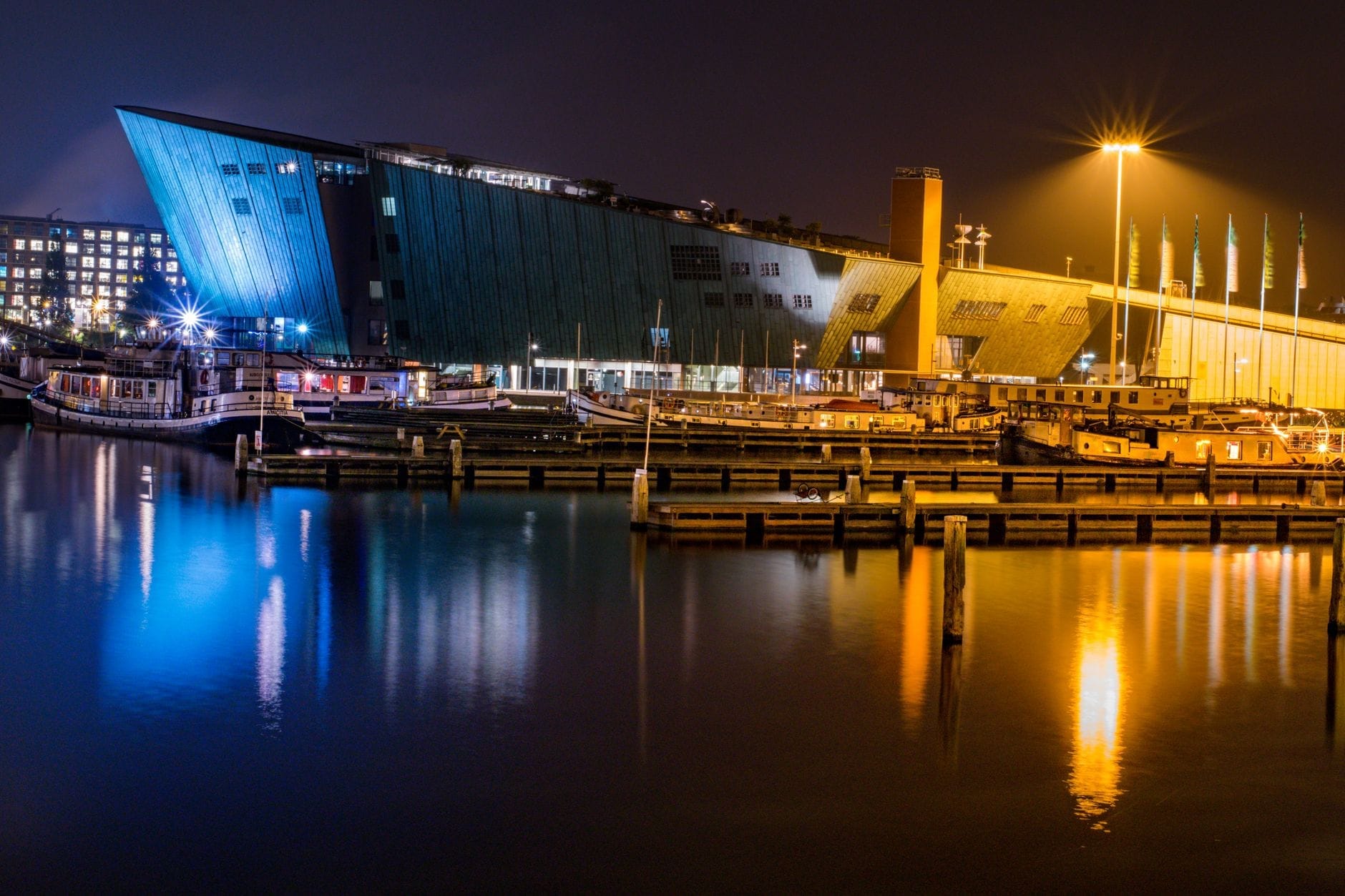
What the National Maritime Museum Actually Is
The National Maritime Museum, known in Dutch as Het Scheepvaartmuseum, occupies one of Amsterdam's most architecturally significant buildings: the 's Lands Zeemagazijn, a vast classical naval storehouse constructed in 1656 for the Admiralty of Amsterdam. For more than three centuries this building stored ropes, sails, cannons, and provisions for the Dutch fleet. Today it holds one of the largest maritime collections in the world, covering roughly 500 years of seafaring history through maps, navigational instruments, ship models, paintings, and full-size historic vessels moored at its jetty.
The building itself is worth the visit before you see a single exhibit. The façade along the water is long and symmetrical, built from the yellow-grey Dutch brick common in the mid-17th century, with a monumental courtyard at its center now covered by a geometric glass roof. That roof, added during the museum's 2011 renovation, turns the former open courtyard into a luminous interior atrium. The contrast between the 370-year-old masonry and the modern steel-and-glass canopy overhead is striking without being jarring.
💡 Local tip
The museum is generally open daily from 10:00 to 17:00, but check current hours before your visit as schedules can change. Arrive within the first hour of opening if you want to board the replica ship without waiting. By midday, school groups and tour parties are usually on the jetty in force.
The Building: A Naval Storehouse Turned Cultural Institution
Standing outside on the Kattenburgerplein, looking at the building's waterfront elevation, it is easy to underestimate the scale. Step inside and the courtyard stops you. The glass roof diffuses natural light across the stone floor below, and the four interior walls of the original building rise around you with their original proportions intact. The sensation is closer to entering a covered public square than a museum lobby. On overcast Amsterdam days, the atrium glows with soft diffused light; on bright days, the geometry of the glass casts angular shadows across the courtyard floor.
The renovation preserved the building's historic character while adding modern infrastructure. Floors throughout are largely accessible, corridors are wide, and the layout follows a logical sequence through the collection. The building is not flat, but lifts serve the main levels. Visitors with mobility limitations should check the accessibility details on the museum's official website before arriving, as a historic structure does impose some physical constraints.
The museum sits in the eastern docklands, a short walk from the Plantage neighborhood, which also contains the Artis Amsterdam Royal Zoo and the Hortus Botanicus. Combining two or three of these in a single half-day is straightforward on foot.
Tickets & tours
Live prices and dates from our booking partner. If you book, we may earn a commission at no extra cost to you.
National Maritime Museum entrance ticket and Amsterdam canal cruise
From 38 €Instant confirmationTickets for the National Maritime Museum in Amsterdam
From 19 €Instant confirmationFree cancellationGray Line Canal Cruise with snackbox & Heineken Experience
From 48 €Instant confirmationFree cancellationAmsterdam evening canal cruise
From 18 €Instant confirmationFree cancellation
The Collection: Five Centuries of Dutch Maritime Power
The permanent collection is organized thematically rather than strictly chronologically, which allows the museum to draw connections across time: a 17th-century navigation chart displayed alongside a modern satellite positioning device, for example, makes the continuity of human wayfinding viscerally clear. Core holdings include an exceptional collection of antique sea charts and atlases, detailed ship models built to Admiralty specifications, navigational instruments, paintings from the Dutch Golden Age depicting naval battles and harbor scenes, and personal objects from sailors and officers across different centuries.
The painted panoramas and maritime scenes are worth pausing over. Dutch Golden Age painters treated the sea with the same seriousness as portraiture, and the collection here includes works that capture the gray-green quality of the North Sea light with unusual precision. The models are equally absorbing: scale replicas of VOC (Dutch East India Company) ships show the complexity of rigging, storage, and armament that enabled the Netherlands to project commercial and naval power across the globe in the 17th and 18th centuries.
The Royal Barge, built between 1816 and 1818 for the Dutch royal family, is housed indoors and is one of the most visually arresting single objects in the museum. Gilded, carved, and painted, it represents the ceremonial face of maritime power, entirely unlike the functional brutality of a warship. It was last used in 1962 for Queen Juliana's Silver Jubilee and now sits in climate-controlled display in remarkable condition.
The Ships at the Jetty: Where the Museum Comes Alive
The outdoor jetty is where the museum separates itself from a conventional collection space. Three vessels are moored alongside the building, and visitors can board at least one of them as part of their ticket. The centerpiece is the replica Dutch East Indiaman Amsterdam, a full-size reconstruction of the VOC cargo ship of the same name, which sank on its first voyage in 1749 off the English coast near Hastings. The wreck was excavated in the 20th century; many of its artifacts are in museum collections across Europe. The replica, built to original specifications, gives a physical sense of the scale and cramped conditions aboard a mid-18th-century ocean-going merchantman.
Walking the gun deck, ducking through low doorways, and looking into the officer's cabin makes the human experience of a long VOC voyage concrete in a way no photograph or description achieves. The smell of old timber and rope is present throughout the lower decks. Children respond strongly to this space: the ship functions almost as a walk-through exhibit, with information panels placed throughout. Adults often find it more absorbing than expected.
Also moored at the jetty is the ss Christiaan Brunings, a steamship and icebreaker built in 1900. The contrast between the East Indiaman's wooden construction and the Christiaan Brunings' iron hull, just 150 years later in historical terms, is a tangible illustration of how quickly shipbuilding technology transformed. Weather affects the jetty experience: on cold or wet days, the outdoor sections are exposed, and the interiors of the ships are small and can feel crowded when visitor numbers are high. Bring a layer regardless of season.
⚠️ What to skip
The jetty and ship boarding areas are not fully accessible to wheelchair users due to the physical structure of historic vessels. Check with the museum directly if accessibility on the ships is essential to your visit.
How the Experience Changes Through the Day
Mornings from 10:00 to 11:30 are the calmest period. The atrium is quiet enough to hear footsteps echo on the stone floor. The light through the glass roof is soft at this hour, which makes the courtyard particularly photogenic. The collection rooms feel unhurried and you can read exhibit panels without people pressing around you.
By mid-morning, school groups begin arriving, often in organized tours. They tend to move quickly through the indoor collection toward the replica ship, which is where noise and crowding concentrate. If you are visiting with older travelers or want a contemplative experience with the maps and instruments collection, the upper floors tend to stay quieter throughout the day while the ground floor and jetty see the highest footfall.
Late afternoon, from around 15:30 onward, sees crowds thin again as tour groups depart and families with young children leave for dinner. The museum closes at 17:00 and last entry is shortly before closing time. The museum does not usually offer evening access, so unlike some Amsterdam institutions there is no twilight option.
Practical Details and Getting There
The museum is at Kattenburgerplein 1, in the eastern docklands east of Amsterdam Centraal. Walking from the central station takes roughly 20 to 25 minutes along the waterfront; cycling takes around 10 minutes and there is bicycle parking near the entrance. GVB bus routes such as line 22 serve the eastern docklands area, but specific lines and stop names are subject to change, so check the GVB route planner or Google Maps before traveling.
The museum is open daily from 10:00 to 17:00. Holders of the Amsterdam City Card receive free entry, making this one of the card's stronger inclusions given the standard ticket price. The Museumkaart (Dutch national museum pass) is also accepted.
Photography is permitted throughout the museum without flash in most areas. For the Royal Barge, conditions may differ; check signage on arrival. If you are planning a wider day around this area, the Dutch Resistance Museum is also within walking distance and pairs well thematically for visitors interested in Dutch history across different periods.
ℹ️ Good to know
The museum has a café and a gift shop. The café is a reasonable option for a mid-visit break but is not a destination in its own right. Alternatively, the Plantage neighborhood has several good coffee spots a short walk away.
Who This Museum Is For, and Who Might Pass
Travelers with a genuine interest in history, particularly the Dutch Golden Age and the VOC's role in global trade, will find this one of the more intellectually rewarding museums in Amsterdam. The depth of the collection rewards time, and the contextual framing around colonial trade, naval power, and cartographic achievement is handled with more nuance than you might expect.
Families with children aged roughly 6 and up tend to have a strong experience here, primarily because of the replica ship. The boarding and exploration aspect keeps children engaged where a purely display-based museum would not. For children under 5, the ship is physically tricky to navigate and the indoor collection has limited interactive elements at that age level.
Visitors with only one or two days in Amsterdam who are already committed to the Rijksmuseum and the Van Gogh Museum may find that adding the Maritime Museum stretches a short itinerary thin. It is better suited to those with three or more days, or those who specifically prioritize naval and maritime history over fine art. It is not a quick 45-minute stop; to see it properly requires at least two and a half hours.
Visitors who are uninterested in historical context and come primarily for visual spectacle may find the indoor collection dry in places. The replica ship, however, tends to convert skeptics.
Insider Tips
- Book tickets online in advance through the museum's official website. On busy summer days and school holiday periods, timed entry helps you avoid queuing on the jetty. Walk-up tickets are generally available but online booking saves time.
- The glass-roofed courtyard atrium is one of the best indoor photography spots in Amsterdam for architectural composition. Arrive in the first 30 minutes for the cleanest shots without crowds in frame.
- Bring a jacket even in summer. The Eastern Docklands waterfront is exposed to North Sea wind, and the lower decks of the replica ship are cool regardless of the outdoor temperature.
- If you hold a Museumkaart (the Dutch national museum pass), this is a high-value inclusion. The Maritime Museum's standard admission is among the higher single-museum entry prices in Amsterdam, so using the card here makes the math work in your favor.
- Combine the visit with a walk along the Marineterrein, the historic navy yard adjacent to the museum that has been partially opened to the public. The waterfront views east along the IJ from this stretch are among the quietest and most photogenic in the area.
Who Is National Maritime Museum For?
- History enthusiasts with a specific interest in the Dutch Golden Age, the VOC, and naval power
- Families with children aged 6 to 14 who respond well to hands-on and walk-through exhibits
- Architecture lovers drawn to 17th-century Dutch civic buildings and contemporary interventions
- Travelers on three or more days who want to move beyond the central museum district
- Museumkaart or Amsterdam City Card holders looking to maximize the value of their pass
Nearby Attractions
Other things to see while in Plantage & Jewish Quarter:
- ARTIS Amsterdam Royal Zoo
Founded in 1838, ARTIS Amsterdam Royal Zoo is the oldest zoo in the Netherlands and the fifth oldest zoo in the world still in operation. Set across landscaped grounds in the Plantage neighborhood, it blends wildlife, botanical gardens, and 19th-century heritage architecture into a single half-day destination that works for families, history enthusiasts, and curious solo travelers alike.
- Brouwerij 't IJ
Brouwerij 't IJ is Amsterdam's most distinctive craft brewery, operating inside an early-20th-century bathhouse at the foot of the De Gooyer windmill. The tasting room is free to enter, pours a rotating lineup of house-brewed beers, and offers short brewery tours on weekends. It is one of the few places in the city where industrial heritage, local brewing culture, and canal-side atmosphere converge in a single address.
- De Gooyer Windmill
Standing 26.6 metres tall on the eastern edge of the city, De Gooyer is widely described as the tallest wooden windmill in the Netherlands and one of Amsterdam's most photogenic historic structures. The mill itself is private, but the exterior is free to visit, and the craft brewery in the former bathhouse beside it is reason enough to linger.
- Dutch Resistance Museum
The Dutch Resistance Museum (Verzetsmuseum Amsterdam) tells the story of the Nazi occupation of the Netherlands through the choices ordinary people made: those who resisted, those who complied, and those who stood between. Located in the Plantage district, it is one of the most thoughtfully curated war museums in Europe.
Planning a trip? Discover personalized activities with the Nomado app.