Nanjing Road Pedestrian Street: What to Expect on Shanghai's Most Famous Commercial Strip
Nanjing Road Pedestrian Street (南京路步行街) is Shanghai's historic commercial spine, running along East Nanjing Road from People's Square to the Bund in Huangpu District. Entry is free and the street is open around the clock, though the real experience shifts dramatically depending on when you arrive. This guide tells you what you'll actually find there. Entry is free and the street is open around the clock, though the real experience shifts dramatically depending on when you arrive. This guide tells you what you'll actually find there.
Quick Facts
- Location
- East Nanjing Road Pedestrian Street, Huangpu District, Shanghai (between People's Square and the Bund)
- Getting There
- East Nanjing Road Station — Lines 2 and 10, use the exit signed for the pedestrian street
- Time Needed
- 1–2 hours for a walk-through; half a day if you plan to shop or eat
- Cost
- Free to enter the street; shops and restaurants charge separately
- Best for
- First-time visitors, evening atmosphere, Chinese brand shopping, people-watching
What Nanjing Road Pedestrian Street Actually Is
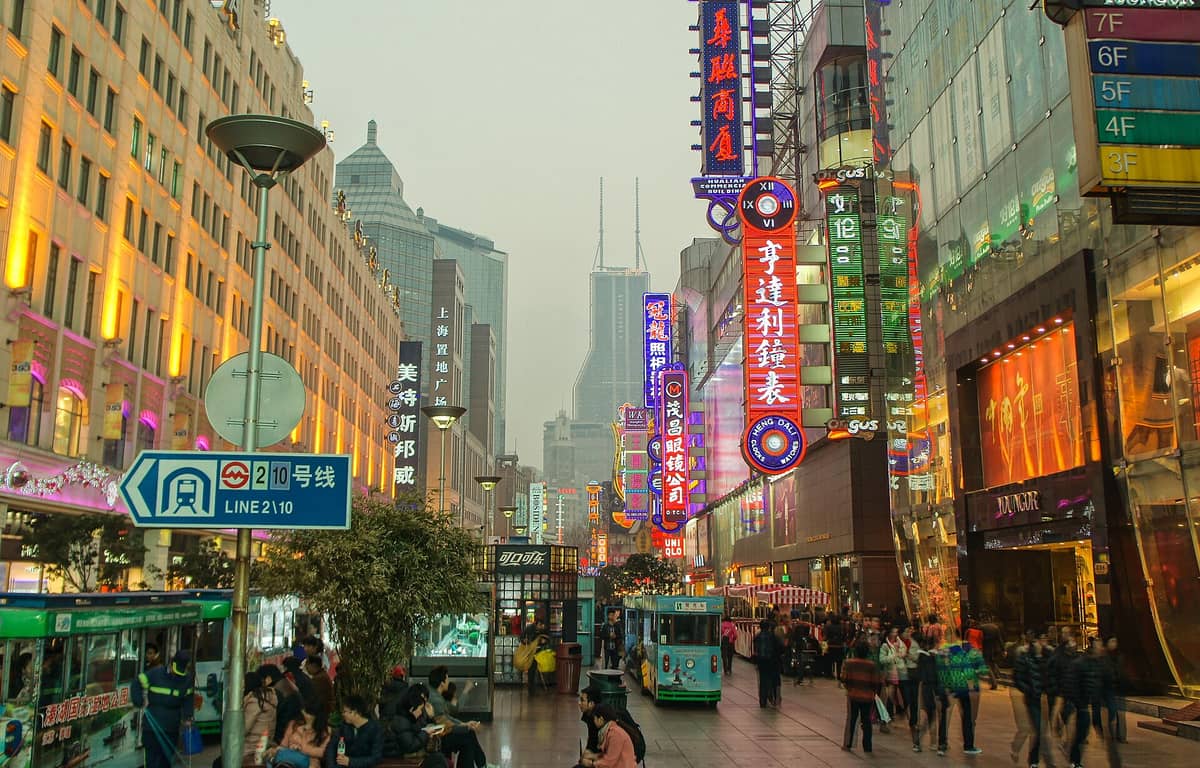
Nanjing Road Pedestrian Street (南京路步行街) is a car-free commercial strip running along East Nanjing Road through the heart of Huangpu District. It extends from People's Square in the west toward the Bund waterfront in the east, covering roughly 1.2 to 1.5 kilometers of wide, granite-paved walkway lined with department stores, flagship brand outlets, heritage storefronts, and food counters. The street is free to access, open 24 hours a day year-round, with individual shops generally trading from 10:00 to 22:00.
This is not a boutique shopping district. It is one of Shanghai's busiest commercial corridors, with domestic tourism numbers that rival other major commercial streets in China. Foreign visitors expecting the curated atmosphere of Xintiandi or the lane-house intimacy of Tianzifang will find something quite different here: scale, noise, neon, and a crowd density that on weekends and public holidays becomes genuinely difficult to move through. None of that makes the street unworthy of a visit — it just requires adjusted expectations.
💡 Local tip
If your primary goal is shopping or photos without large crowds, arrive on a weekday morning between 09:30 and 11:00, before most shops open and before tour groups arrive. The street is a different place at that hour.
A Brief History: Why This Street Matters
Nanjing Road's commercial history dates to the late 19th century, when it grew into a major retail artery of the International Settlement. By the 1920s and 1930s, it had become the definitive shopping address in China, home to the four great department stores — Sincere, Wing On, Sun Sun, and The Sun — whose Art Deco and neoclassical facades still anchor different sections of the street today. The road represented the intersection of Chinese entrepreneurship and colonial-era commercial infrastructure, attracting buyers from across the country.
After 1949, state-owned enterprises replaced the private stores, and Nanjing Road maintained its status as the retail center of socialist Shanghai. The pedestrianization of the eastern section was completed in 1999 as part of a broader urban renewal push, transforming the road into a dedicated walking and sightseeing zone. Today, the Shanghai municipal government has announced plans to divide the street's development into four distinct zones, reflecting its ongoing positioning as a world-class shopping and tourism corridor. The preserved early-20th-century building stock along the route gives the street an architectural coherence that distinguishes it from purely modern commercial developments.
For a deeper understanding of how Nanjing Road fits into Shanghai's architectural and urban development story, the Shanghai architecture guide traces the city's building layers from treaty-port era to contemporary skyline.
Tickets & tours
Hand-picked options from our booking partner. Prices are indicative; availability and final rates are confirmed when you complete your booking.
Shanghai city and Zhujiajiao water town private tour with lunch
From 371 €Instant confirmationFree cancellationShanghai private tour with iconic landmarks of the old and new city
From 284 €Instant confirmationFree cancellationShangai Yuyuan Garden entrance tickets
From 9 €Instant confirmationFree cancellation
How the Street Changes Through the Day
Early morning, roughly 07:00 to 09:30, the pedestrian street is as calm as it ever gets. Older residents walk at pace or do slow exercises in the side plazas. Delivery workers load goods into the ground floors of department stores. The granite underfoot reflects the sky. This window is short but genuinely good for photography — the building facades are lit by soft directional light and the wide walkway is actually visible without people filling every frame.
By midday, particularly on weekends, the character shifts completely. The sightseeing trolley runs along the street's center, its bell audible over the general noise. The smell shifts between roasted chestnuts near the food counters, baked goods from chain bakeries, and occasionally the faint sweetness from the old-brand candy shops that still operate here. Foot traffic thickens noticeably, and queue lines form outside popular snack counters. Navigating in a straight line requires patience.
After dark, particularly between 19:00 and 21:00, the street reaches its most photographically dramatic state. The LED facades of major department stores, the illuminated signage of heritage buildings, and the light strings strung at intervals across the walkway create a dense, layered visual texture. The crowd is still substantial but the atmosphere shifts from transactional to something closer to a public promenade. This is when the street best earns its reputation as a Shanghai spectacle.
⚠️ What to skip
During Golden Week (National Day, October 1–7) and Chinese New Year, pedestrian density on Nanjing Road reaches levels that make movement genuinely difficult. Crowd management measures may apply. Verify current holiday arrangements before visiting during these periods.
What You Will Find Along the Street
The pedestrian section runs through several distinct commercial clusters. At the western end near People's Square, the density of large department stores is highest — New World City and several flagship malls occupy nearby blocks. Moving east, the street narrows slightly in character and the older building stock becomes more visible, including preserved facades from the Republican-era stores. Toward the Bund end, retail gradually gives way to the riverfront transition zone.
The street's retail offer is weighted toward domestic Chinese brands, mid-range fashion, sportswear flagships (Nike, Adidas, Li-Ning), and large pharmacy chains. International luxury labels are largely absent from the pedestrian section itself, though nearby malls carry them. What is genuinely interesting here are the old-brand shops (老字号, laoziha) that still operate on the street: Wing On for household goods, and confectionery counters that have been trading under similar formats for decades.
Food options run the gamut from fast food chains to sit-down Shanghainese restaurants and the street-level snack counters that draw the longest queues. For visitors focused on eating rather than shopping, the street functions well as a starting or ending point for a broader food circuit in Huangpu.
If the food angle interests you, the what to eat in Shanghai guide gives a broader overview of the city's food landscape, including which dishes are worth seeking out near this corridor.
Getting There and Getting Around
The most direct metro access is East Nanjing Road Station, served by Lines 2 and 10. Use the exit signed for the pedestrian street, near the red signpost that marks the boarding point for the sightseeing trolley. Line 2 connects directly to Lujiazui and the Pudong financial district in one direction, and to Jing'an Temple with transfers toward Hongqiao Airport in the other. This makes Nanjing Road a natural mid-point stop on a full-day city circuit.
People's Square Station, at the western end of the street, is served by Lines 1, 2, and 8 and functions as one of Shanghai's main metro interchange hubs. If you are combining the pedestrian street with a visit to the Shanghai Museum or the Shanghai Urban Planning Exhibition Center, both are a short walk from the western entry point.
For a full breakdown of how to navigate the metro system and plan multi-stop itineraries, the getting around Shanghai guide covers routes, fares, and practical tips.
The street itself is entirely flat and paved, making it accessible for wheelchairs and pushchairs in terms of surface. The practical challenge is crowd density rather than physical infrastructure, particularly on weekend evenings when movement through the busiest sections requires significant patience.
Photography Notes
The street rewards photographers who work with crowds rather than against them. Wide-angle shots in the morning capture the full facade run of heritage buildings with minimal clutter. At night, the reflective granite surface picks up the colored LED lighting from storefronts, creating foreground interest that works well in long exposures. A small tripod or a surface to brace against is useful for the evening shots.
Nanjing Road is included in most comprehensive photography itineraries for the city. The best photo spots in Shanghai guide identifies additional locations that pair well with an evening here, including the nearby Bund promenade.
💡 Local tip
The eastern end of the pedestrian street, near its junction with the Bund, gives a view back down the corridor with department store signage and street lighting receding into the distance — a strong compositional line that most visitors miss by not walking the full length.
Honest Assessment: Who This Is (and Isn't) For
Nanjing Road Pedestrian Street is worth seeing once, particularly at night when the lighting transforms the scale of the street into something genuinely impressive. As a first-time-in-Shanghai experience, it works well as a spatial orientation — the contrast between the street's commercial density and the relative calm of the Bund a few hundred meters away tells you something important about how the city layers its identities.
As a shopping destination for foreign visitors, it is generally not the strongest option. The retail mix is heavily oriented toward domestic consumers, and the department stores stock items available more cheaply elsewhere or online. Visitors looking for unique goods, artisan products, or independent labels will find better options in the Former French Concession or in the creative retail clusters around M50.
Travelers who find the pedestrian street overly commercial often prefer the quieter, more atmospheric streets around Tianzifang or the independent boutiques along Wukang Road in Xuhui District.
Visitors sensitive to noise and crowd pressure should note that evening hours on the pedestrian section involve high ambient sound levels from broadcast music, vendor calls, and sheer pedestrian volume. This is not a quiet or contemplative space at peak times. Those seeking that version of Shanghai should look elsewhere.
Insider Tips
- The sightseeing trolley (观光小火车) that runs along the center of the street boards near East Nanjing Road Station at the pedestrian-street exit. It is a slow, useful way to cover the full length without fighting foot traffic, and gives a different perspective on the building facades above street level.
- Several of the ground-floor food counters in the older department stores on the eastern section carry Shanghai old-brand products — preserved vegetables, specialty sauces, and packaged snacks — that make genuinely distinctive souvenirs at much lower prices than airport shops.
- If you want to photograph the street at night without people dominating every shot, position yourself at the second-floor window of any café or restaurant overlooking the walkway. The elevated angle removes most of the crowd and emphasizes the light and architecture.
- The street officially runs to the Bund, but most visitors turn back before reaching the eastern transition zone near Zhongshan East Road. Walking the full length and continuing to the Bund promenade adds only a short extra walk and gives the visit a natural geographic conclusion.
- On weekday mornings before 10:00, some of the old-brand confectionery shops have shorter queues and fresher stock than at peak times. The nut and seed counters near the mid-section are worth the stop if you catch them early.
Who Is Nanjing Road Pedestrian Street For?
- First-time visitors to Shanghai who want to understand the city's commercial scale and energy
- Evening walkers and photographers interested in LED-lit urban nightscapes
- Travelers interested in Republican-era commercial architecture alongside contemporary retail
- Shoppers focused on domestic Chinese brands, sportswear, and old-brand (laoziha) food products
- Anyone using the street as a connector route between People's Square and the Bund
Nearby Attractions
Combine your visit with:
- Chongming Island
Chongming Island sits at the mouth of the Yangtze River, a vast alluvial island that functions as Shanghai's rural counterweight. Wetland reserves, a national forest park, cycling paths through farmland, and virtually no high-rises make it a genuinely different Shanghai experience.
- ERA Acrobatics Show
Running nightly at Shanghai Circus World in Jing'an District, ERA2 – Spirit of Shanghai is the city's flagship acrobatics production. Expect gravity-defying stunts, dramatic lighting, and a 60-to-100-minute show that needs no translation. Here is everything you need to know before buying a ticket.
- Jade Buddha Temple
The Jade Buddha Temple (玉佛禅寺, Yùfó Chán Sì) is one of Shanghai's most significant active Buddhist monasteries, housing two exceptional jade Buddha statues brought from Burma in the late 19th century. Unlike many temples that have become purely ceremonial attractions, this one functions as a working monastery, with monks in residence and daily rituals that visitors can witness firsthand.
- Jinshan City Beach
Jinshan City Beach (金山城市沙滩景区) is a man-made coastal resort on Hangzhou Bay, about 60 km south of central Shanghai. It is the closest thing to a genuine beach day the city offers, with designated swimming zones, a long promenade, and seasonal facilities. This guide covers what to realistically expect, when to go, and how to get there.