Museo Palacio de la Condesa de Lebrija: Seville's Best-Kept Palace Secret
Tucked behind Calle Sierpes in the heart of Seville's old city, the Palacio de la Condesa de Lebrija is a privately owned aristocratic palace that houses one of the finest collections of Roman mosaics in Andalusia. Two floors of richly decorated rooms reward visitors who look beyond the cathedral circuit.
Quick Facts
- Location
- Calle Cuna 8, Historic Centre, Seville (Santa Cruz / Casco Antiguo)
- Getting There
- City buses 27, 32, A2 stop nearby. About a 10-minute walk from Seville Cathedral. No metro stop within the immediate block.
- Time Needed
- 1 to 1.5 hours for both floors; 30–45 minutes for ground floor only
- Cost
- €12 adults; €6 children (6–12); free ground-floor visit Fridays at 10:00 (capacity limited). Verify prices before visiting.
- Best for
- History lovers, archaeology enthusiasts, architecture fans, and travellers who want a quieter alternative to Seville's major monuments
- Official website
- palaciodelebrija.com
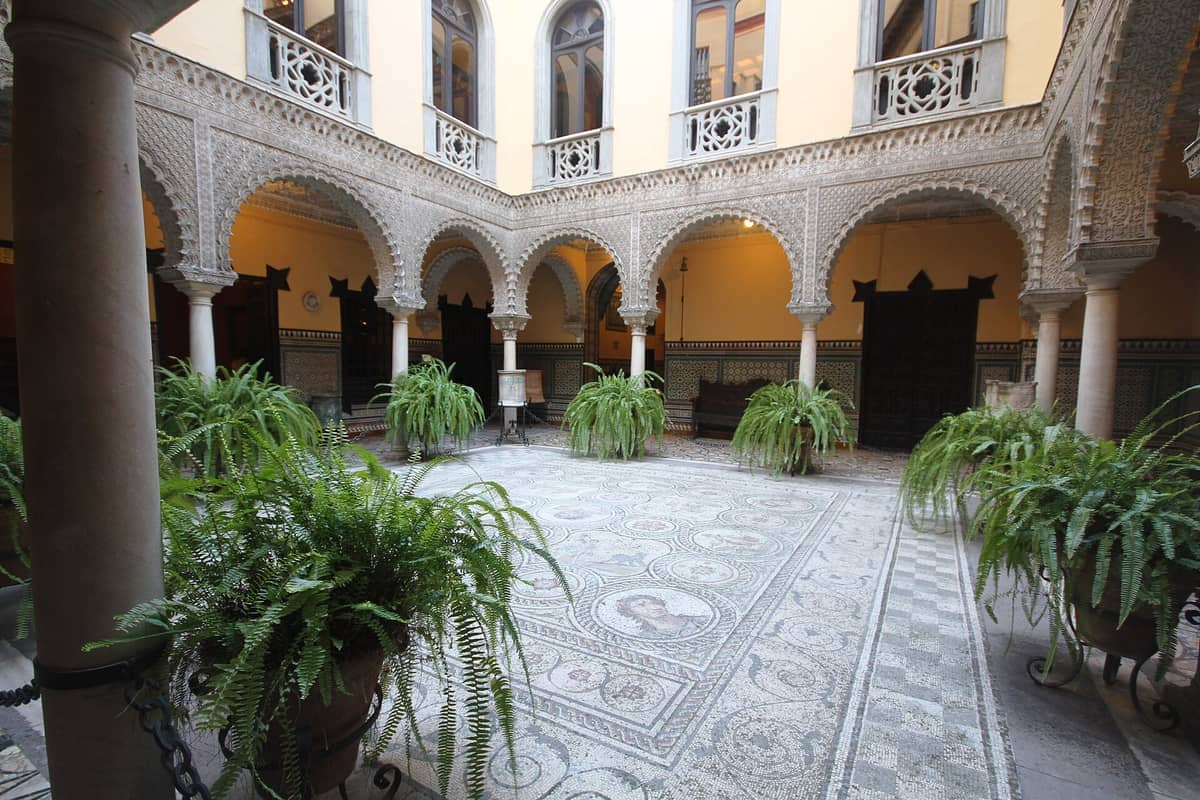
What Is the Palacio de la Condesa de Lebrija?
The Museo Palacio de la Condesa de Lebrija, at Calle Cuna 8, is one of Seville's most unusual cultural spaces: a privately owned aristocratic palace that has been open to the public for years but still draws a fraction of the visitors who queue daily at the Alcázar or Cathedral. That relative quiet is part of its appeal.
The building traces its structure to the 16th century, when it was built as a classic Andalusian casa-palacio with a large central courtyard. Over subsequent centuries it was remodelled with historicist details, giving the façade a layered quality that is easy to appreciate even from the street. The ornate doorway on Calle Cuna gives the first hint of what waits inside.
Its defining feature is the ground-floor courtyard, where ancient Roman mosaics have been set directly into the floor and walls. These were collected in the early 20th century by the Countess of Lebrija, an aristocrat and passionate archaeologist who assembled pieces from different periods and cultures, including from the nearby Roman city of Italica. If you plan to visit Italica Roman Ruins on a day trip, seeing the mosaics here first gives useful context for what Roman decorative culture looked like in the region.
💡 Local tip
Friday free entry: the palace offers a free visit to the ground floor every Friday at 10:00, with limited places. Arrive early — spaces go quickly and groups are not allowed for this slot.
The Ground Floor: Roman Mosaics and Andalusian Architecture
The central courtyard is the palace's showpiece. A large polychrome Roman mosaic covers much of the floor, its geometric and figurative patterns still surprisingly vivid after nearly two millennia. The Countess restored the palace in the early 1900s, embedding the mosaic beneath a Mudéjar arcade of horseshoe arches and glazed tiles that creates a striking visual tension between Roman antiquity and Andalusian ornament.
The walls around the courtyard carry additional Roman fragments: smaller mosaic panels, inscribed stones, and ceramic pieces displayed at eye level. The effect is less like a conventional museum and more like visiting a private home whose owner collected obsessively and arranged everything by personal logic rather than curatorial convention. Labels are present but sparse, which suits visitors who prefer to look before they read.
In the morning, when light falls through the courtyard's upper openings, the mosaic floor picks up a warm glow that photographs well without artificial assistance. By early afternoon the light flattens and the colours become harder to read. If photography matters to you, aim for the first hour after opening.
ℹ️ Good to know
Ground floor only vs. full visit: some ticket options cover the ground floor alone. The upper floor contains the furnished private rooms and may require a different ticket. Check the options at the door or on the official website before you pay.
Tickets & tours
Live prices and dates from our booking partner. If you book, we may earn a commission at no extra cost to you.
Palacio de Duenas Guided Tour
From 25 €Instant confirmationFree cancellationTablao Palacio Andaluz flamenco show with cava
From 54 €Instant confirmationFree cancellationFlamenco Show entrance tickets at El Palacio Andaluz
From 32 €Instant confirmationFree cancellationPrivate Guided Tour of Medinaceli and Lebrija's Palaces
From 190 €Instant confirmationFree cancellation
The Upper Floor: Aristocratic Rooms and Decorative Arts
The second floor is a different kind of experience altogether. Here the palace reads as a lived-in aristocratic house rather than an archaeological showcase. Rooms retain their period furnishings: painted ceilings, tapestries, antique furniture, porcelain collections, and personal objects belonging to the Lebrija family.
The staircase connecting the floors is itself worth pausing on. The walls are tiled in elaborate azulejo panels, and the proportions of the stairwell give a clear sense of the building's original ambitions. At the top, the main salon looks out over the courtyard below, offering a different perspective on the mosaic floor you just walked across.
The upper floor is accessed only as part of the full-admission ticket and, at certain times, as part of a guided visit. The guided format adds context that the sparse labels downstairs cannot provide, and staff are generally knowledgeable. If your Spanish is limited, ask at the door whether tours are available on the day you visit.
When to Visit and How the Experience Changes by Hour
The palace is rarely crowded by Seville standards, but visit numbers do increase between 11:00 and 13:00 when morning tour groups pass through the centre. Arriving at opening time (10:00) or after 15:00 typically means you will have the courtyard mostly to yourself.
In summer (July and August), the palace closes at 15:00 rather than 18:00, which means the typical afternoon lull is no longer an option. The earlier closing also makes it easier to combine with other morning visits. Pair it with nearby sights in the old quarter, or continue toward the Cathedral district.
Spring and autumn are the most comfortable seasons for walking Seville's historic streets, and visiting the palace slots naturally into a broader morning itinerary. For guidance on timing your overall trip, the best time to visit Seville page covers seasonal conditions in detail.
⚠️ What to skip
Summer hours: between July and August the palace closes at 15:00, with last entry at 14:15. Do not assume year-round opening times apply. Check the official site before visiting.
Getting There and Practical Logistics
The palace sits on Calle Cuna, a street that runs parallel to the pedestrian shopping street Calle Sierpes in Seville's historic centre. If you are coming from the Cathedral, walk north through the old quarter for roughly 10 minutes. The entrance is easy to miss: look for the ornate stone portal between the shops.
City buses 27, 32, and A2 have stops within a short walk of the palace. There is no practical metro connection to this specific block. Most visitors arrive on foot from the cathedral-Alcázar area.
The surrounding neighbourhood of Santa Cruz is easily walkable from here. The narrow streets between the palace and the Cathedral district are among the most atmospheric in Seville, particularly in the early morning before tourist foot traffic builds.
Accessibility
The ground floor and courtyard are accessible without stairs. The upper floor is reached via a grand staircase with no lift reported. Visitors with reduced mobility should confirm current conditions directly with the palace before their visit, as the building is a historic structure and adaptations are limited.
The Collection in Context: Why These Mosaics Matter
The Roman mosaic collection here is not a conventional museum display. The Countess of Lebrija assembled it with the enthusiasm of a private collector rather than the systematic approach of a state institution, which means some pieces are exceptionally fine and others are fragmentary. The most complete mosaics, set into the courtyard floor, depict mythological scenes and geometric patterns typical of wealthy Roman domestic architecture in the 1st to 3rd centuries AD.
Several pieces in the collection came from excavations at Italica, the Roman city just north of modern Seville that served as birthplace of emperors Trajan and Hadrian. Visiting both sites in the same trip gives a layered picture of Roman presence in this part of Andalusia. The Italica Roman Ruins are reachable as a day trip from Seville and take around an hour to explore thoroughly.
Beyond the Roman material, the palace's Mudéjar tilework and plasterwork belong to a long Sevillian tradition of using Islamic decorative vocabulary in Christian-era buildings. You will see this same visual language in the Real Alcázar and in many of the city's historic houses, but here it appears at a domestic scale that makes it easier to read in detail.
Honest Assessment: Who Will Love This, and Who Might Not
The Palacio de la Condesa de Lebrija is genuinely rewarding for visitors with an interest in Roman archaeology, Andalusian decorative arts, or historic domestic architecture. The combination of a functioning aristocratic aesthetic with ancient mosaics is unusual and gives the palace a character that larger, better-funded institutions rarely replicate.
That said, it is a relatively small site. Visitors expecting the scale or interpretive depth of the Real Alcázar or the Museo de Bellas Artes will find the palace modest by comparison. The labelling is sparse, and without a guided tour some visitors leave feeling they lacked context for what they saw.
Families with young children may find the fragile, open-floor mosaic setting stressful. The palace is not designed for supervised exploration by small children, and the atmosphere is quiet and somewhat formal. Visitors who prioritise large outdoor spaces or interactive displays will not find them here.
Insider Tips
- The free Friday visit at 10:00 covers the ground floor only, but it is the best introduction to the palace. Arrive at least 15 minutes before opening since capacity is genuinely limited and there is no advance booking.
- Ask at the ticket desk about the current guided tour schedule for the upper floor. The guided format is the most efficient way to understand the collection's acquisition history, and some staff offer informal explanations in English even outside official tour times.
- The courtyard mosaic floor is best photographed in the first 60 to 90 minutes after opening (10:00 to 11:30), when natural light from above angles across the tesserae and brings out the colour contrast. By midday the light is flat and direct.
- Combine this visit with a walk along Calle Sierpes immediately to the west, Seville's main pedestrian shopping street. The contrast between the commercial street and the palace's enclosed calm makes the transition into the building feel more pronounced.
- If you visit in July or August, note the 15:00 closure. Build your morning around the palace first, before the heat peaks and before the early closing cuts off your options.
Who Is Museo Palacio de la Condesa de Lebrija For?
- Archaeology and Roman history enthusiasts who want to see in-situ mosaics in an intimate setting
- Architecture lovers interested in the intersection of Roman, Islamic, and Renaissance decorative traditions
- Travellers who have already covered the main Seville monuments and want a less-visited alternative with genuine historical depth
- Visitors planning a day trip to Italica who want to see related Roman material in an urban context first
- Anyone seeking a cool, calm indoor stop during Seville's summer heat
Nearby Attractions
Other things to see while in Santa Cruz:
- Archivo General de Indias
Standing beside the Cathedral on Avenida de la Constitución, the Archivo General de Indias holds one of the most significant collections of colonial-era documents in the world. Entry is free, the building is architecturally remarkable, and most visitors leave having completely underestimated what's inside.
- Casa de Pilatos
Casa de Pilatos is a 16th-century palace in Seville's historic centre that quietly outshines many better-known landmarks. Its central courtyard, azulejo-lined rooms and classical statuary collection reward visitors who take the time to look closely.
- Hospital de los Venerables
Built in the late 17th century as a refuge for elderly priests, the Hospital de los Venerables is one of Seville's most rewarding architectural and artistic stops. Its church ceiling, Baroque courtyard, and Focus-Abengoa Foundation art collection combine in a space that feels both intimate and historically weighty.
- Iglesia de San Salvador
Standing on the site of Seville's former Great Mosque, the Iglesia del Divino Salvador is the city's second largest church and one of its most rewarding visits. With soaring Baroque nave, layers of Islamic and Christian history, and far fewer crowds than the Cathedral, it earns more attention than most itineraries give it.
Planning a trip? Discover personalized activities with the Nomado app.