Museo Nivola (Orani): Costantino Nivola's Legacy in the Sardinian Mountains
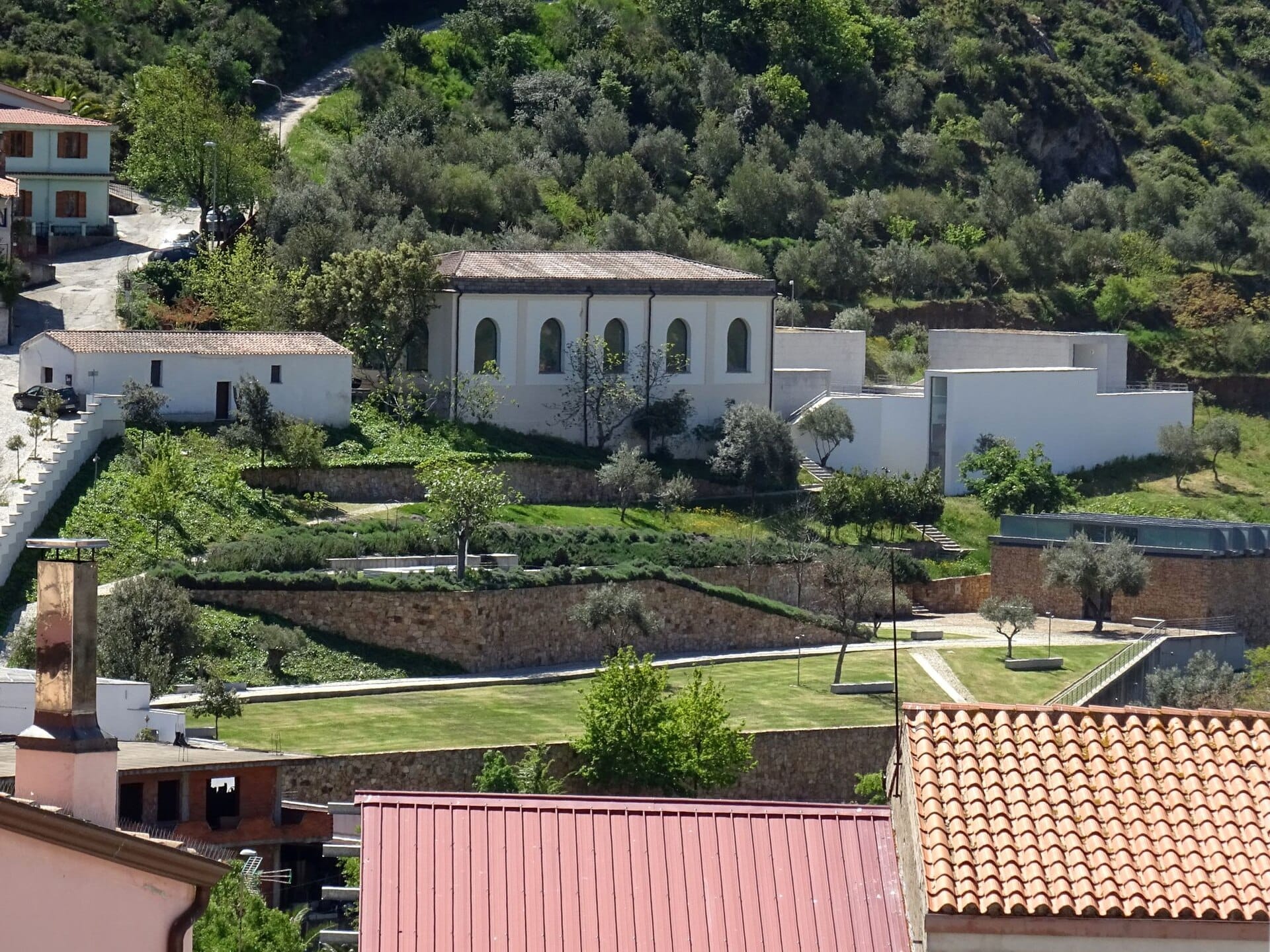
Perched on a panoramic hill above the village of Orani in central Sardinia, Museo Nivola houses a permanent collection of more than 200 sculptures, paintings, and drawings by Costantino Nivola — one of the 20th century's most quietly influential Sardinian artists. Inaugurated in 1995 inside a beautifully restored former village wash house, this is a rare contemporary art museum that feels rooted in its landscape.
Quick Facts
- Location
- Via Gonare 2, Orani (NU), Barbagia, central Sardinia
- Getting There
- Car recommended — Orani is ~20 km southwest of Nuoro via SP 22. No direct public bus service to the museum door; check ARST for Nuoro–Orani connections
- Time Needed
- 1.5 to 2.5 hours for the collection; allow extra time for the village and views
- Cost
- Ticketed entry (check official site for current prices); free for museum members; guided tours +€2 per person in addition to the ticket price for reserved groups of at least 10 people
- Best for
- Art lovers, architecture enthusiasts, Sardinian cultural history, slow travellers
- Official website
- museonivola.it/en
What Is Museo Nivola?
Museo Nivola is a contemporary art museum in the mountain village of Orani, in the Barbagia region of central Sardinia. It is dedicated entirely to the life and work of Costantino Nivola (1911–1988), a sculptor and designer who was born in Orani and went on to become a significant figure in mid-century American and European modernism. The museum holds a permanent collection of more than 200 works: sculptures, paintings, drawings, and design objects that trace an extraordinary arc from Barbagia to the Bauhaus-influenced New York art world.
The building itself is part of the story. The museum was established in 1994 and dedicated in 1995 inside Orani's former communal wash house — a structure that once sat at the social centre of village life. Architects Peter Chermayeff and Umberto Floris oversaw the renovation, preserving the raw stone character of the original while introducing the spatial clarity that a serious art collection demands. The result is a building that commands its hillside setting without shouting about it.
ℹ️ Good to know
The museum is open Monday, Tuesday, Thursday, Friday, Saturday, and Sunday from 10:30–19:30 and closed on Wednesdays; hours apply year-round but can shift for special events — always check the official site at museonivola.it before making the drive.
Costantino Nivola: Who Was He, and Why Does It Matter?
Costantino Nivola grew up in Orani in a family of craftsmen — his father was a mason, and the tactile relationship with stone and surface would define his entire output. He studied in Sassari and then in Monza at the Istituto Superiore per le Industrie Artistiche, before fleeing Fascist Italy in 1938 with his Jewish wife Ruth Guggenheim. They settled in New York, where Nivola befriended Le Corbusier, Alexander Calder, and Hans Scharoun. He pioneered a sand-casting technique for large-scale architectural reliefs that was novel — used most famously in commissions for buildings on the Olivetti campus and for the Harvard Law School.
Despite decades in the United States, Nivola never severed his ties to Sardinia. The terracotta figurines and painted forms in the later sections of the collection carry unmistakable echoes of Nuragic bronzetti and Barbagia's textile traditions. Standing in front of these works inside the old wash house in Orani, the distance between Long Island and central Sardinia seems to collapse. That is the particular emotional charge this museum carries that larger institutions cannot replicate.
If you want deeper context before visiting, the Sardinian Nuragic culture that quietly echoes through Nivola's later work is worth understanding — the visual language of the bronzetti, the recurring circular and animal forms, shows up in his sculptures in ways that reward attention.
Tickets & tours
Hand-picked options from our booking partner. Prices are indicative; availability and final rates are confirmed when you complete your booking.
Cagliari's historic centre tour with National Archaeological Museum
From 66 €Instant confirmationFree cancellationBread Workshop and Visit to the Bread Museum in Orgosolo
From 84 €Instant confirmationFree cancellationAlghero Porto Conte Park Eco-Museum Tickets
From 15 €Instant confirmationFree cancellationBerchidda Wine Museum entrance ticket with wine tasting
From 24 €Instant confirmationFree cancellation
Navigating the Collection: What to Expect Room by Room
The permanent collection is distributed across multiple levels connected by an elevator — an important accessibility feature given the hillside geometry of the building. The ground floor typically introduces Nivola's early works: paintings and graphic pieces from his Italian period, showing the influence of his design education and the Rationalist aesthetic that dominated Italian institutions in the 1930s.
Moving upward, the collection transitions into the sand-casting works and architectural reliefs that made Nivola's name in America. These are physically substantial pieces: textured surfaces that catch light differently depending on the hour and the angle of approach. Morning light entering through the upper windows creates a raking effect across the relief surfaces that is worth planning for — if you arrive close to opening at 10:30, you will find the large sculptures at their most dramatic.
The later galleries focus on the terracotta sculptures and drawings from the 1970s and 1980s, when Nivola increasingly returned to Mediterranean and Sardinian imagery. These smaller, warmer works have an intimacy the earlier architectural commissions lack. The paintings, which are sometimes overlooked in accounts of his career, are among the most accessible entry points for visitors unfamiliar with his sculpture.
💡 Local tip
Guided tours cost an additional €2 per person in addition to the ticket price and must be reserved in advance for groups of at least 10. If you are visiting independently but want interpretation, check the museum website for scheduled guided visits open to individuals — these do run periodically, especially in the warmer months.
The Setting: Orani, the Wash House, and the View
Orani is a compact Barbagia village of around three thousand people, set among oak-covered hills roughly 30 kilometres southwest of Nuoro. The drive in from the main road climbs through classic Sardinian interior landscape: granite outcrops, cork oaks, the occasional shepherd's enclosure. The village itself has the slightly spare character of inland Sardinian settlements — pale stone, narrow lanes, no beachside concession to tourism.
The museum sits on a panoramic hill above the village centre. The position means there are views across the valley that reward a few minutes on the terrace before or after the collection. In summer, this is best done early — by midday the upland heat is serious, and the stone terracing provides little shade. In autumn and spring, the same terrace offers some of the most quietly beautiful viewpoints in Barbagia, with the scrubland turning amber and gold against the granite.
The renovated wash house structure is handsome from the outside: raw stone walls, careful contemporary insertions, none of the clumsy additions that disfigure many repurposed rural buildings in Sardinia. The interior smells faintly of the cool, mineral air particular to old stone buildings — not an unpleasant smell, but a specific one that adds to the sense of being somewhere old that has been given a second purpose.
Orani sits within the broader Barbagia and Nuoro region, which rewards a slower pace and at least one overnight stay rather than a rushed day trip. The region's combination of mountain landscape, traditional culture, and scattered cultural sites makes it distinct from coastal Sardinia.
Getting to Orani: Practical Logistics
A car is the realistic option for most visitors. From Nuoro, the drive takes roughly 30 to 40 minutes on the SP 22, a provincial road that is well-surfaced but demands attention on the curves. Nuoro itself is reachable by ARST bus from several Sardinian cities, and by regional train from Cagliari and Olbia, though connections are infrequent. ARST operates some services between Nuoro and Orani, but the timetable is sparse and the bus stop is not adjacent to the museum — check arst.sardegna.it for current schedules before relying on public transport.
Parking in Orani is not complicated. The village is small, and spaces near the museum are generally available except on the rare occasions when a major event is running. Travelling by car also allows you to combine the museum with other stops in the area without being stranded on a rural timetable.
⚠️ What to skip
Museo Nivola is closed on Wednesdays. This is the single most common mistake that causes wasted journeys. Double-check the day before you plan to visit, especially if your itinerary is tight.
For visitors building a longer Sardinian interior itinerary, the Sardinia road trip guide covers routes that connect Barbagia with the coast and other inland highlights efficiently.
Practical Notes: Strengths, Limitations, and Who Should Think Twice
Museo Nivola is a serious, well-curated institution. The collection is substantial at 200+ works, the building is architecturally distinguished, and the scholarly context provided in the displays is rigorous without being inaccessible. For anyone interested in 20th-century sculpture, modernist design, or the relationship between emigrant identity and artistic production, this is a rewarding visit.
It is not, however, a broad contemporary art museum. The collection is monographic — dedicated entirely to one artist — which means that visitors who are not already curious about Nivola or willing to become so will find the depth less compelling than the breadth. There is no permanent collection of other Sardinian or Italian artists to fall back on if Nivola's work doesn't connect.
The location in Orani also means this is not a casual detour. The journey from the coast takes the better part of a day. For visitors on a one-week beach holiday with a single cultural excursion to allocate, there are more immediately accessible options. For travellers specifically exploring interior Sardinia or building an itinerary around art and culture, the detour is fully justified.
If your trip centres on the Nuoro area, pairing Museo Nivola with a visit to the Museo del Costume in Nuoro and a look at the political murals of Orgosolo makes for a coherent day in Barbagia that covers art, traditional culture, and landscape without redundancy.
Photography and Practical Details
Photography for personal use is generally permitted in the permanent collection, though you should confirm current policy at the desk on arrival — exhibition loans occasionally carry restrictions. The textured surfaces of the sand-cast reliefs photograph exceptionally well in low, raking light. If you arrive at opening time in the morning, the quality of light in the upper galleries is noticeably better than in the afternoon, when the angle flattens. The exterior of the building and the panoramic terrace can be photographed freely at any time.
An elevator provides access between floors, making the permanent collection reachable for visitors with mobility limitations. The museum notes that its full accessibility programme is still being implemented, so it is worth calling ahead (+39 0784 730063) if specific access requirements apply. Companion dogs and small animals are permitted inside — an unusual and welcome policy for a contemporary art institution.
There is no large museum café on site, but Orani's village centre has a bar and a couple of small local restaurants within easy walking distance. Lunch in the village is part of the experience rather than a logistical compromise.
Insider Tips
- Arrive at opening time (10:30) to catch low morning light raking across the sand-cast reliefs in the upper galleries — the texture of these surfaces changes dramatically with the angle of light, and afternoon visits miss the best of it.
- The terrace overlooking the valley is easy to walk past without stopping. Spend five minutes there before entering the collection and again on the way out — the shift in perspective after seeing Nivola's work makes the landscape feel different.
- If you have any interest in contemporary Sardinian art beyond Nivola, ask at the desk about temporary exhibitions. The museum hosts rotating shows that occasionally feature other artists and are not always publicised heavily outside Sardinia.
- The village of Orani itself has a small ethnographic character worth five minutes of slow walking. The streets around the museum are quiet and the stone architecture is well-preserved — it reads as context for understanding where Nivola came from, not just backdrop.
- Museum membership waives entry fees and is available to purchase. If you are spending more than a couple of weeks in Sardinia and plan to return to cultural sites regularly, it is worth considering — the museum is small enough that a second visit to a temporary exhibition makes it worthwhile.
Who Is Museo Nivola (Orani) For?
- Art and design enthusiasts with a specific interest in mid-century modernism and sculpture
- Travellers exploring the Barbagia interior on a road trip rather than a beach itinerary
- Anyone interested in diaspora identity and the relationship between place of origin and artistic production
- Architecture lovers drawn to sensitive adaptive reuse of historic vernacular buildings
- Visitors combining Nuoro's cultural sites into a coherent one-day circuit
Nearby Attractions
Other things to see while in Barbagia & Nuoro:
- Giara di Gesturi
Rising to around 550 metres above central Sardinia, the Giara di Gesturi is a 45-square-kilometre basalt plateau formed by Oligocene volcanic activity. Cork oak forests, seasonal wetlands, and an extraordinary population of small wild horses make it one of the most ecologically singular landscapes on the island.
- Gola di Su Gorropu
Gola di Su Gorropu is a karst canyon in Sardinia's Supramonte massif with walls rising over 500 metres and passages as narrow as 4 metres across. It's a serious hiking destination that rewards physical effort with one of the most dramatic landscapes in the Mediterranean.
- Monte Ortobene
Reaching a maximum elevation of 955 metres above sea level near the inland city of Nuoro, Monte Ortobene is a forested mountain with panoramic views across central Sardinia, a landmark bronze statue of Cristo Redentore, and walking paths through fragrant Mediterranean scrubland. Access is free, the road reaches the summit, and the atmosphere is unlike anything on the coast.
- Murales di Orgosolo
Orgosolo, a small hill town in the Barbagia region of central Sardinia, has covered its streets in around 150 murals since the late 1960s. Free to visit at any hour, the Murales di Orgosolo form one of the most politically charged and visually striking open-air art experiences in Italy.