Museo Evita: Understanding Argentina's Most Mythologized Figure
Housed in a restored early 20th-century townhouse in Palermo, Museo Evita traces the life, politics, and enduring legend of Eva Perón through documents, clothing, personal objects, and archival film. It is one of the few museums in Buenos Aires that provokes genuine reflection rather than passive observation.
Quick Facts
- Location
- Lafinur 2988, Palermo, Buenos Aires
- Getting There
- Subte Line D, Plaza Italia station (approx. 300 m walk)
- Time Needed
- 1.5 to 2 hours
- Cost
- Adult with audioguide: 9,000 ARS (verify current rate); discounts for students, residents, and retirees. Prices change frequently.
- Best for
- History lovers, politics and gender studies enthusiasts, visitors interested in 20th-century Latin American figures
- Official website
- museoevita.org.ar
What Is Museo Evita?
Museo Evita is a museum dedicated entirely to María Eva Duarte de Perón, widely known as Evita, the former First Lady of Argentina who died in 1952 at age 33 and became one of the most contested political figures in 20th-century Latin American history. The museum opened on 26 July 2002, exactly 50 years after her death, and is managed by the Instituto Nacional de Investigaciones Históricas Eva Perón.
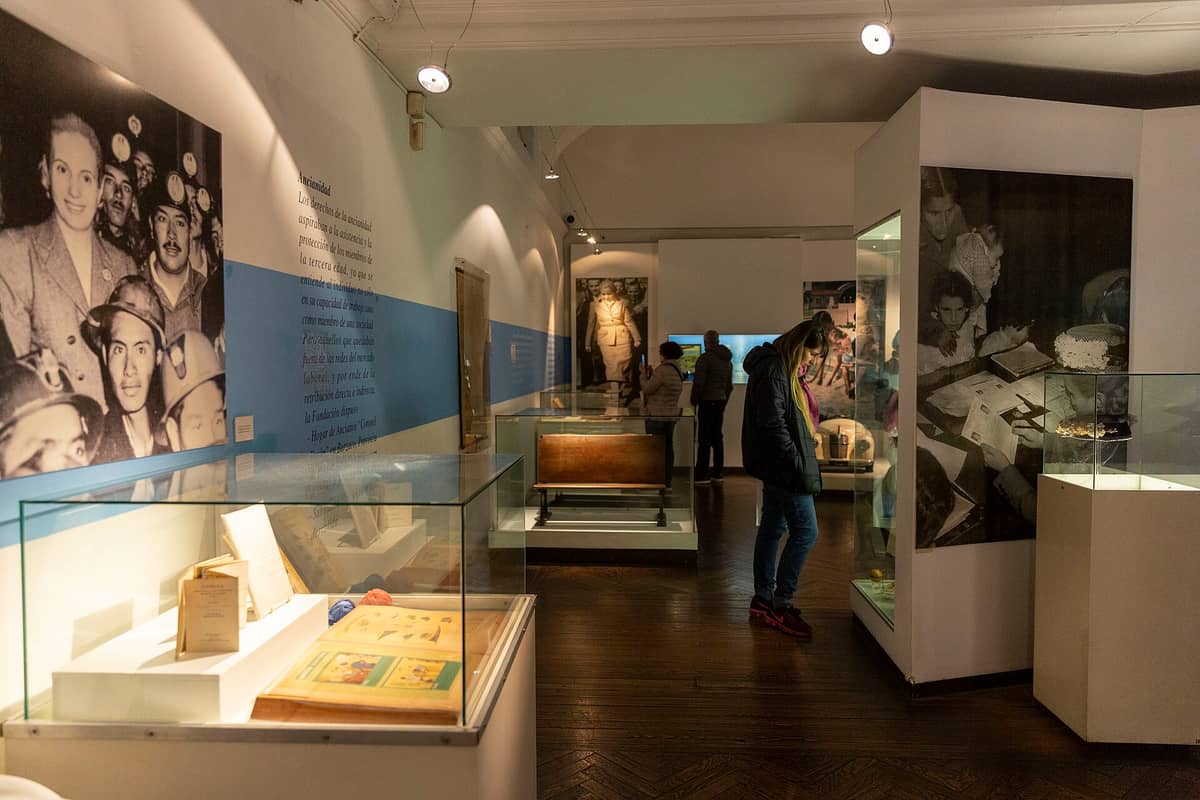
The building itself is part of the story. The museum occupies a petit hotel constructed in the first decade of the 1900s. Before its conversion, the structure had served as a transit home. The three-story townhouse retains much of its original architectural character: parquet floors, high ceilings, wrought-iron railings, and tiled courtyards. Walking through it feels less like a conventional museum and more like entering a private residence where the past has been carefully preserved.
ℹ️ Good to know
Admission prices in Argentine pesos shift frequently due to inflation. The figures cited here were verified in 2024 but should be confirmed at the official website (museoevita.org.ar) or at the door before your visit.
The Collection: What You Actually See
The permanent collection is organized chronologically and thematically across multiple rooms. It opens with Eva's origins in Los Toldos, a small town in Buenos Aires Province, and traces her arrival in the capital as a teenage actress, her relationship with Juan Domingo Perón, her rise to public prominence, and her intensive political and social work during the years of the first Peronist government.
Personal objects anchor the experience throughout. Display cases hold original documents, photographs, correspondence, and campaign materials. One of the most striking sections focuses on her wardrobe: designer suits, gloves, hats, and shoes, some attributed to Christian Dior, are presented with the care you would expect in a fashion archive. These are not replicas. The physical presence of her actual clothing gives the collection a weight that photographs alone cannot.
Archival film footage plays on loop in several rooms. The quality is grainy but the content is arresting: public speeches, state ceremonies, footage of crowds gathered in the Plaza de Mayo. Audio guides are available and are genuinely useful, providing context that wall text alone does not supply. The guide is available in Spanish and English.
The museum does not shy away from presenting Evita's role in expanding women's suffrage in Argentina. The Peronist Women's Party, which she founded, was instrumental in securing voting rights for Argentine women in 1947. That political dimension is covered seriously and in depth, making the museum worth visiting for anyone interested in gender history alongside the broader Peronist narrative. For more context on Evita's legacy throughout the city, the Buenos Aires Evita guide covers related sites you can pair with this visit.
Tickets & tours
Live prices and dates from our booking partner. If you book, we may earn a commission at no extra cost to you.
Evita and the Peronism private tour in Buenos Aires
From 52 €Instant confirmationFree cancellationBoca Juniors Museum skip-the-line tickets
From 17 €Instant confirmationFree cancellationTour to La Boca Jrs and River Plates Stadiums and museums
From 99 €Instant confirmationFree cancellationRiver Stadium and Museum Official Guided Tour
From 33 €Instant confirmationFree cancellation
The Building and Its Atmosphere
Visiting in the morning, particularly on weekdays, means the rooms are quiet enough that you can stand in front of a display case without being jostled. The light entering through the courtyard changes depending on the season. In autumn and spring, the garden at the back of the building, visible from certain windows, takes on a quality that softens the otherwise formal interior. In summer, the rooms can feel warm by midday, though the building's thick walls moderate the temperature somewhat.
The upper floors are accessed by a staircase that is not particularly steep but is narrow. Visitors with significant mobility limitations should contact the museum directly before visiting, as the historic structure has constraints that a purpose-built museum would not. The main floor, however, contains substantial content and can be visited without navigating stairs.
By late afternoon, particularly on weekends, tour groups arrive and the smaller rooms become crowded. The intimacy of the building works against it at peak times: when 20 people stand in a room designed for 6, the spell breaks. Tuesday to Thursday mornings offer a noticeably more contemplative visit.
Opening Hours, Tickets, and Getting There
The museum is open Tuesday to Sunday from 11:00 to 19:00. It is closed on Mondays and on January 1, May 1, and December 24, 25, and 31. Last admission is 30 minutes before closing, so aim to arrive by 18:30 at the latest if you want to move through the collection without rushing.
The address is Lafinur 2988, in the residential section of Palermo closest to Recoleta. The nearest Subte stop is Plaza Italia on Line D, roughly a 300-metre walk west along Avenida Las Heras and then a short turn south. Numerous bus lines run along Avenida Santa Fe and Avenida Las Heras, including routes 10, 12, 29, 36, 55, 60, and 110, among others. A remis or ride-hailing app from central Palermo or Recoleta takes under 10 minutes in normal traffic.
💡 Local tip
If you are using the Subte, exit at Plaza Italia rather than Scalabrini Ortiz. Plaza Italia puts you within easy walking distance and also places you next to the Jardín Botánico and Parque Las Heras, useful if you want to extend the day.
The museum sits within walking distance of several of Palermo's green spaces. Jardín Botánico Carlos Thays is a five-minute walk southeast, and the broader Bosques de Palermo park complex is accessible from the same area. Combining a museum visit with a walk through those gardens makes for a full half-day in the neighborhood.
Historical and Cultural Context
Eva Perón remains a deeply polarizing figure in Argentine memory. To Peronist supporters, she is a saint-like symbol of social justice, a woman who built hospitals, distributed aid through her foundation, and refused to be defined by the class into which she was born. To her critics, she was a symbol of authoritarian populism and state overreach. The museum's curatorial stance leans sympathetic to Evita's legacy, which is worth knowing before you visit. This is not a neutral academic presentation; it is an act of institutional memory with a clear point of view.
That framing does not make the museum less valuable. Understanding how Argentina officially chooses to remember Eva Perón is itself historically significant. The contrast between this museum and the more ambiguous, street-level memory that lingers in Buenos Aires (graffiti, murals, political slogans that invoke her name decades later) gives the city's relationship with its own history a texture you cannot get from reading alone.
For a deeper understanding of how Peronism shaped Buenos Aires's architecture and public spaces, the walk along Avenida de Mayo offers visible evidence of that political era in the city's built environment.
Practical Notes on Photography and the Visit
Photography is generally permitted in the permanent collection without flash. The display cases create reflections, so angling your camera slightly and using natural light from windows rather than flash produces cleaner results. The room containing the wardrobe collection is the most photogenic, with the clothing lit carefully against dark backgrounds.
The museum shop at the ground-floor entrance carries books, posters, and prints related to Evita and Peronism. The quality varies, but there are a few scholarly titles available in Spanish that are difficult to find elsewhere. There is also a small restaurant and café space attached to the museum, useful for a coffee or a light lunch before or after the visit.
Visitors who are unfamiliar with Argentine political history and arrive without any prior context may find some sections harder to interpret. Reading a brief overview of Juan Perón's two presidential terms (1946 to 1955) and Eva's role within that administration before visiting will significantly improve how much you take away from the exhibits.
⚠️ What to skip
The museum is housed in a historic building, and climate control is limited. Summer visits (December to February) can feel warm inside, especially on the upper floors. Visiting during morning hours reduces discomfort and also avoids the larger tour groups that tend to arrive after midday.
Is It Worth Your Time?
For anyone with genuine interest in Argentine history, Latin American political movements of the 20th century, or the intersection of gender and power, Museo Evita justifies its admission cost. The collection is specific and the setting is appropriate to its subject. It is not a large museum by any measure: a thorough visit takes between 90 minutes and two hours. But what is here is curated with care and presented at a level of seriousness that many Buenos Aires museums do not consistently achieve.
Visitors primarily interested in art, architecture, or natural history may find the experience thin. Buenos Aires offers specialist alternatives for all three, and Palermo alone contains the Museo MALBA for modern Latin American art within easy reach. But if your trip includes any interest in how Argentina understands its own recent past, this museum belongs on your list.
Those who find personality cults uncomfortable regardless of political orientation may find the curatorial tone grating. The museum is candid about its admiration for its subject. That is part of what makes it culturally honest, but it is not a detached institution and does not pretend to be.
Insider Tips
- Arrive at opening time (11:00) on a Tuesday or Wednesday for the quietest experience. Weekend afternoons bring organized tour groups that compress the smaller rooms significantly.
- The audioguide is worth the extra cost, especially for visitors without a background in Peronist history. It provides context that wall labels abbreviate. Ask for it at the ticket desk, as it is not always mentioned unless you request it.
- The museum café is a genuinely decent spot for lunch in a neighborhood that gets expensive. The outdoor seating in the courtyard area is pleasant in mild weather and rarely packed mid-week.
- Combine this visit with the Cementerio de la Recoleta (a 15-minute walk), where Eva Perón is buried in the Duarte family vault. The contrast between the interpretive museum and the physical burial site adds another dimension to the day.
- If you want photographs without other visitors in frame, the wardrobe room is best captured in the first 30 minutes after opening, before the rooms fill. Light quality there is also better in the morning.
Who Is Museo Evita For?
- Travelers with an interest in 20th-century Latin American political history
- Visitors researching feminist history and women's political movements in Argentina
- Those who have seen the musical or film adaptations of Evita and want factual grounding
- Couples or solo travelers spending a half-day in Palermo who want substance alongside the neighborhood's parks and cafés
- Students or researchers focused on Peronism, populism, or Argentine cultural memory
Nearby Attractions
Other things to see while in Palermo:
- Bosques de Palermo (Parque Tres de Febrero)
Parque Tres de Febrero, universally known as Bosques de Palermo, is Buenos Aires' most expansive urban park. Spanning roughly 370 hectares of lakes, tree-lined avenues, a famous rose garden, and open lawns, it offers a genuinely different pace from the surrounding city, and it costs nothing to enter.
- Campo Argentino de Polo
Campo Argentino de Polo in Palermo is the spiritual home of world-class polo, hosting the prestigious Argentine Open each November. Whether you're drawn by the sport or simply curious about one of Buenos Aires' most dramatic spectacles, here is everything you need to plan a visit.
- Ecoparque Buenos Aires
Once the city's traditional zoo, the Ecoparque de la Ciudad de Buenos Aires has been gradually transformed since 2017 into an urban conservation and education center. Set across 18 hectares in Palermo, it offers a quieter, more thoughtful alternative to conventional animal attractions, with free entry for Buenos Aires City residents and some categories of visitors and easy access from the Plaza Italia Subte station.
- El Rosedal de Palermo
Tucked inside the sprawling Parque Tres de Febrero, El Rosedal de Palermo is a formal rose garden containing more than 18,000 roses arranged around a central lake. Free to enter and a short walk from Subte Line D's Plaza Italia station, it offers one of the city's most rewarding outdoor experiences, especially during spring and autumn bloom.
Planning a trip? Discover personalized activities with the Nomado app.