Museo delle Maschere Mediterranee: Mamoiada's Window into Carnival Ritual
Housed in the village of Mamoiada in the heart of Barbagia, the Museo delle Maschere Mediterranee (Museum of Mediterranean Masks) explores one of Sardinia's most striking folk traditions through an internationally comparative lens. From the heavy cowbells and blackened faces of the Mamuthones to carnival masks from Greece, Slovenia, and Portugal, this compact ethnographic museum makes a persuasive case that the island's ancient rituals are part of something much larger.
Quick Facts
- Location
- Piazza Europa 15, Mamoiada (NU), Barbagia — approximately 16 km from Nuoro
- Getting There
- By car from Nuoro via SS389 (approx. 20 min). ARST regional buses connect Nuoro to Mamoiada; check current timetables at arst.sardegna.it
- Time Needed
- 60–90 minutes for a thorough visit; 45 minutes at a comfortable pace
- Cost
- Approx. €4–5 full price, €2.60–3 reduced (seniors, school groups). Verify current rates with the museum directly, as prices vary by source.
- Best for
- Anthropology enthusiasts, carnival culture followers, travellers exploring inland Barbagia
- Official website
- www.museomaschere.it
What This Museum Actually Is
The Museo delle Maschere Mediterranee — also known locally as MaMu — is an ethnographic museum dedicated to the masked carnival traditions of Barbagia and their counterparts across the wider Mediterranean world. It sits on Piazza Europa in the centre of Mamoiada, a small village roughly 16 km from Nuoro in the Barbagia di Ollolai subregion of central Sardinia. The building is modest from the outside, which can lead visitors to underestimate what's inside.
The collection organises itself around a core insight: the masked figures that emerge every January in Mamoiada's Mamuthones procession are not a local curiosity but part of a broader Mediterranean and European pattern of winter carnival rites that share deep structural similarities across cultures separated by hundreds of kilometres of sea and mountain. That comparative argument is what lifts this museum above a simple folklore display.
⚠️ What to skip
Check opening hours before you visit. The museum was closed for major refurbishment from May to August 2024. The museum is open Monday, Wednesday to Sunday, 10:00–18:00, and closed Tuesday. Contact the museum directly at info@museomaschere.it or +39 0784 1898135 to confirm current hours.
The Mamuthones and Issohadores: The Heart of the Collection
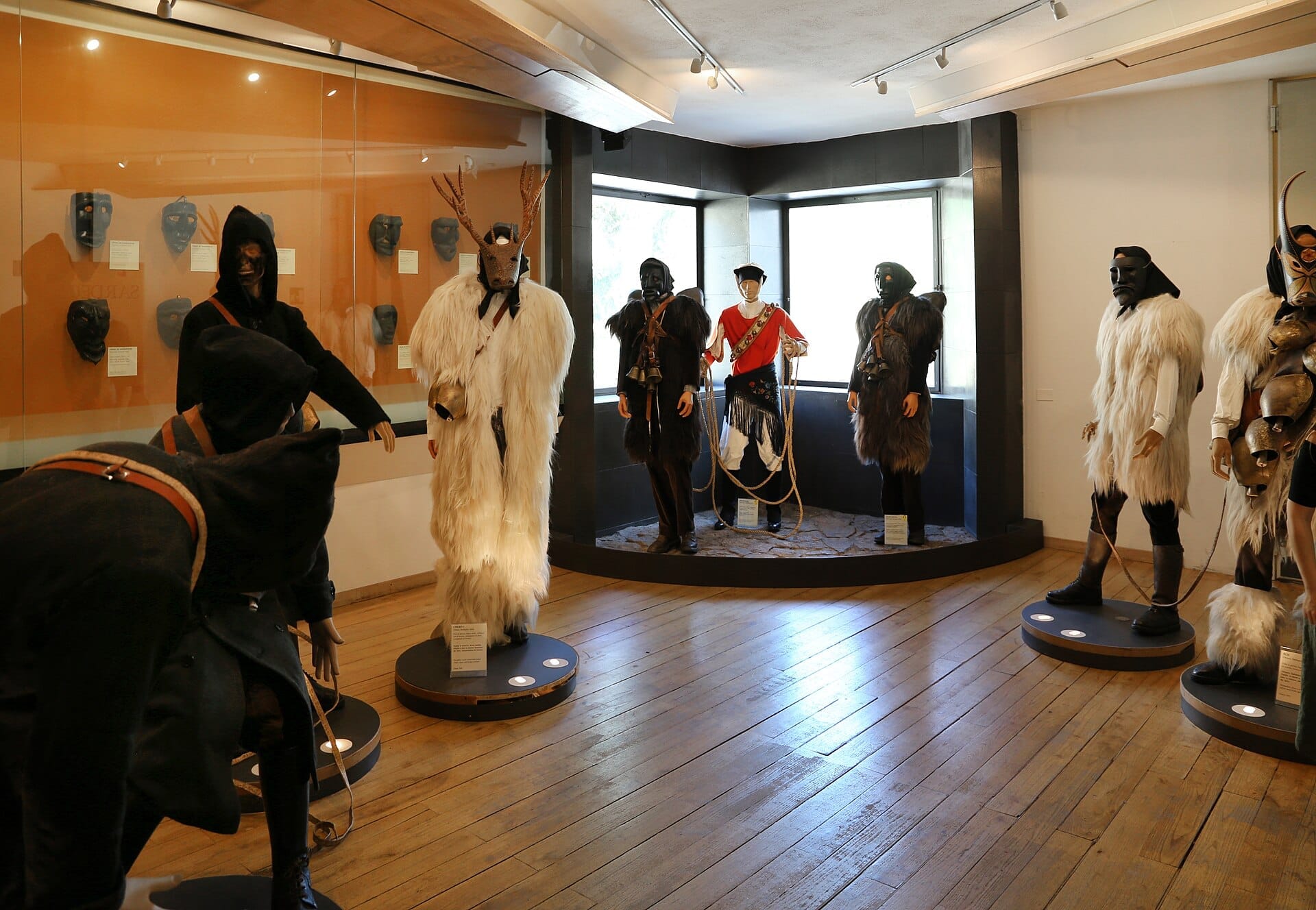
The centrepiece of the museum is the representation of Mamoiada's own carnival figures: the Mamuthones and the Issohadores. The Mamuthones wear dark wooden masks with expressionless, almost mournful faces and carry a cascade of heavy cowbells — the sa carriga — strapped across their backs. The weight can exceed 30 kilograms. During the processions that take place on the last days of January and again during Carnival, these figures move in a synchronised shuffle, lurching forward and back so the bells ring in unison. The sound is difficult to describe in advance: low, rhythmic, almost funerary.
The Issohadores, by contrast, wear white shirts, red waistcoats, and carry a rope (the soha) with which they symbolically lasso spectators. They are the lighter counterpart to the Mamuthones, agile where the others are heavy. The museum presents both sets of costumes at close range, with interpretive text explaining theories about the ritual's origins — theories that remain contested among ethnographers. Some scholars connect the procession to pre-Christian agricultural rites; others are more cautious. The museum handles this uncertainty openly rather than fixing on one romantic explanation.
Tickets & tours
Hand-picked options from our booking partner. Prices are indicative; availability and final rates are confirmed when you complete your booking.
Cagliari's historic centre tour with National Archaeological Museum
From 66 €Instant confirmationFree cancellationSanta Teresa di Gallura hiking tour of Valle della Luna
From 30 €Instant confirmationFree cancellationBread Workshop and Visit to the Bread Museum in Orgosolo
From 84 €Instant confirmationFree cancellationAlghero Porto Conte Park Eco-Museum Tickets
From 15 €Instant confirmationFree cancellation
Ottana, Orotelli, and the Barbagia Carnival Circuit
Mamoiada's figures are the most internationally recognised, but the museum dedicates significant space to neighbouring villages with their own distinct traditions. From Ottana come the Boes (ox-masked figures) and the Merdules (farmer figures), whose masks are carved in a different idiom entirely: rougher, more animalistic, with exaggerated features that read as confrontational rather than mournful. The Filonzana of Ottana is a separate figure, an old woman carrying a distaff and scissors, who threatens to cut the thread of life.
Orotelli contributes the Thurpos, masked figures who wear sheepskin and simulate blindness. Taken together, these three villages form what the museum calls the carnival circuit of Barbagia, and the displays make clear that each village's tradition, while related, has evolved in its own direction. For anyone planning to attend any of these carnivals in person, the museum provides essential context.
The Barbagia and Nuoro region remains one of Sardinia's most culturally distinct areas, and the carnival traditions documented here are inseparable from the landscape and social structure of these inland villages. Understanding the museum's context makes a broader exploration of the region considerably more rewarding.
The Mediterranean Comparison: Masks from Friuli to the Balkans
The second major dimension of the collection moves beyond Sardinia to place these Barbagian traditions within a wider Mediterranean and European frame. The museum holds masks and costumes from Friuli and Alto Adige in northern Italy, from Portugal, Spain, Bulgaria, Greece, Slovenia, and Croatia. The parallels are striking and not superficial: animal-masked figures, bell-laden costumes, rituals that mark the agricultural calendar, and the symbolic inversion of social hierarchies all recur across cultures that had little documented contact with one another.
The quality of the comparative display varies by section. The Balkan material is particularly strong, with well-presented masks from Bulgarian kukeri traditions that share an uncanny visual resemblance to the Mamuthones. The Iberian section is somewhat thinner. But the overall argument holds, and for visitors with any interest in comparative anthropology or religious studies, this section is the most intellectually stimulating part of the museum.
💡 Local tip
If you read Italian, pick up the museum's printed guide rather than relying solely on panel text. It goes into considerably more depth on the scholarly debates around carnival origins and the anthropological literature underpinning the collection.
Visiting in Practice: Layout, Atmosphere, and Timing
The museum is compact enough that it never feels overwhelming. The exhibition rooms flow logically, beginning with the local Barbagia traditions and expanding outward to the Mediterranean comparisons. Lighting is generally good, though some of the older wooden masks are displayed in lower light to preserve them, which can make photography challenging without flash.
Visitor numbers tend to be modest outside of the Carnival period itself (late January and February), which means you can often have rooms largely to yourself on a weekday morning. This is the ideal time to visit if you want to examine the costumes closely and read the interpretive panels without being pressed by crowds. Weekends in summer attract more visitors, particularly Italian families on road trips through the Barbagia interior.
The museum pairs well with a morning in Mamoiada itself, which has a tight stone village centre worth twenty minutes of wandering. For a fuller day in the area, combine it with a visit to Monte Ortobene near Nuoro, or spend time at the Museo del Costume in Nuoro, which approaches Sardinian material culture from a different angle and complements what you see here.
Guided visits are available and are worth arranging if your group has a specific interest in the ethnographic material. The staff can provide significantly more context than the panel text alone, and for non-Italian speakers, a guided visit helps navigate the more nuanced interpretive arguments. Contact the museum in advance to request an English-language guide.
Getting to Mamoiada and Practical Logistics
Mamoiada is most easily reached by car from Nuoro, a drive of roughly 20 minutes along the SS389. Having your own vehicle is the practical default for most visitors, since it also allows you to combine the museum with other Barbagia villages on the same day. ARST regional buses do connect Nuoro with Mamoiada, but schedules are infrequent and should be verified at arst.sardegna.it before you plan around them.
Nuoro itself is accessible by ARST bus from Cagliari (approximately 3 hours) or by regional train. If you are building a wider itinerary around central Sardinia, the Sardinia road trip guide covers the logistics of moving between Barbagia villages efficiently.
Parking in Mamoiada is straightforward: the village is small, and spaces near Piazza Europa are generally available outside peak summer weekends. There are no parking fees to speak of. The square itself is flat and walkable. Accessibility within the museum for visitors with mobility impairments is not explicitly documented in public sources; contact the museum directly at +39 0784 1898135 before visiting if this is a consideration.
Who Will Love This — and Who Will Not
This museum is not a spectacle. If you are looking for interactive displays, multimedia reconstructions, or the kind of immersive experience that larger ethnographic museums in major European cities offer, you will find MaMu relatively straightforward. The collection is genuine and the interpretive ambition is real, but the presentation is essentially traditional: objects in cases, wall text, some photographs.
Visitors who approach it with curiosity about Sardinian culture, or who have any background in anthropology, folklore studies, or comparative religion, will find it unexpectedly rich. Those doing a beach holiday who add it as a quick inland detour may leave feeling it was more niche than they expected. That is not a criticism of the museum; it is a mismatch of expectations. Come here because you are curious about why people in Mamoiada and in Bulgarian villages dress in animal skins and bells at midwinter, and you will not be disappointed.
The museum also connects naturally to Sardinia's wider calendar of festivals and traditions. If your trip timing allows, the Sardinia festivals and events guide explains when and where you can witness the Mamuthones procession in person, which is a very different experience from seeing the costumes in a museum setting.
Insider Tips
- The Mamuthones procession happens in Mamoiada on 17 January (Sant'Antonio Abate) and during the Carnival period in late January or February. Visiting the museum before attending the live procession transforms the experience — you will recognise specific costume details and understand what you are watching in a way casual spectators do not.
- Ask at the ticket desk about the Sistema Musei di Mamoiada: a combined ticket may be available that includes the Casa Museo, a second ethnographic site in the village dedicated to rural domestic life in Barbagia.
- Photography of the masks is generally permitted inside, but low-light conditions in some rooms mean a smartphone alone will struggle. Bring a camera with a reasonable lens if documentation matters to you, and avoid flash near the older organic materials.
- The village bar on Piazza Europa is a reliable stop for coffee and sometimes serves traditional Barbagian pastries. It is where locals actually eat, not a tourist operation, and prices reflect that.
- If you arrive and find the museum unexpectedly closed (renovation work and irregular hours have been an issue), the village itself rewards a short walk. The street facades and the stone construction of Mamoiada's centre are characteristic of Barbagia architecture and worth seeing regardless.
Who Is Museo delle Maschere Mediterranee For?
- Travellers with a genuine interest in Mediterranean anthropology, folklore, or comparative ritual traditions
- Anyone attending the Mamoiada Carnival who wants to understand the context before the procession
- Cultural travellers building an itinerary around inland Barbagia rather than the coast
- Families with older children (12+) who are curious about how different cultures mark the seasons
- Photographers interested in the visual texture of ceremonial objects and traditional costume
Nearby Attractions
Other things to see while in Barbagia & Nuoro:
- Giara di Gesturi
Rising to around 550 metres above central Sardinia, the Giara di Gesturi is a 45-square-kilometre basalt plateau formed by Oligocene volcanic activity. Cork oak forests, seasonal wetlands, and an extraordinary population of small wild horses make it one of the most ecologically singular landscapes on the island.
- Gola di Su Gorropu
Gola di Su Gorropu is a karst canyon in Sardinia's Supramonte massif with walls rising over 500 metres and passages as narrow as 4 metres across. It's a serious hiking destination that rewards physical effort with one of the most dramatic landscapes in the Mediterranean.
- Monte Ortobene
Reaching a maximum elevation of 955 metres above sea level near the inland city of Nuoro, Monte Ortobene is a forested mountain with panoramic views across central Sardinia, a landmark bronze statue of Cristo Redentore, and walking paths through fragrant Mediterranean scrubland. Access is free, the road reaches the summit, and the atmosphere is unlike anything on the coast.
- Murales di Orgosolo
Orgosolo, a small hill town in the Barbagia region of central Sardinia, has covered its streets in around 150 murals since the late 1960s. Free to visit at any hour, the Murales di Orgosolo form one of the most politically charged and visually striking open-air art experiences in Italy.