Muralha Fernandina: Walking Porto's Medieval City Walls
Built between 1368 and 1437 under King Fernando I, the Muralha Fernandina once encircled much of Porto in roughly 2.5 kilometres of battlements and watchtowers. Today, two surviving stretches above the Ribeira quarter offer free access to some of the most atmospheric medieval stonework in northern Portugal, with Douro river views that no postcard quite captures.
Quick Facts
- Location
- Rua de Arnaldo Gama 80 (Trecho dos Guindais), Porto
- Getting There
- Guindais Funicular; on foot from Ribeira quay via Escadas do Caminho Novo
- Time Needed
- 45–90 minutes for both surviving stretches
- Cost
- Free (no ticket required)
- Best for
- History enthusiasts, photographers, walkers who want Douro views without the crowds
- Official website
- visitporto.travel/en-GB/poi/5cd04b4ef979e00001fe4826
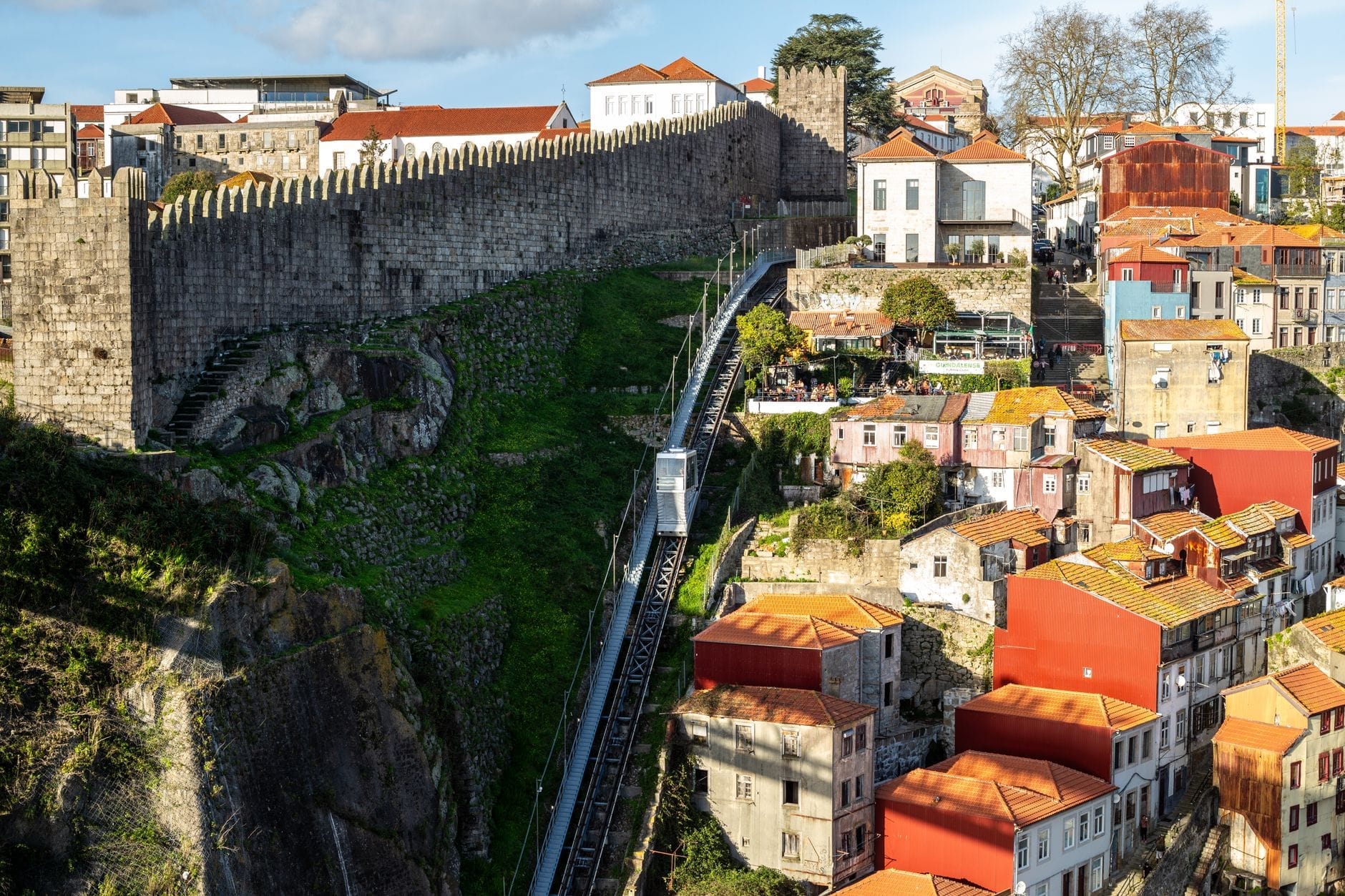
What the Muralha Fernandina Actually Is
The Muralha Fernandina is Porto's second ring of medieval defensive walls, ordered by King Fernando I to replace an earlier circuit that had grown too small for the expanding city. Construction ran from 1368 to 1437, funded in part by a tax on wine transfers, which feels fitting for a city whose commercial identity has always been tied to the Douro. At its peak, the wall stretched roughly 2.5 to 3 kilometres around the city, standing approximately 9 to 10 metres high and reinforced with battlements, bastions, turrets, and rectangular watchtowers.
Almost all of it was demolished as Porto expanded beyond its medieval boundaries in the 18th and 19th centuries. What remains today are two distinct stretches: the Trecho dos Guindais, near Rua de Arnaldo Gama, and the Trecho do Caminho Novo, accessible via the Escadas do Caminho Novo stairway. Both sit above the Ribeira quarter, clinging to the steep granite escarpment that drops toward the Douro. This is not a reconstructed heritage site with information panels every few metres. These are raw, weathered walls, mossy in winter and sun-bleached in summer, that have simply survived.
ℹ️ Good to know
The Trecho dos Guindais is managed as a municipal facility with listed opening hours of Monday to Friday, 08:30–17:30. Hours have changed before due to renovation works — check locally before making a specific trip.
The Two Surviving Stretches: What to Expect
Trecho dos Guindais
This is the longer and more visited of the two sections, running along the clifftop above the Guindais Funicular. The funicular itself descends about 61 metres from the Batalha area down to the Ribeira quay beside the Dom Luís I Bridge, and the upper station sits near this stretch of wall. If you ride the funicular up, you step off and find yourself at eye level with battlements that are six centuries old.
Walking along the top of the Guindais stretch, the Douro opens up below you to the south, with Vila Nova de Gaia and its port wine lodge rooftops visible across the water. The wall itself is rough-textured granite, darkened in places where water seeps through over winter. In the morning, when the light comes from the east, the stone takes on a warm amber tone. By midday the same surface looks grey and flat. Photographers should note that early morning or late afternoon gives the wall its best texture.
Trecho do Caminho Novo
The Caminho Novo section is accessed from the bottom of the Escadas do Caminho Novo stairway, a steep cobbled climb from the Ribeira waterfront. This stretch is shorter but arguably more dramatic in isolation: you encounter segments of wall rising from the hillside amid older residential buildings, some of which are built directly against the medieval masonry. It feels less curated and more integrated into the working texture of the neighbourhood.
⚠️ What to skip
Both stretches involve steep steps, uneven cobblestones, and significant gradients. The Escadas do Caminho Novo in particular is not suitable for wheelchairs or visitors with significant mobility difficulties. Wear shoes with grip, especially after rain when the stone surfaces become slippery.
Tickets & tours
Hand-picked options from our booking partner. Prices are indicative; availability and final rates are confirmed when you complete your booking.
Serralves All-Access Pass
From 24 €Instant confirmationFree cancellationSantiago de Compostela Full-Day Tour
From 79 €Instant confirmationFree cancellationPeneda Geres park full-day tour from Porto
From 100 €Instant confirmationFree cancellationPorto historical center and the best viewpoints on a tuk-tuk
From 39 €Instant confirmationFree cancellation
How the Experience Changes by Time of Day
Early morning, before 09:00, is the best time to visit if you want the walls largely to yourself. The Ribeira quarter below is still quiet, the river light is soft, and you can hear the city waking up rather than performing for tourists. There is a particular stillness to the Guindais stretch at this hour: a smell of damp stone and, on some mornings, woodsmoke drifting up from the lower streets.
By midmorning, tour groups begin arriving at the Ribeira and some make their way up toward the walls, but crowds never reach the levels you find at, say, the Livraria Lello or the Clérigos Tower. The walls attract a different type of visitor: people who already know Porto reasonably well, or travellers who have done some research. First-time visitors often skip them entirely, which is their loss and your advantage.
At sunset, the Guindais stretch offers views across the Douro that rival any of the city's formal miradouros. The light drops behind the city to the west, and the silhouette of the Dom Luís I Bridge catches it from the south. It is not a secret, and you will share the moment with other people, but it remains far less crowded than the Miradouro da Vitória or the gardens above Gaia.
Historical Context: Why Porto Built These Walls
Porto's earlier defensive wall, the Romanesque circuit, had been adequate for a smaller medieval settlement but was overwhelmed by the city's commercial expansion through the 13th and 14th centuries. King Fernando I commissioned the new ring to bring Porto's growing suburbs within a proper fortified perimeter, creating a wall that was as much a statement of civic ambition as a military necessity.
The wine tax that partly funded construction is worth noting. Porto's economy in this period was already organised around trade through the Douro corridor, and the merchant class that paid the tax understood that a defensible city was a commercially viable one. The wall's financing tells you something about the relationship between commerce and governance that still defines how Porto thinks about itself.
The Fernandine Walls sit within Porto's UNESCO-listed historic centre, the same designation that covers the São Bento Railway Station, the Ribeira waterfront, and the broader collection of medieval and baroque architecture that makes this part of the city exceptional. The walls are not a standalone monument but part of a layered urban landscape that rewards slow exploration. A well-planned Porto walking tour will often thread through both surviving stretches as part of a broader circuit of the historic centre.
Getting There: Practical Walkthrough
The most straightforward approach to the Trecho dos Guindais is the Guindais Funicular, which runs from the Ribeira quay near the foot of the Dom Luís I Bridge up to the Batalha neighbourhood. The upper station drops you almost directly beside the wall. Note that the funicular charges a separate fare from regular bus or metro tickets; check current prices on the STCP network before your visit.
If you prefer to walk, the Escadas do Caminho Novo is the traditional pedestrian route from the Cais da Ribeira up to the walls. It is a direct but demanding climb of around 100 steep stone steps, passing tiled house facades and small shrines tucked into alcoves. Most reasonably fit visitors manage it without difficulty, but it is not a casual stroll. Allow around 10 minutes from the riverfront to reach the Caminho Novo section of the wall.
From the city centre, the walls are also walkable in 15 to 20 minutes from Avenida dos Aliados, heading south and downhill through the Batalha area. Public buses serve the Batalha square, which functions as a transit hub connecting the upper city with the riverside neighbourhood.
Photography, Weather, and What to Bring
The walls photograph best in low-angle light, morning or late afternoon. At noon in summer, the contrast is harsh and the stone surface loses its detail. A wide-angle lens captures the full height of the battlements against the sky, while a short telephoto compresses the layers of Gaia's rooftops visible across the river from the Guindais stretch.
Porto's wet season runs from roughly November through February, and visiting the walls after rain is a genuinely different experience: the granite darkens, water trickles through the ancient mortar, and the moss on the lower courses of stone turns vivid green. It is atmospheric but slippery. Bring waterproof shoes if you are visiting in winter, and check whether the Guindais section is open — it has been closed temporarily in the past due to maintenance and safety concerns.
There are no facilities at the walls themselves: no café, no toilets, no luggage storage. Use the Ribeira waterfront's cafés and restaurants before or after your visit. Water and comfortable walking shoes are the only essentials.
Who Should Skip the Muralha Fernandina
If you are visiting Porto for the first time with only a day or two and want to cover the headline attractions efficiently, the walls may not make the cut. They require physical effort to reach, they have limited interpretive signage, and what survives is fragmentary rather than a complete circuit. Visitors who want polished, well-explained heritage experiences will be better served by the Palácio da Bolsa, the Igreja de São Francisco, or the city's excellent museums.
Visitors with mobility difficulties should note that the main access routes, both the Escadas do Caminho Novo stairs and the Guindais clifftop path, are not wheelchair accessible. The terrain is medieval in every sense. If physical access is a concern, the views across the Ribeira from the Dom Luís I Bridge offer a good view of the wall's cliff-face location without the climb.
Insider Tips
- Visit the Guindais stretch on a weekday morning before 09:30. The opening hour of 08:30 means you can often have the entire battlements to yourself for the first hour, with direct views across the Douro before tour groups begin moving through the Ribeira below.
- Combine both surviving sections in a single loop: take the Guindais Funicular up to visit the Trecho dos Guindais, then descend via Escadas do Caminho Novo to see the Trecho do Caminho Novo, and finish at the Ribeira waterfront. The whole circuit takes under two hours at a relaxed pace.
- The wall's granite changes colour dramatically with weather. If you visit during or just after rain, the stone takes on deep charcoal and green tones that are far more photogenic than the bleached summer surfaces. Winter visits, while cold, can produce striking shots.
- The upper section of the Guindais stretch connects naturally to the Batalha neighbourhood, one of Porto's less-touristed central areas. After visiting the walls, walk five minutes north to Campo 24 de Agosto, a genuine local square with cafés frequented almost entirely by residents rather than tourists.
- Check the official Visit Porto listing before your visit if you plan specifically around the Guindais section. The stretch has been closed before due to conservation works, and access can change during maintenance periods. A quick check saves a wasted journey.
Who Is Muralha Fernandina (Medieval City Walls) For?
- History and architecture enthusiasts who want to connect Porto's medieval past to its present urban form
- Photographers looking for textured stone, Douro river views, and low-crowd conditions
- Return visitors who have already done Porto's main attractions and want to go deeper
- Walkers who enjoy combining physical effort with historical discovery on a self-guided circuit
- Travellers who appreciate free, unmediated access to genuine heritage rather than ticketed museum experiences
Nearby Attractions
Other things to see while in Ribeira:
- Cais da Ribeira
Cais da Ribeira is Porto's historic riverside promenade along the north bank of the Douro, part of the UNESCO World Heritage-listed centre. Free to walk, lined with colourful buildings and boat tour kiosks, it is one of Portugal's most recognisable urban waterfronts.
- Casa do Infante
Casa do Infante stands on Rua da Alfândega in the heart of Porto's Ribeira district, occupying a site that has been central to the city's life since the Roman period. Built as a royal customs house in 1325 and later named for Prince Henry the Navigator, traditionally regarded as having been born here in 1394, it now operates as a unit of the Museu do Porto, housing archaeological remains and centuries of civic records beneath one roof.
- Dom Luís I Bridge
The Ponte Dom Luís I is a double-deck iron arch bridge spanning the Douro River between Porto's Ribeira quarter and Vila Nova de Gaia. Open 24 hours a day and free to cross on foot, it rewards visitors with sweeping river views from both its road-level walkway and its elevated metro deck, 45 metres above the water.
- Douro River Cruise
A Douro River cruise transforms Porto's skyline into a living panorama of medieval towers, port wine lodges, and six iron bridges. Whether you take a 50-minute sightseeing loop or a multi-day voyage into the Alto Douro Wine Region, the river gives you a perspective on Porto and its surroundings that no viewpoint on land can match.