Murales di San Sperate: Walking Through Sardinia's Living Open-Air Museum
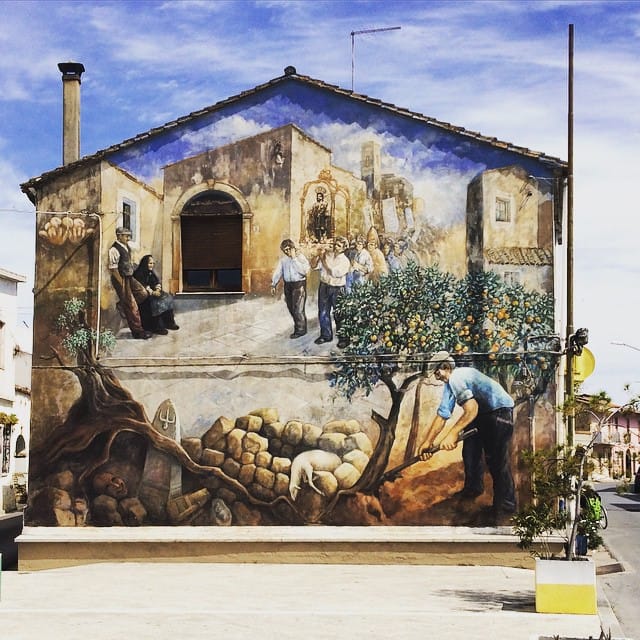
San Sperate, a quiet agricultural town roughly 20 kilometres from Cagliari, has transformed its streets into one of the most concentrated open-air mural collections in Italy. With over 400 works painted across whitewashed walls since 1966, the so-called paese-museo is a free, self-guided experience that rewards curious wanderers willing to leave the coast behind for a few hours.
Quick Facts
- Location
- San Sperate, Sud Sardegna (approx. 20 km northwest of Cagliari)
- Getting There
- ARST buses 111/112 from Cagliari Piazza Matteotti (~30 min); by car via SS 131 then SP 4 (~25-30 min)
- Time Needed
- 1.5 to 3 hours for a thorough self-guided walk
- Cost
- Free (open-air murals); separate tickets apply for the Parco Sonoro di Pinuccio Sciola
- Best for
- Art lovers, day-trippers from Cagliari, cultural travellers, photographers
- Official website
- idese.cultura.gov.it/en/place/murales-di-san-sperate
What Is San Sperate, and Why Does It Matter?
San Sperate is a modest farming town of a few thousand residents, surrounded by citrus groves and flat agricultural land in the Campidano plain. For most of its history it was known for its saffron cultivation and its ceramic tradition. Then, in 1968, a young sculptor from the town named Pinuccio Sciola began painting murals on its walls, inviting other artists to do the same. In that same year, San Sperate acquired the designation paese-museo, meaning country-museum or village-museum, a label that has stuck ever since.
What Sciola started was not purely decorative. The early murals carried explicit social commentary: agricultural exploitation, Sardinian poverty, land reform, and the island's fraught relationship with mainland Italy were all recurring subjects. Over the following decades, the project expanded to include artists from across Sardinia and beyond, and the tone diversified. Today the Murales di San Sperate number over 400 works, ranging from politically charged figurative scenes to abstract compositions, folklore imagery, and portraits of ordinary village life.
This is a rare thing: a living art project embedded in a working community, not a museum constructed around art for tourists. San Sperate's residents still live beside the murals, hang laundry nearby, and park their cars in front of them. That ordinariness is part of what makes the place interesting. For context on how this fits into wider Sardinian culture, see the things to do in Sardinia guide.
The Experience: Walking the Streets
There is no single entrance, no ticketing booth, and no enforced route. You simply arrive in San Sperate and start walking. The murals are distributed across the old town centre, appearing on house facades, courtyard walls, narrow alley passages, and the sides of agricultural outbuildings. Some are large-scale, covering entire building sides in bold colour. Others are tucked into doorway alcoves or wrapped around corner walls at eye level, close enough to see every brushstroke.
The streets are narrow and largely unshaded. Bring water in summer. The paving is a mix of tarmac and uneven stone, and some of the most interesting murals sit at the end of small lanes that require a little exploratory wandering to find. That is actually the point: San Sperate rewards people who slow down rather than those ticking through a checklist. You will turn a corner expecting nothing and find a floor-to-ceiling panoramic work on a wall that gets almost no foot traffic.
💡 Local tip
Pick up a free map from the Pro Loco tourist office in the town centre if it is open when you visit. It marks the main murals with approximate locations. If the office is closed, the town is compact enough that you will naturally cover most of the centre on foot within two hours.
Thematically, you can trace distinct eras in the collection. The oldest murals from the 1960s and 1970s carry a rawness and political urgency that reflects the post-war social movements in Sardinia. Later works from the 1980s and 1990s show a shift toward cultural pride and folkloric imagery: traditional Sardinian costumes, nuragic motifs, and scenes of pastoral life. More recent additions experiment with abstraction and international street art conventions, making the whole collection read almost like a visual timeline of Italian and Sardinian public art.
Tickets & tours
Hand-picked options from our booking partner. Prices are indicative; availability and final rates are confirmed when you complete your booking.
Guided tour to San Sperate from Cagliari
From 84 €Instant confirmationFree cancellationVineyard Guided Tour and 7 Wine Tasting in Palau
From 84 €Instant confirmationFree cancellationFull-Day Sailboat Tour in La Maddalena Archipelago from Cannigione
From 112 €Instant confirmationFree cancellationHiking excursion to the Devil's Saddle
From 35 €Instant confirmationFree cancellation
Pinuccio Sciola and the Sound Garden
You cannot understand the murals without understanding Pinuccio Sciola (1942-2016), the sculptor who started everything. Born in San Sperate, Sciola studied art in Cagliari, Florence, and eventually worked internationally, but always returned to his home village. He did not simply organise the mural project; he was its philosophical engine, arguing that art should belong to the community that lives with it, not to institutions behind walls.
Sciola is also internationally known for his Pietre Sonore, or Sounding Stones: large basalt and limestone sculptures incised with precise cuts that produce musical tones when touched. Several of his stone sculptures are installed throughout the town, and his studio and garden, now operating as the Parco Sonoro di Pinuccio Sciola, is a separately administered site with its own opening hours and entrance fee. If you are visiting San Sperate, the Parco Sonoro is worth the extra stop. Running your hand along a two-metre block of basalt and hearing it resonate like a bass note is unexpectedly moving.
ℹ️ Good to know
The Parco Sonoro di Pinuccio Sciola is a distinct venue from the open-air murals. It has its own ticket price and seasonal opening hours. Check current availability before your visit, as hours vary by season.
Best Time to Visit and How the Experience Changes
San Sperate can be visited year-round, but the time of day and season affect the experience significantly. Morning light between 8 and 10 is ideal for photography: the sun hits the walls at a low angle, picking out texture and depth in the painted surfaces, and the streets are almost entirely empty. By mid-morning, residents are moving around, adding the kind of lived-in atmosphere that makes the place feel genuine rather than preserved.
Midday in July and August should be approached with caution. The Campidano plain traps heat, and San Sperate's narrow streets offer limited shade. Temperatures regularly reach 35-38 degrees Celsius in peak summer. If you visit in high season, aim for early morning or late afternoon. From September through November and from April through June, the weather is ideal: warm, mostly dry, and comfortable for extended walking.
Winter visits (December to February) are quiet but entirely feasible. The murals do not close. The light is softer, the village more subdued, and you will almost certainly have long stretches of streets entirely to yourself. Colours look different under flat winter light, and some of the more sombre, politically themed works feel more resonant in that quieter atmosphere.
⚠️ What to skip
San Sperate is not a tourist resort town. Cafes and restaurants are few and may close early or on certain days. Bring snacks and water, especially outside peak season. Do not assume shops will be open at Italian urban hours.
Getting There from Cagliari
San Sperate sits about 25 kilometres northwest of Cagliari, making it a straightforward half-day trip from the city. By car, take the SS 131 towards Sassari, exit at the Sestu roundabout at approximately kilometre 12, then follow the SP 4 for about 7 kilometres into San Sperate. The drive takes roughly 25 to 30 minutes from central Cagliari.
By public transport, ARST buses on lines 111 and 112 depart from Piazza Matteotti in Cagliari and reach San Sperate in around 30 minutes. Bus frequency varies by time of day and season, so check the ARST timetable before you go. The bus is a practical option that avoids parking in the narrow village streets, which can be fiddly for drivers unfamiliar with the layout.
San Sperate pairs naturally with other sites in the Cagliari hinterland. If you are planning a full day out of the city, consider combining it with a visit to the Su Nuraxi di Barumini, the UNESCO-listed nuragic complex about 50 kilometres further north, or pairing it with a morning at one of the coastal sites south of Cagliari before heading inland in the afternoon.
Photography Practical Notes
San Sperate is among the more photogenic towns in inland Sardinia, but shooting it well requires some planning. The murals sit on walls of varying colours and textures, some painted on smooth render, others on rough stone or old plaster. The contrast can be extreme, so shooting in RAW format gives you more latitude in post-processing.
Wide lenses (between 24mm and 35mm equivalent) work better than telephotos in most situations because the streets are narrow and you often cannot step back far enough to frame a full mural with anything longer. A 50mm equivalent is useful for detail shots and for pulling out individual figures from larger compositions.
The best single-image opportunities tend to appear in the oldest part of the village, where the mural density is highest and the architecture most characterful. Several murals have been painted on walls that frame views down long, tapering lanes, giving a kind of layered depth that can look striking with a relatively wide field of view.
Honest Assessment: Who Will Love This and Who Might Not
San Sperate is not a polished attraction. There is no audio guide, no interpretation panels beside each mural (in most cases), and no obvious visitor infrastructure beyond the occasional signpost. Travellers who need structure, who prefer guided experiences with context delivered to them, or who have very limited time in Sardinia may find the experience frustrating relative to the travel time from Cagliari. It is also not a beach, a dramatic coastal viewpoint, or a UNESCO site of international renown. If your Sardinian itinerary is already full and you are debating whether to include it, be realistic about your appetite for inland cultural exploration versus time at places like Poetto beach or the Castello district in Cagliari.
That said, for travellers with real curiosity about Sardinian culture beyond the coastline, San Sperate offers something almost no other site on the island can: a living record of political and artistic history painted directly onto the walls of the community that made it. It is slow, unpretentious, and free. Those are not small things.
Insider Tips
- The densest concentration of early, politically themed murals is in the oldest streets near the town church. Start there before walking outward to find the more contemporary works on peripheral streets.
- The Parco Sonoro di Pinuccio Sciola operates independently with seasonal hours. If it is a priority, contact them or check their current schedule before building your trip around it.
- ARST bus schedules on weekends and holidays differ significantly from weekday timetables. If you plan a Sunday visit by bus, check return times carefully before you leave Cagliari.
- Some of the most surprising murals are on private courtyard gates and inner walls visible through open archways. Walking slowly and looking through doorways rather than just ahead of you substantially increases what you find.
- San Sperate has a small but authentic local bar scene near the central piazza. A mid-morning coffee stop there puts you in contact with the actual rhythm of the town and is worth doing even if you are not thirsty.
Who Is Murales di San Sperate For?
- Art and street art enthusiasts who want depth over spectacle
- Day-trippers from Cagliari looking for something beyond city sightseeing
- Photographers seeking light, texture, and quiet streets without tourist crowds
- Travellers interested in Sardinian social and political history
- Families with older children who are curious about how communities use public art
Nearby Attractions
Other things to see while in Cagliari:
- Anfiteatro Romano di Cagliari
The Roman Amphitheatre of Cagliari is the most significant Roman monument in Sardinia, partially carved into the limestone hillside of Colle di Buoncammino. With a capacity estimated at 10,000 spectators, it dates to the late 1st or early 2nd century AD. Ongoing restoration limits what you can explore, but the scale of the structure and its setting repay the modest entrance fee.
- Bastione di Saint Remy
Standing at the southern edge of the Castello district, the Bastione di Saint Remy is a monumental Belle Époque terrace that offers some of the most commanding views in Cagliari. Free to enter and, as a public terrace, generally accessible at all hours, it rewards visitors who time their ascent right — especially at dusk, when the city lights begin to compete with the last colour in the sky.
- Castello District
Perched about 100 metres above sea level on a fortified limestone hill, the Quartiere Castello is the oldest and most historically layered part of Sardinia's capital. Enclosed by 13th-century Pisan walls, it holds the city's cathedral, major museums, and some of the best rooftop views in the Mediterranean. Entry is free, and the streets can be walked at any hour.
- Cattedrale di Santa Maria (Cagliari)
Rising above the Castello quarter on Piazza Palazzo, the Cattedrale di Santa Maria e Santa Cecilia is Cagliari's most important religious monument. First documented in the mid‑13th century and remodelled across several centuries, it layers Pisan Romanesque, Gothic, Baroque, and Neo-Romanesque styles into a single compelling structure. Entry is free, and the interior rewards anyone willing to look closely.