Mozarthaus Vienna: Inside the House Where Mozart Wrote The Marriage of Figaro
Mozarthaus Vienna, at Domgasse 5 in the historic Innere Stadt, is the only surviving apartment where Wolfgang Amadeus Mozart lived in Vienna. It was here, between 1784 and 1787, that he composed some of his most celebrated works. The three-floor museum opened on the 250th anniversary of his birth and gives visitors a rare, grounded encounter with the composer's actual domestic world.
Quick Facts
- Location
- Domgasse 5, 1010 Vienna (Innere Stadt, 1st District)
- Getting There
- U1 or U3 to Stephansplatz; Bus 3A to Stephansplatz
- Time Needed
- 1 to 1.5 hours
- Cost
- Adults €12, Reduced €10, Children (under 19) €4.50, Family €25. Audioguide included. Verify on official site.
- Best for
- Classical music lovers, history enthusiasts, first-time Vienna visitors
- Official website
- www.mozarthausvienna.at
What Mozarthaus Vienna Actually Is
Mozarthaus Vienna is not a reconstructed stage set or a theatrical tribute. It is the real apartment building at Domgasse 5, just a short walk behind St. Stephen's Cathedral, where Mozart rented rooms from 1784 to 1787. Of the many addresses Mozart cycled through during his decade in Vienna, this is the only one still standing. That fact alone gives it a weight that no purpose-built museum can manufacture.
The museum opened on 27 January 2006, the 250th anniversary of Mozart's birth, and spreads across three floors of the building. The actual apartment Mozart occupied is on the first floor, and it forms the emotional core of the visit. The upper floors contextualize his life in Vienna through exhibitions on his social world, his patrons, Freemasonry, and the musical culture of late 18th-century Austria. The combination works better than you might expect: by the time you descend to the apartment itself, you understand the city he moved through, not just the rooms he slept in.
ℹ️ Good to know
Admission includes an audioguide in multiple languages. Pick it up at the entrance before you go upstairs — the commentary adds real depth to the upper-floor exhibitions that can otherwise feel like display cases without context.
The Apartment: What You See and Feel on the First Floor
Mozart's first-floor apartment is the largest he ever rented in Vienna, which tells you something about where he was in his career during these three years. His finances were relatively stable, his reputation was near its peak, and he had the space and confidence to work on ambitious projects. It was here that he completed Le nozze di Figaro (The Marriage of Figaro) in 1786, one of the most structurally intricate operas ever written.
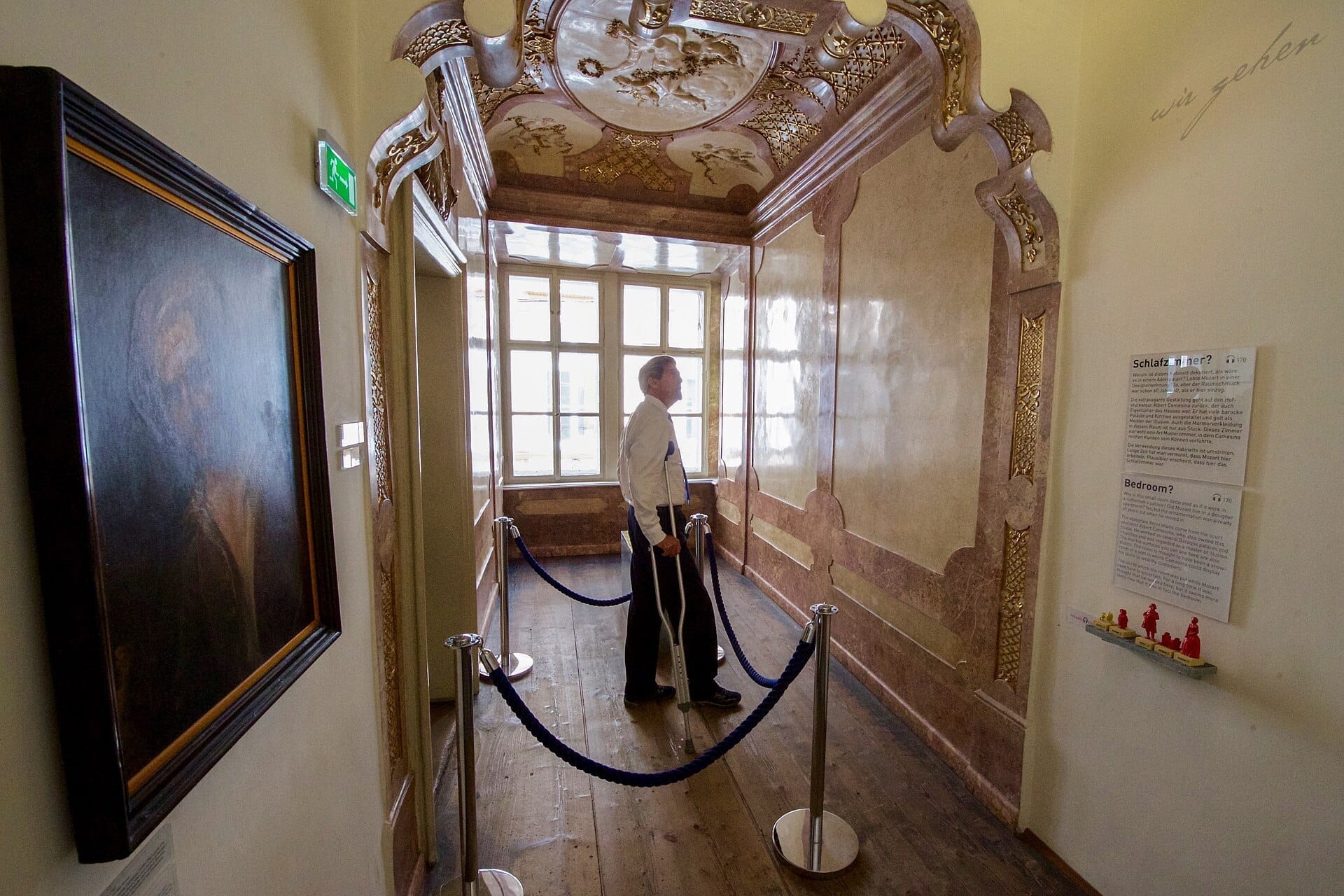
The rooms are not heavily furnished — there is no attempt to crowd in period furniture and call it a recreation. Instead, the space is interpreted through text, original documents, and some artifacts, while the architecture itself is allowed to breathe. The ceilings are high, the windows look onto a quiet courtyard, and in the mornings, when the museum first opens, the light comes in at a low angle that makes the plaster walls look almost warm. It is one of those rare moments in Vienna where you can stand in a genuinely old room without a crowd pressing in behind you.
The building itself is a well-preserved example of a Viennese Baroque residential structure from the mid-18th century. The staircase, courtyard, and proportions of the rooms all survive largely intact, which matters enormously when you are trying to understand how Mozart actually lived, not how posterity wants to imagine he lived.
Tickets & tours
Hand-picked options from our booking partner. Prices are indicative; availability and final rates are confirmed when you complete your booking.
Mozarthaus Vienna tickets
From 14 €Instant confirmationFree cancellationMozarthaus Vienna and Haus der Musik combo ticket
From 20 €Instant confirmationFree cancellationImperial Vienna 72-hour hop-on hop-off bus
From 55 €Instant confirmationFree cancellationLuggage Storage in Vienna
From 6 €Instant confirmationFree cancellation
The Upper Floors: Context and Musical Life
The top two floors cover Mozart's broader Vienna years, from his arrival in 1781 to his death in 1791. The exhibitions address his relationship with the Habsburg court, his Masonic lodge membership, his finances, his teaching practice, and the social circles he moved in. Some of this material is more engaging than the apartment floor, particularly the sections on his patrons and the musical culture of the Burgtheater era.
If you are planning to visit other music-related sites during your trip, the upper-floor exhibitions at Mozarthaus give useful context for understanding the broader classical music scene Mozart inhabited. The House of Music on Seilerstätte covers Vienna's musical heritage more interactively, while Mozarthaus is quieter and more specifically biographical. The two complement each other well and are within walking distance.
There are original letters and scores on display — handled with appropriate conservation lighting — that bring you close to Mozart's actual handwriting in a way that a digital reproduction cannot. These are among the most genuinely affecting exhibits in the building.
When to Visit and How Crowds Work
Mozarthaus is open daily from 10:00 to 19:00, with last admission at 18:30. It sits in the middle of one of the most tourist-dense streets in Vienna, a short walk from Stephansplatz, which means foot traffic through the area is high throughout the day. The museum itself, however, rarely feels overwhelmed inside. Midday in summer brings the largest groups, usually tour parties moving through on a tight schedule. If you arrive when it opens at 10:00, or after 16:00 in the late afternoon, the rooms are noticeably quieter and the experience improves.
💡 Local tip
The late afternoon slot, around 16:30 to 18:30, is particularly good. Tour groups have typically moved on, and the lower sun angle through the first-floor windows gives the apartment a quality of light that feels appropriate to the building's age.
The museum is small enough that a focused visit takes about 60 to 90 minutes. If you linger over the audioguide commentary and spend real time in the apartment, you can fill two hours comfortably. There is no need to rush.
Getting There and the Surrounding Streets
Take the U1 or U3 to Stephansplatz. From the exit, walk south along Schulerstrasse for about two minutes, then turn right into Domgasse. The museum entrance is on the left. The route passes through the pedestrian lanes of the Innere Stadt, which are narrow and often crowded in summer. Allow a few extra minutes if you are visiting between June and August. The bus route 3A also stops at Stephansplatz for those staying elsewhere in the inner city.
The building is surrounded by one of Vienna's most historically layered neighborhoods. St. Stephen's Cathedral is a three-minute walk north. The Vienna State Opera is about ten minutes on foot to the southwest. If you are combining several attractions in a single morning or afternoon, this part of the first district allows you to move efficiently on foot without needing transit.
Honest Assessment: Is It Worth Your Time?
If you have a genuine interest in Mozart, the Classical period, or the social history of 18th-century Vienna, Mozarthaus is worth prioritizing. The apartment is the real thing, the audioguide is well-made, and the museum avoids the worst tendencies of composer shrines, which is to say it does not reduce a complex figure to a cartoon of genius.
If you are visiting Vienna primarily for its art museums, palaces, or food scene and have only passing familiarity with Mozart, this museum may feel like a long hour of reading panels about someone you do not know well enough to be moved by. The exhibition relies substantially on text and contextual material rather than visual spectacle. There are no grand portraits, no dramatic objects, no interactive technology to speak of. The power of the place is quieter and more dependent on what you bring to it.
Travelers following a classical music itinerary should consider pairing Mozarthaus with the Vienna classical music guide to structure a coherent day. The combination of Mozarthaus in the morning and a concert at the Musikverein or Konzerthaus in the evening makes for one of the more satisfying Vienna days possible.
Accessibility and Practical Notes
The official website and Wien.info both list accessibility information for Mozarthaus Vienna. Given the age of the building, visitors with mobility considerations should check the official site or contact the museum directly before visiting to confirm current step-free access arrangements, lift availability, and facilities. The historic staircase structure of an 18th-century Viennese building can present challenges that are not always immediately apparent from general descriptions.
Photography policies inside the museum should be confirmed on arrival, as they can vary by gallery section. The courtyard of the building, visible from the entrance and some interior windows, is one of the more photogenic spaces and tends to be freely photographable.
⚠️ What to skip
Ticket prices and opening hours can change seasonally or without advance notice online. Always verify current information at mozarthausvienna.at before your visit, particularly if you are planning around a specific time slot or budget.
Insider Tips
- The audioguide is included in your ticket price and genuinely earns its place — unlike many museum audioguides, it was developed with substantive musicological input, and the commentary on the Figaro period is particularly well-written. Do not skip it.
- Start on the upper floors and work your way down to the apartment last. This counterintuitive route means you arrive at Mozart's actual rooms with the most context, and the experience of finally standing in the real space lands harder.
- Domgasse itself is a quiet lane by Vienna inner-city standards. If you arrive early or linger after your visit, the street and the immediate courtyard of the building offer a rare sense of what the neighborhood would have felt like in Mozart's time, before the tourist infrastructure of nearby Stephansplatz overwhelms the atmosphere.
- The museum is included in the Vienna City Card discount scheme. If you are already holding one, check the current reduction before paying full price at the door.
- Combine your visit with a stop at one of the nearby coffeehouses to read through your notes or the museum's exit materials. Café Central and similar historic venues are a short walk away and provide the kind of setting that makes processing a museum visit feel like a continuation rather than a conclusion.
Who Is Mozarthaus Vienna For?
- Classical music enthusiasts who want to stand in a place where major works were actually composed
- History travelers interested in the social and cultural life of 18th-century Habsburg Vienna
- First-time Vienna visitors combining the major inner-city landmarks in a single day on foot
- Parents introducing older children to classical music through a tangible, story-driven setting
- Architecture-focused visitors interested in well-preserved Baroque residential buildings in the first district
Nearby Attractions
Other things to see while in Innere Stadt (1st District):
- Albertina Museum
Housed in a former Habsburg palace at the edge of the Ringstrasse, the Albertina holds one of the largest and finest graphic art collections in the world. With over one million drawings and prints alongside rotating exhibitions of modern masters, it rewards both the casual visitor and the serious art traveler.
- Austrian National Library (Prunksaal State Hall)
The Prunksaal, or State Hall of the Austrian National Library, is a Baroque masterpiece built for Emperor Charles VI between 1723 and 1726. At roughly 80 metres long and crowned by Daniel Gran's sweeping ceiling frescoes, it is one of the most visually arresting interiors in central Europe, and still holds around 200,000 historic volumes in its carved walnut shelves.
- Burgtheater
The Burgtheater is Austria's national theatre and one of the most significant German-language stages in the world. Its Neo-Renaissance building on Vienna's Ringstraße dates to 1888, and its institutional history stretches back to the court of Empress Maria Theresa. Whether you come for a performance or a guided tour, it rewards attention.
- Café Central
Housed inside the Palais Ferstel in Vienna's historic first district, Café Central has been serving coffee and conversation since 1876. Once the gathering point for Freud, Trotsky, and a constellation of Central European intellectuals, it remains one of the most architecturally remarkable coffeehouses in the world.