Monasterio de San Miguel de los Reyes: Valencia's Forgotten Royal Monastery
Founded in the mid-16th century by the Dukes of Calabria and now housing the Biblioteca Valenciana Nicolau Primitiu, the Monasterio de San Miguel de los Reyes is one of the city's most architecturally significant monuments. Entry is free, and guided tours typically run on weekends, though schedules can vary, and the crowds that pack the historic centre rarely make it this far north.
Quick Facts
- Location
- Avda. de la Constitución 284, 46019 Valencia
- Getting There
- Tram Line T6, stop Sant Miquel dels Reis; EMT bus lines 11, 16, 36
- Time Needed
- 1 to 2 hours (45-minute guided tour available on weekends)
- Cost
- Free entry; guided tours also free
- Best for
- Architecture, history, quiet cultural exploration
- Official website
- bv.gva.es/es/la-seu-sant-miquel-dels-reis
What the Monasterio de San Miguel de los Reyes Actually Is
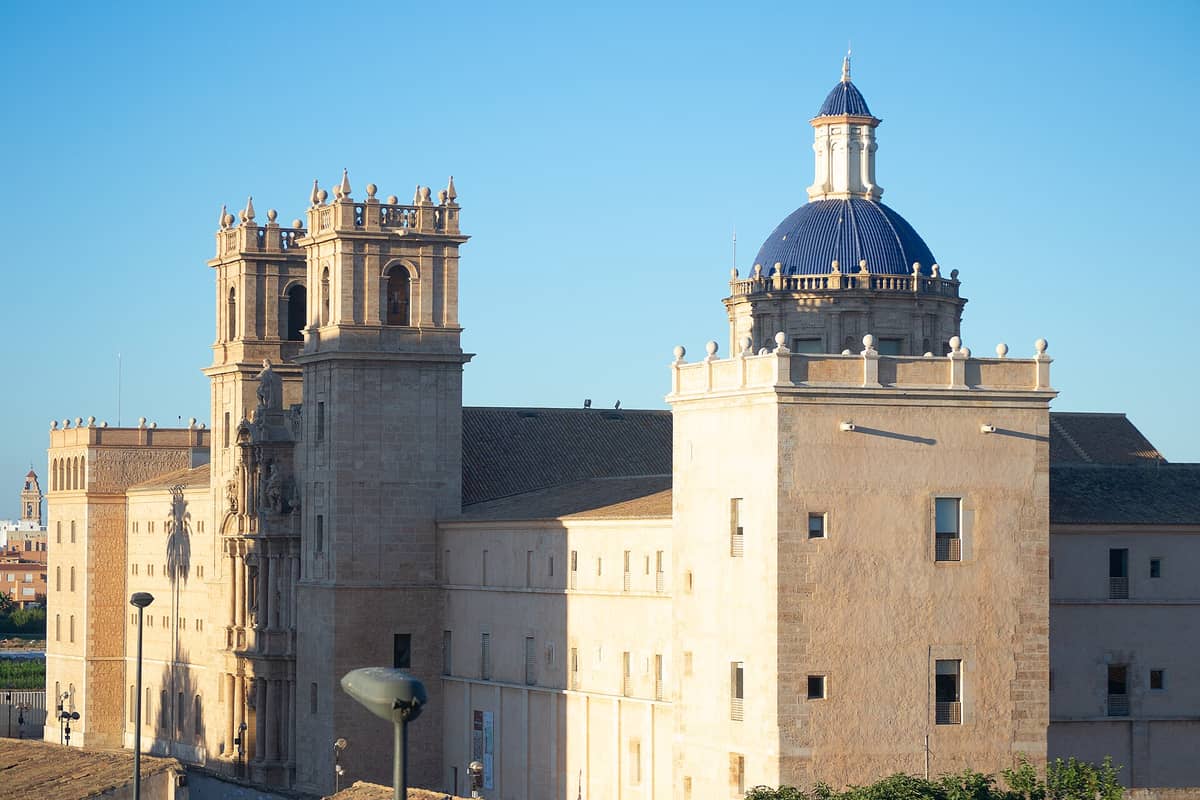
The Monasterio de San Miguel de los Reyes sits on Avenida de la Constitución in Valencia's northern edge, roughly 3.5 to 4 kilometres from the cathedral. It is not a working monastery and has not been for nearly two centuries. What you find instead is a monumental Renaissance complex of austere stone cloisters, soaring vaulted corridors, and a church nave that now serves as the reading room for the Biblioteca Valenciana Nicolau Primitiu, the regional library of the Valencian Community.
The building's scale tends to surprise first-time visitors. From the street, the facade reads as imposing but restrained, all grey stone and classical proportions. Step through the entrance gate and the main cloister opens up around you: two storeys of Renaissance arcading, carved column capitals, and a central garden where the ambient noise of the city drops away almost completely.
💡 Local tip
Entry to the monument and its exhibitions is free. Weekend guided tours in Valencian and Spanish also cost nothing and depart at 12:00 and 13:00 respectively. Arrive a few minutes early at the main entrance to join the group.
Five Centuries of History in One Building
The site's origins predate the current structure by roughly two centuries. A Cistercian monastery stood here from the 14th century before the Hieronymite order established a new foundation in the mid-16th century, promoted by Fernando de Aragón, Duke of Calabria and Viceroy of Valencia, and his wife Germana de Foix, Duchess of Calabria. The duke intended the monastery as a dynastic mausoleum and poured considerable resources into the project, which is why the building delivers more than the weight of a provincial religious house.
Construction stretched across the late 16th and early 17th centuries, and the result reflects the transitional moment between Spanish Plateresque and the more severe Herreran style that would define the Escorial. The two cloisters are the most studied elements: the southern cloister dates to the original Hieronymite construction phase, while the northern cloister was completed later and shows the shift toward plainer, more geometric forms.
After the dissolution of the monasteries in the mid-1830s, the building's fortunes deteriorated sharply. It passed through several hands and functions, serving at different points as a prison and an agricultural storage facility. Restoration work accelerated in the late 20th century, and since 2000 the complex has been the permanent home of the Biblioteca Valenciana Nicolau Primitiu. This adaptive reuse has preserved the architecture in good condition while giving the building a genuine working purpose. For architectural context across the city, the Valencia architecture guide places this monastery within the broader pattern of the city's historic religious buildings.
Tickets & tours
Hand-picked options from our booking partner. Prices are indicative; availability and final rates are confirmed when you complete your booking.
Valencia Silk Museum tickets and audio guide
From 7 €Instant confirmationFree cancellationSaint Nicholas Church Entrance Tickets and Audioguide
From 11 €Instant confirmationHistoric Valencia walking tour
From 27 €Instant confirmationFree cancellationNatural thermal springs and Girlfriend Waterfall tour from Valencia
From 89 €Instant confirmationFree cancellation
What You See: A Room-by-Room Walkthrough
The visit follows a logical sequence through the complex. The main entrance leads directly into the first cloister, which sets the tone immediately. The stonework here is warm-toned limestone, slightly roughened by age, and the proportions of the arcade are calm rather than dramatic. On a clear morning, the light falls across the courtyard at a low angle and catches the carved details on the column capitals, each one slightly different from its neighbour.
The exhibition galleries occupy the ground-floor rooms off the main cloister. The shows rotate and tend to focus on Valencian history, book culture, and heritage topics related to the library's collections. The quality varies by exhibition, but the rooms themselves, stone-vaulted and thick-walled, are worth seeing regardless of what is on display.
The church nave is the spatial highlight of the visit. The original 16th-century structure was heavily modified over the centuries, but the scale of the interior remains impressive. The vaulted ceiling rises considerably above the current library furnishings, and you can read the building's layers clearly: Renaissance mouldings alongside later interventions, all washed in quiet, cool light from high windows. The presence of library users working quietly at the tables adds an unexpectedly pleasant quality to the space, a reminder that the building is genuinely alive.
Morning, Afternoon, and Weekend: How the Visit Changes
The monastery sees modest visitor numbers by any standard, which means the experience rarely feels pressured. On weekday mornings, the courtyards are almost entirely quiet. The library is in full operation at this time, and the atmosphere leans toward studious calm rather than tourist destination. If you prefer to explore the architecture at your own pace without a guide, a Tuesday or Wednesday morning visit gives you the most freedom.
Weekend mornings bring the guided tours, which are worth attending if your Spanish is adequate. The guides cover the founding history, the architectural evolution of the two cloisters, and aspects of the monastery's more difficult periods as a prison. They also access areas that are not always open to independent visitors. The 12:00 tour tends to attract a slightly smaller group than the 13:00 slot.
ℹ️ Good to know
Opening hours for the exhibition areas: Tuesday to Friday 10:00–14:00 and 17:00–20:00; Saturdays, Sundays and public holidays 11:00–13:30. The monastery’s exhibition halls are closed on Mondays.
The afternoon slot, from 17:00 to 20:00 on weekdays, is useful in summer when the midday heat makes walking across the city uncomfortable. The building stays noticeably cool inside even in July and August, partly because of the thermal mass of the stone walls and the ventilation effect of the open courtyards. That makes it a sensible option for a summer afternoon when outdoor sightseeing becomes draining.
Getting There and Getting Around
The monastery is not in the historic centre, which partly explains why it attracts less foot traffic than sites like the cathedral or the Lonja. Tram Line T6 stops at Sant Miquel dels Reis, which is the most direct public transport option. EMT bus lines 11, 16, and 36 also stop nearby. The journey from the city centre takes around 15 to 20 minutes by tram.
Cycling is a practical option if you are already using Valencia's bike infrastructure. The Turia Garden park runs roughly parallel to the route from the centre, and the approach to the monastery from the south along the park path is quiet and shaded. The cycling route through the Turia Garden can be extended northward to reach the monastery with minimal road exposure.
Parking is available on the surrounding streets, which are less congested than the city centre. If you are combining the visit with the Bioparc Valencia, which sits approximately 2 kilometres to the south along the same avenue, driving or cycling between the two sites is straightforward.
Photography, Accessibility, and Practical Details
Photography is permitted in the public areas of the monument. The main cloister is the most rewarding subject, particularly in the morning when the light is directional and the courtyard is free of crowds. A wide-angle lens is useful here; the arcade framing and the garden at the centre reward that kind of composition. The church interior is darker and requires patience with exposure settings, but the vaulted ceiling and the contrast between the historic architecture and the contemporary library furniture make for an unusual shot.
The building houses an active public library, so discretion is expected in the reading rooms. Avoid flash photography near working library users, and keep noise low in the nave area.
The main areas of the complex are accessible at ground level, and the conversion to a library has involved some modernisation of access routes. However, the specific provision of lifts or step-free access throughout the multi-level building is not fully detailed in published sources. If mobility access is a concern, it is worth contacting the Biblioteca Valenciana directly before visiting to confirm which areas are reachable.
⚠️ What to skip
This attraction is off the standard tourist trail and is not well signed from the city centre. Check tram and bus routes before leaving your accommodation. The surrounding neighbourhood is residential and quiet, so there are few cafes or services immediately adjacent to the monastery.
Is It Worth Your Time? An Honest Assessment
The Monasterio de San Miguel de los Reyes rewards visitors who are genuinely interested in Renaissance architecture, Valencian history, or monastic building traditions. It is not a site that delivers instant spectacle. There are no dramatic art collections, no famous altarpieces, and no rooftop views. What it offers instead is architectural coherence, genuine historical depth, and an almost complete absence of tourist infrastructure, which in Valencia's increasingly crowded old city can feel like a significant advantage. Visitors who enjoy sites like La Lonja de la Seda for the quality of their late medieval and Renaissance stonework will find something kindred here, with considerably fewer other visitors to navigate around.
Travellers on a tight two or three day itinerary may reasonably decide to prioritise the historic centre's concentration of monuments. But for anyone spending a week or more in Valencia, or for those who have already seen the headline sites and want to go deeper, this monastery is one of the city's more satisfying half-day additions. It pairs naturally with a visit to the Bioparc Valencia if you are travelling with children, or with a long walk through the Turia Garden for those who prefer a quieter programme.
Travellers seeking colour, energy, and street-level atmosphere will find this monastery quiet to the point of stillness. If your priority is the kind of Valencia that appears in food and nightlife guides, this is probably not where your afternoon should go.
Insider Tips
- The 12:00 guided tour on Saturdays and Sundays is in Valencian and the 13:00 tour is in Spanish; if you want a more personal experience with the guide, arriving for the earlier departure often helps, but exact group sizes vary.
- The building stays significantly cooler than the city streets in summer. If you are visiting Valencia in July or August, the 17:00 weekday slot gives you an air-conditioned afternoon without spending money on a museum ticket.
- Combine the visit with a walk along Avenida de la Constitución — the monastery sits well outside the tourist core, so plan transport before you go.
- The northern cloister, completed in a later phase than the southern one, shows the shift toward plainer Herreran forms. Comparing the two side by side is a compact lesson in how Spanish Renaissance architecture evolved across the 16th century.
- If you read Spanish, the Biblioteca Valenciana's own website provides detailed historical documentation about the monastery's construction phases and later uses. It is more precise than most guidebook summaries and worth reading before you visit.
Who Is Monasterio de San Miguel de los Reyes For?
- Architecture enthusiasts interested in Spanish Renaissance and Hieronymite monastic building traditions
- Travellers who have already covered Valencia's historic centre and want a less-visited monument with genuine depth
- Visitors in summer looking for a cool, uncrowded indoor space with no admission fee
- History readers interested in the intersection of royal patronage, religious dissolution, and adaptive heritage reuse
- Photographers seeking architectural subjects without crowds or lighting restrictions
Nearby Attractions
Combine your visit with:
- Parc Natural de l'Albufera
Just 10 kilometres south of Valencia, Parc Natural de l'Albufera is a protected coastal lagoon covering 21,120 hectares of freshwater lake, rice paddies, pine forests, and wetlands. It is one of Spain's most important bird sanctuaries, the birthplace of Valencian paella, and a complete change of pace from the city.
- Devesa del Saler
Stretching roughly 8 kilometres between the Mediterranean Sea and Lake L'Albufera, the Devesa del Saler is one of Europe's most intact coastal dune forests. Part of Albufera Natural Park since 1986, this approximately 800-hectare strip of umbrella pines, wetland edges, and wild beach is free to enter and reachable from central Valencia in under 30 minutes.
- El Palmar Village
Tucked inside Albufera Natural Park roughly 20 kilometres south of Valencia, El Palmar is a small fishing village of around 750 residents that sits on the edge of a freshwater lagoon ringed by rice fields. It is widely credited as one of the birthplaces of authentic Valencian paella, and a visit here combines slow rural atmosphere, boat trips on the lake, and some of the most seriously traditional rice cooking in the region.
- Estadio de Mestalla
Estadio de Mestalla is the historic home of Valencia CF, one of Spain's most decorated football clubs. Inaugurated in 1923, it holds close to 49,430 spectators and ranks among the oldest top-flight grounds in La Liga. Whether you're catching a live match or exploring the stadium on a guided tour, Mestalla delivers a concentrated dose of local identity that few attractions in Valencia can match.