Parc Natural de l'Albufera: Valencia's Ancient Lagoon Worth the Trip
Just 10 kilometres south of Valencia, Parc Natural de l'Albufera is a protected coastal lagoon covering 21,120 hectares of freshwater lake, rice paddies, pine forests, and wetlands. It is one of Spain's most important bird sanctuaries, the birthplace of Valencian paella, and a complete change of pace from the city.
Quick Facts
- Location
- 10 km south of Valencia city centre, Province of Valencia
- Getting There
- EMT bus line 24 (to El Palmar) or line 25 (to El Perellonet) from central Valencia
- Time Needed
- 3–5 hours for a half-day visit; full day if combining boat trip, village, and rice lunch
- Cost
- Free park entry; boat trips and restaurant meals are paid separately
- Best for
- Birdwatching, landscape photography, paella pilgrimage, slow travel
- Official website
- parquesnaturales.gva.es/es/web/pn-l-albufera
What Is the Albufera, and Why Does It Matter?
Parc Natural de l'Albufera is a coastal freshwater lagoon separated from the Mediterranean by a narrow strip of dunes and pine forest. Declared a protected natural park on 8 July 1986, it covers 21,120 hectares and sits roughly 10 kilometres south of Valencia's city centre. The name comes from Arabic: al-buhayra, meaning 'the small sea'. That etymology tells you everything about the scale of what you are looking at when you reach the waterside.
The park is not a manicured garden or a curated experience. It is a working wetland: rice farmers still cultivate the fields that surround the lake, fishermen set nets from flat-bottomed boats, and the transition between flooded paddies and open water is often blurry. Ecologically, this is one of the most significant bird habitats in the Iberian Peninsula, serving as a migration stopover and wintering ground for tens of thousands of waterfowl. Over 250 bird species have been recorded here.
Culturally, the Albufera carries equal weight. The specific combination of local rice varieties, the nearby fishing village of El Palmar, and the freshwater ingredients found here are directly tied to the origin of Valencian paella. For anyone tracing Valencian identity, a visit to the Albufera is not optional, it is foundational.
The Landscape: What You Actually See
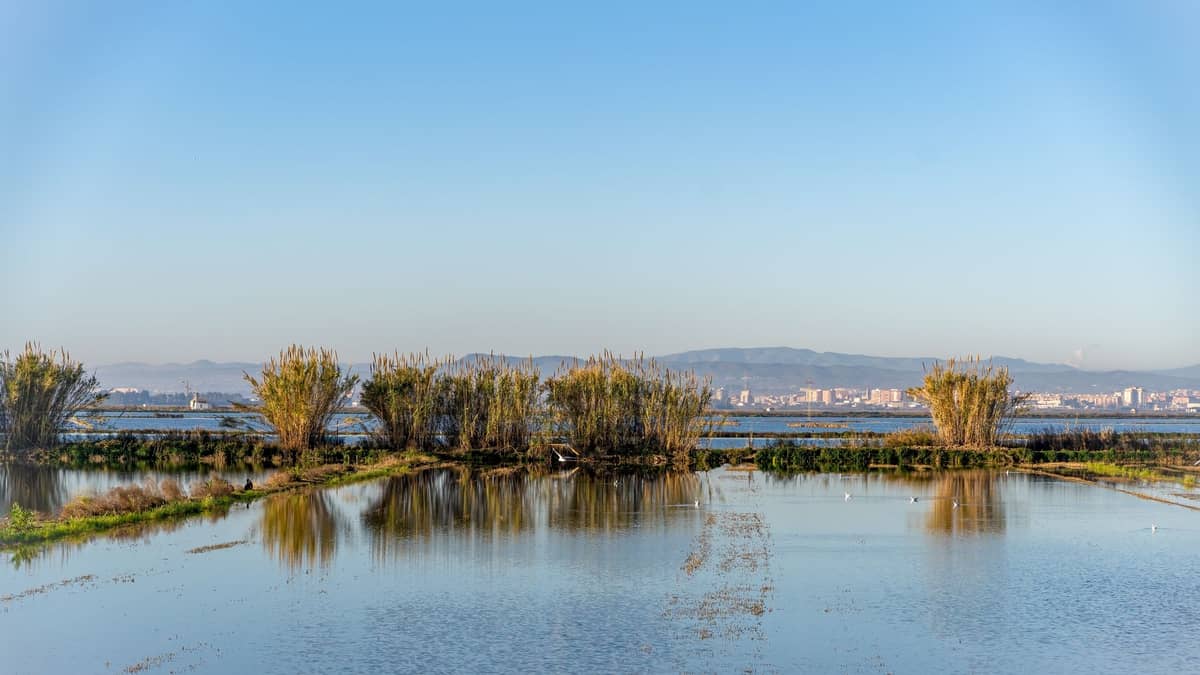
Approaching from Valencia along the CV-500, the landscape shifts noticeably about 8 kilometres out of the city. Pine woods line the road on the seaward side, and the rice fields open up to the west in long, flat rectangles stretching to the horizon. In summer, when the paddies are green and growing, the colour contrast with the still water of the lake is striking. In autumn, after the October harvest, the fields are flooded again and the whole plain becomes a shallow mirror.
The lake itself, which locals simply call la laguna, is the centrepiece. It covers roughly 2,800 hectares of open water, shallow enough in most places that you can see the bottom through a boat's hull. The water carries a slight greenish tint from algae and sediment. On calm mornings, the surface is so still that the horizon line disappears between water and sky, a disorientation that makes the place feel larger than it is.
The Devesa del Saler, the pine and dune strip between the lake and the sea, adds a third environment to explore. The trees here are dense maritime pines, and the ground beneath them is soft sand. Walking trails cross the Devesa and connect to the beach on the other side, giving you access to open Mediterranean water within a short walk of the lagoon.
💡 Local tip
Arrive at the lakeside before 9am if you want the still water and quiet that make the Albufera photogenic. By mid-morning, boat traffic picks up and the characteristic mirror-flat reflections are gone.
Tickets & tours
Hand-picked options from our booking partner. Prices are indicative; availability and final rates are confirmed when you complete your booking.
Guided Tour of Valencia's Albufera Natural Park with Boat Ride
From 55 €Instant confirmationFree cancellationAlbufera Natural Park with Sunset Boat Tour from Valencia
From 35 €Instant confirmationFree cancellationValencia: Albufera Natural Park Tour with Boat Ride and Panoramic Bus
From 20 €Instant confirmationFree cancellationNatural thermal springs and Girlfriend Waterfall tour from Valencia
From 89 €Instant confirmationFree cancellation
How the Experience Changes by Time of Day
Dawn at the Albufera is one of the genuinely memorable natural spectacles within reach of Valencia. The light comes in low and golden across the lake, the reed beds hold the sounds of coots, herons, and purple gallinules calling before the noise of the day begins. The smell at this hour is clean and slightly brackish, the combination of freshwater, mud, and pine resin that you will associate with this place long after you leave.
By late morning, day-trippers from Valencia begin to arrive, particularly on weekends. The village of El Palmar fills up quickly with families heading to the rice restaurants lining its single main street. This is not a bad time to visit, but it is a different kind of visit, sociable and food-focused rather than contemplative. Boat operators at the embarkation points on the lake edge also start their tours from mid-morning onward.
Sunset is the other peak moment. The light turns orange and then deep red over the water, and the reed beds catch the last colour in a way that amateur and professional photographers alike find worth planning around. The visitor interpretation centre at Racó de l'Olla, on the CV-500 road towards Sueca, is a particularly good vantage point for late afternoon light over the northern part of the lagoon.
Birdwatching: What to Look For and When
The Albufera is categorised as a Ramsar Wetland of International Importance, which puts it in the same conservation tier as the Camargue in France or the Doñana in Andalusia. The diversity of habitats, open water, reed beds, flooded rice fields, and pine woodland, means that the birdlife is stratified and abundant across seasons.
Autumn and winter bring the largest numbers of wintering duck species, including thousands of pochards and mallards. Spring is migration season, when marsh harriers, ospreys, and various waders pass through. Summer is quieter in terms of sheer numbers but good for resident species: purple herons nest in the reed beds, kingfishers work the irrigation channels, and the narrow waterways through the rice paddies produce unexpected sightings at close range.
The Racó de l'Olla interpretation centre (carretera de El Palmar s/n, accessed from the CV-500) serves as the main visitor information point and has hides overlooking key wetland areas. It is the logical first stop for anyone arriving with binoculars.
ℹ️ Good to know
Binoculars are worth bringing. The reed beds are dense and many species stay low in the vegetation. A basic pair will significantly change what you see during a boat trip or a walk along the lake edge.
Boat Trips: The Practical Reality
Traditional flat-bottomed wooden boats, called albuferencs, operate from several embarkation points around the lake. The most accessible point for visitors arriving on public transport is the Embarcadero de la Gola de Pujol, on Avinguda dels Pinars in the Poblados del Sur area. Boat tours typically last 45 minutes to an hour and take you through channels cut through the reed beds and out onto the open water.
Be realistic about what a boat trip offers. The lake is wide and flat, and the scenery is largely horizontal: sky, water, reeds, distant rice fields. It is atmospheric rather than dramatic, and the experience depends heavily on weather and light conditions. Overcast days flatten the palette considerably. What makes it worthwhile is being on the water itself, at water level, which gives you a fundamentally different sense of the ecosystem than any viewpoint from land.
Boat trips are not free and prices are set by individual operators rather than the park authority. Verify current prices directly at the embarkation point or through the Visit Valencia tourism portal before you go, as they vary by season and group size.
⚠️ What to skip
Boat trips in summer can be hot and exposed. There is little shade on the water. Sunscreen, a hat, and water are not optional in July and August.
El Palmar and the Paella Question
The village of El Palmar, reachable on EMT bus line 24 from central Valencia, is small enough to walk end to end in ten minutes, but it anchors the entire cultural narrative of the Albufera visit. The restaurants here serve paella valenciana cooked with local ingredients, particularly the rice grown in the paddies surrounding the village. If you want to understand why Valencia is serious about paella being more than a dish, eating here is more instructive than any reading. For context on the wider debate about authentic preparation, the best paella in Valencia guide covers what distinguishes a serious version from a tourist approximation.
Reserve a table at El Palmar in advance on weekends, particularly from April through October. The restaurants fill early with Valencians who treat this as a ritual Sunday outing, and walk-ins during peak hours are often turned away.
Getting There and Getting Around
From Valencia city centre, EMT bus line 24 runs to El Palmar and line 25 runs to El Perellonet. Both pass through the park's main access corridor along the CV-500. Journey times are roughly 30 to 45 minutes depending on traffic and your starting point. If you are combining the Albufera with a beach day, the Devesa del Saler pine forest and dune system connects the lake to the Mediterranean shore and is walkable.
Cycling is a genuinely good option for reaching the Albufera. The city's cycling infrastructure extends southward along dedicated paths, and the flat terrain makes the ride manageable even in warm weather. The cycling routes through Turia Garden connect directly to paths heading toward the park, making a full day by bike feasible without navigating traffic.
By car, the CV-500 from Valencia is the primary route, with parking available near the main access points and at El Palmar. Driving gives you the flexibility to visit the interpretation centre, the lake embarkation points, the village, and the Devesa in a single day without relying on bus schedules.
Organised day trips from Valencia are available through various tour operators and offer a curated combination of boat ride, village walk, and lunch. These can be a practical choice for visitors with limited time who want to see the highlights without planning the logistics independently. A general overview of what to expect is covered in the Albufera day trip guide.
Practical Notes and Who Should Think Twice
Entry to the park itself is free. The costs are in the activities: boat trips, restaurant meals, and transport. A day here can be done cheaply (bus fare, packed lunch, walking) or expensively (organised tour, full paella lunch with wine, boat trip). Both versions are valid.
Weather matters significantly at the Albufera. Summer visits mean heat, insects, and flat midday light that washes out the landscape. The mosquito population around the rice fields and reed beds in summer is not trivial. Long sleeves at dawn and dusk are a practical choice rather than an overcaution. Autumn and spring offer better light, cooler temperatures, more birdlife, and the visual drama of either the flooded post-harvest fields or the green growing season.
The Albufera is not for visitors who need constant stimulation or who expect a polished visitor attraction. There are no queues for exhibits, no audio guides, no manicured viewpoints. The park asks you to slow down and pay attention to a landscape that reveals itself gradually. Travellers who find unstructured natural spaces boring will be disappointed. For everyone else, the scale and stillness of the place are precisely the point.
💡 Local tip
Autumn is the best season for a first visit. The October rice harvest leaves the fields flooded and reflective, migratory birds are arriving in large numbers, the light is softer, and the heat has dropped to comfortable levels.
Insider Tips
- The interpretation centre at Racó de l'Olla is free and often overlooked by visitors who head straight to El Palmar. It has excellent hides overlooking the northern lagoon and staff who can tell you what species have been active that week.
- If you are taking the bus, line 24 to El Palmar will get you to the village, but ask the driver or check the stop before the village centre if you want to access the embarkation points on the lake edge first.
- The rice restaurants in El Palmar typically serve lunch only, from around 1:30pm to 4pm. Arrive before 2pm or you risk a long wait or no table at all on weekends.
- Walking the Devesa pine forest trail between the lagoon side and the Mediterranean beach takes about 20 to 30 minutes through quiet woodland. It is one of the few places within easy reach of Valencia where you can walk from a freshwater lake to a sea beach on foot.
- In the flooded post-harvest period (roughly November through March), the entire rice plain surrounding the lake becomes a shallow wetland that can hold more birds than the lake itself. A slow drive or bike ride along the field tracks at this time of year is more rewarding than the boat trip for serious birdwatchers.
Who Is Parc Natural de l'Albufera For?
- Birdwatchers and wildlife photographers wanting a major wetland habitat within easy reach of a city
- Food travellers seeking context for Valencian paella in the landscape that produced it
- Cyclists looking for a rewarding half-day or full-day route south from Valencia on flat terrain
- Families with children who want outdoor space, boat rides, and a relaxed village lunch without long transfers
- Slow travellers who want to contrast Valencia's urban intensity with genuine natural quiet
Nearby Attractions
Combine your visit with:
- Devesa del Saler
Stretching roughly 8 kilometres between the Mediterranean Sea and Lake L'Albufera, the Devesa del Saler is one of Europe's most intact coastal dune forests. Part of Albufera Natural Park since 1986, this approximately 800-hectare strip of umbrella pines, wetland edges, and wild beach is free to enter and reachable from central Valencia in under 30 minutes.
- El Palmar Village
Tucked inside Albufera Natural Park roughly 20 kilometres south of Valencia, El Palmar is a small fishing village of around 750 residents that sits on the edge of a freshwater lagoon ringed by rice fields. It is widely credited as one of the birthplaces of authentic Valencian paella, and a visit here combines slow rural atmosphere, boat trips on the lake, and some of the most seriously traditional rice cooking in the region.
- Estadio de Mestalla
Estadio de Mestalla is the historic home of Valencia CF, one of Spain's most decorated football clubs. Inaugurated in 1923, it holds close to 49,430 spectators and ranks among the oldest top-flight grounds in La Liga. Whether you're catching a live match or exploring the stadium on a guided tour, Mestalla delivers a concentrated dose of local identity that few attractions in Valencia can match.
- Monasterio de San Miguel de los Reyes
Founded in the mid-16th century by the Dukes of Calabria and now housing the Biblioteca Valenciana Nicolau Primitiu, the Monasterio de San Miguel de los Reyes is one of the city's most architecturally significant monuments. Entry is free, and guided tours typically run on weekends, though schedules can vary, and the crowds that pack the historic centre rarely make it this far north.