Estadio de Mestalla: Valencia's Football Cathedral Since 1923
Estadio de Mestalla is the historic home of Valencia CF, one of Spain's most decorated football clubs. Inaugurated in 1923, it holds close to 49,430 spectators and ranks among the oldest top-flight grounds in La Liga. Whether you're catching a live match or exploring the stadium on a guided tour, Mestalla delivers a concentrated dose of local identity that few attractions in Valencia can match.
Quick Facts
- Location
- Avenida de Suecia s/n, 46010 Valencia – Mestalla neighborhood, between Avenida de Suecia and Avenida de Aragón
- Getting There
- Urban bus lines 10, 32, 71, and 80, as well as metro lines 3 (Facultats station) and 5 (Aragón station), serve the area; also reachable by taxi from the city centre
- Time Needed
- 2–3 hours for a match (plus pre-match atmosphere); 1–1.5 hours for a guided tour
- Cost
- Match tickets approximately €30–€120+ depending on seat and opponent; tour prices vary – check Valencia CF official site
- Best for
- Football fans, architecture lovers, anyone wanting to experience authentic Valencian culture beyond the tourist circuit
- Official website
- www.valenciacf.com/mestalla
What Mestalla Actually Is
Estadio de Mestalla is not a museum piece. It is a working football ground with nearly a century of continuous use, situated in the residential Mestalla neighborhood about one to one and a half kilometers northeast of Valencia's historic core. Inaugurated on 20 May 1923 as the Campo de Mestalla, it has operated under three official names: Campo de Mestalla (1923–1969), Estadio Luis Casanova (1969–1994), and finally Estadio de Mestalla again from 1994 onward, restored at the personal request of the man the second name had honored. That detail alone tells you something about the culture surrounding the club.
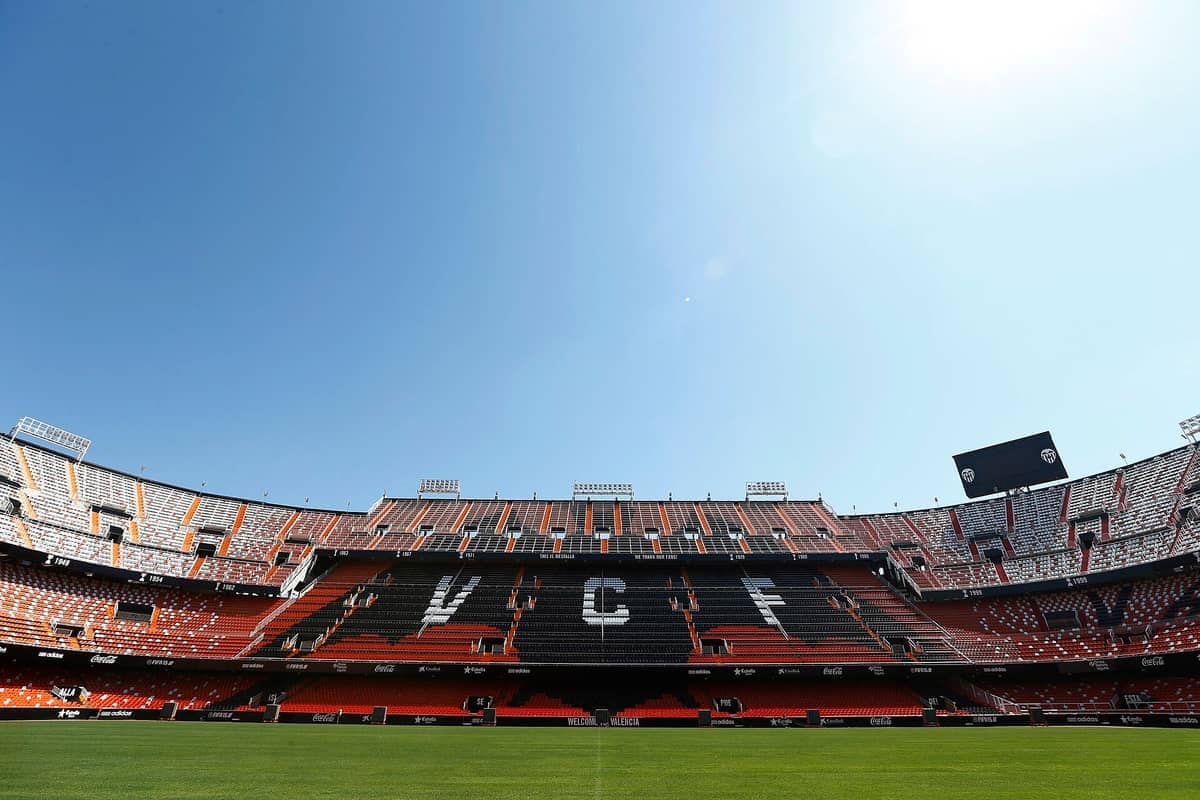
The ground holds approximately 49,430 spectators and sits on a 105 x 70 meter pitch. By La Liga standards it is not the largest stadium, but it has one of the most intense acoustics in Spanish football. The steep upper tiers bring the upper stands unusually close to the pitch, which concentrates crowd noise in a way that modern, architecturally flat arenas rarely achieve.
ℹ️ Good to know
Mestalla is open to the public primarily for match days and guided tours. There are no fixed daily walk-in hours. Always check Valencia CF's official site or contact the club directly before visiting, as tour schedules and match fixtures change each season.
The Stadium's Place in Valencia's Identity
Valencia CF was founded in 1919, and Mestalla has been the club's home for almost its entire history. The club has won six La Liga titles, eight Copa del Rey trophies, and one UEFA Cup (now the Europa League), making it one of the historically significant clubs in Spanish football. For many Valencians, attachment to the club and to this specific ground runs alongside family, language, and the local rice fields in the hierarchy of things that matter.
The stadium sits in a city already dense with landmark architecture. You can spend a morning at La Lonja de la Seda, a UNESCO World Heritage Gothic silk exchange, and reach Mestalla by afternoon bus. The contrast is instructive: Valencia's heritage is not confined to cathedrals and palaces. The football ground is part of the same civic fabric.
If you are exploring the city's architectural range, note that Mestalla represents a very different register from the futurist structures of the Ciudad de las Artes y las Ciencias to the south. The stadium was built incrementally across decades, and its exterior carries the slightly unpolished quality of a structure that grew organically rather than being designed in a single gesture. That authenticity is part of its appeal.
Tickets & tours
Hand-picked options from our booking partner. Prices are indicative; availability and final rates are confirmed when you complete your booking.
Mestalla Stadium Guided Visit
From 13 €Instant confirmationValencia Silk Museum tickets and audio guide
From 7 €Instant confirmationFree cancellationSaint Nicholas Church Entrance Tickets and Audioguide
From 11 €Instant confirmationHistoric Valencia walking tour
From 27 €Instant confirmationFree cancellation
Attending a Match: What the Experience Is Like
On match days, the neighborhood transforms in the two hours before kick-off. Bars along Avenida de Suecia and the surrounding streets fill with supporters wearing the club's traditional white and orange. The smell of fried food from nearby cafes mixes with cigarette smoke in the plazas outside the gates. Street vendors selling scarves and flags appear around the perimeter. This pre-match ritual is genuinely part of the experience and worth arriving early to absorb.
Inside, the seating rakes steeply upward on all four sides. If you are seated in the upper tiers, the height and angle can feel vertiginous at first, but it means almost every seat has a clear sightline to the pitch. The sound during a goal or a close decision is physical in the upper bowl – the concrete amplifies the crowd response in a way you feel as much as hear. Bring layers in autumn and winter: elevated seats are exposed to the wind that comes off the surrounding city blocks.
💡 Local tip
Buy match tickets through Valencia CF's official channels well in advance for high-profile fixtures against clubs like Real Madrid, Barcelona, or Atletico Madrid. These matches sell out quickly and ticket prices rise substantially on the secondary market.
Match tickets range from approximately €30 for seats in the upper tiers against lower-ranked opponents, to over €120 for premium or category seats in key fixtures. Prices are not fixed across the season and change by opponent and competition stage. Always verify current pricing on the official Valencia CF site before booking.
Stadium Tours: Visiting Without a Match
Valencia CF offers guided tours of Mestalla that take visitors through sections of the ground not accessible on match days, including the dressing rooms, the players' tunnel, pitchside areas, and the press facilities. For anyone interested in football history or stadium architecture, this is the more contemplative way to experience the ground. The noise and crowd are gone, but the scale of the structure is easier to appreciate when you can stand at the edge of the pitch and look up at the empty tiers.
Tour schedules are not fixed year-round and vary by season and club calendar. Before planning a visit specifically around a tour, check availability on the Valencia CF website. Tours typically last between 60 and 90 minutes. The ground is in the Mestalla neighborhood, which is a pleasant area to walk through before or after a visit – not a tourist district, but genuinely residential Valencia with local bars and bakeries that see few foreign visitors.
⚠️ What to skip
If your primary goal is a tour rather than a match, do not assume tours run daily. The tour schedule pauses around match days and during closed-season maintenance periods. Always confirm dates in advance.
Getting There and Practical Logistics
Mestalla is located at Avenida de Suecia s/n in the 46010 postal district. Urban bus lines 10, 32, 71, and 80 serve the area, with metro line 3 (Facultats) and line 5 (Aragón) stations nearby. From the city centre, a taxi or ride-share takes around 10 minutes outside of peak traffic. On match days, traffic around the stadium becomes congested in the 45 minutes before and after kick-off, so arriving on foot or by bus is significantly easier than arriving by car.
The stadium is served by the metro network, with line 3 stopping at Facultats and line 5 at Aragón, which is one practical advantage compared with some other major European grounds. If you are combining the visit with a wider day in the city, the Mercado Central in the historic centre and the Mestalla neighborhood are about 25 minutes apart on foot or 10 minutes by bus, making them manageable in the same afternoon.
Accessibility provisions at Mestalla include designated seating areas for supporters with reduced mobility, in line with La Liga stadium standards. Visitors requiring wheelchair access or specific assistance should contact Valencia CF directly before match day or tour booking to confirm current arrangements, as facilities and access routes may differ by entry gate.
Honest Assessment: Is It Worth Your Time?
If you have no interest in football, the guided tour offers limited return compared to Valencia's other attractions. The stadium does not have the architectural audacity of the Palau de les Arts or the historical depth of the cathedral complex. It is a football ground, and its power comes entirely from the activity it was built to house.
For football followers, attending a live Valencia CF match at Mestalla is a genuinely worthwhile experience in a city that offers a lot of competition for your attention. It pairs well with Valencia's food culture: the pre-match tradition of eating together means that combining a match with a meal at a local restaurant fits naturally into the rhythm of the day. If you want context for understanding the city beyond its monuments, a match at Mestalla delivers it efficiently. For more ways to spend your time in the city, the full Valencia guide covers a wide range of options across neighborhoods and interests.
Travelers with limited time who are not football fans, families with very young children who might find a full match too long, or visitors primarily focused on heritage architecture may find their hours better spent elsewhere. That said, the neighborhood itself – unpretentious, local, and rarely overrun with tourists – is worth a short detour even without entering the ground.
Insider Tips
- The best seats for atmosphere rather than view are in the Fondo Norte (north end), where the most vocal supporter groups are concentrated. The noise level is significantly higher than in the main lateral stands.
- Weekday evening matches (often scheduled for European competition or mid-week La Liga fixtures) draw a different crowd than weekend games: more local season-ticket holders and fewer casual visitors, which often creates a more intense atmosphere.
- The bars on Carrer de Menorca and the streets directly north of the stadium are frequented by home supporters before games and are far less crowded than those right on Avenida de Suecia. Food and drink prices are also lower.
- If you are doing a tour on a non-match day, the area around the stadium is very quiet. Combine it with a walk through the residential Mestalla neighborhood, which has several good local bakeries and zero tourist infrastructure.
- Check the Valencia CF fixture list before booking your trip dates rather than after. Home matches against the top six clubs sell out weeks in advance, while fixtures against newly promoted sides often have last-minute availability.
Who Is Estadio de Mestalla For?
- Football fans wanting to experience La Liga in a historic, steep-sided urban ground
- Travelers interested in Spanish sporting culture and local identity beyond the tourist circuit
- Architecture enthusiasts curious about how a major stadium evolves over a century of incremental development
- Anyone visiting Valencia for more than three days who wants to see how the city functions outside its heritage core
- Groups and families with older children who follow European football
Nearby Attractions
Combine your visit with:
- Parc Natural de l'Albufera
Just 10 kilometres south of Valencia, Parc Natural de l'Albufera is a protected coastal lagoon covering 21,120 hectares of freshwater lake, rice paddies, pine forests, and wetlands. It is one of Spain's most important bird sanctuaries, the birthplace of Valencian paella, and a complete change of pace from the city.
- Devesa del Saler
Stretching roughly 8 kilometres between the Mediterranean Sea and Lake L'Albufera, the Devesa del Saler is one of Europe's most intact coastal dune forests. Part of Albufera Natural Park since 1986, this approximately 800-hectare strip of umbrella pines, wetland edges, and wild beach is free to enter and reachable from central Valencia in under 30 minutes.
- El Palmar Village
Tucked inside Albufera Natural Park roughly 20 kilometres south of Valencia, El Palmar is a small fishing village of around 750 residents that sits on the edge of a freshwater lagoon ringed by rice fields. It is widely credited as one of the birthplaces of authentic Valencian paella, and a visit here combines slow rural atmosphere, boat trips on the lake, and some of the most seriously traditional rice cooking in the region.
- Monasterio de San Miguel de los Reyes
Founded in the mid-16th century by the Dukes of Calabria and now housing the Biblioteca Valenciana Nicolau Primitiu, the Monasterio de San Miguel de los Reyes is one of the city's most architecturally significant monuments. Entry is free, and guided tours typically run on weekends, though schedules can vary, and the crowds that pack the historic centre rarely make it this far north.