Mission Beach Boardwalk: San Diego's Classic Coastal Promenade
Stretching along the Pacific from Mission Beach into Pacific Beach, the Mission Beach Boardwalk is San Diego's most social stretch of coastline. Free to use around the clock, it draws cyclists, skaters, joggers, and sun-seekers year-round. Here is what to actually expect when you show up.
Quick Facts
- Location
- W Mission Bay Dr & Ventura Pl, San Diego, CA 92109
- Getting There
- Drive via SeaWorld Drive to W Mission Bay Dr; no direct trolley stop — MTS bus routes serve the area. Street and lot parking available nearby.
- Time Needed
- 1–3 hours for a casual stroll or bike ride; a full end-to-end run takes roughly 45–60 minutes on foot
- Cost
- Free to walk, jog, or skate. Bike and skate rentals available from nearby shops at varying prices.
- Best for
- Cyclists, inline skaters, people-watchers, families, and anyone wanting genuine Southern California beach culture
- Official website
- www.sandiego.gov/citycouncil/cd2/communities/missionbeach
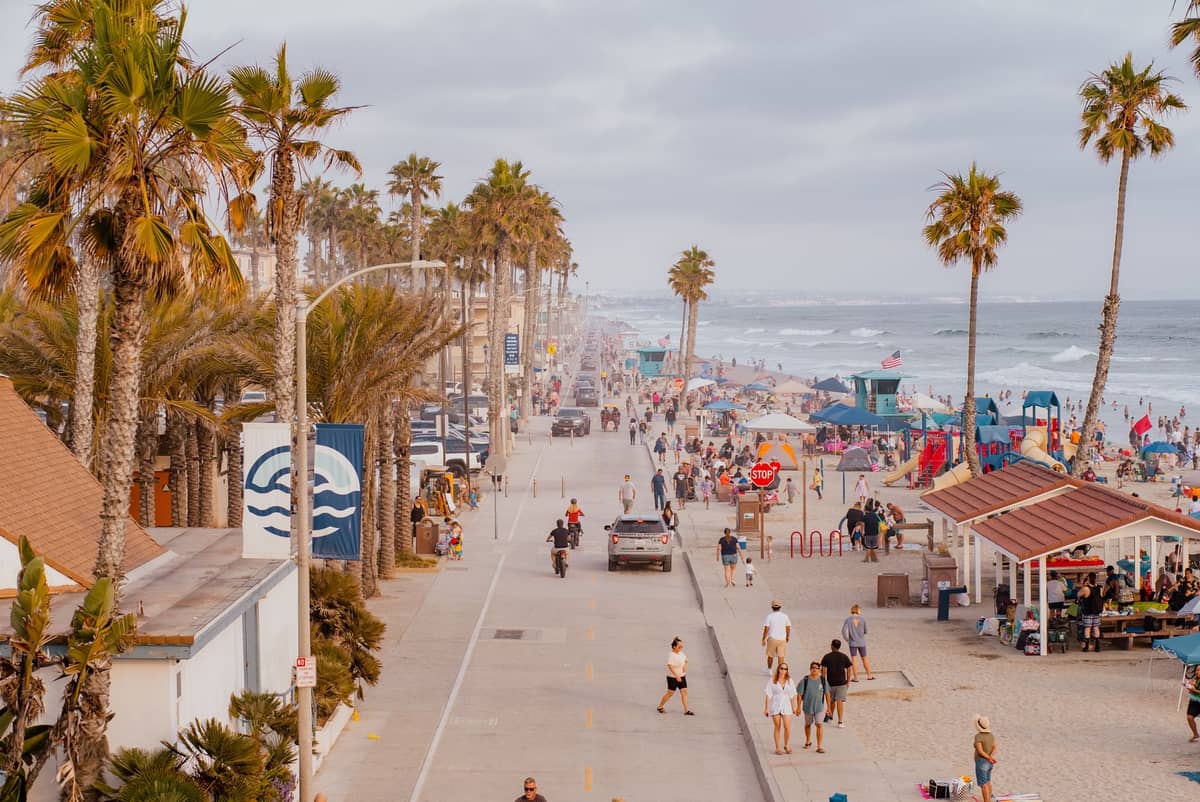
What the Mission Beach Boardwalk Actually Is
The Mission Beach Boardwalk, also referenced by the City of San Diego as the Mission Beach–Pacific Beach Oceanfront Boardwalk, is a paved promenade running along the Pacific Ocean edge of the Mission Beach and Pacific Beach neighborhoods. It is one of the longest and most continuous beachfront walkways on the California coast, connecting the two neighborhoods across a stretch of low-rise beach houses, rental shops, and sand.
Unlike Balboa Park or a ticketed attraction, there is nothing to queue for here. The boardwalk has no entrance, no fee, and no closing time. It is a public promenade in the most literal sense: a wide, concrete path separating the sand from the residential strip, open to foot traffic, cyclists, inline skaters, and anyone else who shows up.
The boardwalk sits a short drive from Mission Bay, and it threads past SeaWorld San Diego to the south and the quieter Pacific Beach stretch to the north. Understanding that geography helps set realistic expectations: this is not a manicured resort promenade. It is a working-class beach strip that has been drawing San Diegans since the 1920s, and it still feels that way.
💡 Local tip
Arrive before 9 AM on weekdays if you want the boardwalk mostly to yourself. By 11 AM on any sunny weekend, the path is thick with cyclists, dog walkers, and rental surreys, and the pace slows considerably.
History: Born in 1925, Still Running
City of San Diego archival records include a 1925 photograph captioned 'Mission Beach – Pacific Beach Boardwalk,' establishing the promenade's origin in the mid-1920s. The same year saw the opening of Belmont Park, the amusement park that still anchors the southern end of the boardwalk with its historic Giant Dipper roller coaster. Both the park and the boardwalk were born from a wave of Southern California coastal development in the early 20th century, when the idea of a planned beach resort community was being realized on the narrow peninsula between the ocean and Mission Bay.
For a century, the boardwalk has served as the social spine of Mission Beach. The architecture along its inland edge tells that story: small beach bungalows from the 1920s and 1930s shoulder against newer condos and vacation rentals, with surf shops, taco stands, and ice cream windows filling the ground-floor commercial spaces. Nothing here is particularly grand, but the continuity of it, a century of low-key beach life playing out on the same strip of concrete, gives it a texture you do not find at purpose-built resort destinations.
How the Boardwalk Changes Through the Day
Early morning on the boardwalk is the closest it gets to peaceful. Joggers run in both directions. Dog owners let their leashed pets sniff the edge of the sand. The light off the Pacific is flat and silver before the sun gets high, and you can hear the waves clearly over the low foot traffic. The smell of salt and damp sand is strongest at this hour, before sunscreen and food smells fill the air.
By mid-morning the tone shifts fast. Rental shops along the strip open, and four-wheeled surreys, tandem bikes, and rollerblades start appearing. Families with strollers, groups of teenagers, and leisure cyclists create a slow-moving current on the path. The boardwalk is wide enough to handle this, but it is not designed for speed: the path is shared use, and on a Saturday in July, the southern stretch near Belmont Park can feel genuinely congested.
Afternoon is peak hour for sun, crowds, and noise. Beach volleyball nets fill up. The sound of competing music from open doors mixes with the surf. The concrete retains heat and reflects light. This is the most photogenic time in terms of energy and color, and also the least comfortable for a relaxed walk. Late afternoon, roughly 4 to 6 PM, brings a second wave: the after-work crowd, and a softer, warmer light that turns the water amber. Sunset from the boardwalk is not as dramatic as from the cliffs at Sunset Cliffs to the south, but the sky above the water turns vivid and the crowds thin noticeably once the sun drops.
ℹ️ Good to know
June mornings frequently bring 'June Gloom,' a marine layer that keeps the boardwalk overcast until noon or later. If you are visiting in early summer and want sun, plan afternoon activities. September and October typically offer clearer skies and comfortable temperatures in the low-to-mid 70s°F.
What to Do on the Boardwalk
Walking the full length of the boardwalk, from the Belmont Park area in the south to the northern end near Pacific Beach, takes roughly 45 minutes at a relaxed pace. Most visitors do not complete the full route. Instead, they park, pick a direction, walk for 20 to 30 minutes, and double back.
Cycling is arguably the best way to experience the boardwalk. It is fast enough to cover real distance while still allowing you to stop, scan the water, and dip down to the sand. Bike rentals are available from multiple shops within walking distance of the main parking areas. Inline skates are also a classic choice here, and you will see genuine skaters who have been coming to this strip for decades.
At the southern end, Belmont Park is worth a walk-through even if you are not riding the coaster. The Giant Dipper roller coaster, a wooden structure dating from 1925, is a historic West Coast coaster that still operates today. The park sits right on the boardwalk edge and draws a separate crowd from the casual beach-walkers.
Beach access is immediate from any point on the boardwalk: step off the concrete and you are on the sand. The water is swimmable year-round for those comfortable with Pacific temperatures, which stay roughly 60–68°F. For more sheltered water and calmer beach conditions, La Jolla Shores to the north offers a quieter alternative.
Practical Details: Getting There, Parking, and Accessibility
The boardwalk does not have a single entrance point. The standard approach by car is via SeaWorld Drive to West Mission Bay Drive, which runs along the bay side of the peninsula. From there, surface streets cross the narrow strip to the ocean side. Parking lots and metered street parking exist near the boardwalk, but supply is tight on weekends between May and September. Arriving before 9 AM on a weekend morning is the most reliable way to find a spot without circling.
There is no direct San Diego Trolley stop at Mission Beach. MTS bus routes serve the broader area, and ride-hailing services drop off easily. If you are staying in Pacific Beach or Mission Beach itself, the boardwalk is likely walkable from your accommodation.
Accessibility along the promenade is reasonable. Access California documents accessible parking, accessible restrooms, and beach wheelchairs available free for one-hour loans. The promenade surface is paved concrete, which is manageable for most mobility aids, though the transition to sand is unassisted. Dogs on leash are permitted on the boardwalk and on the beach outside the posted daytime restriction hours.
⚠️ What to skip
Cyclists and pedestrians share the same path with no physical separation. Speed and lane awareness matter, especially in the busy midday hours. Watch for children, rental surreys, and pedestrians stepping unpredictably toward the sand.
Photography, Light, and What to Expect From the Scenery
The boardwalk photographs best in the first two hours after sunrise and the hour before sunset. Morning light catches the water at a low angle and avoids the harsh mid-day contrast. At golden hour, the beach-house facades along the inland side glow warm while the water turns a deep blue-green.
Do not expect dramatic coastal geology here. The Mission Beach shoreline is a broad, flat sandy beach without cliffs or rock formations. The visual interest comes from the human landscape: the parade of people, the low-slung beach architecture, the retro signage around Belmont Park, and the unbroken horizon over the Pacific. Photographers looking for dramatic coastal scenery will find more at Sunset Cliffs or La Jolla Cove.
For a comparison of San Diego's coastal viewpoints, the best views in San Diego guide covers a range of vantage points across the city, from elevated peninsulas to waterfront promenades.
The Bottom Line: Strengths and Limitations
The Mission Beach Boardwalk delivers exactly what it is: a long, free, unpretentious stretch of Southern California beach culture. It is not curated, not particularly scenic in a postcard sense, and not quiet. What it is is real. The mix of serious cyclists, casual strollers, elderly locals who have been coming here for 40 years, and first-time visitors from abroad creates a cross-section of beach-going life that is harder to find at more polished destinations.
Travelers expecting lush landscaping, upscale dining on the boardwalk, or a resort-style atmosphere will be disappointed. The commercial strip along the inland edge is functional rather than stylish. Food options run to tacos, pizza, and casual counter service. That is part of the character, but it is worth knowing in advance.
If your time in San Diego is limited to two or three days, the boardwalk may not need to be a primary stop unless beach walking is a priority. The 3 days in San Diego itinerary covers how to balance the boardwalk against other key attractions. Visitors with children may find it naturally fits into a beach day that combines the sand, Belmont Park, and the rental bikes.
Travelers more interested in San Diego's natural and cultural depth should also consider time at Balboa Park's Botanical Building or the cliffs at Sunset Cliffs Natural Park, which offer different but equally authentic San Diego experiences.
Insider Tips
- The stretch of boardwalk north of Crystal Pier in Pacific Beach is noticeably quieter and more residential than the southern Mission Beach section. If you want room to move and fewer rental surreys in your path, start your ride or walk from the northern end.
- Free beach wheelchair loans (manual and motorized) are available for one-hour blocks. Confirm availability and current procedures with the local lifeguard station or parks department before relying on this, as logistics can change seasonally.
- Weekday mornings between 7 and 9 AM in September and October hit a sweet spot: summer-warm temperatures, low crowds, and clear skies after the June Gloom marine layer is gone. This is when the boardwalk is most enjoyable for anyone who is not specifically chasing the peak-summer social scene.
- Metered parking on the bay side of the peninsula (Mission Bay Drive) is often less contested than spots immediately adjacent to the boardwalk. It adds a short walk across the peninsula but saves significant circling time on busy days.
- The Giant Dipper roller coaster at Belmont Park is listed on the National Register of Historic Places and is a National Historic Landmark. Even if you skip the ride, the structure itself is worth a slow look. The wooden track and original 1925-era design elements are increasingly rare on the West Coast.
Who Is Mission Beach Boardwalk For?
- Cyclists and inline skaters who want a long, flat, car-free route along the ocean
- Families with children combining beach time, bike rentals, and Belmont Park in a single outing
- People-watchers and photographers drawn to the human energy of a classic California beach strip
- Travelers on a tight budget looking for a free, full-morning activity with built-in beach access
- Visitors staying in Pacific Beach or Mission Beach who want a morning run or evening walk without driving anywhere
Nearby Attractions
Combine your visit with:
- Anza-Borrego Desert State Park
Anza-Borrego Desert State Park stretches across more than 600,000 acres of Colorado Desert in eastern San Diego County, making it one of the largest state parks in the United States. From spring wildflower carpets to ancient slot canyons and some of the darkest skies in Southern California, it rewards visitors who plan carefully and respect the terrain.
- Border Field State Park
Border Field State Park occupies the southwestern corner of the continental United States, where Pacific surf meets the U.S.–Mexico border fence. It offers coastal wetlands, a historic marble boundary monument, and views toward Friendship Park — the U.S.-side gathering space has been closed since 2020, so confirm current access before you go.
- Cedar Creek Falls
Cedar Creek Falls is a backcountry waterfall deep inside Cleveland National Forest, reached by a strenuous 6-mile round-trip hike from Ramona. A mandatory day-use permit keeps crowds manageable, but you'll earn every step of the descent into this rugged gorge. This guide covers the permit process, trail conditions, safety warnings, and what to realistically expect.
- Chicano Park
Chicano Park is a National Historic Landmark tucked beneath the San Diego–Coronado Bridge in Barrio Logan, where more than 80 monumental murals cover the concrete pillars of a freeway overpass. Free to enter and open daily, it is one of the most culturally layered outdoor spaces in the American Southwest.