Sunset Cliffs Natural Park: San Diego's Most Dramatic Coastal Edge
Perched along the western rim of the Point Loma peninsula, Sunset Cliffs Natural Park stretches 1.5 miles of rugged sandstone bluffs above the open Pacific. Admission is free, the park is open around the clock, and the scenery rewards visitors at almost any hour — though the hour before sunset is in a category of its own.
Quick Facts
- Location
- 4401 Ladera St, San Diego, CA 92107 — western edge of Point Loma peninsula
- Getting There
- MTS Bus routes 28 and 84 stop within a short walk; alight near Catalina Blvd & Wilcox St
- Time Needed
- 1–2 hours for the full 1.5-mile coastal path; 30 minutes for a sunset stop
- Cost
- Free. No entrance fee, no permit required. Parking lots close 2:00 AM–4:00 AM daily.
- Best for
- Sunset watching, coastal photography, light walking, tidepooling
What Sunset Cliffs Natural Park Actually Is
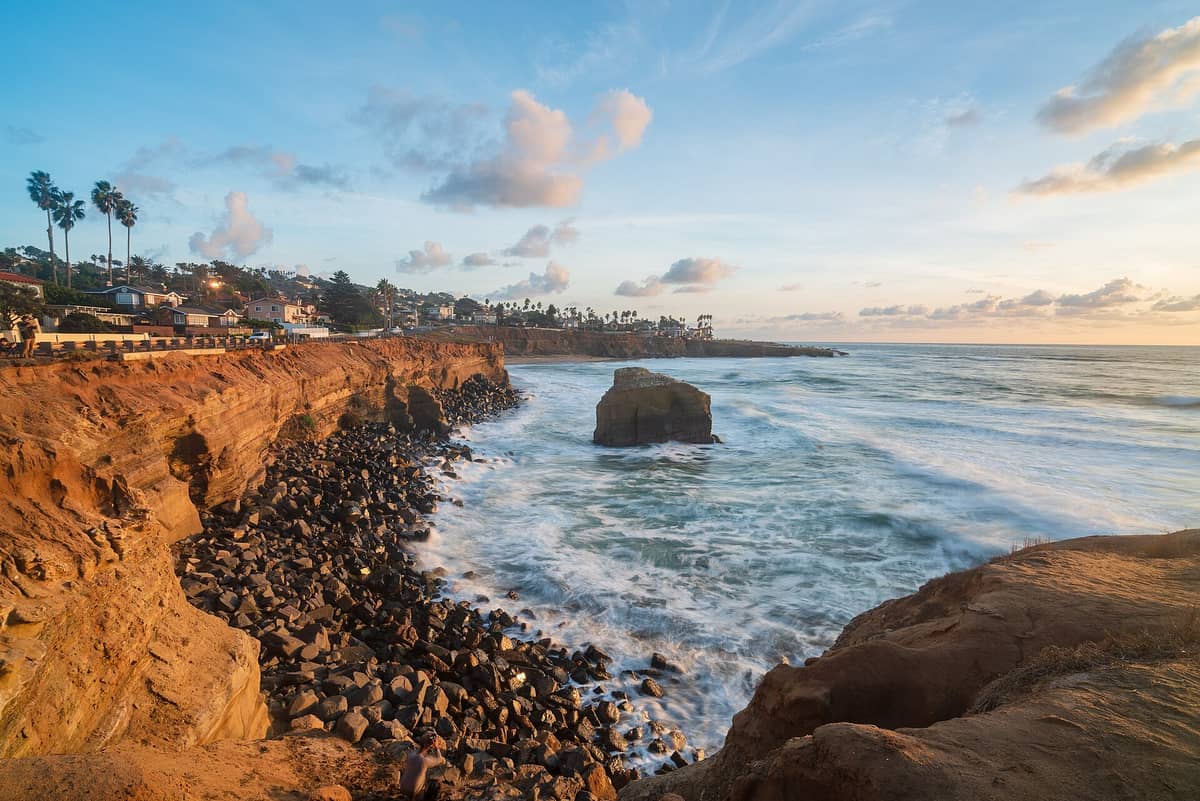
Sunset Cliffs Natural Park is a 68-acre, resource-based regional park dedicated by the City of San Diego in 1983. It runs roughly 1.5 miles along the Pacific-facing side of Point Loma, a hilly peninsula that separates San Diego Bay from the open ocean. What you get is a narrow ribbon of eroded sandstone bluffs, sea caves carved by centuries of wave action, small rocky coves, and unobstructed sightlines toward the horizon. There are no ticket booths, no gift shops, no fences at the main cliff edge. The park is about as uncommercialized as a city-managed coastal space gets.
The geology here is the main event. Point Loma's western cliffs are formed from Cretaceous-era sandstone and mudstone, and the wave erosion has sculpted them into arches, blowholes, and sea caves that are active and changing. The cliffs range in height along the path, with some sections dropping sharply 20 to 30 feet to the water. This is not a groomed promenade. The coastal trail is informal in places, surfaced in compacted dirt and flat rock, and the ground nearest the cliff edge is often crumbly and undercut. The beauty and the hazard are the same thing.
⚠️ What to skip
The cliff edges are actively eroding and are not fenced. Multiple visitors have been injured or killed falling from these bluffs. Stay on established paths and treat every cliff edge as unstable — because it often is.
The Experience at Different Times of Day
Morning: Low Crowds, Sharp Light, and Tide Pools
Arriving before 9:00 AM means you will likely have long stretches of the path to yourself. The marine layer frequently sits low over the water in early morning, softening the light and lending the cliffs a grey, almost monochromatic tone that photographers with an eye for mood find more interesting than the saturated colors of sunset. The air carries a strong salt smell at this hour, mixed with the faint organic scent of kelp drying on exposed rocks below.
Mornings around low tide are the best time to reach the rocky coves at the base of the cliffs, accessible via steep social trails near the southern end of the park. Purple sea urchins, owl limpets, and hermit crabs are visible in the pools. If you are specifically interested in tidepooling, check a tide table before visiting: you need a low tide of roughly +1.0 feet or lower to reach the better pool areas safely.
Midday: The Least Rewarding Window
The hours between 11:00 AM and 3:00 PM offer the harshest overhead light and the most parking pressure on weekends, particularly in summer. The coastal views are still good, but the flat light flattens the texture of the sandstone. If midday is your only option, bring water — there are no fountains or vendors inside the park — and start from the northern end near Ladera Street to walk south with the ocean on your right.
Sunset: The Hour This Park Exists For
In the 45 minutes before the sun touches the horizon, the sandstone cliffs turn amber and rust, the ocean goes from grey-green to near-copper, and the entire western face of Point Loma seems lit from below. On clear evenings this is a genuinely striking natural spectacle. The park fills up quickly. Arrive at least 45 minutes before the listed sunset time to get street parking within a comfortable walk, and expect to share the best bluff-edge spots with dozens of other visitors.
June and early July bring San Diego's marine layer, locally called June Gloom. During this period, the sky above the horizon is frequently overcast at sunset, blocking direct views of the sun dropping into the water. The clouds can diffuse the light attractively, but if you are visiting specifically to see the sun set into the ocean, September through November gives the best odds of a clear western horizon.
💡 Local tip
Check the local sunset time before you go. In summer, sunset can be as late as 8:00 PM. In winter, it falls closer to 4:45 PM. Arriving an hour early is not excessive.
Walking the Park: A Practical Rundown
The main coastal path runs roughly north to south along the bluff edge, beginning near the intersection of Sunset Cliffs Boulevard and Hill Street at the northern end and extending south toward Ladera Street. The full length is about 1.5 miles one way. Most visitors do not walk the entire route; they park near their preferred section and explore outward from there. The path is largely flat with gentle undulation, but the footing near the cliff edge is uneven rock and dirt rather than paved surface.
There is a small paved viewing area with benches near the northern end of the park that offers better accessibility for visitors who cannot manage uneven terrain. Beyond that area, the trail becomes increasingly informal. Sturdy closed-toe shoes are a practical choice. Sandals and flip-flops are common among visitors but will not serve you well on the rocky sections near the coves.
Dogs are permitted throughout the park on a leash. Beach access for dogs has time restrictions: leashed dogs may use the beach areas after 6:00 PM from April through October and after 4:00 PM from November through March. For broader context on where dogs are welcome in San Diego, the Dog Beach at Ocean Beach — a short drive north — offers fully off-leash access and is a natural companion stop.
Getting There and Parking
The park sits in the Point Loma neighborhood, approximately 4 miles west-southwest of downtown San Diego. By public transit, MTS Bus routes 28, 84, and 923 all stop within a short walk of the park's edge. The closest stop for most visitors arriving by bus is near Catalina Blvd and Wilcox St, roughly a 4-minute walk to the cliff path.
Street parking is free along Sunset Cliffs Boulevard and adjacent streets, but it fills fast on weekend afternoons and any day before a clear-sky sunset. Arriving by rideshare on peak evenings avoids the parking scramble entirely. The park's formal lots close between 2:00 AM and 4:00 AM daily, though the park itself remains accessible at all hours.
If you are combining this stop with a broader Point Loma visit, the Cabrillo National Monument sits at the southern tip of the same peninsula and pairs naturally with Sunset Cliffs — both are free or low-cost and offer coastal views, though from very different elevations and angles.
Photography at Sunset Cliffs
The most photographed locations in the park are the sea arches and the sections of cliff where the waves surge directly into narrow channels, sending water spraying upward. These require waiting: the wave timing is irregular, and getting the shot you want means standing in one spot for 10 to 20 minutes. Bring a cloth to wipe salt spray from your lens. A polarizing filter helps cut glare off the water at midday.
For sunset images, the most dramatic compositions are typically from slightly elevated positions looking south, where you get cliff foreground, water midground, and horizon sky. The northern sections of the bluff tend to offer better vantage angles for this type of shot than the southern sections. Wide-angle lenses (24mm to 35mm equivalent) are well suited to the scale of the landscape.
For a comparison of other high-quality sunset and coastal view locations across San Diego, the best views in San Diego guide covers several additional spots worth evaluating based on your schedule.
The Bottom Line: Strengths and Limitations
Sunset Cliffs delivers on its primary promise: a dramatic, uncrowded-enough coastal experience that costs nothing and requires no advance planning. The combination of rugged geology, unobstructed Pacific horizon, and free access makes it one of the more straightforward value propositions in San Diego's outdoor landscape.
The limitations are worth knowing. There are no restrooms inside the park itself — the nearest public facilities are typically at nearby Ocean Beach. The park has no shade, no water sources, and no ranger presence during most hours. The social media popularity of the sunset views means the best spots are genuinely crowded on clear evenings from spring through fall. If you are expecting a solitary nature experience on a Saturday in August, adjust your expectations.
Visitors with significant mobility limitations should note that only a small portion of the park near the northern access point is paved and level. The majority of the cliff-edge path involves uneven rock and compacted dirt, with no handrails. The coves below the cliffs are reachable only via steep, unmarked descents that are genuinely hazardous when wet.
If you are building a fuller day in Point Loma and the surrounding coast, the Point Loma neighborhood guide covers the broader peninsula, including dining options and how to link multiple stops efficiently. You might also consider the best hikes in San Diego if you want to combine the cliff walk with a more structured trail experience nearby.
Insider Tips
- The section of cliff path between the small parking area on Ladera St and the stone steps leading down toward the tide pools tends to be less crowded at sunset than the northern viewpoints — and the wave action into the rock channels is better from this stretch.
- The park faces almost exactly due west. If you want to photograph the sun hitting the cliffs rather than looking into the sun, position yourself at the southern end and look north — you get both cliffs and water in frame without shooting directly into the light.
- September and October give you the best odds of a clear western horizon at sunset, warm temperatures, and smaller crowds than July or August. June and early July regularly disappoint with marine layer cloud cover right at the horizon line.
- Street parking on Sunset Cliffs Boulevard fills from the north. If that strip is full, try Ladera Street or the blocks east of the blvd — they are a slightly longer walk but rarely as congested.
- There are no public restrooms in the park. The closest options are in Ocean Beach, roughly 20–25 minutes on foot to the north. Plan accordingly before entering the park.
Who Is Sunset Cliffs Natural Park For?
- Sunset watchers and landscape photographers looking for an unobstructed Pacific horizon
- Casual walkers wanting a flat-to-gently-rolling coastal path with dramatic scenery
- Tidepoolers visiting during low tide on a weekday morning
- Budget travelers and locals looking for a free, no-ticket outdoor experience
- Visitors building a Point Loma day that includes Cabrillo National Monument
Nearby Attractions
Other things to see while in Point Loma:
- Cabrillo National Monument
Perched at the southern tip of the Point Loma peninsula, Cabrillo National Monument packs an extraordinary amount into a single visit: panoramic views over San Diego Bay and the Pacific, a working-era lighthouse from the 1850s, accessible tidepools, and the site where European explorers first set foot on the West Coast of the United States.
- Liberty Station
Liberty Station transforms a 361-acre former naval training center in Point Loma into one of San Diego's most walkable mixed-use districts. Free to enter, it combines a food hall, arts galleries, historic architecture, waterfront promenades, and open lawns in a setting that rewards slow exploration.