Cabrillo National Monument: San Diego's Most Rewarding Viewpoint and History Stop
Perched at the southern tip of the Point Loma peninsula, Cabrillo National Monument packs an extraordinary amount into a single visit: panoramic views over San Diego Bay and the Pacific, a working-era lighthouse from the 1850s, accessible tidepools, and the site where European explorers first set foot on the West Coast of the United States.
Quick Facts
- Location
- 1800 Cabrillo Memorial Drive, San Diego, CA 92106
- Getting There
- Best reached by car or rideshare; MTS Route 84 serves the Visitor Center complex. Follow signs toward Point Loma from I-8 or Rosecrans Street.
- Time Needed
- 2 to 3 hours for a thorough visit; 1 hour minimum for views and lighthouse only
- Cost
- US$20 per vehicle; US$15 motorcycle; US$10 walk-in or bicycle. America the Beautiful passes accepted. Verify current fees at nps.gov/cabr.
- Best for
- History enthusiasts, photographers, families with curious kids, whale watchers (December to February), and anyone who wants San Diego's best city-and-ocean panorama
- Official website
- www.nps.gov/cabr/index.htm
What Cabrillo National Monument Actually Is
Cabrillo National Monument is a federally protected National Park Service site designated on October 14, 1913, marking the spot where Spanish explorer Juan Rodríguez Cabrillo sailed into San Diego Bay in 1542, becoming the first European to land on the West Coast of what is now the United States. That single historical fact would be enough to anchor a visit. But the monument is also, practically speaking, the highest publicly accessible point on the Point Loma peninsula, which makes it one of the finest viewpoints in all of Southern California.
The park sits at the very tip of Point Loma, a narrow finger of land that separates San Diego Bay from the Pacific Ocean. From the main overlook area, you can see downtown San Diego's skyline to the northeast, the Coronado Bridge arching over the bay, the Pacific stretching west toward Hawaii, and on clear days, the mountains of Baja California to the south. The geography alone makes this worth the drive.
The monument covers several distinct experiences in a compact area: the Old Point Loma Lighthouse (operational from 1855 to 1891), the Bayside Trail descending through coastal sage scrub toward the bay, a tidepool zone at the base of the western cliffs, and exhibits on both Native Kumeyaay history and Cold War-era coastal defense. It fits naturally into any 3-day San Diego itinerary and pairs well with a wider exploration of Point Loma.
ℹ️ Good to know
Park hours: Open daily 9:00 AM to 5:00 PM, closed Thanksgiving and Christmas Day. The Visitor Center is open 10:00 AM to 4:00 PM on weekdays and 10:00 AM to 5:00 PM on weekends. The Bayside Trail and lower tidepool parking area may close earlier — Bayside Trail around 4:00 PM and tidepool area around 4:30 PM. Check signage on arrival.
The View: What You See and When It Looks Best
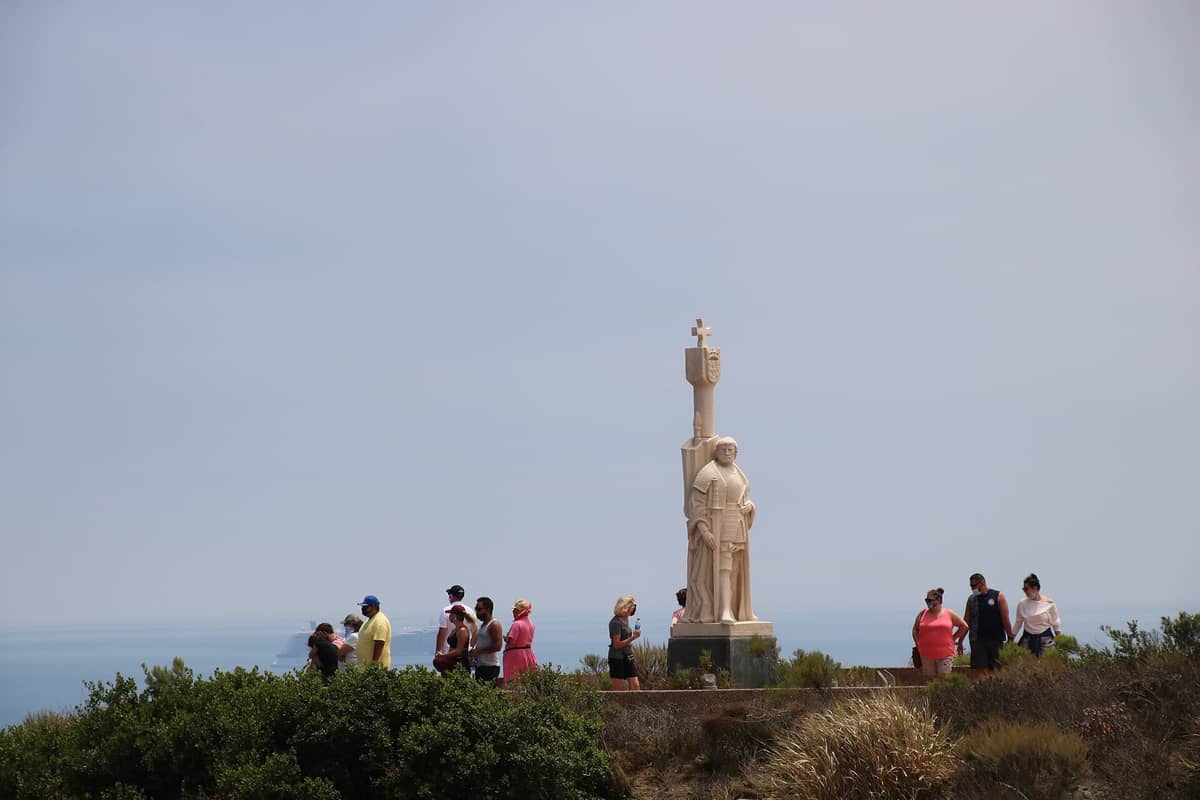
The main overlook near the statue of Juan Rodríguez Cabrillo is the first thing most visitors head for, and with good reason. The panorama from here is genuinely unusual: you can simultaneously look across San Diego Bay toward downtown and Coronado, and then turn 90 degrees to face open ocean. On days with good visibility, the view is layered in depth in a way that photographs only partially capture.
Morning light, especially between 8:00 and 10:00 AM, falls across the bay from the east and catches the downtown skyline in warm tones. The marine layer that often blankets the coast through late June and July (known locally as June Gloom) frequently burns off by midday, so afternoon visits from September through May tend to offer the clearest skies. Late afternoon in autumn is arguably the best photography window: the sun drops toward the Pacific, the downtown buildings catch golden light, and the bay surface picks up texture from the afternoon sea breeze.
Between late December and late February, the overlook also serves as one of San Diego's better whale-watching spots. Pacific gray whales migrate south along this coastline during their journey to Baja California lagoons, and the elevation of Point Loma gives viewers a real advantage over sea-level spotting points. Binoculars are essential.
💡 Local tip
Bring a layer. The point sits exposed to the ocean and is consistently 5 to 8 degrees cooler than downtown San Diego, with a persistent wind off the Pacific. Even on warm days, the ridge feels noticeably brisk.
The Old Point Loma Lighthouse: A Step Inside the 1850s
The Old Point Loma Lighthouse is a small, beautifully preserved structure that operated from 1855 until 1891, when it was decommissioned because fog and low clouds often obscured its light. A replacement lighthouse was built closer to water level, where it still operates today. The old lighthouse sits on the ridge, and stepping inside is one of those rare moments in San Diego where the past feels genuinely present rather than staged.
The interior has been restored to its 1880s appearance, complete with period furnishings, a tiny kitchen, and the original Fresnel lens mechanism on the upper level. The rooms are small — the keepers and their families lived in remarkably tight quarters — and the detail work by NPS is careful enough that the space feels inhabited rather than museumified. Rangers are often posted here and are notably informative; this is not a monument where the interpretation feels thin.
Note that the lighthouse interior is not wheelchair accessible due to its narrow original staircase. The exterior grounds are accessible and worth circling regardless, as the lighthouse sits at the highest ridge point and the surrounding views are among the best in the park.
The Tidepools: Low Tide Is the Only Tide That Matters
The rocky intertidal zone on the monument's western, ocean-facing shoreline is one of the most accessible and ecologically rich tidepool areas in San Diego. When the tide retreats, the exposed rock platforms reveal a layered community of ochre sea stars, hermit crabs, owl limpets, aggregating anemones, sculpin hiding in crevices, and occasionally a bat ray moving through the shallows at the zone's edge. The colors — purple urchins, orange starfish, green anemone columns — are striking in direct sunlight.
Visiting the tidepools requires some planning. You need to arrive during low tide, ideally a minus tide of -0.5 feet or lower, which exposes the most interesting lower zones. Checking a tide chart before you go is not optional — a high-tide visit means standing on dry rocks looking at water with nothing visible underneath. The NPS website publishes tidepool conditions and links to local tide tables. Wear shoes with grip; the rocks are uneven and can be slippery.
⚠️ What to skip
Nothing in the tidepool zone may be touched, collected, or disturbed. This is a protected intertidal area within a National Monument, and rangers do patrol the area. The rule exists because even well-intentioned handling damages the organisms and disrupts the habitat.
The tidepool parking lot is separate from the main monument entrance and sits lower on the western slope. It closes earlier than the main park, often around 4:00 to 4:30 PM. If tidepools are your primary reason for visiting, plan your arrival for mid-morning on a day with a predicted minus or very low tide.
The Bayside Trail: A Quiet Walk Through Coastal Sage
The Bayside Trail is a 2.5-mile round-trip trail that descends from the main monument area down the bay-facing slope of Point Loma. It passes through a dense belt of coastal sage scrub, one of California's most threatened plant communities, and the air along the trail carries a dry, aromatic quality from the sagebrush and lemonade berry shrubs. In spring, the trail edges pick up bursts of flowering buckwheat and black sage.
The trail also passes remnants of the coastal defense fortifications built during World War II — concrete bunkers, gun battery emplacements, and observation platforms that have slowly been absorbed into the hillside. The combination of military history and wild habitat makes this walk more layered than it first appears. It is not strenuous — the elevation change is gradual — but the surface is uneven compressed decomposed granite and is not suitable for wheelchairs or strollers.
If hiking and coastal scenery are central to your San Diego plans, the Bayside Trail is a decent warm-up for more demanding terrain. For longer, more elevated trails, Cowles Mountain and San Diego's best hiking spots offer more challenge and variety.
Crowds, Parking, and Practical Logistics
Cabrillo National Monument is one of the most visited National Park Service sites in the western United States, and on weekends from mid-spring through summer, the main parking lot can fill by mid-morning. Arriving before 9:30 AM on weekends is the most reliable way to avoid a wait at the entrance station. Weekday mornings, especially Tuesday through Thursday, are consistently quieter.
The park entrance requires a vehicle permit or individual admission. The 7-day vehicle pass at US$20 covers all occupants of your car and is valid for a week, so it makes sense if you plan to return. The America the Beautiful annual pass, available for US$80, covers entry to all U.S. national parks and pays for itself quickly if you visit more than four or five sites in a year. Annual passholders can simply present their card at the gate.
There is no food service inside the monument. Bring water and snacks, particularly if you plan to walk the Bayside Trail or spend time at the tidepools. The nearest coffee and food options are back down Cabrillo Memorial Drive toward the Point Loma neighborhood, around the Shelter Island area or further into Ocean Beach.
For visitors combining Cabrillo with a broader Point Loma day, the Sunset Cliffs Natural Park is a natural companion stop on the way back, offering dramatic ocean cliff scenery without an admission fee. Both sites together make for a full and satisfying half-day on the peninsula.
Who Should Reconsider This Visit
If you are primarily seeking beach access, swimming, or active water recreation, Cabrillo National Monument is not that kind of destination. The ocean-facing shoreline is all rocky tidepools and cliffs — no sandy beach, no swimming. For beach days, the Point Loma peninsula is better bookended with stops at nearby Ocean Beach or, across the bay, Coronado Beach.
Visitors who have already seen the downtown waterfront and San Diego Bay from the Embarcadero may find the viewpoint less revelatory than visitors arriving fresh. That said, the perspective from Point Loma is fundamentally different from the Embarcadero — you are looking down at the city from elevation rather than standing at water level — and most visitors find it adds rather than duplicates.
Visitors with significant mobility limitations will find portions of the monument inaccessible, including the lighthouse interior, the Bayside Trail, and much of the rocky tidepool zone. The Visitor Center, Coastal Defense Museum, outdoor overlooks, and lighthouse exterior are accessible, and a loaner wheelchair is available from the Visitor Center. The accessible portions of the monument are genuinely worth visiting, but it is honest to note the limitations before you arrive.
Insider Tips
- The Cabrillo statue overlook gets crowded by late morning on weekends. Arrive right at 9:00 AM when the gate opens and you will often have the main viewpoint to yourself for 20 to 30 minutes — a completely different experience from the midday scene.
- Check the NPS website for ranger-led programs before you visit. Free ranger programs at the lighthouse and tidepool zone can add substantial depth to the visit, particularly for anyone with children.
- The monument's western cliff edge, just north of the tidepool parking area, is one of the less-noticed spots in the park and offers an unobstructed view directly down to the Pacific surf. Most visitors bypass it on the way to the tidepools.
- If you are visiting during gray whale migration season (roughly mid-December through late February), bring 8x or 10x binoculars and post up at the overlook facing the Pacific for at least 20 minutes. Spouts and flukes are regularly spotted from this height, and the elevation makes identification much easier than from a beach.
- The America the Beautiful Senior Pass (for U.S. residents aged 62 and older) costs US$80 for a lifetime pass and covers entry to federal recreation sites, including national parks. At US$20 per visit to Cabrillo alone, it pays for itself in four visits.
Who Is Cabrillo National Monument For?
- History buffs interested in the first European exploration of the West Coast and Cold War coastal defense infrastructure
- Photographers looking for San Diego's best elevated bay-and-skyline panorama, especially in golden-hour light
- Families with children curious about tidepools, wildlife, and lighthouse history (rangers make this especially engaging for kids)
- Whale watchers visiting between mid-December and late February who want an elevated shore-based vantage point
- Travelers who want one site that combines outdoor scenery, cultural history, and natural history without driving to multiple locations
Nearby Attractions
Other things to see while in Point Loma:
- Liberty Station
Liberty Station transforms a 361-acre former naval training center in Point Loma into one of San Diego's most walkable mixed-use districts. Free to enter, it combines a food hall, arts galleries, historic architecture, waterfront promenades, and open lawns in a setting that rewards slow exploration.
- Sunset Cliffs Natural Park
Perched along the western rim of the Point Loma peninsula, Sunset Cliffs Natural Park stretches 1.5 miles of rugged sandstone bluffs above the open Pacific. Admission is free, the park is open around the clock, and the scenery rewards visitors at almost any hour — though the hour before sunset is in a category of its own.