Liberty Station: San Diego's Best Adaptive Reuse District
Liberty Station transforms a 361-acre former naval training center in Point Loma into one of San Diego's most walkable mixed-use districts. Free to enter, it combines a food hall, arts galleries, historic architecture, waterfront promenades, and open lawns in a setting that rewards slow exploration.
Quick Facts
- Location
- Point Loma, San Diego, CA — about 10 min by car from downtown and San Diego International Airport (SAN)
- Getting There
- Primarily by car or rideshare; free self-parking throughout the campus, including EV charging stations at Lots D and P
- Time Needed
- 2–4 hours for a relaxed visit; a full day if you combine dining, galleries, and outdoor walking
- Cost
- Free to enter the campus and park; individual restaurants, shops, and venues set their own prices
- Best for
- Food lovers, architecture enthusiasts, families with kids, couples on a relaxed weekend afternoon
- Official website
- libertystation.com
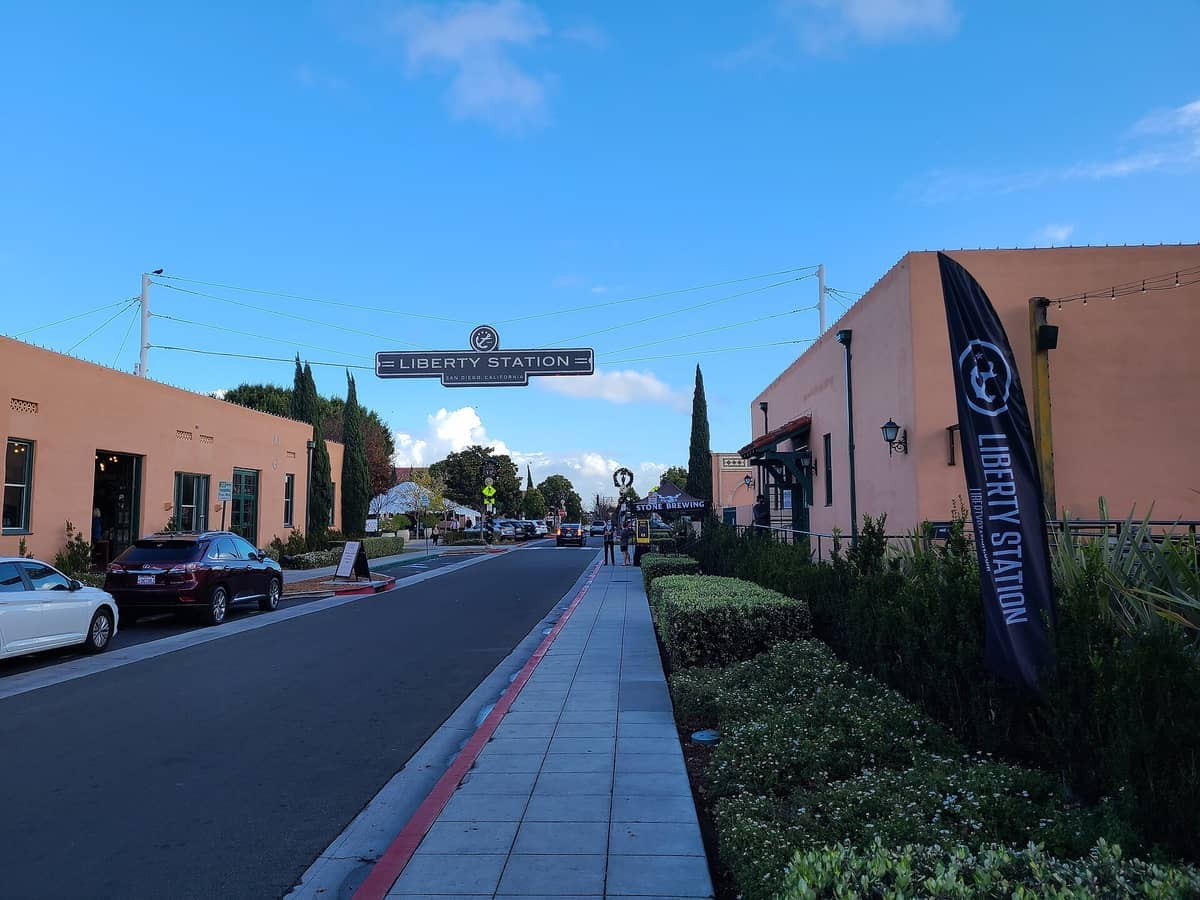
What Liberty Station Actually Is
Liberty Station is not a theme park, a single museum, or a standard shopping mall. It is a 361-acre adaptive reuse district built on the grounds of Naval Training Center San Diego, which opened on October 27, 1923, and closed in 1997 after training approximately 1.75 million Navy recruits and 1 million A and C school sailors over 70 years. After the City of San Diego took ownership in 2000, the site was reimagined as a mixed-use urban village combining dining, arts, retail, education, and open public space within the bones of its original Spanish Colonial Revival architecture.
What makes Liberty Station worth your attention is the scale and coherence of the transformation. The wide parade grounds are now grassy parks. The brick-and-tile barracks and training buildings have become restaurants, galleries, and arts spaces. The channel-side promenade offers views of the water without the crowds you find at other San Diego waterfronts. Walking through it feels genuinely different from anything else in the city — the buildings have presence, the proportions are generous, and the whole campus is navigable on foot.
ℹ️ Good to know
Admission to Liberty Station is free, and parking is free for up to 3 hours while patronizing a Liberty Station business. The Liberty Public Market, the district's central food hall, is open daily from 9:00 a.m. to 8:00 p.m. (verify current hours at libertystation.com before visiting, as individual vendor hours vary).
The Architecture: What You're Actually Looking At
The buildings that anchor Liberty Station were designed in the Spanish Colonial Revival style, characterized by red clay tile roofs, arched colonnades, cream-colored stucco walls, and ornamental ironwork. This aesthetic was chosen deliberately for a naval facility in 1923 to evoke California's Spanish-era heritage and create institutional permanence. Walking the main promenades today, those choices age well. The covered walkways between buildings create shade corridors that make the campus comfortable even on warm autumn afternoons, when temperatures in Point Loma typically reach the low-to-mid 70s Fahrenheit.
The scale of the original construction is hard to miss. These were buildings designed to process and house thousands of naval recruits at a time, so the spaces inside tend to be tall and airy, with proportions suited to something larger than a boutique restaurant. Many current tenants have kept original detailing: exposed timber beams, worn tile floors, transom windows. It gives the whole district an architectural continuity that distinguishes it from standard commercial redevelopments where historic facades are preserved only on the exterior.
If architecture is a primary interest, Liberty Station pairs well with a visit to Old Town San Diego State Historic Park for a contrast in California building styles, or with the broader Point Loma peninsula where the landscape context of the site becomes more apparent.
Liberty Public Market: The Practical Core of Any Visit
The Liberty Public Market is the most consistently busy part of the campus and functions as its social anchor. It is a food hall occupying one of the original naval buildings, housing a rotating collection of independent food and drink vendors under one roof. The range is broad: craft coffee, wood-fired pizza, fresh oysters, Filipino barbecue, artisanal cheese, house-made charcuterie, Korean tacos, and more. The quality tends to be higher than a standard food court because vendors are small operators with reputations to protect rather than franchise branches.
Mornings are the quietest time to visit the market. By late morning on weekends, the main seating areas fill steadily, and by early afternoon on Saturdays, lines at the most popular stalls become meaningful. If you are visiting primarily to eat and want space to sit, arriving before 11:00 a.m. on weekends or on a weekday gives you a noticeably different experience from peak afternoon hours. The outdoor seating on the market's perimeter is pleasant in San Diego's typical weather, which stays mild through most of the year with very little rain from late spring through early autumn.
💡 Local tip
Weekday mornings between 9:00 and 11:00 a.m. are the quietest window at Liberty Public Market. Weekend afternoons between noon and 3:00 p.m. are the busiest. If you have flexibility, a Thursday or Friday mid-morning visit gives you the full range of vendors without the weekend crowd density.
Arts District Liberty Station: More Depth Than It First Appears
A significant portion of Liberty Station's footprint is dedicated to arts and culture organizations, operating under the umbrella name Arts District Liberty Station. The cluster includes working artist studios, nonprofit arts organizations, dance companies, theater groups, and galleries. Unlike Balboa Park, where institutions are well-signposted and heavily visited, the arts spaces here are quieter and require a bit more intentional exploration.
Many of the galleries in this section are free to enter and maintain regular public hours, though specific schedules vary by organization and it is worth checking ahead for any venue you specifically want to see. The atmosphere in the arts corridor on a weekday afternoon is notably calm: a few visitors moving between buildings, the occasional sound of a rehearsal coming from an open door, light filtering through tile-roofed colonnades. It is one of the less-trafficked parts of the campus and often the most rewarding for visitors who slow down.
For travelers building a broader arts itinerary in San Diego, the arts programming at Liberty Station complements the major institutions at Balboa Park, including the San Diego Museum of Art and the Mingei International Museum.
The Waterfront Promenade and Outdoor Spaces
One of Liberty Station's underappreciated features is its outdoor infrastructure. The channel-side promenade runs along a calm waterway adjacent to the site, offering a flat, paved walking path with benches and open water views. It is free, always accessible, and far less crowded than the San Diego Bay waterfront near the Embarcadero. Early morning and late afternoon are particularly good times to walk it: the light on the water in the late afternoon carries a warm quality, and the promenade's orientation gives you a view toward the western sky as the sun drops.
The Ingram Plaza and surrounding green spaces within the campus are maintained as flat, open lawns well-suited to families with young children. Dogs are common on weekend mornings. The grass areas are used for community events and outdoor movie screenings, so checking the Liberty Station events calendar before a visit can surface programming you might not otherwise find.
Photography is well-served throughout the campus. The Spanish Colonial Revival facades photograph best in the hour after sunrise and the 90 minutes before sunset, when low-angle light catches the texture of the stucco and the color of the clay tiles. Midday light tends to flatten the buildings against a bright California sky. The promenade offers reflections from the channel water that are most defined in calm morning conditions.
How Liberty Station Fits Into a Broader Point Loma Visit
Liberty Station sits near the base of the Point Loma peninsula, roughly equidistant between downtown San Diego and the residential neighborhoods closer to the peninsula's tip. A natural extension of a Liberty Station visit is to drive or rideshare south along the peninsula to Cabrillo National Monument, where the dramatic views across San Diego Bay and the Pacific make for a strong visual contrast to the enclosed, campus-like feeling of Liberty Station itself.
If you are building a half-day itinerary, Liberty Station in the morning followed by Cabrillo National Monument in the early afternoon gives you a natural arc: start with architecture, food, and culture, then move to coastal landscape and views. Both are free or low-cost, and the drive between them takes under 15 minutes.
Liberty Station also fits naturally into a broader San Diego budget itinerary. With free entry and free parking, it requires spending only on food and any ticketed venues you choose. Travelers looking to maximize time without high costs will find it consistently useful. For more ideas in this vein, the free things to do in San Diego guide covers complementary options across the city.
Honest Limitations: Who Might Not Enjoy Liberty Station
Liberty Station is not a destination for travelers who want concentrated, ticketed attractions in quick succession. There is no single headline sight. If you arrive expecting a museum with a clear narrative or a theme park with rides, the diffuse, open-ended character of the campus will feel underwhelming. It rewards visitors who are comfortable setting their own agenda and wandering without a fixed itinerary.
Transit access is limited. While San Diego's MTS bus network serves Liberty Station, the nearest trolley connection is at Old Town Transit Center rather than directly at the campus, so rideshare or a personal vehicle is the practical way most visitors arrive. Travelers relying entirely on public transit will find the logistics less straightforward than getting to downtown or Balboa Park attractions.
Weather does not typically pose problems given San Diego's Mediterranean climate, but the outdoor promenade and green spaces become less enjoyable during the occasional winter rain events between December and March. San Diego averages roughly 38 rainy days per year, concentrated in that window, so a wet winter visit may limit the outdoor component of your time here.
Insider Tips
- The outdoor seating on the east side of Liberty Public Market gets morning shade and afternoon sun — useful to know depending on the season, since a clear October afternoon in Point Loma can feel warmer than the coastal temperature suggests.
- The arts district corridor is often overlooked by first-time visitors who spend all their time in the market. Walk at least one full block past the main commercial buildings and you will find quieter galleries, sculpture installations, and working studio spaces that most visitors miss entirely.
- Parking Lot P near the arts district side of the campus tends to fill more slowly on weekends than the lots directly adjacent to the market. If the main lots look full on arrival, try the perimeter lots first before looping back.
- Liberty Station hosts a rotation of outdoor events, including evening markets and seasonal programming, that are not always well-publicized beyond the official website and social channels. Checking libertystation.com/events a few days before your visit surfaces things that do not appear in standard guidebook listings.
- If you are visiting San Diego in June or July and encounter the characteristic morning marine layer ('June Gloom'), Liberty Station is a better morning destination than beach areas — the overcast conditions photograph the Spanish Colonial Revival buildings well and the market is fully operational regardless of sky conditions.
Who Is Liberty Station For?
- Food explorers who want a range of independent San Diego vendors in one walkable location
- Families with young children who need open green space alongside dining options
- Architecture and history enthusiasts interested in adaptive reuse of a significant military site
- Couples looking for a relaxed, low-cost afternoon that combines good food, walking, and waterfront views
- Budget travelers who want a substantial half-day experience without admission fees
Nearby Attractions
Other things to see while in Point Loma:
- Cabrillo National Monument
Perched at the southern tip of the Point Loma peninsula, Cabrillo National Monument packs an extraordinary amount into a single visit: panoramic views over San Diego Bay and the Pacific, a working-era lighthouse from the 1850s, accessible tidepools, and the site where European explorers first set foot on the West Coast of the United States.
- Sunset Cliffs Natural Park
Perched along the western rim of the Point Loma peninsula, Sunset Cliffs Natural Park stretches 1.5 miles of rugged sandstone bluffs above the open Pacific. Admission is free, the park is open around the clock, and the scenery rewards visitors at almost any hour — though the hour before sunset is in a category of its own.