San Diego Museum of Art: What to Know Before You Visit
The San Diego Museum of Art is the city's oldest and largest art museum, anchoring the cultural corridor of Balboa Park with a collection spanning European, American, Latin American, and Asian art. Housed in a landmark Spanish Colonial Revival building, it rewards visitors who allow at least two hours to move through its galleries properly.
Quick Facts
- Location
- 1450 El Prado, Balboa Park, San Diego, CA 92101
- Getting There
- MTS Bus routes serving Balboa Park; parking available in nearby park lots
- Time Needed
- 2 to 3 hours for a focused visit; half a day if combining with adjacent museums
- Cost
- Youth 17 and under free; adult pricing varies — verify at sdmart.org. Free admission on the second Thursday of each month through February 2026 (check current availability thereafter).
- Best for
- Art lovers, architecture enthusiasts, students, rainy-day visitors, and families with older children
- Official website
- www.sdmart.org
What the San Diego Museum of Art Actually Is
The San Diego Museum of Art is the oldest and largest art museum in San Diego, and it has anchored the El Prado promenade in Balboa Park since the early twentieth century. The collection runs wide rather than deep: European old masters, American paintings, substantial Latin American holdings, South Asian sculpture, and rotating contemporary exhibitions share space across two floors and a sculpture court. This is not a museum built around a single transformative collection, but it is a genuinely comprehensive one that holds works of real quality across multiple traditions.
For travelers who want a single institution that gives them a broad survey of art history in a manageable format, it delivers. For specialists looking for a world-class depth comparable to the Metropolitan or the Art Institute of Chicago, expectations need adjusting. What it does offer, and what is easy to undervalue, is an architectural setting that few American art museums can match.
💡 Local tip
Youth 17 and under are admitted free every day. Active military, veterans with one guest, and students with valid ID also qualify for free daily admission under the museum's Access for All initiative through February 2026. Check sdmart.org for the current second-Thursday free admission program before you visit.
The Building: Spanish Colonial Revival Done Right
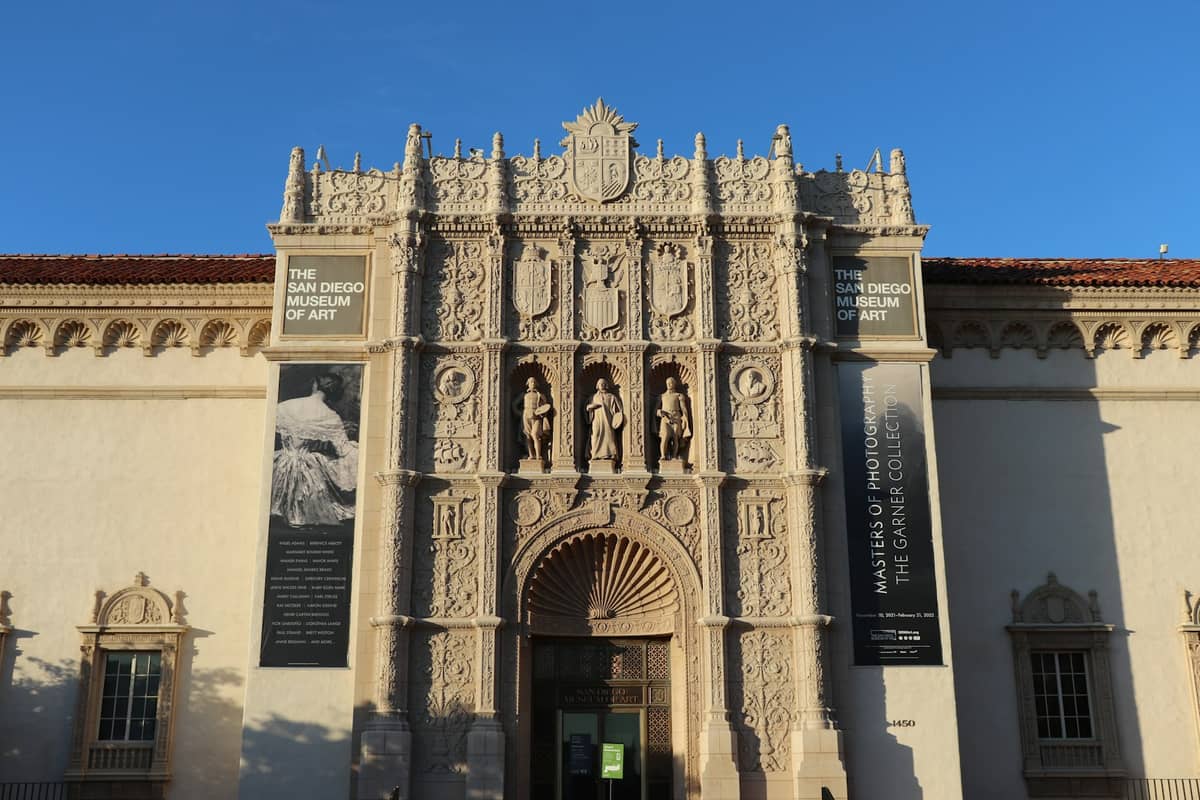
Before you think about the collection, take a moment with the exterior. The facade facing El Prado is a serious piece of architecture. Designed in the Spanish Colonial Revival style that gives Balboa Park much of its visual character, the building features an ornate plateresque facade with carved stone detailing, ironwork grilles, and a central tower that frames the main entrance. The stonework was crafted with an attention to surface texture that most visitors walk past without stopping to examine.
The building was later constructed in the wake of the 1915 Panama-California Exposition and subsequently expanded. It sits in direct visual conversation with the other Spanish Colonial buildings along El Prado, including the Botanical Building's reflecting pool a short walk to the west. Arriving on foot through the park rather than by car lets you approach the building as it was intended to be seen, from the pedestrian promenade with the surrounding greenery framing the facade.
If the architecture interests you, plan to walk the broader El Prado corridor as part of your visit. The Balboa Park Botanical Building and the Spreckels Organ Pavilion are both within a five-minute walk and represent the same architectural period.
What to Expect Inside
The entrance hall sets a formal tone: high ceilings, stone floors, and a central staircase. The galleries on the ground floor tend to cover European painting chronologically, with Spanish Golden Age works occupying a prominent position, which makes sense given San Diego's cultural ties to Spanish colonial history. The Latin American collection is among the stronger holdings and is worth seeking out specifically, as it includes works that get less attention than the European galleries but represent real acquisitions depth.
Upper floor galleries rotate more frequently, hosting traveling exhibitions that can change the character of a visit significantly. It is worth checking the current exhibition schedule on sdmart.org before you arrive, because a major traveling show can either be a compelling reason to visit or, depending on your interests, something to skip to keep focus on the permanent collection.
The sculpture court at the rear of the building is a quieter space than the main galleries and is often overlooked. It is an outdoor courtyard with works positioned around a central open area, and on a clear Balboa Park afternoon with light coming in from above, it is one of the more pleasant places to sit down and collect yourself mid-visit. The noise level drops noticeably once you step through from the main galleries.
ℹ️ Good to know
The museum is closed on Wednesdays. Hours are 10:00 a.m. to 5:00 p.m. Monday, Tuesday, Thursday, Friday, and Saturday. Sunday hours are 12:00 p.m. to 5:00 p.m. Verify holiday exceptions at sdmart.org before planning your trip.
How the Experience Changes Through the Day
Arriving at or shortly after opening, around 10:00 a.m. on a weekday, means near-empty galleries. The light inside the museum in the morning is flat and controlled by design, so time of day does not dramatically alter the interior experience the way it would at an outdoor site. What changes is the crowd density. By midday, particularly on weekends and during summer school holiday periods, tour groups and families move through the ground floor galleries in clusters, which can make sustained looking difficult in the more popular rooms.
Late afternoon, in the hour before the 5:00 p.m. closing, sees a notable drop in visitors. If you are combining the museum with a broader Balboa Park day, visiting the museum in the final two hours of operation and spending the first part of your day outdoors in the park is a practical approach, especially from June through September when daytime temperatures are comfortable enough to spend time outside.
Balboa Park as a whole rewards an extended visit. The San Diego Natural History Museum and the Fleet Science Center are both a short walk from the museum along El Prado, and the best museums in San Diego guide covers how to sequence them efficiently.
Getting There and Practical Logistics
The museum's address is 1450 El Prado, Balboa Park, San Diego, CA 92101. If you are coming from downtown San Diego, MTS bus routes connect to Balboa Park; the specific routes and schedules should be confirmed at sdmts.com before travel, as service patterns change. Rideshare drop-off works well if you are traveling from another neighborhood. Request drop-off near the El Prado entrance rather than the park perimeter to minimize walking.
Parking is available in several lots within Balboa Park, but on weekends and during events these fill early. Arriving before 10:30 a.m. on a weekend morning gives the best chance of finding a space near the museums. Street parking is also available around the park's edges, with shorter walks than they might appear on a map.
Wheelchair users and visitors with mobility equipment will find the museum fully accessible. An access ramp entrance is located at the east end of the museum's front facade. The flooring inside is smooth and gallery corridors are wide. Gallery label text is available online in both English and Spanish, which is a useful detail for Spanish-speaking visitors or families.
⚠️ What to skip
Balboa Park can get warm in summer, and the walk from some parking areas to the museum adds up. Wear comfortable shoes, bring water, and if you are visiting between June and September, plan outdoor time in the park for morning and museum time for midday or afternoon when it is cooler inside the air-conditioned galleries.
Photography and Visitor Behavior
Personal photography for non-commercial use is generally permitted in the permanent collection galleries without flash. Tripods are not permitted. Traveling exhibitions frequently have different photography restrictions, which are posted at the gallery entrance; pay attention to these as they are enforced. The sculpture court is one of the better photography locations in the building, with natural light and three-dimensional works that respond well to ambient conditions.
The museum's exterior is one of the most photographed facades in Balboa Park. The best light on the front of the building falls in the morning, when the sun is behind the photographer standing on El Prado. By midday and into afternoon, the facade moves into harsher overhead light. If the exterior is a photography priority, plan your approach accordingly.
Who Should Skip This
Travelers with a single day in San Diego and primary interests in beaches, outdoor activities, or the waterfront will likely find the time investment hard to justify against other priorities. The museum is not so exceptional at any single collecting area that it competes with a dedicated great collection in another city; if you are traveling from a major metropolitan area with a strong art museum, the permanent collection may feel familiar in range, if not in specific works.
Very young children find the museum difficult; the galleries require quiet and controlled movement that is hard for small children to sustain. Families with children under six should consider whether the nearby Fleet Science Center or the San Diego Zoo better match the group's needs.
For travelers trying to decide how to allocate time across Balboa Park's many institutions, the Balboa Park neighborhood guide sets out the full range of options.
Insider Tips
- The museum's sculpture court is accessible from inside the building but easy to miss if you follow the main gallery flow. Look for the passage at the rear of the ground floor and step outside into the courtyard even if you only stay five minutes.
- The second Thursday free admission program has been a recurring offer, but its availability changes. Check sdmart.org specifically for the current schedule before building your visit around it.
- If you are visiting Balboa Park across a full day, buy the museum ticket first and then spend your late morning in the park before returning to the galleries in the early afternoon when tour groups tend to clear out.
- Gallery label text for the permanent collection is available in Spanish online at sdmart.org, which is useful for Spanish-speaking visitors who want to engage with works more deeply.
- The Timken Museum of Art, a short walk east along El Prado, is free to enter and holds a small but genuinely strong collection of European old masters and American paintings. Pairing it with the San Diego Museum of Art adds minimal walking time and meaningful depth to a Balboa Park art day.
Who Is San Diego Museum of Art For?
- Art history enthusiasts who want a broad survey across European, American, Latin American, and Asian traditions
- Rainy-day visitors looking for a full half-day of indoor activity in Balboa Park
- Architecture watchers interested in the Spanish Colonial Revival buildings of the 1915 Panama-California Exposition
- Students and military personnel who benefit from free or reduced admission programs
- Travelers combining multiple Balboa Park museums into a single cultural day
Nearby Attractions
Other things to see while in Balboa Park:
- Botanical Building and Lily Pond
Built for the 1915 Panama-California Exposition, the Botanical Building and Lily Pond is one of Balboa Park's most photographed landmarks and one of San Diego's few genuinely free indoor plant experiences. The structure, historically billed as one of the largest wood lath buildings in the world, shelters over 2,100 plant varieties beneath a domed roof that filters light into something close to dusk at midday.
- Comic-Con Museum
Opened in November 2021, the Comic-Con Museum brings the legendary San Diego convention to life year-round in Balboa Park. Rotating exhibitions, interactive experiences, and deep dives into comics, film, and sci-fi make it a serious destination for pop culture fans, not just Comic-Con regulars.
- Fleet Science Center
The Fleet Science Center anchors the eastern edge of Balboa Park's museum row with interactive science exhibits, a giant-dome theater, and monthly planetarium evenings. It draws curious visitors of all ages, from toddlers tackling discovery stations to adults catching an IMAX-style documentary under a five-story screen.
- Japanese Friendship Garden
Tucked into about 12 acres of Balboa Park, the Japanese Friendship Garden & Museum is San Diego's dedicated space for Japanese landscape design, cultural art, and quiet reflection. Symbolizing the bond between San Diego and its sister city Yokohama, the garden rewards visitors with stone lanterns, koi ponds, a centuries-old bronze Kannon statue, and rotating museum exhibitions.