San Diego Natural History Museum (The Nat): Complete Visitor Guide
The San Diego Natural History Museum, known locally as The Nat, anchors the eastern end of Balboa Park's El Prado promenade with four exhibition floors of natural science focused on the Californias. From Cretaceous-era fossils to living desert ecosystems, the museum rewards curious visitors of all ages with genuine depth and well-organized exhibitions.
Quick Facts
- Location
- 1788 El Prado, Balboa Park, San Diego, CA 92101
- Getting There
- MTS Route 7 serves Balboa Park; confirm current routes at sdmts.com
- Time Needed
- 2 to 3.5 hours for a thorough visit; 90 minutes if focused on one or two floors
- Cost
- Adults $24.95, Youth (3–17) $16.95, Children 2 and under free (verify at sdnhm.org)
- Best for
- Families with school-age children, geology and paleontology enthusiasts, rainy-day visitors
- Official website
- www.sdnhm.org
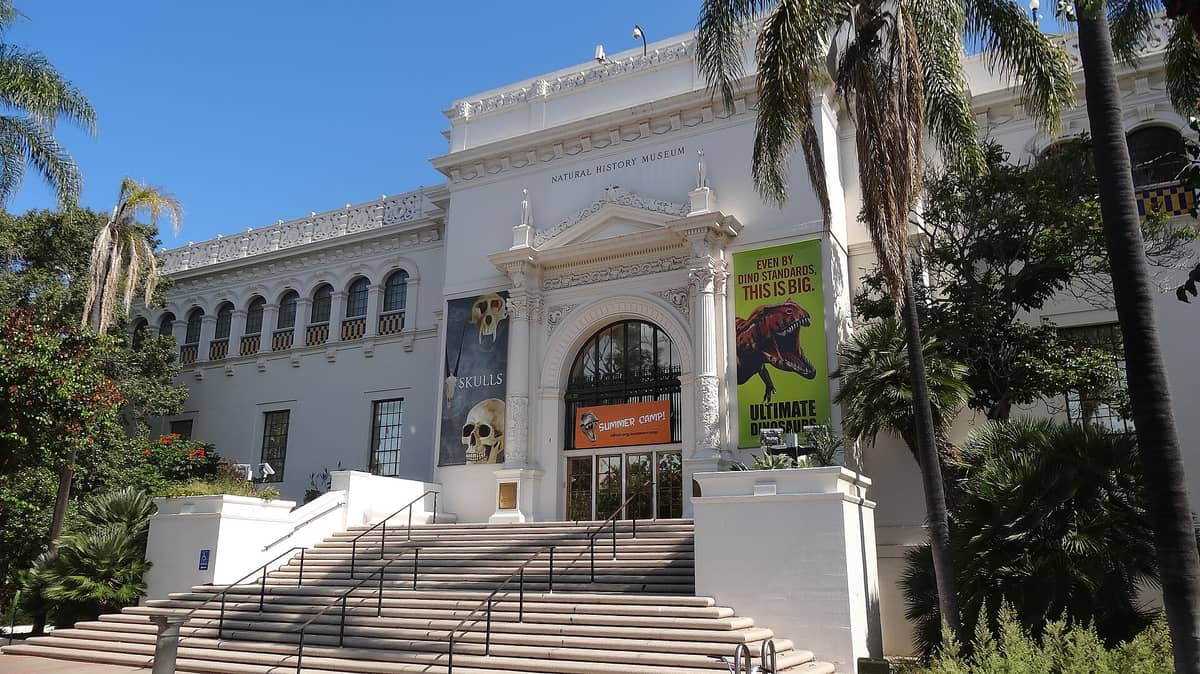
What The Nat Actually Is
The San Diego Natural History Museum, known locally as The Nat, is the oldest scientific institution in Southern California. Its roots go back to the San Diego Society of Natural History, founded in 1874, and the institution has grown steadily around a single geographic focus: the natural world of Southern California and the Baja California Peninsula. That regional specificity is what makes the museum more interesting than a generic natural history collection. Everything on display connects, directly or indirectly, to the landscape visible from San Diego's own coast and deserts.
The building itself is one of the more quietly impressive structures along El Prado, Balboa Park's main pedestrian corridor. Its neoclassical facade, with arched windows and a restrained ornamental cornice, anchors the eastern end of the promenade. Early morning, before the park fills, the cream-colored exterior catches southern light well and draws photographers before crowds arrive.
ℹ️ Good to know
Arrive a few minutes before 10:00 on busy weekends to avoid a queue at the admissions desk.
The Exhibitions: What You Will Actually See
The museum's permanent collection spans minerals, fossils, taxidermied specimens, entomology, and marine life, but the two exhibitions that consistently draw the most sustained attention are Coast to Cactus in Southern California and the paleontology galleries. Coast to Cactus is an immersive walk through eight distinct California ecosystems, from the kelp forest and rocky intertidal zone up through chaparral, oak woodland, and into the Sonoran Desert. The diorama-style displays are detailed enough that identifying individual plant species is genuinely possible, which makes the exhibition useful rather than purely decorative.
The fossil halls contain specimens drawn from San Diego County and Baja California, including marine reptiles, early whales, and a respectable dinosaur section. Children tend to slow down significantly here, and the labeling is clear enough that adults without a science background can follow the geological timelines without losing the thread.
The museum also hosts rotating special exhibitions, typically one or two running concurrently with the permanent galleries. These have historically covered topics like citizen science, gemstones, and wildlife photography. Check the museum's current calendar before visiting, since special exhibitions sometimes carry a separate admission supplement.
💡 Local tip
The Coast to Cactus and Extraordinary Ideas exhibitions contain wheelchair lifts that require a key from the Admissions Desk. If you are visiting with a mobility device, ask for the key at entry so you are not turned back mid-gallery.
How the Experience Changes by Time of Day
Opening time at 10:00 is the most comfortable window. The fossil halls and ground-floor lobby are calm, staff are attentive, and the large skylight in the atrium lets in the sharpest morning light. School groups typically arrive between 10:30 and 11:30, and they cluster in the dinosaur and marine sections. If you want uninterrupted time in the paleontology galleries, arrive at opening and move through them first.
Midday, particularly on school-holiday weekdays and weekends from November through March when San Diego draws visitors seeking indoor options during light rain, is the museum's busiest window. The lobby and ground-floor gift shop become congested. The upper floors, particularly the mineralogy section, stay noticeably quieter throughout the day because fewer visitors climb past the first two floors.
On select Fridays the museum runs Nat at Night events extending hours past the standard 17:00 close. These evenings have a noticeably different atmosphere: less family traffic, more adults, and sometimes a bar setup in the atrium. If an evening event overlaps with your visit, it is worth checking the schedule in advance since they occasionally require separate tickets.
Getting There and Navigating Balboa Park
The museum sits at the corner of Park Boulevard and Village Place in Balboa Park, with an accessible north entrance near a large Moreton Bay fig tree that is hard to miss once you are on El Prado. Paid parking is available in the East Parking Lot off Village Place and in the South Carousel Lot nearby. On busy weekends these fill quickly by late morning, so arriving before 10:30 or using MTS buses along Park Boulevard is practical. Route-specific transit information changes; always confirm current schedules at sdmts.com before your visit.
Rideshare drop-off along El Prado works well, and the walk from most Balboa Park parking areas to the museum entrance is flat and paved. The park itself has enough ground to cover that comfortable shoes matter more than they might seem.
If you are combining the museum with other Balboa Park stops, the San Diego Museum of Art and the Timken Museum of Art are a short walk west along El Prado. The Fleet Science Center is also nearby and shares the science-focused audience that tends to enjoy The Nat.
Accessibility and Practical Details
Wheelchairs are available at no charge from the Visitor Services Desk at the north entrance, subject to availability. The north entrance is the accessible entry point. Designated accessible parking spaces are in the east-side lot off Village Place and the South Carousel Lot. Service dogs are welcome on a non-retractable leash no longer than six feet, one per visitor.
For visitors who are hard of hearing, the Charmaine and Maurice Kaplan Theater is equipped with an infrared Assistive Listening System. Headsets can be requested at the north entrance desk. The museum's accessibility page provides the most current information on any temporary closures or lift availability, and it is worth checking before visiting if these accommodations are essential to your visit.
Weather, Seasonality, and When to Go
San Diego's Mediterranean climate, with its mild, mostly dry weather year-round, means The Nat is a reasonable choice in any month, but it genuinely earns its keep on the roughly 35 rainy days San Diego sees annually, concentrated mostly between November and March. On those gray winter days when outdoor alternatives lose their appeal, the museum fills up faster than usual. If you have flexibility and want a quieter experience, aim for a weekday in September or October, when summer-range temperatures persist but school groups have largely returned to schedules. For more context on how the city's seasons affect visitor planning, the best time to visit San Diego guide covers this in detail.
The museum is climate-controlled throughout, so temperature is not a factor once inside. What does matter in warmer months is that Balboa Park gets very warm by midday. If you plan to combine the museum with outdoor park time, do the outdoor portion first and retreat indoors after noon.
The Bottom Line
The Nat is not a grand sweep-everything national institution. Its strength is depth over breadth: if you are curious about why the Southern California landscape looks the way it does, or how the Baja Peninsula's ecosystems connect to San Diego's coast, the museum provides genuinely useful, well-sourced context. For general natural history with global scope, it will feel narrower than expected. Travelers who want something broader might find the best museums in San Diego guide useful for comparing options across the city.
The building's size means it is not exhausting in the way larger institutions can be. Most visitors cover the core permanent exhibitions in two to two-and-a-half hours, which leaves time and energy for the rest of Balboa Park.
Insider Tips
- The upper mineralogy and entomology floors are consistently less crowded than the ground-floor fossil and dinosaur sections. If peace and quiet matter, head upstairs first and work back down.
- The museum's Charmaine and Maurice Kaplan Theater screens films on natural history topics using a large format screen. Check the screening schedule when you buy tickets; a film can add useful context to the permanent exhibitions for relatively little extra time.
- Balboa Park's free Tram stops near the museum. If you park in one of the outer lots, take the tram in and walk back at your own pace rather than doing the reverse after a few hours on your feet.
- The San Diego Museum Council sells an Explorer Pass that covers entry to multiple Balboa Park museums. If you plan to visit two or more museums in the park, the pass typically offers meaningful savings over individual admissions. Verify current pricing and participating institutions at sandiegomuseumcouncil.org before your visit.
- The large Moreton Bay fig tree near the north entrance is worth a moment of attention. It is a specimen-quality tree with a canopy spread that photographs well and provides shade on warm days while waiting for your group to reassemble.
Who Is San Diego Natural History Museum For?
- Families with school-age children who can engage with paleontology, ecosystems, and hands-on displays without needing theme-park-level spectacle
- Geology and natural science enthusiasts who want regional specificity rather than a generalist overview
- Visitors with half a day in Balboa Park who want to pair a serious museum with the outdoor spaces of the park
- Rainy-day travelers looking for a substantive indoor option that justifies two to three hours
- Travelers interested in the natural relationship between San Diego and Baja California, a cross-border ecological connection rarely covered well elsewhere
Nearby Attractions
Other things to see while in Balboa Park:
- Botanical Building and Lily Pond
Built for the 1915 Panama-California Exposition, the Botanical Building and Lily Pond is one of Balboa Park's most photographed landmarks and one of San Diego's few genuinely free indoor plant experiences. The structure, historically billed as one of the largest wood lath buildings in the world, shelters over 2,100 plant varieties beneath a domed roof that filters light into something close to dusk at midday.
- Comic-Con Museum
Opened in November 2021, the Comic-Con Museum brings the legendary San Diego convention to life year-round in Balboa Park. Rotating exhibitions, interactive experiences, and deep dives into comics, film, and sci-fi make it a serious destination for pop culture fans, not just Comic-Con regulars.
- Fleet Science Center
The Fleet Science Center anchors the eastern edge of Balboa Park's museum row with interactive science exhibits, a giant-dome theater, and monthly planetarium evenings. It draws curious visitors of all ages, from toddlers tackling discovery stations to adults catching an IMAX-style documentary under a five-story screen.
- Japanese Friendship Garden
Tucked into about 12 acres of Balboa Park, the Japanese Friendship Garden & Museum is San Diego's dedicated space for Japanese landscape design, cultural art, and quiet reflection. Symbolizing the bond between San Diego and its sister city Yokohama, the garden rewards visitors with stone lanterns, koi ponds, a centuries-old bronze Kannon statue, and rotating museum exhibitions.