Timken Museum of Art: Old Masters, Free Admission, and No Crowds in Balboa Park
The Timken Museum of Art is one of San Diego's best-kept cultural secrets: a compact, free museum in Balboa Park housing genuine European Old Master paintings, 19th-century American works, and a rare collection of Russian icons. No tickets, no lines, no noise. Just art.
Quick Facts
- Location
- 1500 El Prado, Balboa Park, San Diego, CA 92101
- Getting There
- MTS Bus routes serving Balboa Park; rideshare drop-off at Park Blvd entrance
- Time Needed
- 45 minutes to 1.5 hours
- Cost
- Always free — no tickets required; walk-ins welcome and donations optional
- Best for
- Art lovers, quiet culture seekers, first-time Balboa Park visitors
- Official website
- www.timkenmuseum.org
What the Timken Museum of Art Actually Is
The Timken Museum of Art is a small, permanently free art museum positioned along El Prado, the main pedestrian promenade that runs through the heart of Balboa Park. Unlike the park's larger institutions, which charge admission and funnel visitors through ticketing queues, the Timken operates on a walk-in basis, every day it is open Wednesday through Sunday. No reservation. No fee. You simply push open the door and you are inside.
The collection is compact by design and by philosophy. The Timken holds European Old Master paintings spanning roughly the 14th through 18th centuries, a selection of 19th-century American paintings, and one of the more unusual offerings in any California museum: a dedicated gallery of Russian Orthodox icons. The total number of works on view at any given time is deliberately limited, so each piece receives proper wall space and proper light rather than being crowded into dense salon-style arrangements.
This is not the place to spend a full afternoon absorbing contemporary installations. It is the place to stand in front of a Rembrandt, a Rubens, or a Pieter de Hooch without jostling for position. If you are planning a broader Balboa Park day, the Timken fits naturally into an itinerary that also takes in the San Diego Museum of Art across the plaza or the Mingei International Museum a short walk away.
💡 Local tip
Walk-ins are genuinely welcome at any point during opening hours. There is no benefit to arriving right at 10 AM unless you want the galleries entirely to yourself, which is a reasonable reason.
The Collection: What You Will Actually See
The European Old Masters section is the anchor of the Timken's permanent holdings. Works here span the Northern European and Italian traditions, with examples from Dutch Golden Age painters, Flemish masters, and Italian Renaissance and Baroque artists. The quality is genuine: these are not reproductions or minor workshop pieces. The museum's partnership with the Putnam Foundation, which funds the collection, has allowed acquisitions that would be the centerpiece of much larger institutions.
The American painting collection covers the 19th century, a period when American artists were grappling seriously with landscape, portraiture, and the influence of European academicism. The works here complement what you might find at larger American art institutions, but at the Timken they are displayed without the visual noise of a sprawling permanent collection.
The Russian icon gallery is worth particular attention even for visitors who do not arrive with an interest in religious art. Orthodox icons follow precise compositional conventions — gold backgrounds, frontal figures, hierarchical scaling — and seeing a serious grouping of them in one gallery makes those conventions legible in a way that a single icon in a general collection rarely does. The Timken's holding is uncommon for a West Coast museum and represents a meaningful contribution to San Diego's cultural range.
Temporary exhibitions run alongside the permanent collection and are listed on the museum's website. These have varied in scope and subject; checking the exhibitions page before your visit takes about thirty seconds and tells you whether there is something additional beyond the permanent galleries.
The Building and Its Setting on El Prado
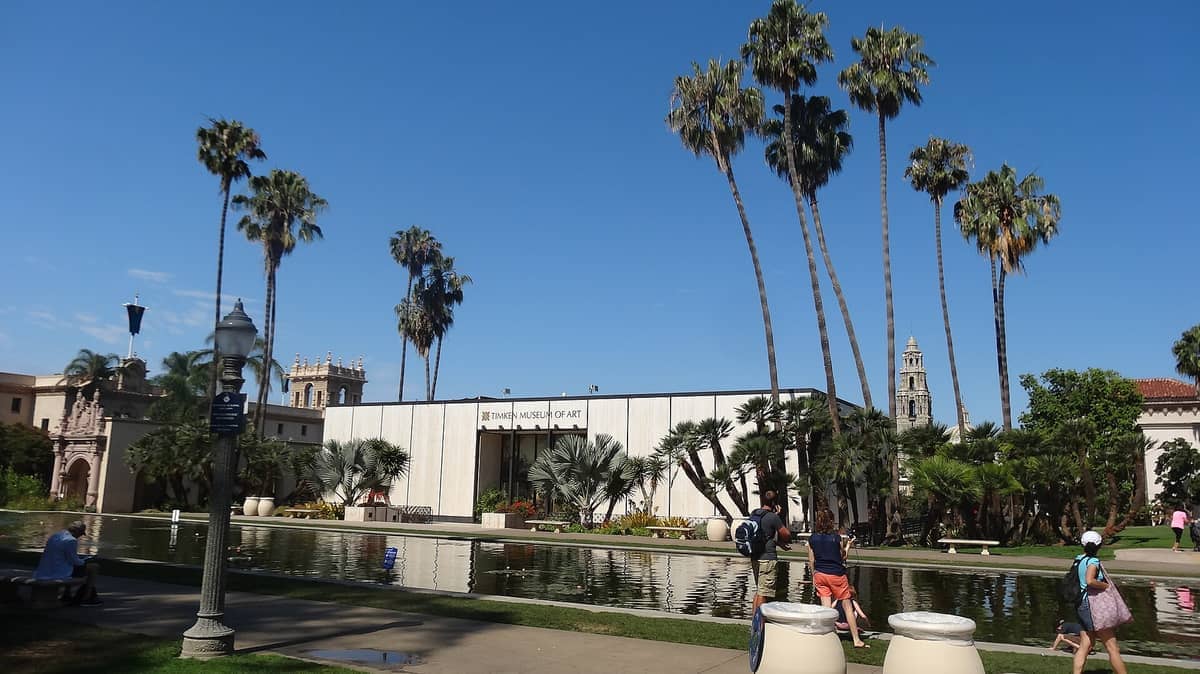
The Timken's building is architecturally distinctive within Balboa Park. Most of the park's major cultural buildings were constructed in a Spanish Colonial Revival style for the 1915 Panama-California Exposition and its 1935 sequel, producing the ornate facades, arcaded walkways, and terra cotta rooflines that characterize El Prado. The Timken, by contrast, was built in 1965 in a modernist idiom: clean horizontal lines, travertine marble cladding, and large glass panels that admit controlled natural light into the galleries.
This stylistic contrast is not a flaw. Standing on El Prado, the Timken reads as a quiet counterpoint to the decorative exuberance of its neighbors. The building's restraint signals its interior purpose: a place designed around the art rather than around architectural spectacle. The travertine exterior ages gracefully in San Diego's dry climate, and the proportions of the structure are modest enough that it does not overwhelm the pedestrian scale of the promenade.
The museum sits directly across from the Botanical Building's reflecting pool, one of the most photographed spots in the park. If you are approaching from the Cabrillo Bridge entrance, you will pass the reflecting pool before reaching the Timken. The Balboa Park Botanical Building is worth a few minutes on its own before or after your museum visit.
When to Visit and How the Experience Changes by Time of Day
Weekday mornings between opening at 10 AM and around noon are the quietest periods. At this time the galleries can hold only a handful of visitors simultaneously, which means you can take your time in front of any single work without feeling pressured to move along. The light inside the galleries is consistent throughout the day due to controlled artificial lighting, so there is no particular optical advantage to arriving at one hour versus another.
Weekend afternoons, particularly Saturday afternoons in spring and summer, bring a noticeable increase in visitor numbers as Balboa Park fills with families and tourists. The Timken never becomes chaotic the way a blockbuster exhibition at a major metropolitan museum does, but the galleries are small enough that fifteen or twenty people distributed through them creates a meaningfully different atmosphere than five. If quiet contemplation is your priority, a Wednesday or Thursday morning is the reliable choice.
The first Saturday of each month features free ASL-enhanced museum tours, which are organized specifically for visitors who use American Sign Language. These tours run alongside general visiting and do not require separate registration; checking the museum's visit page for timing is advisable if you plan to attend.
ℹ️ Good to know
The museum is open Wednesday through Sunday, 10:00 AM to 5:00 PM. It is closed Monday and Tuesday, and on New Year's Day, July 4th, Veterans Day, Thanksgiving, and Christmas. Hours are subject to change for special events; verify on the official site before visiting.
Getting There and Practical Logistics
The Timken's address is 1500 El Prado, within Balboa Park. If you are arriving by car, the park has several parking areas; the most convenient for El Prado is the lot near the Museum of Man. Parking within Balboa Park is generally free, though availability on weekends can require a short walk from wherever a space opens up.
San Diego MTS bus routes serve Balboa Park from downtown and surrounding neighborhoods. Rideshare services (Uber and Lyft both operate throughout San Diego) can drop you at the Park Boulevard entrance, from which it is a comfortable five-to-ten minute walk along El Prado to the museum. If you are staying in or near downtown, the walk from the Gaslamp Quarter through Balboa Park's main entrance is approximately fifteen to twenty minutes and passes through attractive parkland.
Balboa Park is a large destination in its own right, and the Timken is one component of it. Spending a full day in the park is entirely reasonable. For a structured approach to the park's cultural institutions, the best museums in San Diego guide covers how to sequence visits efficiently.
Accessibility
The Timken has invested seriously in accessibility. All public areas of the building are accessible to visitors using wheelchairs, walkers, scooters, or other mobility equipment. An access ramp entrance is located to the left of the main entrance. A limited number of wheelchairs are available free of charge at the museum, loaned on a first-come basis.
Large-print labels are available throughout the galleries. The museum also provides EnChroma glasses, designed to assist visitors with color vision deficiencies, which is an accommodation that remains relatively rare among American art museums. Trained service animals are permitted throughout the building. ASL-enhanced tours, as noted, run on the first Saturday of each month.
Who Should Adjust Their Expectations
Travelers who prefer large encyclopedic museums with ancient artifacts, contemporary art, or immersive experiences will not find those things here. The Timken is a single-building institution with a focused collection covering a specific period and tradition. If you need a full day of varied content from a single museum, this is not that museum.
Visitors with young children who are not yet engaged with Old Master painting or Byzantine icon traditions may find the galleries less appealing than interactive science or natural history institutions nearby. The space is quiet and the art requires stillness. That said, the free admission and short visit time make it an easy add-on without risk.
Families looking for child-oriented programming in Balboa Park will find more structured options at the Fleet Science Center, which is also within the park.
Insider Tips
- The museum's free admission is not a promotional period or a special day — it is the permanent policy. You will not be asked for a suggested donation at the door. Walk in, pick up a gallery map, and go straight to whatever interests you.
- The Russian icon gallery tends to be the quietest in the building even on busier weekend days, possibly because many visitors move quickly through it without recognizing what they are looking at. Spend time here: the craftsmanship in the gilded grounds and the theological logic of the compositions repay close attention.
- Because the building is small and climate-controlled, it makes an effective refuge on days when Balboa Park is particularly warm or when one of San Diego's rare rainy-season drizzles arrives. The park's outdoor attractions lose their appeal in light rain; the Timken does not.
- The plaza immediately outside the Timken, facing the Botanical Building's reflecting pool, is one of the calmer spots on El Prado in the late afternoon once tour groups have moved on. The combination of the pool's reflections and the low sun angle makes for good photography after 3 PM.
- Check the exhibitions page before your visit. The Timken occasionally presents focused temporary shows that recontextualize works from the permanent collection alongside loans from other institutions. These exhibitions change the feel of the galleries substantially and are worth timing a visit around if one coincides with your trip.
Who Is Timken Museum of Art For?
- Art history enthusiasts who want unobstructed time with genuine Old Master paintings
- Travelers adding a cultural component to a Balboa Park day without spending additional money
- Visitors interested in religious art traditions, particularly Eastern Orthodox iconography
- Anyone seeking a quiet, unhurried museum experience away from large crowds
- Accessibility-conscious travelers who need wheelchair access and inclusive accommodations
Nearby Attractions
Other things to see while in Balboa Park:
- Botanical Building and Lily Pond
Built for the 1915 Panama-California Exposition, the Botanical Building and Lily Pond is one of Balboa Park's most photographed landmarks and one of San Diego's few genuinely free indoor plant experiences. The structure, historically billed as one of the largest wood lath buildings in the world, shelters over 2,100 plant varieties beneath a domed roof that filters light into something close to dusk at midday.
- Comic-Con Museum
Opened in November 2021, the Comic-Con Museum brings the legendary San Diego convention to life year-round in Balboa Park. Rotating exhibitions, interactive experiences, and deep dives into comics, film, and sci-fi make it a serious destination for pop culture fans, not just Comic-Con regulars.
- Fleet Science Center
The Fleet Science Center anchors the eastern edge of Balboa Park's museum row with interactive science exhibits, a giant-dome theater, and monthly planetarium evenings. It draws curious visitors of all ages, from toddlers tackling discovery stations to adults catching an IMAX-style documentary under a five-story screen.
- Japanese Friendship Garden
Tucked into about 12 acres of Balboa Park, the Japanese Friendship Garden & Museum is San Diego's dedicated space for Japanese landscape design, cultural art, and quiet reflection. Symbolizing the bond between San Diego and its sister city Yokohama, the garden rewards visitors with stone lanterns, koi ponds, a centuries-old bronze Kannon statue, and rotating museum exhibitions.