Japanese Friendship Garden & Museum: A Tranquil Escape Inside Balboa Park
Tucked into about 12 acres of Balboa Park, the Japanese Friendship Garden & Museum is San Diego's dedicated space for Japanese landscape design, cultural art, and quiet reflection. Symbolizing the bond between San Diego and its sister city Yokohama, the garden rewards visitors with stone lanterns, koi ponds, a centuries-old bronze Kannon statue, and rotating museum exhibitions.
Quick Facts
- Location
- 2215 Pan American Road E, Balboa Park, San Diego, CA 92101
- Getting There
- Free parking in Balboa Park lots; MTS Bus Route 7 serves Park Blvd nearby
- Time Needed
- 1.5 to 2.5 hours
- Cost
- $16 adults; $14 students, seniors (65+), active military; free for children 6 and under; free for San Diego residents on the 3rd Tuesday of each month
- Best for
- Couples, photography enthusiasts, culture seekers, and anyone wanting calm away from busier Balboa Park crowds
- Official website
- www.niwa.org
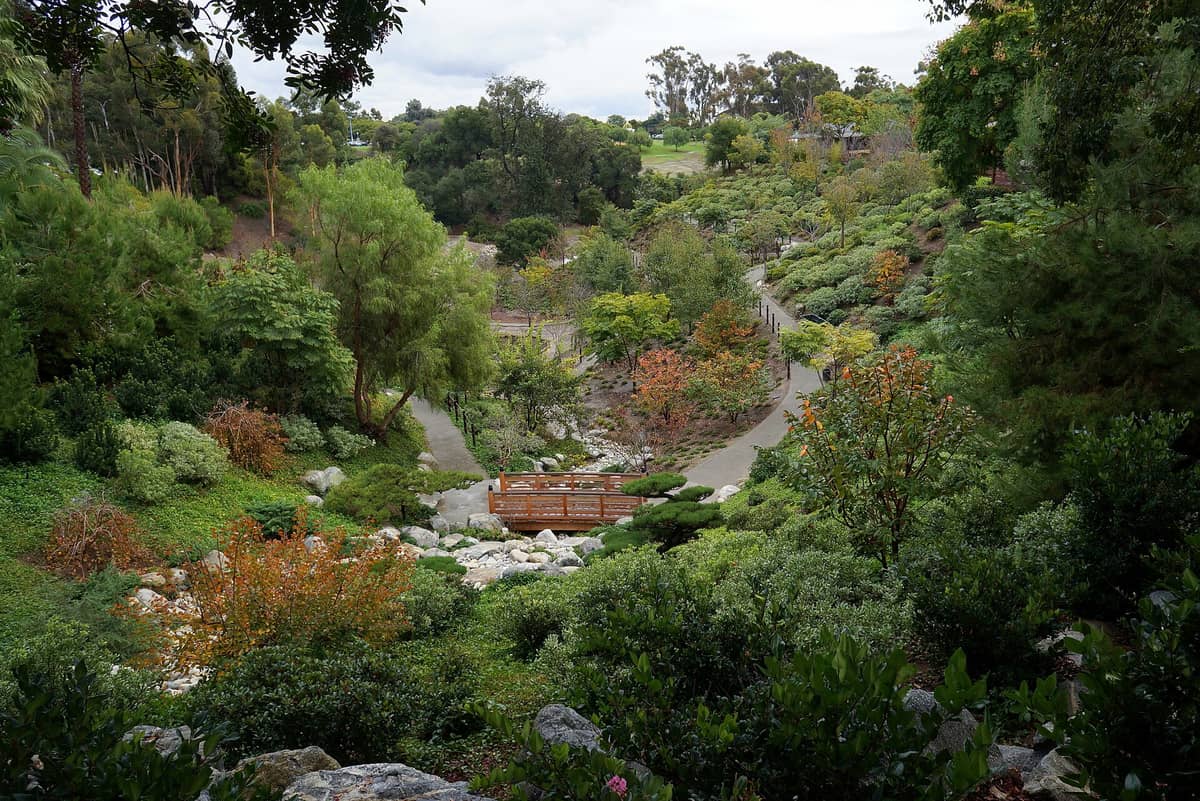
What Is the Japanese Friendship Garden?
The Japanese Friendship Garden & Museum is a cultural garden and exhibition space occupying roughly 12 acres within Balboa Park. It exists as a living symbol of the sister-city relationship between San Diego and Yokohama, Japan, a bond formalized in 1957 that continues to shape the garden's programming, design philosophy, and rotating cultural exhibitions. The garden is operated under the name Niwa, the Japanese word for garden, and its official site uses that branding.
Unlike the manicured lawns and Spanish Colonial facades that dominate Balboa Park's central promenade, this garden occupies a canyon-edged section of the park and feels genuinely separate from the rest of the complex. The transition from the busy Prado walkway to the garden entrance is almost immediate: the ambient noise drops, foot traffic thins, and the design deliberately slows your pace.
ℹ️ Good to know
Hours: Daily 10:00 a.m. to 6:00 p.m., with last admission at 5:00 p.m. On the 3rd Tuesday of each month, San Diego residents enter free with proof of residency; hours shift to 10:00 a.m. to 5:00 p.m. on those days, with last admission at 4:00 p.m. Always verify current hours at niwa.org before visiting, as they adjust for special events and major U.S. holidays.
The Garden's Key Features
The most striking single object in the garden is a bronze Kannon statue, a figure of the Buddhist bodhisattva of compassion that is approximately 280 years old. Its age and patina put it in a different category from anything ornamental: this is a genuine artifact, and standing near it creates a different quality of attention than the rest of the landscape design.
Beyond the Kannon, the garden layers a koi pond with wooden footbridges, stone lanterns at intervals along the paths, a traditional dry sand-and-rock garden, a tea pavilion, a bonsai collection, and a waterfall feature fed into the canyon. Each zone corresponds to a recognizable tradition in Japanese landscape architecture: the karesansui dry garden for contemplation, the water garden for movement and sound, and forested hillside paths that create changes in elevation as you walk.
The museum component hosts rotating exhibitions on Japanese art, craft, and cultural history. These change seasonally and vary considerably in content, so the indoor gallery is worth checking before your visit if that component matters to you. The permanent outdoor landscape is the consistent draw regardless of what is installed inside.
How the Experience Changes by Time of Day
Morning visits, particularly before noon on weekdays, offer the garden at its quietest. The koi in the main pond are active and visible near the surface, the stone paths are cool underfoot, and the sound of water from the falls carries clearly without being masked by crowd noise. Birdlife is more active in the canyon section at this hour, and the light through the trees falls at a low angle that photographers tend to prefer.
By early afternoon on weekends, visitor numbers increase noticeably. The paths around the koi pond and near the Kannon statue become congested enough that the sense of quiet gets harder to maintain. That said, the garden is large enough that moving further into the canyon section or along the hillside trail reliably recovers some solitude.
Late afternoon, in the hour before last admission, brings warm directional light over the western edge of the canyon. This is a productive window for photography: the stone lanterns and the surface of the pond both catch this light well. The crowd has usually thinned by 4:30 p.m. on most days. On San Diego's coastal schedule, the garden rarely feels oppressively hot; summer afternoons here usually reach the low-to-mid 70s°F near the coast, though Balboa Park sits slightly inland and can run a few degrees warmer.
💡 Local tip
Photography tip: The koi pond reflects best in the morning when the water surface is undisturbed. The bronze Kannon photographs well in indirect light rather than direct midday sun, which flattens the surface detail on the aged metal.
Historical and Cultural Context
The garden's roots connect to the 1915 Panama-California Exposition that originally shaped much of Balboa Park's current layout, though the Japanese Friendship Garden in its present form developed over decades following the San Diego-Yokohama sister-city agreement. Yokohama is Japan's second-largest city by population and one of its principal port cities, making the pairing with San Diego, also a major Pacific port, a coherent diplomatic match.
Japanese garden design, particularly in the tradition represented here, is not primarily about botanical rarity. It is about controlled composition: the placement of rocks, water, and plants to create a landscape that evokes rather than replicates. Each element in a classical Japanese garden carries meaning, and the proportions between open space and planted areas are as deliberate as anything you'd find in a formal European garden, just governed by entirely different aesthetic principles. Visitors who understand this tend to slow down and get considerably more from the experience.
The garden sits adjacent to the Spreckels Organ Pavilion and is within easy walking distance of the Mingei International Museum, which frequently shows craft-focused exhibitions from across Asia and the Pacific. Combining the two in a single afternoon adds cultural depth to either visit.
Getting There and Getting Around Inside
Balboa Park's parking is free, and there are several lots accessible from Park Boulevard and Cabrillo Freeway (I-163). The closest lot to the Japanese Friendship Garden is the one near the Organ Pavilion, off Pan American Road. On weekends and during Balboa Park's busier summer months, these lots fill up, but overflow space is usually available in the north end of the park with a slightly longer walk.
MTS Bus Route 7 runs along Park Boulevard on the east side of Balboa Park and is a practical option from downtown San Diego. From the Park and University bus stop, the walk to the garden entrance is around 10 to 15 minutes through the park. The San Diego Trolley does not stop directly at Balboa Park, but the City College station on the Blue and Orange Lines connects by bus to Balboa Park in about 6 minutes rather than a 20-minute walk.
Inside the garden, paths include both paved and gravel surfaces. There is elevation change as the trail descends into the canyon section. This is worth knowing if anyone in your group uses a wheelchair or has limited mobility: the flat sections near the entrance and around the main pond are generally accessible, but the hillside trail and some canyon-edge paths are steeper. Contact the garden directly at niwa.org for current accessibility details before visiting with specific mobility needs.
⚠️ What to skip
The garden's paths include gravel and sloped terrain in the canyon section. Comfortable closed-toe shoes are a practical choice. Sandals and dress shoes can be slippery on the gravel paths after morning fog or light rain.
Weather and Seasonal Considerations
San Diego's Mediterranean climate means this garden is visitable year-round without significant weather risk. Summer mornings occasionally bring coastal fog, which clears by mid-morning and can actually create a moody, atmospheric quality in the garden before it burns off. Autumn, specifically September through November, tends to offer the sharpest light and the most stable conditions, with average daytime temperatures in the low-to-mid 70s°F and almost no rainfall.
Winter visits, from December through February, bring the garden's quietest crowds. Rain is possible (San Diego averages around 10 to 11 inches annually, concentrated in winter), and a light rain can actually be one of the more rewarding times to visit: the stone surfaces darken, the sound of rainfall on the pond surface adds another layer to the garden's acoustic environment, and visitor numbers drop sharply. Bring a light rain jacket and you will have much of the space to yourself.
Spring, particularly March through May, is when the garden's planted areas show the most active growth and color. This aligns well with the rest of Balboa Park's busier season, so pairing a morning at the Japanese Friendship Garden with an afternoon visit to the San Diego Museum of Art or the Balboa Park Botanical Building makes for a full day in the park without needing a car between stops.
Honest Assessment: Is It Worth Your Time?
At $16 for general admission, the Japanese Friendship Garden is one of the pricier individual attractions in Balboa Park, which has many free or low-cost options. Whether it justifies the cost depends almost entirely on what you want from it. If you are looking for a stimulating, dense attraction with lots to read and do, it will probably feel slow. If you want somewhere to genuinely decompress, think clearly, or engage with Japanese cultural aesthetics in a well-maintained setting, it earns its fee.
The 12-acre size means there is more to explore than the garden's reputation suggests. First-time visitors who spend less than 90 minutes here typically haven't reached the canyon section or the hillside trail, which are the parts that differentiate this garden from a smaller ornamental installation. Giving it two hours changes the experience considerably.
Travelers building a multi-stop Balboa Park day should consider this alongside the park's broader cultural offerings. The best museums in San Diego guide covers the full range of what Balboa Park contains, which helps with prioritization if you are choosing between several options.
People who may want to skip this: visitors with very young children who need high-stimulation activities, travelers on tight budgets who have already allocated museum spend elsewhere in the park, and anyone who finds slow, contemplative walking inherently frustrating. The garden is not a theme park, and it does not try to be.
Insider Tips
- The 3rd Tuesday free admission for San Diego residents (with proof of residency) runs on reduced hours, with last admission at 4:00 p.m. rather than 5:00 p.m., so arrive before 2:30 p.m. to have comfortable time.
- The canyon section in the lower third of the garden is often entirely empty even when the entrance area and koi pond are moderately busy. Walk past the main features and descend the trail for near-solitude.
- If you are visiting Balboa Park across multiple days, the park's Explorer Pass bundles admission to several museums and gardens, which can reduce the per-attraction cost below the walk-up price.
- The bonsai exhibit near the pavilion area changes its displayed specimens periodically. If bonsai is a specific interest, check the garden's social media before visiting to see what is currently on display.
- Parking along Pan American Road West, on the street near the Organ Pavilion, is often free and more reliably available than the main park lots on busy weekend mornings.
Who Is Japanese Friendship Garden For?
- Couples looking for a quiet, scenic hour away from Balboa Park's main crowds
- Photography enthusiasts interested in landscape composition, water reflections, and aged bronze sculpture
- Travelers with an interest in Japanese art, design history, or the Pacific cultural connections between San Diego and Japan
- Anyone seeking sensory contrast after a busy stretch of urban sightseeing
- Visitors combining a full Balboa Park day with cultural depth across multiple institutions
Nearby Attractions
Other things to see while in Balboa Park:
- Botanical Building and Lily Pond
Built for the 1915 Panama-California Exposition, the Botanical Building and Lily Pond is one of Balboa Park's most photographed landmarks and one of San Diego's few genuinely free indoor plant experiences. The structure, historically billed as one of the largest wood lath buildings in the world, shelters over 2,100 plant varieties beneath a domed roof that filters light into something close to dusk at midday.
- Comic-Con Museum
Opened in November 2021, the Comic-Con Museum brings the legendary San Diego convention to life year-round in Balboa Park. Rotating exhibitions, interactive experiences, and deep dives into comics, film, and sci-fi make it a serious destination for pop culture fans, not just Comic-Con regulars.
- Fleet Science Center
The Fleet Science Center anchors the eastern edge of Balboa Park's museum row with interactive science exhibits, a giant-dome theater, and monthly planetarium evenings. It draws curious visitors of all ages, from toddlers tackling discovery stations to adults catching an IMAX-style documentary under a five-story screen.
- Mingei International Museum
Dedicated to folk art, craft, and design from cultures across the globe, Mingei International Museum occupies a 41,000-square-foot landmark in Balboa Park. With a rotating mix of textile, ceramic, furniture, and everyday-object exhibitions, it rewards slow, deliberate visitors who appreciate the handmade and the human.