Botanical Building and Lily Pond: Balboa Park's Free Greenhouse Worth Your Time
Built for the 1915 Panama-California Exposition, the Botanical Building and Lily Pond is one of Balboa Park's most photographed landmarks and one of San Diego's few genuinely free indoor plant experiences. The structure, historically billed as one of the largest wood lath buildings in the world, shelters over 2,100 plant varieties beneath a domed roof that filters light into something close to dusk at midday.
Quick Facts
- Location
- 1550 El Prado, Balboa Park, San Diego, CA 92101
- Getting There
- MTS Bus routes serve Balboa Park; parking lots available on-site within the park
- Time Needed
- 30–60 minutes for the building and pond; pair with nearby gardens for a half-day
- Cost
- Free admission — no tickets or reservations required
- Best for
- Plant lovers, photographers, families, and anyone wanting a quiet break in the park
- Official website
- balboaparkbotanical.org
What the Botanical Building Actually Is
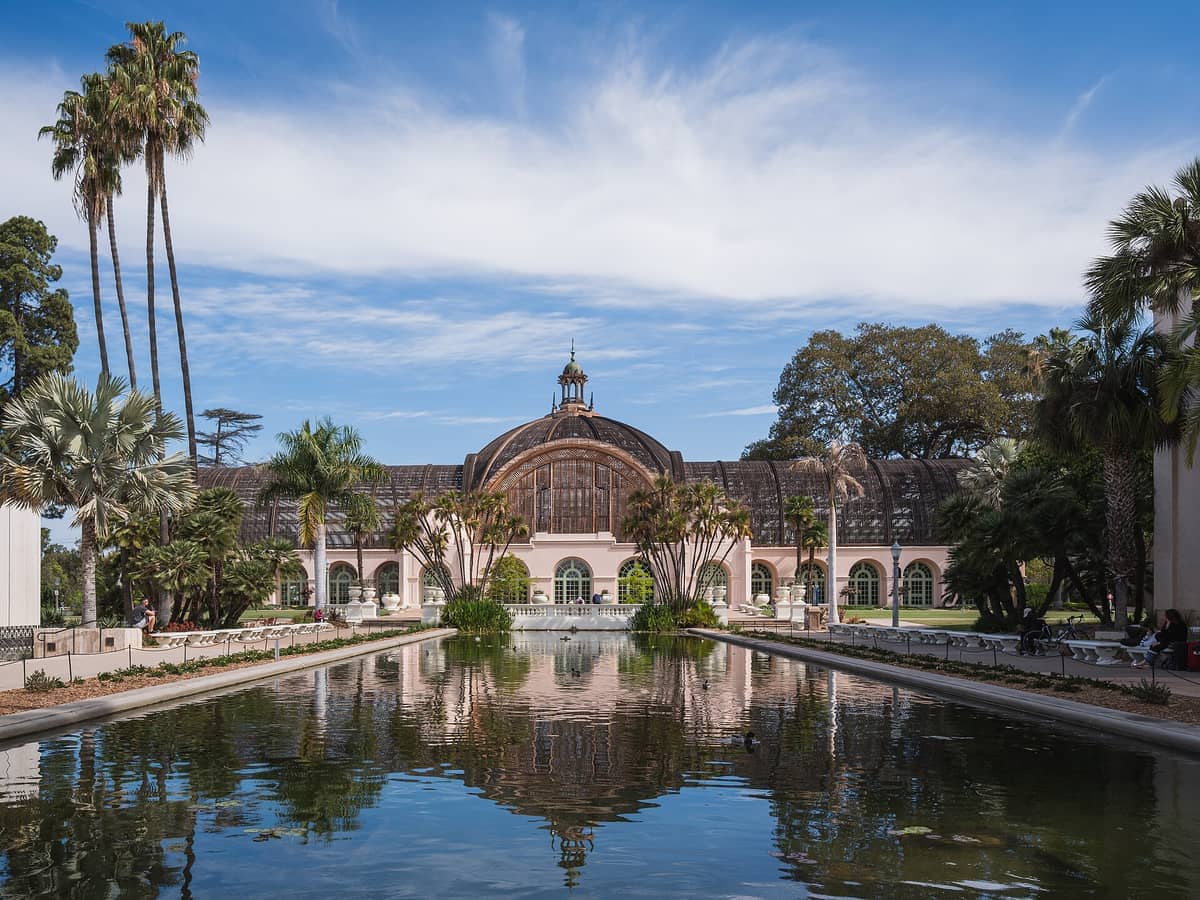
The Botanical Building and Lily Pond sits along El Prado, the grand pedestrian promenade that runs through the heart of Balboa Park. From a distance, the structure reads as a long, cathedral-shaped cage of redwood lath strips, its open lattice casting a dappled grid of shadows over the path and the wide reflecting pond in front of it. Up close, the scale surprises most first-time visitors: the building stretches roughly 250 feet in length, 75 feet wide, and climbs about 60 feet to the peak of its central dome. When it was completed in 1915, it was promoted as the largest wood lath structure in the world.
The building was designed for the 1915-1916 Panama-California Exposition, a world's fair held in San Diego to celebrate the opening of the Panama Canal. The concept came from Alfred D. Robinson, with architectural work handled under Bertram Goodhue and Carleton M. Winslow Sr. The lath construction was deliberate: the overlapping redwood strips filter direct sunlight into a diffuse, low-intensity glow that suits tropical and subtropical plants that cannot tolerate harsh Southern California sun. Inside, you will find more than 2,100 plants, including ferns, orchids, palms, and cycads, arranged along a central walkway that runs the full length of the building.
ℹ️ Good to know
Hours: Open 10:00 a.m. to 4:00 p.m. daily, but closed on City of San Diego holidays. Verify current hours at balboaparkbotanical.org before your visit, as post-renovation schedules have shifted on occasion.
The Lily Pond: More Than a Photo Opportunity
The rectangular lily pond in front of the building is roughly 193 feet long and is planted with giant Victoria water lilies, lotus, and papyrus. It functions as both an ecological feature and a mirror for the greenhouse behind it. On calm mornings, the reflection of the building's arched lath skeleton on the still water is essentially perfect, and the image has appeared on more postcards of San Diego than almost any other Balboa Park feature.
The pond is also a working habitat. Koi and goldfish cruise the shallows, turtles sun themselves on the lip of the concrete edges, and dragonflies move over the lily pads in summer and early autumn. Children tend to crouch at the water's edge to watch the fish, which respond readily to visitors gathering nearby. The pond edge is low and unfenced, so parents should keep an eye on very young children close to the water.
The water lily plants change noticeably by season. Peak bloom for the Victoria water lilies typically falls in summer and early autumn, when the enormous circular leaves can exceed six feet in diameter and white or pale-pink flowers open at the surface. In winter, the pond surface is quieter, the lilies reduced or absent, but the reflection of the building on the water is often sharper in the cooler, clearer air.
Inside the Building: What to Expect at Different Times
Stepping inside the Botanical Building from the bright San Diego midday is a minor sensory adjustment. The air is noticeably more humid than outside, carrying a light green, earthy smell — not unpleasant, more like a well-tended greenhouse than a botanical garden conservatory. The temperature stays relatively stable year-round, cooler than outside in summer, warmer than outside in winter. Natural light filters through the lath in shifting patterns depending on the angle of the sun.
The central walkway is wide enough for strollers and wheelchairs, though the path can narrow at bends where larger palm specimens have spread. Benches placed along the interior allow for sitting quietly, which some visitors do for extended periods. The ambient sound inside is mostly rustling leaves and muffled park noise from outside; on weekday mornings before noon, it can be genuinely quiet.
Weekends between 11:00 a.m. and 2:00 p.m. see the highest foot traffic, with tour groups occasionally moving through alongside families and couples. If you want the building nearly to yourself, aim for a weekday morning shortly after 10:00 a.m. opening, or on a winter afternoon when park attendance drops considerably. Fridays tend to be moderately busy; the Thursday closure catches some visitors off guard, so confirm the day before you go.
⚠️ What to skip
The building is open daily from 10:00 a.m. to 4:00 p.m., but closed on City of San Diego holidays. Arriving on a city holiday is the most common reason visitors find the doors locked. Check the schedule at balboaparkbotanical.org before you make it a centerpiece of your day.
Photography: When and Where to Shoot
The lily pond reflection shot works best in the morning, before foot traffic creates ripples on the water surface and while the light hits the building from a low eastern angle. The structure faces roughly south along El Prado, so mid-morning gives you a combination of clear sky, calm water, and warm light on the lath facade. By midday, the sun is too high for the reflection to hold much detail, and visitors are clustered along the pond edge.
Inside the building, the lath grid creates strong graphic shadows on the interior path and plant beds. Wide-angle shots looking down the central axis toward the far end capture the curved dome ceiling above the plants. Macro photography of orchid blooms or cycad fronds works well in the diffuse interior light, though a stabilized lens or tripod helps because the light levels are lower than they appear to the eye.
The building exterior photographed from the far end of the pond, with the dome centered in the frame, is the classic composition. Late afternoon in autumn casts warm golden light on the redwood lath from the west, giving the structure a richer color than morning shots. Overcast days also produce clean, reflection-friendly conditions at the pond.
Historical Context and Place in Balboa Park
The Botanical Building is one of several structures in Balboa Park that survive from the 1915 Panama-California Exposition. The park was purpose-built for the event and contains a concentration of Spanish Colonial Revival architecture that is unusual even by California standards. Most of the exposition buildings were constructed as temporary structures, but the Botanical Building and several of the permanent museum buildings along El Prado were built to last. The building underwent significant restoration work in recent years, closing for an extended period before reopening to the public.
The lath construction technique was not merely decorative or expedient. The building functions as a passive climate system: the overlapping wood strips block roughly half of incoming direct sunlight, reducing heat buildup while maintaining a semi-open airflow that prevents the extreme humidity of a glass conservatory. This makes it hospitable to a broader range of tropical and subtropical species than a sealed greenhouse would allow, while remaining comfortable for visitors without mechanical climate control.
Visitors interested in the broader museum and garden landscape around the building should know that the Japanese Friendship Garden is a short walk west, and the Spreckels Organ Pavilion — home to one of the world's largest outdoor pipe organs — sits just south of the Prado. Free Sunday concerts at the Spreckels Pavilion make a natural pairing with a morning visit to the Botanical Building.
Getting There and Practical Details
Balboa Park lies about two miles northeast of downtown San Diego and is accessible by car or public bus. Several free parking lots are distributed around the park perimeter; large visitor lots include Inspiration Point and the Organ Pavilion area off Presidents Way. Parking fills quickly on weekends, particularly between 10:00 a.m. and 1:00 p.m., so arriving before 10:00 a.m. or after 2:00 p.m. improves your chances of finding a space without circling.
San Diego MTS bus routes serve Balboa Park from downtown and surrounding neighborhoods. Uber and Lyft drop-offs work well at the park's El Prado entrance. For visitors combining the Botanical Building with other park institutions, the San Diego Museum of Art is directly adjacent, and the San Diego Natural History Museum faces El Prado from the opposite side. A single walk along El Prado connects most of the park's major institutions without backtracking.
Accessibility: The Botanical Building is a ground-level structure with paved walkways. The park maintains accessible paths connecting major attractions, and the Botanical Building itself is wheelchair-accessible. Visitors with mobility concerns should note that El Prado is a wide, flat pedestrian promenade, making the walk from parking or the park entrance manageable. After the recent restoration, interior conditions are reported to be in good repair, though visitors should verify current conditions before planning a visit around accessibility needs.
💡 Local tip
Pair this visit with the free Sunday 2:00 p.m. organ concerts at the Spreckels Organ Pavilion (a few minutes' walk south). The concerts draw a crowd but are a genuinely good use of an hour, and the Pavilion itself is architecturally interesting. Check the concert schedule through the City of San Diego Parks department.
The Bottom Line: Who Should Come and Who Might Skip It
The Botanical Building is not a world-class botanical garden in the sense of a large, curated scientific collection. If you have visited major conservatories at botanical institutions elsewhere, the plant collection here will feel modest in scope. The building's true distinction is architectural and contextual: the lath structure itself, the lily pond reflection, and the 1915 Exposition setting are what make this special. The plants are the interior texture, not the headline.
For travelers on a tight schedule, the stop takes 30 to 45 minutes and adds real visual variety to a Balboa Park morning without costing anything. Visitors who find slow, quiet spaces useful — people traveling with older adults, those who want a break from walking busy streets, parents with toddlers who need to decompress near water — tend to find it genuinely pleasant rather than merely photogenic.
Visitors with no interest in architecture, plants, or photography, and who are primarily focused on San Diego's beach neighborhoods or outdoor recreation, can reasonably skip this in favor of spending more time at La Jolla or along the coast. The Botanical Building rewards a contemplative pace; it does not suit visitors moving quickly through Balboa Park trying to check institutions off a list.
Insider Tips
- The lily pond reflection is sharpest on calm weekday mornings before 10:30 a.m. Even a light breeze after 11:00 a.m. disrupts the surface enough to soften the building's reflection significantly.
- The building used to close every Thursday, a detail still shown on some outdated third-party listings. As of the recent restoration it is open daily 10:00 a.m.–4:00 p.m., except on City of San Diego holidays, so always confirm current hours before you go.
- In summer, the Victoria water lilies bloom at night and close by mid-morning. If you want to see the flowers open rather than closed, be at the pond by 9:30 a.m. The giant circular pads are present all day, but the flowers are fleeting.
- The interior is quieter and cooler than the rest of the park on hot autumn afternoons, which makes it a useful rest stop in September and October when Balboa Park afternoons can reach the mid-70s with direct sun.
- The park's free tram runs along a circuit through Balboa Park and stops near the Botanical Building area. If you are visiting multiple institutions and want to avoid walking the full length of El Prado repeatedly, the tram reduces fatigue on longer visits.
Who Is Botanical Building and Lily Pond For?
- Photographers seeking the classic Balboa Park reflection shot at the lily pond
- Families with young children who are drawn to the koi, turtles, and water plants in the pond
- Travelers combining a full Balboa Park museum day and wanting a free, unhurried outdoor-indoor counterpoint
- Architecture and history enthusiasts interested in the surviving 1915 Panama-California Exposition structures
- Anyone who wants a genuinely quiet, shaded break in the middle of a warm park day
Nearby Attractions
Other things to see while in Balboa Park:
- Comic-Con Museum
Opened in November 2021, the Comic-Con Museum brings the legendary San Diego convention to life year-round in Balboa Park. Rotating exhibitions, interactive experiences, and deep dives into comics, film, and sci-fi make it a serious destination for pop culture fans, not just Comic-Con regulars.
- Fleet Science Center
The Fleet Science Center anchors the eastern edge of Balboa Park's museum row with interactive science exhibits, a giant-dome theater, and monthly planetarium evenings. It draws curious visitors of all ages, from toddlers tackling discovery stations to adults catching an IMAX-style documentary under a five-story screen.
- Japanese Friendship Garden
Tucked into about 12 acres of Balboa Park, the Japanese Friendship Garden & Museum is San Diego's dedicated space for Japanese landscape design, cultural art, and quiet reflection. Symbolizing the bond between San Diego and its sister city Yokohama, the garden rewards visitors with stone lanterns, koi ponds, a centuries-old bronze Kannon statue, and rotating museum exhibitions.
- Mingei International Museum
Dedicated to folk art, craft, and design from cultures across the globe, Mingei International Museum occupies a 41,000-square-foot landmark in Balboa Park. With a rotating mix of textile, ceramic, furniture, and everyday-object exhibitions, it rewards slow, deliberate visitors who appreciate the handmade and the human.