Spreckels Organ Pavilion: Free Concerts at Balboa Park's Iconic Outdoor Stage
Spreckels Organ Pavilion is a century-old outdoor concert venue in Balboa Park housing one of the largest outdoor pipe organs in the world. Free public performances run every Sunday year-round, with a summer festival on Monday evenings from July through early September.
Quick Facts
- Location
- 1549 El Prado, Balboa Park, San Diego, CA 92101
- Getting There
- Drive via Hwy 163 south to Park Blvd, then left onto President's Way. Parking lot directly behind the pavilion. Balboa Park tram also stops nearby.
- Time Needed
- 1 hour for a Sunday concert; 15–20 minutes if just visiting the structure
- Cost
- Free. Sunday concerts and Summer Organ Festival performances are open to the public at no charge.
- Best for
- Music lovers, families, picnickers, architecture admirers, and anyone seeking free entertainment in San Diego
- Official website
- www.spreckelsorgan.org
What Is Spreckels Organ Pavilion?
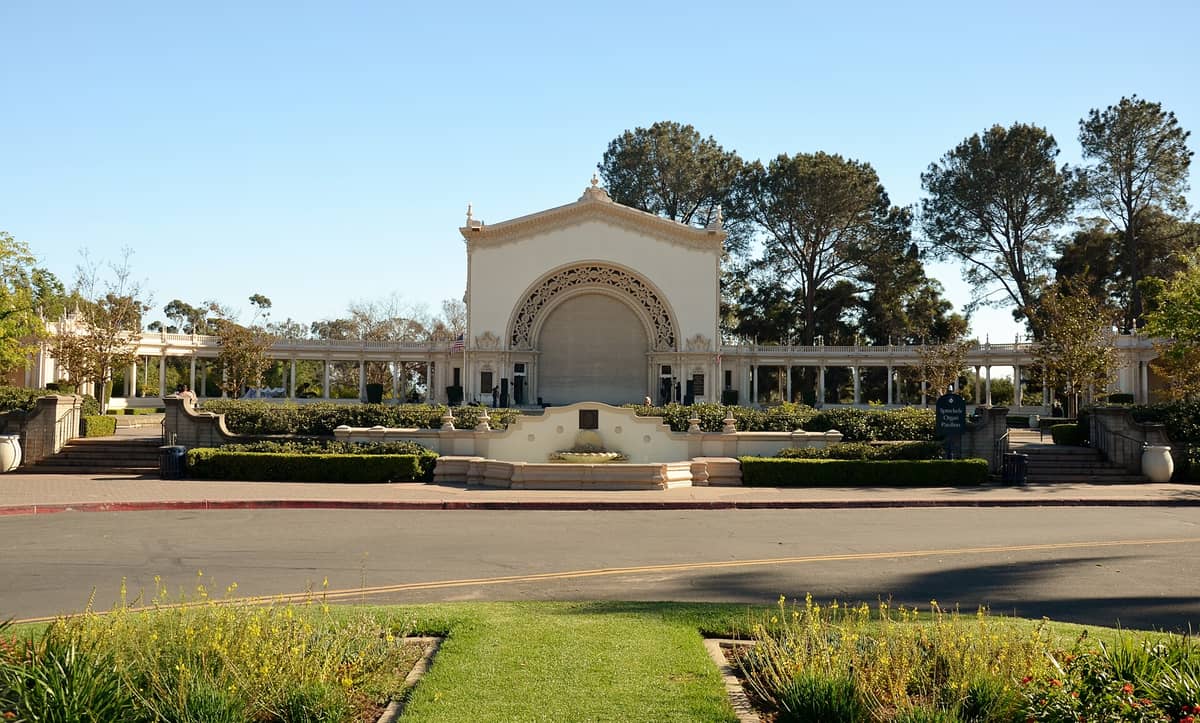
Spreckels Organ Pavilion is a grand, open-air performance space at the heart of Balboa Park, completed over a century ago and built to house one of the largest outdoor pipe organs in the world. The semicircular colonnade of white concrete arches frames an enormous stage and the towering organ case behind it, creating a focal point visible from much of the surrounding park promenade. It is not a venue that hides itself: the scale commands attention.
The pavilion sits on El Prado, the main cultural corridor of Balboa Park, surrounded by fountains, open lawns, and the facades of several major museums. On days without scheduled concerts, visitors still stop here to photograph the architecture, rest on the curved benches facing the stage, and let children run across the open plaza. The space functions as a gathering point even in silence.
💡 Local tip
Free Sunday concerts run every week from 2:00–3:00 p.m. Arrive 15–20 minutes early to claim a bench. Latecomers typically spread blankets on the surrounding lawn — which works well when the weather cooperates.
A Brief History Worth Knowing
The organ and pavilion were donated to the City of San Diego by sugar magnate John D. Spreckels and his brother Adolph in 1914, for the Panama-California Exposition that put Balboa Park on the international map. The instrument was conceived from the outset as a civic gift, designed for free public performance rather than ticketed events, a philosophy that has held for more than a century.
The instrument itself is a complex mechanical achievement. The organ contains thousands of pipes, ranging from small flute-sized whistles to pipes large enough to walk through, and its design had to account for San Diego's ocean air, temperature swings, and outdoor acoustics. Ongoing maintenance and restoration work has kept the instrument in playing condition across decades of use. The Spreckels Organ Society, a nonprofit organization that partners with the city, manages programming and preservation.
This context matters if you're visiting with curious travelers or older children. The pavilion isn't a replica or recreation: it's an original Beaux Arts structure from the same era as the buildings that line El Prado. For a broader look at that architectural landscape, the San Diego Museum of Art and the Mingei International Museum are a short walk away along the same promenade.
The Sunday Concert Experience
The weekly Sunday concert series is the main draw for most visitors. Performances run from 2:00 to 3:00 p.m. every Sunday throughout the year. The program typically rotates through classical repertoire, popular arrangements, Broadway music, and occasionally international folk pieces, depending on who is performing. The city's Civic Organist plays regularly, and guest organists appear throughout the year.
Sound at the pavilion carries surprisingly well. The curved colonnade acts as a natural acoustic shell, and seated visitors in the center benches get the fullest, most balanced sound. Visitors on the lawn to the sides still hear clearly; the volume drops off more noticeably at the far edges of the plaza. There is no amplification in the traditional sense: what you hear is the pipe organ projecting into open air.
The crowd on a typical Sunday afternoon skews multigenerational. You'll find older regulars who have attended for years seated toward the center, families with young children on the lawn, tourists working the performance into a broader Balboa Park afternoon, and the occasional music student taking notes. The atmosphere is unhurried. People arrive, settle, and then often linger after the final note, reluctant to move on.
ℹ️ Good to know
The San Diego International Summer Organ Festival runs on Monday evenings at 7:30 p.m., typically from mid-July through early September (the 2026 season runs July 13 – September 7). Evening concerts draw a different crowd and a slightly different mood: the light changes, the park quiets, and the music takes on a different quality as temperatures cool.
Visiting Outside of Concert Hours
The pavilion grounds are accessible daily from 8:00 a.m. to 10:00 p.m. At any hour outside of performances, the space is genuinely worth a few minutes. The scale of the colonnade reads differently up close than it does in photographs. The organ pipes are visible through the open stage, and the carved architectural details on the arches and railings reward close inspection.
Morning visits are quiet and photogenic. The plaza gets good light in the late morning, and the white concrete of the colonnade reflects warmly before midday. At this hour you'll likely share the space with joggers passing through, park staff, and the occasional photographer. By contrast, weekend afternoons before a Sunday concert see the plaza fill gradually, with vendors occasionally present near the perimeter.
If you're building a full Balboa Park itinerary, the pavilion pairs naturally with a walk along El Prado and visits to nearby attractions. The Botanical Building is a short stroll west, and the Fleet Science Center is just across the Plaza de Panama. Most visitors combine the organ pavilion with two or three museum stops and a meal in the park.
Practical Details for Your Visit
Getting There and Parking
The most direct driving route follows Highway 163 south to Park Boulevard, then left at the stoplight and left again onto President's Way. The Organ Pavilion parking lot sits directly behind the structure at the corner of President's Way and Pan American Road East. On Sunday afternoons before concerts, this lot fills quickly. Additional parking is available near the Comic-Con Museum and the Starlight Bowl nearby. The Balboa Park tram connects the main park entry areas to the pavilion zone, which helps on high-traffic days.
What to Bring
- A blanket or lightweight folding chair if you plan to sit on the lawn during a concert
- Sunscreen and sunglasses for afternoon Sunday performances in warmer months
- A light jacket for Monday evening summer concerts, when temperatures can drop noticeably after sunset
- Water — there is no concession stand inside the pavilion itself, though vendors sometimes operate near the perimeter
Accessibility
The pavilion is a city-run facility with a dedicated parking lot and access from surrounding pedestrian paths in the park. For specific information on seating arrangements, ramps, or assistive services, confirm directly with the Spreckels Organ Society or the City of San Diego before your visit, as detailed accessibility specifications are not published in current online sources.
Weather and Its Effect on the Experience
San Diego's Mediterranean climate means outdoor performances are viable nearly year-round. Concerts proceed rain or shine, though heavy rain (uncommon but possible between December and March) makes the open lawn seating uncomfortable. Winter Sunday afternoon concerts can feel chilly by the end of the hour, particularly in the shade of the colonnade. Summer Monday evenings are generally the most comfortable outdoor concert conditions in the city, with temperatures in the high 60s to low 70s Fahrenheit after sunset.
The Bottom Line: Who Should Come, and Who Might Not
For the cost of a Sunday afternoon and nothing more, you can hear a world-class instrument played live in one of the most architecturally distinctive outdoor settings in California. That is a genuinely unusual offer, and the Sunday concerts consistently deliver it. This is not an overhyped attraction.
That said, the experience depends heavily on the concert program. Visitors whose musical interests are narrow may find some programming less engaging. The pipe organ is a specific sound, and a full hour of it in any arrangement is not for everyone. Travelers who are indifferent to music and primarily visual in their interests will get reasonable value from a 15-minute architectural visit outside of concert hours, but they are unlikely to stay for a full performance.
Families with very young children can attend Sunday concerts, and the open lawn accommodates restless toddlers reasonably well. But if you're planning a fuller day of Balboa Park activities with kids, check out the broader San Diego with kids guide to sequence your visit efficiently.
Insider Tips
- For the best acoustics without the crowd, sit in the center section of the permanent curved benches rather than on the side lawn areas. The sound is noticeably fuller there, and you'll have a direct sightline to the organist.
- Monday evening Summer Organ Festival concerts feel more intimate than the Sunday matinees. The park is quieter after museum closing time, parking is easier, and the cooler air makes the seating more comfortable. Check the Spreckels Organ Society website for the current season's guest artist lineup before choosing which concert to attend.
- Photography of the pavilion structure is best in the late morning before midday. The white colonnade faces roughly south, and by early afternoon the arches are in partial shadow. A morning walk-through before a later afternoon concert gives you the best of both.
- The Balboa Park tram is genuinely useful on busy Sunday afternoons when the nearby parking lot fills before 1:30 p.m. Board near the main park entry on El Prado and it will drop you close to the pavilion without the parking stress.
- If you visit during the summer festival and want to stay for the full concert, bring an extra layer. Even in July and August, San Diego evenings cool quickly after sunset, and the open concrete of the plaza retains less heat than you might expect.
Who Is Spreckels Organ Pavilion For?
- Music lovers seeking a free, high-quality outdoor performance in a historic setting
- Families wanting a calm, accessible Balboa Park activity that doesn't require tickets
- Architecture and history enthusiasts interested in early 20th-century civic design
- Travelers building a full Balboa Park day who want a cultural centerpiece for the afternoon
- Couples looking for a relaxed Sunday afternoon that doesn't feel like a tourist checklist item
Nearby Attractions
Other things to see while in Balboa Park:
- Botanical Building and Lily Pond
Built for the 1915 Panama-California Exposition, the Botanical Building and Lily Pond is one of Balboa Park's most photographed landmarks and one of San Diego's few genuinely free indoor plant experiences. The structure, historically billed as one of the largest wood lath buildings in the world, shelters over 2,100 plant varieties beneath a domed roof that filters light into something close to dusk at midday.
- Comic-Con Museum
Opened in November 2021, the Comic-Con Museum brings the legendary San Diego convention to life year-round in Balboa Park. Rotating exhibitions, interactive experiences, and deep dives into comics, film, and sci-fi make it a serious destination for pop culture fans, not just Comic-Con regulars.
- Fleet Science Center
The Fleet Science Center anchors the eastern edge of Balboa Park's museum row with interactive science exhibits, a giant-dome theater, and monthly planetarium evenings. It draws curious visitors of all ages, from toddlers tackling discovery stations to adults catching an IMAX-style documentary under a five-story screen.
- Japanese Friendship Garden
Tucked into about 12 acres of Balboa Park, the Japanese Friendship Garden & Museum is San Diego's dedicated space for Japanese landscape design, cultural art, and quiet reflection. Symbolizing the bond between San Diego and its sister city Yokohama, the garden rewards visitors with stone lanterns, koi ponds, a centuries-old bronze Kannon statue, and rotating museum exhibitions.