Chicano Park: San Diego's Most Significant Outdoor Mural Site
Chicano Park is a National Historic Landmark tucked beneath the San Diego–Coronado Bridge in Barrio Logan, where more than 80 monumental murals cover the concrete pillars of a freeway overpass. Free to enter and open daily, it is one of the most culturally layered outdoor spaces in the American Southwest.
Quick Facts
- Location
- 1949 Logan Ave, Barrio Logan, San Diego, CA 92113 — beneath the San Diego–Coronado Bridge
- Getting There
- MTS Blue Line Trolley to Barrio Logan Station, then walk several blocks northeast toward Logan and National Avenues
- Time Needed
- 45 minutes to 2 hours depending on how closely you read the murals
- Cost
- Free (outdoor park and murals). Adjacent Chicano Park Museum: $8 general, $4 students/teachers, $3 community rate for local residents, under 18 free
- Best for
- History enthusiasts, art and photography lovers, anyone interested in Chicano culture and civil rights history
What Chicano Park Actually Is
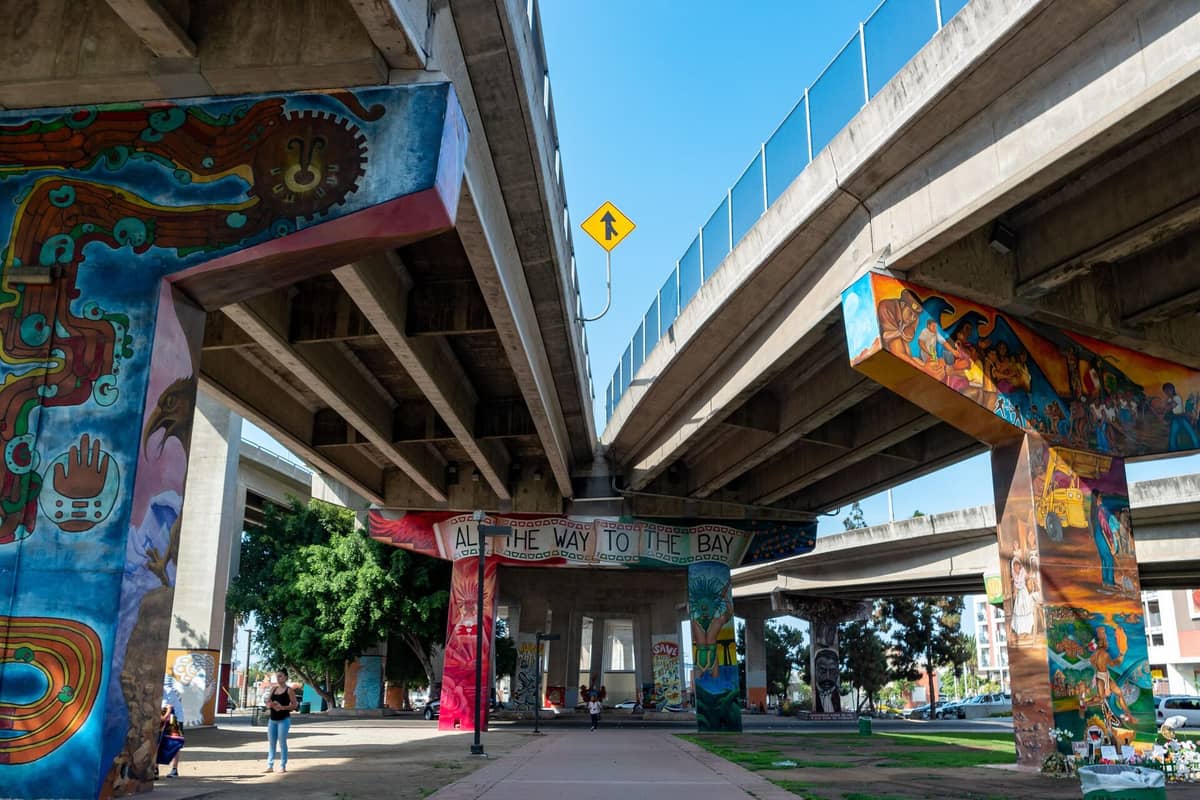
Chicano Park is a public urban park covering approximately 7.4 acres beneath the concrete columns and freeway ramps of the San Diego–Coronado Bridge in the Barrio Logan neighborhood. The defining feature is a collection of more than 80 large-scale murals painted directly onto the bridge's support pillars, most of them created between 1973 and 1989 by Chicano artists from San Diego and across California. The scale is difficult to convey from a photograph: the pillars are three to four stories tall, and walking between them feels more like moving through an outdoor gallery than a neighborhood park.
The park was designated a U.S. National Historic Landmark in December 2016 and was listed on the National Register of Historic Places in 2013. Those are serious designations, and the park earns them. This is not a decorative mural project added to brighten a wall. It is the physical record of a community's fight for land, identity, and political recognition, told entirely in paint on freeway infrastructure.
💡 Local tip
The park is open daily from approximately 6:00 am to 10:00 pm and is free to enter. No reservation is required to visit the murals.
The History Behind the Park
Barrio Logan had already lost significant land to highway construction and industrial uses before the California Department of Transportation announced plans in 1969 to use the cleared land beneath the Coronado Bridge approach ramps for a California Highway Patrol station. The Chicano residents of Barrio Logan had been promised a park to compensate for the community space lost to bridge construction. In April 1970, local activists occupied the site and began planting a garden. The city and the community eventually reached an agreement to use the land as a park.
The first murals went up on March 23, 1973, when a group of Chicano artists gathered to begin painting the bridge pillars. What followed was not a commissioned public art program. Artists worked collectively, over years, to document Mexican history, indigenous heritage, labor struggles, and the Chicano civil rights movement in a medium that could not easily be erased or moved. The permanence was deliberate.
For visitors who want more historical depth, the Old Town San Diego State Historic Park covers the Spanish and Mexican colonial period that forms one layer of the cultural narrative depicted in several Chicano Park murals. The two sites complement each other in ways that a single afternoon can connect.
What You Will See Walking Through the Park
The murals are organized loosely across different structural sections of the bridge. Some pillars carry single, massive images spanning twenty or thirty feet. Others are divided into panels that tell sequential stories. Subjects include Aztec mythology, the Virgin of Guadalupe, portraits of Emiliano Zapata and César Chávez, depictions of agricultural labor and farm worker organizing, and scenes from the 1970 occupation itself. The color palette is saturated and bold, which holds up well under the bridge's partial shade.
The ground-level experience shifts depending on where you stand. Near Logan Avenue, the space is relatively open and the pillars are spaced widely enough that you can step back and take in full compositions. Deeper under the bridge, the columns cluster more tightly, and you feel enclosed by the concrete overhead. The sound environment changes too: traffic noise from the bridge above creates a low constant hum, while birds and voices from the surrounding neighborhood carry underneath.
The skate park occupies a portion of the grounds and is active on most days. Depending on your timing, you will likely see skaters alongside families using the park for ordinary neighborhood recreation. The coexistence of a nationally significant historic landmark and an everyday community space is not incidental. It reflects the founding purpose of the park.
How the Experience Changes by Time of Day
Morning visits before 10:00 am offer the clearest light for photography. The sun angles from the east and hits the western-facing pillars at a low angle, which brings out texture and depth in the paint. Crowds at this hour are minimal, usually just locals walking through or the occasional jogger.
Midday light is harsh and flattening under the bridge, which makes photography more difficult but also makes the colors appear at their most vivid to the naked eye. This is also when tour groups and school visits tend to arrive, particularly on weekdays. If you prefer a quieter experience, aim for late afternoon on a weekday.
Weekends bring noticeably more activity, including families, cyclists passing through the neighborhood, and occasional community events in the park space. On certain weekends and during the annual Chicano Park Day celebration in April, the park draws large crowds and live cultural programming. Checking local event listings before your visit is worthwhile if you either want to attend these events or avoid the density.
ℹ️ Good to know
The annual Chicano Park Day celebration typically takes place in late April. It is one of the largest Chicano cultural events in the country and draws thousands of visitors. The park takes on a completely different character during this event compared to an ordinary weekday visit.
The Adjacent Chicano Park Museum and Cultural Center
The Chicano Park Museum and Cultural Center is a separate indoor facility near the park entrance, distinct from the outdoor park itself. Admission is $8 for general visitors, $4 for students and teachers, $3 for local community members, and free for visitors 18 and under. It provides deeper context for the murals and the history of Barrio Logan through rotating and permanent exhibits. The museum states that all building levels, including restrooms, are wheelchair accessible.
Most visitors find the outdoor murals fully rewarding on their own, but the museum is worth the additional time and cost if you want to understand the political and artistic decisions behind specific works. The two together make for a thorough two-hour visit.
Getting There and Practical Logistics
Barrio Logan is accessible by the San Diego MTS UC San Diego Blue Line Trolley. Alight at Barrio Logan Station and walk several blocks northeast toward Logan and National Avenues, following the bridge structure overhead as a navigation landmark. Bus routes also serve the surrounding streets. Confirm current schedules and fares on the MTS official website before your visit, as these details change.
Street parking is available on Logan Avenue and surrounding neighborhood streets. On ordinary weekdays it is not difficult to find a spot. During special events, including Chicano Park Day, parking fills quickly and using public transit is strongly advisable.
The park sits within a walkable cluster of Barrio Logan attractions. From here you can reach the waterfront and the Maritime Museum of San Diego without a long drive, making it easy to combine both into a half-day itinerary.
💡 Local tip
Wear comfortable shoes with grip. Parts of the ground beneath the bridge are uneven concrete and asphalt, and some of the best mural angles require walking off the main path to find the right vantage point.
Photography Advice and Accessibility
The murals photograph best in morning light or during overcast conditions, which are common in San Diego from May through July due to the coastal marine layer. Overcast skies eliminate harsh shadows on the pillars and allow even exposure across a full mural composition. A wide-angle lens helps with the larger pillar compositions, while a standard focal length works well for detail shots.
Access to the park from Logan Avenue and National Avenue is flat and paved, making it manageable for wheelchairs and strollers. The ground surface under the bridge varies, with some areas of rougher pavement, but the main viewing paths are generally navigable. The adjacent museum confirms ADA-accessible entrances and restrooms.
If Chicano Park is part of a broader exploration of San Diego's cultural and historical sites, consider pairing it with a visit to the Mingei International Museum in Balboa Park, which approaches folk and world art with comparable seriousness, or the San Diego Museum of Art for contrast with the indoor fine art tradition.
Who Should Skip This and Who Will Love It
Visitors who want a conventional park experience with manicured lawns and quiet surroundings will find Chicano Park unfamiliar. The setting is urban and industrial: a freeway overpass, surrounding streets with automotive traffic, and a working-class neighborhood rather than a landscaped green space. There are no cafes, gift shops, or visitor facilities directly within the park itself.
For anyone interested in American civil rights history, Chicano identity and culture, public art at monumental scale, or simply in seeing something that does not appear on most tourist itineraries, this park is one of the most rewarding stops in San Diego. It holds genuine historical significance and artistic ambition in a format that requires no admission fee and no advance planning.
Chicano Park pairs naturally with a broader exploration of San Diego's neighborhoods and outdoor cultural sites. The guide to San Diego's lesser-known attractions covers several other sites that share this quality of depth without the usual tourist infrastructure.
Insider Tips
- Walk the full perimeter of the pillar clusters rather than staying on the main path. Some of the most detailed mural work faces inward and is easy to miss if you only view the outer columns.
- The kiosk signs near certain pillar groups identify the artist and the year each mural was painted. Reading them before looking at the image gives you a different experience than approaching the mural cold.
- Early weekday mornings before 9:00 am are when you are most likely to have extended sections of the park entirely to yourself, which makes it easier to photograph without other visitors in frame.
- The Chicano Park Museum sometimes offers guided mural tours that cover the historical and artistic context of specific works. Check their website before visiting if this interests you, as availability is not daily.
- Barrio Logan has several Mexican restaurants and bakeries along Logan Avenue within walking distance of the park. The neighborhood's food is a practical extension of the cultural experience the park represents.
Who Is Chicano Park For?
- History and civil rights enthusiasts who want to understand the Mexican-American experience in Southern California
- Art and photography travelers looking for large-scale public works with genuine artistic and political weight
- Budget travelers: the outdoor park and murals are completely free to visit
- Educators and students with an interest in Chicano studies, urban planning, or community activism
- Curious visitors who have seen downtown San Diego and want to understand a different part of the city's identity
Nearby Attractions
Combine your visit with:
- Anza-Borrego Desert State Park
Anza-Borrego Desert State Park stretches across more than 600,000 acres of Colorado Desert in eastern San Diego County, making it one of the largest state parks in the United States. From spring wildflower carpets to ancient slot canyons and some of the darkest skies in Southern California, it rewards visitors who plan carefully and respect the terrain.
- Border Field State Park
Border Field State Park occupies the southwestern corner of the continental United States, where Pacific surf meets the U.S.–Mexico border fence. It offers coastal wetlands, a historic marble boundary monument, and views toward Friendship Park — the U.S.-side gathering space has been closed since 2020, so confirm current access before you go.
- Cedar Creek Falls
Cedar Creek Falls is a backcountry waterfall deep inside Cleveland National Forest, reached by a strenuous 6-mile round-trip hike from Ramona. A mandatory day-use permit keeps crowds manageable, but you'll earn every step of the descent into this rugged gorge. This guide covers the permit process, trail conditions, safety warnings, and what to realistically expect.
- Cowles Mountain
Cowles Mountain is the highest point in the City of San Diego, rising 1,591 feet above sea level inside Mission Trails Regional Park. The main trail climbs 1.5 miles from the Golfcrest Drive trailhead, gaining roughly 950 feet of elevation, and rewards hikers with panoramic views stretching from the Pacific to the desert. Entry is completely free.