Maritime Museum of San Diego: America's Finest Fleet on the Embarcadero
The Maritime Museum of San Diego is one of the largest collections of historic ships in the United States, moored along the downtown waterfront. From the iron-hulled Star of India to a full-scale replica of a 16th-century galleon, this is hands-on naval history at its most tangible.
Quick Facts
- Location
- 1492 North Harbor Drive, San Diego, CA 92101-3309 (Star of India Wharf)
- Getting There
- Short walk from Santa Fe Depot (Amtrak, Coaster, Trolley); several MTS bus routes serve North Harbor Drive
- Time Needed
- 2 to 3 hours for a thorough visit; allow more if you explore every vessel
- Cost
- Adults $28 | Military & Seniors (62+) $20 | Youth (6–17) $15 | Ages 5 and under free. Open daily 10 AM–5 PM; last entry 4 PM
- Best for
- History enthusiasts, families with older kids, nautical photography, naval heritage
- Official website
- sdmaritime.org
What the Maritime Museum of San Diego Actually Is
The Maritime Museum of San Diego is not a building. It is a fleet. Stretched along the Embarcadero at Star of India Wharf, the museum consists of multiple historic vessels moored side by side, each one a self-contained exhibit you can actually walk aboard. The collection spans more than 150 years of maritime history and is considered one of the largest collections of historic ships in the United States.
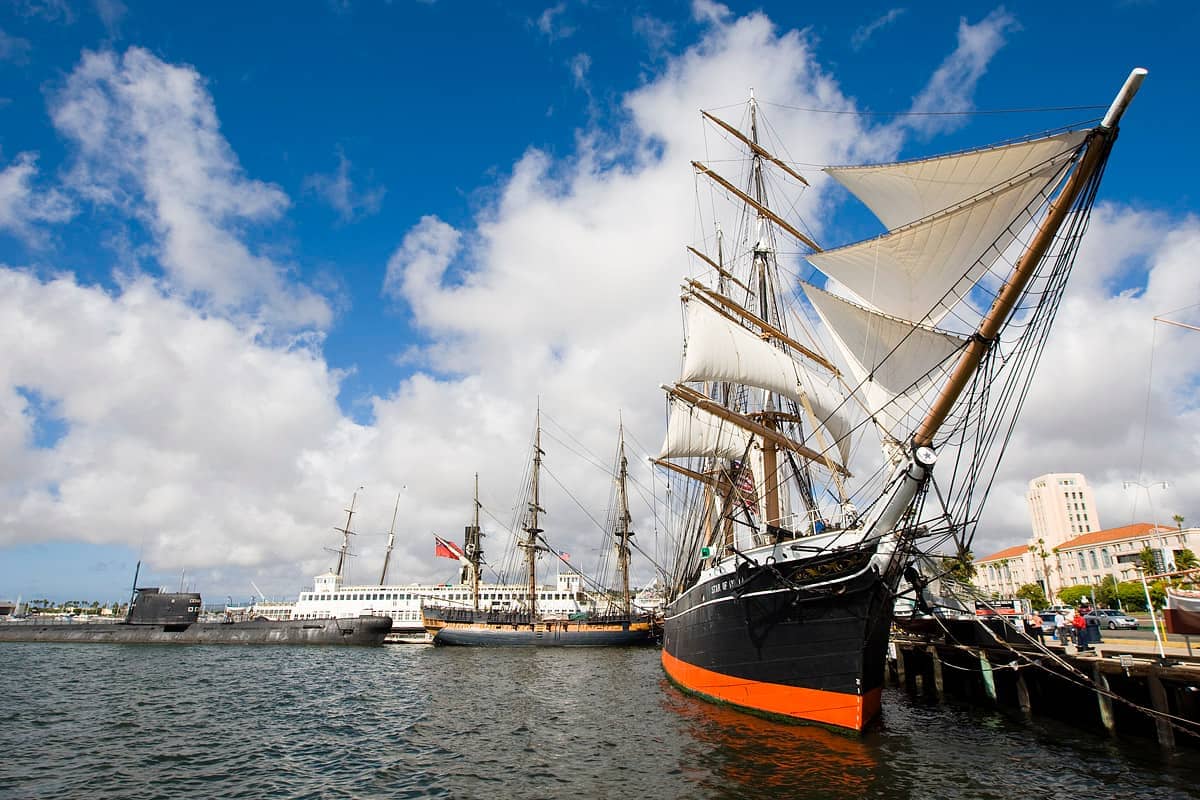
The centerpiece is the Star of India, an iron-hulled square-rigger launched in 1863 that is the oldest active sailing ship in the world. Alongside her sit the steam-powered ferry Berkeley (1898), the replica 16th-century Spanish galleon San Salvador, the U.S. Navy research submarine USS Dolphin, and several other vessels covering sail, steam, and diesel eras. Together they form a timeline of seafaring technology you can touch, smell, and in some cases descend into.
💡 Local tip
Last entry is at 4:00 PM, one hour before closing. If you want meaningful time aboard the larger ships, arrive by 2:00 PM at the latest.
The Star of India: The Anchor of the Collection
Built on the Isle of Man as the Euterpe and later renamed, the Star of India completed many voyages before retiring to San Diego Bay in 1926. She was rescued from near-dereliction by volunteers and later restored. Today she remains one of the oldest iron-hulled merchant vessels afloat, and that age is perceptible the moment you step on deck.
The smell hits first: salt-treated rope, aged timber, and the particular metallic coolness of iron below the waterline. The main deck pitches slightly even in calm harbor water, a reminder that this is a real ship, not a static display. Below decks, the low headroom and narrow passages give a visceral sense of what 200 immigrant passengers endured on months-long voyages to New Zealand and Alaska. Period furnishings and interpretive panels are thoughtfully installed without obscuring the ship's bones.
The rigging overhead is the other spectacle. On a clear morning the masts disappear into sharp blue sky, and the light plays differently across the deck at different times of day. Early visitors (around 10 AM opening) get the masts backlit by the eastern sun, which makes for dramatic photographs from the bow. By afternoon the light flattens, but the deck grows warm and the bay behind the ship turns a deeper green.
The Rest of the Fleet: What Each Vessel Offers
The steam ferry Berkeley served San Francisco Bay from 1898 until after the 1906 earthquake, when she helped evacuate survivors. She now functions as one of the museum's exhibit spaces. Her interior is far more accessible than the sailing ships, with broad decks and exhibit rooms that work well for visitors with limited mobility or families with strollers. The maritime history displays here provide essential context for everything else you see on the waterfront.
The San Salvador is a full-scale operational replica of the flagship Juan Rodriguez Cabrillo sailed into San Diego Bay in 1542, one of the first European vessels to enter what is now California. The attention to period construction is impressive, and the ship represents one of the most significant archaeological and historical recreation projects on the West Coast. She is not always open to the public for boarding, so check the museum's current schedule before building your visit around her.
The USS Dolphin, a U.S. Navy deep-diving research submarine, is the most claustrophobic and arguably the most fascinating vessel in the collection. You enter through a hatch and navigate a corridor barely wide enough for one person, past control panels, equipment bays, and crew bunks no wider than shelves. It is a powerful, unsettling exhibit. Children who are enthusiastic about it at the gangway sometimes find the interior too confining once inside. The museum's former Soviet Foxtrot-class submarine B-39 left the collection in 2021 and is no longer on site.
⚠️ What to skip
Several vessels require climbing steep ladders and ducking through low hatches. The submarine requires navigating a very narrow interior corridor. Visitors with claustrophobia, mobility limitations, or young children who dislike confined spaces should plan accordingly.
How the Experience Changes by Time of Day
The waterfront setting means the museum's atmosphere shifts significantly with the light and the tide of visitors. At opening (10 AM), the harbor is quiet and the ships stand out sharply against the morning sky. The Star of India casts long shadows across the dock, and you may have significant stretches of the deck to yourself. This is the best window for photography, particularly of the rigging and hull from the dock below.
By midday, especially on weekends and in summer, school groups and families arrive in volume. The Berkeley's exhibit rooms can feel crowded, and queues form for the submarine hatch. If you are visiting in summer, a weekday morning visit is markedly more comfortable than a Saturday afternoon. San Diego's summer coastal fog, known locally as 'June Gloom,' sometimes persists until mid-morning from June through early July, softening the light but also muting the harbor views.
Late afternoon, particularly between 3 and 4 PM, brings a second wave of calm. The tour groups have largely departed and the low western sun illuminates the ships' wooden superstructures in warm amber light. The harbor at that hour reflects the sky clearly enough to make the ships' waterlines photogenic from street level. If last entry is 4 PM, arriving at 3 PM gives you a focused, crowd-reduced hour aboard whichever vessel interests you most.
Getting There and Practical Logistics
The museum is on North Harbor Drive in the Embarcadero, San Diego's downtown waterfront strip. Santa Fe Depot, the city's main rail hub serving Amtrak, the Coaster commuter rail, and the San Diego Trolley, is approximately a 10-minute walk south along the waterfront. Several MTS bus routes stop along Harbor Drive. If you are staying downtown, the walk along the waterfront from the Gaslamp Quarter takes around 15 to 20 minutes and is flat the entire way.
Paid parking is available in nearby lots along North Harbor Drive and at the Embarcadero Marina Park. Driving and parking on weekends is possible but can add meaningful time to your visit. The waterfront location makes public transit and on-foot approaches genuinely practical options.
The museum has no formal dress code, but consider that you will be climbing, crouching, and walking on uneven wooden and metal decking. Closed-toe shoes with some grip are considerably more comfortable than sandals. A light layer is worth having: the Berkeley's interior is air-cooled and the open decks can catch a sea breeze even on warm days.
ℹ️ Good to know
Photography is permitted throughout the museum and fleet. A wide-angle lens or smartphone panorama mode works well for interior ship cabins and tight deck spaces. The best exterior hull shots of the Star of India are taken from the dock level to the north of her bow, where you get the full length of the ship with the bay in the background.
Who Gets the Most Out of This Museum (And Who Should Think Twice)
The Maritime Museum of San Diego rewards curiosity about how things were built and how people lived aboard them. Naval history enthusiasts, anyone with ancestors who emigrated by sea, and visitors drawn to the USS Midway Museum nearby will find substantial depth here. The Midway is a carrier docked just south along the same waterfront and covers 20th-century naval aviation; the two museums complement each other without significant overlap, and some visitors tackle both in a single waterfront day.
Families with children aged 8 and up typically engage well: the submarine is genuinely exciting for older kids, and the Star of India's deck is large enough for children to roam freely while adults absorb the interpretive panels. Younger children, particularly those under 5, are admitted free but may find the confined spaces difficult and the content abstract. If you are visiting San Diego with young children and weighing options, the San Diego with kids guide covers a broader range of age-appropriate attractions.
Visitors with significant mobility limitations will find the Berkeley accessible and worthwhile on its own, but will not be able to access most of the other vessels without assistance. The steep ladders and hatch openings are structural features of the historic ships themselves and cannot practically be modified. Contact the museum in advance if you have specific accessibility needs so staff can advise on what is currently navigable.
Those who prefer climate-controlled, gallery-style museum experiences may find the outdoor-heavy, physically interactive format less comfortable. In that case, San Diego's indoor museum landscape at Balboa Park offers a wide range of alternatives, from natural history to fine art.
The Bottom Line: Is It Worth It?
At $28 for adults, the Maritime Museum is not cheap relative to other San Diego attractions. The value calculation depends almost entirely on how much you want to engage with the ships themselves rather than simply see them from the outside. The Star of India alone justifies the visit for anyone interested in 19th-century seafaring: she is a genuinely rare and moving object. Boarding USS Dolphin adds a layer of naval research history that few museums can offer.
If the ticket price is a concern, the museum is not currently listed among the free attractions available in San Diego. However, it is worth noting that the ships are visible from the public Embarcadero walkway at no cost, and the scale of the Star of India is impressive even from the dock. For budget-conscious visitors, the free things to do in San Diego guide covers waterfront experiences that don't require admission.
The museum is not overhyped. It delivers exactly what it promises: a collection of real, historically significant vessels you can explore on your own terms. The interpretive material is solid without being overwhelming, and the setting, harbor water on three sides of you, ships creaking gently, container ships passing in the distance, is unlike any indoor museum experience in the city.
Insider Tips
- The Star of India sometimes sails for special events and annual outings. If you want to see her under full sail rather than moored, check the museum's events calendar well in advance.
- Weekday mornings between 10 AM and noon offer the emptiest decks and the best light for photography. Summer weekend afternoons are the most crowded windows by a significant margin.
- The USS Dolphin submarine tour is included in general admission but can feel rushed when groups are waiting at the hatch. Go early in the day when queue pressure is lower, and take your time below decks. The Soviet Foxtrot-class B-39 left the collection in 2021 and is no longer on site.
- Santa Fe Depot, a short walk south along the Embarcadero, is itself a beautiful 1915 Spanish Colonial Revival building worth seeing. Combining the depot visit with the museum walk makes for an efficient waterfront morning.
- Bring water. There is food service nearby at Portside Pier, but the ships themselves have no cafes, and you may spend longer than expected in the open air, particularly on sunny afternoons.
Who Is Maritime Museum of San Diego For?
- Naval and maritime history enthusiasts looking for ships you can actually board
- Families with children aged 8 and older who want hands-on, exploratory experiences
- Photography enthusiasts interested in tall ships, rigging, and period vessel aesthetics
- Visitors combining a full Embarcadero waterfront itinerary with the USS Midway nearby
- Anyone with an interest in 16th-century Spanish exploration or Cold War-era submarine technology
Nearby Attractions
Other things to see while in Embarcadero & Downtown Waterfront:
- Rady Shell at Jacobs Park
The Rady Shell at Jacobs Park is the San Diego Symphony's permanent open-air home on the downtown waterfront, set against the backdrop of San Diego Bay. Whether you're attending a ticketed concert or simply wandering the public grounds during park hours, this architecturally striking venue delivers one of the most scenic settings in Southern California.
- USS Midway Museum
The USS Midway Museum puts visitors aboard one of the longest-serving aircraft carriers in U.S. Navy history, docked on San Diego's downtown waterfront. From flight deck aircraft to cramped crew quarters, the scale of this ship is difficult to grasp until you're standing on it.
- Waterfront Park
Waterfront Park sits along San Diego's downtown bayfront, offering free access to interactive splash fountains, open event lawns, and sweeping views of San Diego Bay. Anchored by the 1930s County Administration Center, it works equally well as a family outing, a midday break, or a front-row seat for waterfront sunsets.