Anza-Borrego Desert State Park: What to Know Before You Go
Anza-Borrego Desert State Park stretches across more than 600,000 acres of Colorado Desert in eastern San Diego County, making it one of the largest state parks in the United States. From spring wildflower carpets to ancient slot canyons and some of the darkest skies in Southern California, it rewards visitors who plan carefully and respect the terrain.
Quick Facts
- Location
- 200 Palm Canyon Drive, Borrego Springs, CA 92004 — eastern San Diego County, approx. 90 miles from downtown San Diego
- Getting There
- Car only — no public transit serves Borrego Springs. Roughly 2 hours from San Diego via CA-78 or S-22
- Time Needed
- Half day minimum; full day or overnight recommended for serious exploration
- Cost
- US$10 per vehicle/day at developed areas; most of the park is free to enter. California State Parks annual pass accepted.
- Best for
- Wildflower season (Feb–April), stargazing, slot canyon hiking, desert photography, and off-road exploration
- Official website
- www.parks.ca.gov/anzaborrego
What Anza-Borrego Actually Is
Anza-Borrego Desert State Park is a place that takes most visitors by surprise, even those who think they know what to expect from a desert. At over 600,000 acres, it is one of the largest state parks in California, roughly twice the size of the city of Los Angeles. The park sits within the Colorado Desert, a subdivision of the Sonoran Desert, and occupies a dramatic basin ringed by mountain ranges that create sharp shifts in elevation, temperature, and plant life within a short drive.
The nearest town is Borrego Springs, a small community of a few thousand residents that functions as the park's base camp. It has a handful of restaurants, a grocery store, and accommodation ranging from basic motels to resort properties. Beyond town, the park spreads in almost every direction: palm-lined canyons to the northwest, painted badlands to the east, and remote wilderness to the south where you can drive for an hour on dirt roads without seeing another vehicle.
The park is managed by California State Parks and preserves desert ecosystems alongside significant cultural history connected to Indigenous peoples including the Cahuilla and Cocopah. Those histories are covered through exhibits at the Visitor Center and along several interpreted trails. If you are weighing a visit as part of a broader San Diego trip, the day trips from San Diego guide gives useful context for deciding how Anza-Borrego fits alongside other escapes from the city.
The Wildflower Season: Why Timing Changes Everything
If there is one reason Anza-Borrego attracts visitors who would not otherwise care about a desert park, it is the annual wildflower bloom. In years with sufficient winter rainfall, typically between late February and early April, the desert floor transforms in a way that can feel genuinely implausible. Hillsides go yellow-orange with brittlebush. Dried washes fill with purple sand verbena and white dune primrose. The air, usually sharp and mineral-dry, picks up faint sweetness from the flowers.
The key word is 'in years with sufficient rain.' The bloom is never guaranteed. Dry winters produce sparse displays, and even good years see the peak last only a week or two before heat and wind strip the flowers back. The local bloom tracking resources and the park's own hotline are worth consulting before booking anything specifically for flowers. Coming in a lean year and still expecting the famous carpet effect will disappoint you.
💡 Local tip
Check the Anza-Borrego wildflower hotline (recorded updates at +1 760-767-4684) before planning a bloom trip. The Visitor Center staff can also advise on which areas are showing best color for a given week.
Bloom season is also the park's most crowded period. On peak weekends in good years, the two-lane roads into Borrego Springs back up for miles, parking at popular pull-offs fills by 8 a.m., and accommodation within 40 miles books out weeks in advance. Arriving before sunrise and heading for less-visited spots like the Borrego Badlands or Font's Point area rather than the Borrego Palm Canyon trail can make a real difference.
Key Experiences Inside the Park
Borrego Palm Canyon Trail
The most-visited trail in the park, Borrego Palm Canyon follows a seasonal stream into a narrow canyon sheltered by California fan palms, one of the few native palm species in the United States. The round-trip to the palm grove is roughly 3 miles and gains about 350 feet. It reads as easy on paper, but the loose gravel wash, exposed sun, and return uphill stretch make it harder than beginners expect in warm weather. The trailhead sits adjacent to the campground, about a mile from the Visitor Center.
The canyon is best in the morning: the walls shade the lower section before 9 a.m., the light is softer for photography, and the bighorn sheep that occasionally appear on the rocky ridges above are more active in cooler hours. By midday in summer, temperatures in the canyon can exceed 100°F (38°C). The $10 day-use fee applies at this trailhead.
The Slot at Anza-Borrego
Known locally as The Slot, this narrow sandstone canyon on the park's eastern side is formed by water cutting through layers of compressed mud and ancient lake sediment. Walking through it means turning sideways in places where the walls close to less than two feet. The walls ripple in layers of terracotta, ochre, and pale grey, and the light filtering from the strip of sky above changes color depending on the time of day. Late afternoon turns the canyon walls deep orange. A $10 day-use fee is collected at the trailhead.
The hike itself is under a mile each way and requires no special equipment, but the sandy floor shifts underfoot and the entry point involves a short scramble down. Flash floods are a genuine risk during and after rain, even when skies above the canyon appear clear, because the drainage area extends far into the mountains. Do not enter The Slot if there is any storm activity in the region.
⚠️ What to skip
Flash flood risk is real in all narrow canyons, including The Slot. Check weather forecasts for the entire watershed, not just the immediate area, before entering. Slot canyon walls show clear high-water marks well above head height.
Font's Point
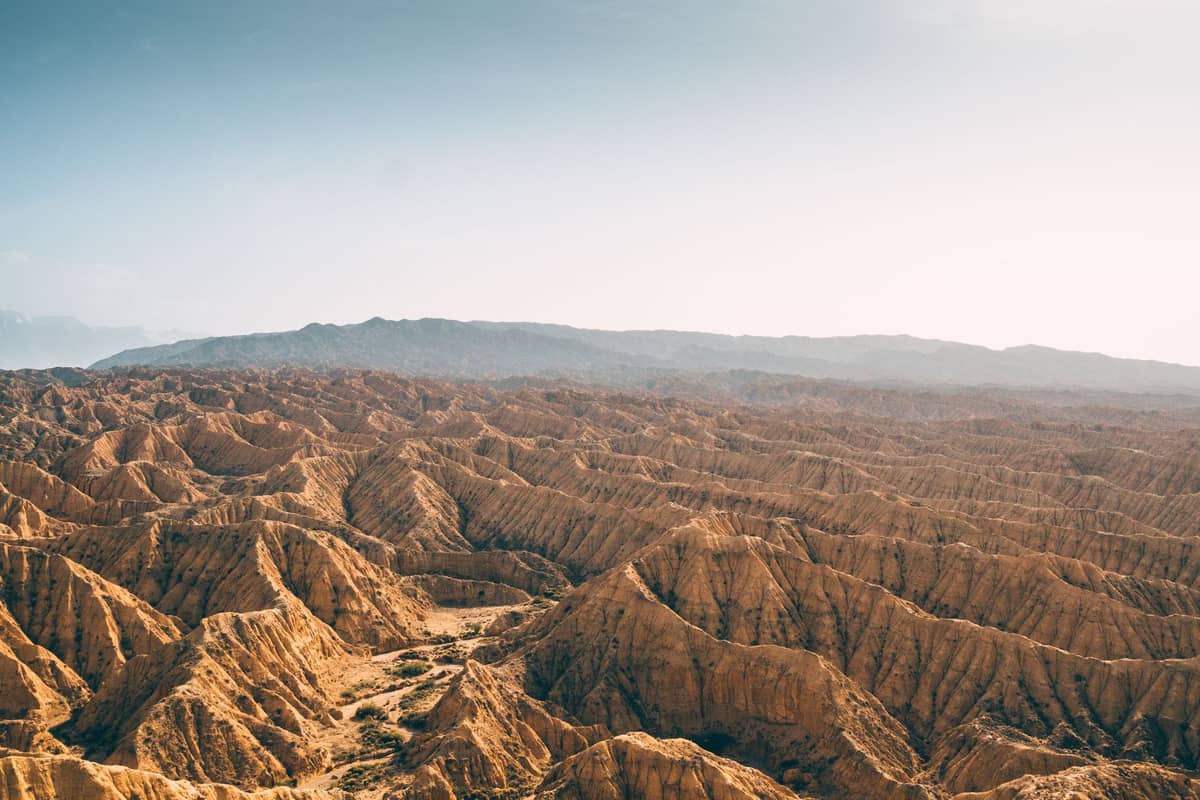
Font's Point requires a 4-mile round trip on an unmaintained sand road that most standard vehicles cannot complete without a high-clearance 4WD, but the payoff is an unobstructed overlook above the Borrego Badlands: hundreds of square miles of eroded mudstone formations stretching east to the Salton Sea. Sunrise and sunset light at Font's Point produce the kind of photographs that look like they required extensive post-processing but don't. Check road conditions at the Visitor Center before attempting the drive.
Stargazing: The Underrated Reason to Stay Overnight
Borrego Springs is one of a small number of International Dark Sky Communities in the world, a designation that reflects both the natural darkness of the surrounding desert and active local effort to limit light pollution. On a clear night away from town, the Milky Way core is visible to the naked eye for much of the year, and the band of stars above the horizon can appear almost three-dimensional in its depth. The park itself adds no light of its own, and the surrounding mountains block distant city glow from San Diego and the Coachella Valley.
Camping at Borrego Palm Canyon Campground puts you inside the park with full darkness after 9 p.m. Alternatively, driving to any pull-off on S-22 east of town on a moonless night achieves similarly dark conditions. Bring a red-light headlamp rather than a white-beam flashlight, both for your own night-vision adaptation and out of courtesy to other stargazers.
Practical Details: Climate, Heat, and What to Bring
The desert climate here is not the same as San Diego's coastal Mediterranean conditions. Summer temperatures in the Borrego Springs basin routinely exceed 110°F (43°C). June through September are functionally inhospitable for most hiking and should be treated with serious caution. The Visitor Center reduces its hours to weekends only during this period, which reflects how few visitors the park reasonably expects to serve in the heat.
The practical window for comfortable visiting is October through May, with November through March offering reliably mild hiking temperatures between roughly 60°F and 80°F (15–27°C) during the day. Nights at any time of year can drop sharply: even April nights in the desert can dip into the low 40s°F (5–7°C), which surprises visitors who equate desert with warmth.
- Water: carry a minimum of one liter per hour of hiking, more in warm weather. There is no reliable water on most trails.
- Sun protection: full sun exposure at desert elevation is intense. Long sleeves, a brimmed hat, and SPF 50+ sunscreen are not optional.
- Navigation: cell signal is absent across most of the park. Download offline maps and bring a paper backup for any off-pavement exploration.
- Footwear: sandy wash trails and rocky canyon floors require closed-toe shoes with grip. Flip-flops are not suitable for any trail in the park.
- Fuel: Borrego Springs has limited fuel availability and no 24-hour stations. Fill up before entering the desert.
Getting There and Getting Around
There is no public transit to Anza-Borrego. A private vehicle is essential, and for anything beyond the paved main roads, a high-clearance vehicle is strongly advisable. The standard driving route from San Diego takes approximately 90 minutes to 2 hours via CA-78 east through Ramona and Julian, or via S-22 west from the Salton Sea side. The mountain descent on S-22 from the Borrego Springs side is steep, winding, and spectacular, particularly in the last 10 miles as the desert basin opens below.
If you are passing through the mountain town of Julian on the way, it is worth a short stop. The Julian, California attraction page covers what the town offers alongside the apple orchards and historic downtown, and it pairs naturally with a same-day drive to Borrego Springs.
Within the park, many of the most interesting features, including Font's Point, Coyote Canyon, and the mountain palm springs in the south, are only reachable on unpaved roads. Some require 4WD and high clearance; others can be managed in a standard crossover with careful driving in dry conditions. Always check current road conditions at the Visitor Center or by calling ahead before attempting dirt roads.
ℹ️ Good to know
Visitor Center address: 200 Palm Canyon Drive, Borrego Springs, CA 92004. Open daily October through May, 9 a.m. to 5 p.m. Weekends and holidays only, June through September. Phone: +1 760-767-4205.
Who Should Skip This Park
Anza-Borrego is not for everyone, and knowing that in advance saves wasted time. Visitors looking for a comfortable half-day outing from San Diego with amenities nearby will find the distance, the heat risk, and the lack of services frustrating. The park has no food vendors, no shade structures on most trails, and limited cell coverage for navigation or emergency use. If your tolerance for raw, undeveloped landscapes is low, Balboa Park or the coastal cliffs at La Jolla will serve you better.
Travelers with mobility limitations will find most trails inaccessible, though the Visitor Center, park office, and accessible tent sites at Borrego Palm Canyon Campground (sites 118-120) are designed for wheelchair access. The Cabrillo National Monument in Point Loma offers a more accessible desert-adjacent experience with paved paths and interpretive exhibits, if terrain is a concern.
Young children can enjoy the park during the wildflower season or for short canyon walks in mild weather, but any summer visit with kids is genuinely inadvisable. Heat illness in a remote location with no phone signal is a serious emergency.
Insider Tips
- The Galleta Meadows sculptures, spread across several roads near Borrego Springs, are free to visit and include dozens of large steel animal figures by artist Ricardo Breceda. Many visitors miss them entirely by heading straight to the Visitor Center. Pick up a map at the Visitor Center or search for the sculpture locations before you arrive.
- The Visitor Center itself is partially underground, built into the hillside to maintain a cooler interior temperature without air conditioning. The exhibit on desert geology inside the building is surprisingly detailed and worth 20 minutes even for visitors eager to get on trail.
- Coyote Canyon, accessed from the north end of the park, is one of the few year-round water sources in the desert here and attracts more wildlife than most other areas. The canyon closes each year between June 15 and September 15 to protect bighorn sheep lambing habitat.
- If you are visiting for stargazing, the new moon period produces the darkest skies. The park's darkness is genuine, not relative — even experienced astrophotographers rank it among the best accessible dark sky sites in California.
- Split a two-day visit between the west (palm canyons, Visitor Center area) and the east (Borrego Badlands, Font's Point, The Slot). The character of the landscape is different enough that treating them as one experience shortchanges both.
Who Is Anza-Borrego Desert State Park For?
- Hikers and trail runners seeking uncrowded desert routes with genuine solitude
- Photographers, both landscape and astrophotography, who want dramatic light and dark skies within a day's drive of San Diego
- Spring wildflower chasers during favorable rainfall years (late February to early April)
- Road-trippers combining Anza-Borrego with Julian, the Salton Sea, and Palm Springs on a multi-day Southern California loop
- Travelers who want a stark contrast to San Diego's beach culture and are comfortable with self-sufficient desert travel
Nearby Attractions
Combine your visit with:
- Border Field State Park
Border Field State Park occupies the southwestern corner of the continental United States, where Pacific surf meets the U.S.–Mexico border fence. It offers coastal wetlands, a historic marble boundary monument, and views toward Friendship Park — the U.S.-side gathering space has been closed since 2020, so confirm current access before you go.
- Cedar Creek Falls
Cedar Creek Falls is a backcountry waterfall deep inside Cleveland National Forest, reached by a strenuous 6-mile round-trip hike from Ramona. A mandatory day-use permit keeps crowds manageable, but you'll earn every step of the descent into this rugged gorge. This guide covers the permit process, trail conditions, safety warnings, and what to realistically expect.
- Chicano Park
Chicano Park is a National Historic Landmark tucked beneath the San Diego–Coronado Bridge in Barrio Logan, where more than 80 monumental murals cover the concrete pillars of a freeway overpass. Free to enter and open daily, it is one of the most culturally layered outdoor spaces in the American Southwest.
- Cowles Mountain
Cowles Mountain is the highest point in the City of San Diego, rising 1,591 feet above sea level inside Mission Trails Regional Park. The main trail climbs 1.5 miles from the Golfcrest Drive trailhead, gaining roughly 950 feet of elevation, and rewards hikers with panoramic views stretching from the Pacific to the desert. Entry is completely free.