Cedar Creek Falls: San Diego's Most Rewarding Backcountry Waterfall
Cedar Creek Falls is a backcountry waterfall deep inside Cleveland National Forest, reached by a strenuous 6-mile round-trip hike from Ramona. A mandatory day-use permit keeps crowds manageable, but you'll earn every step of the descent into this rugged gorge. This guide covers the permit process, trail conditions, safety warnings, and what to realistically expect.
Quick Facts
- Location
- Cleveland National Forest, near Ramona, CA (trailhead: 15519 Thornbush Rd, Ramona, CA 92065)
- Getting There
- Private vehicle required; no public transit serves the trailhead. Access via Hwy 67, San Vicente Road, Ramona Oaks Road, and Thornbush Road.
- Time Needed
- 4 to 6 hours for the full 6-mile out-and-back hike, including time at the falls
- Cost
- Day-use permit required; currently $6 per group (up to 5 people), booked in advance at Recreation.gov. Verify current fee before visiting.
- Best for
- Fit hikers, nature photographers, visitors wanting to escape the coastal crowds
What Cedar Creek Falls Actually Is
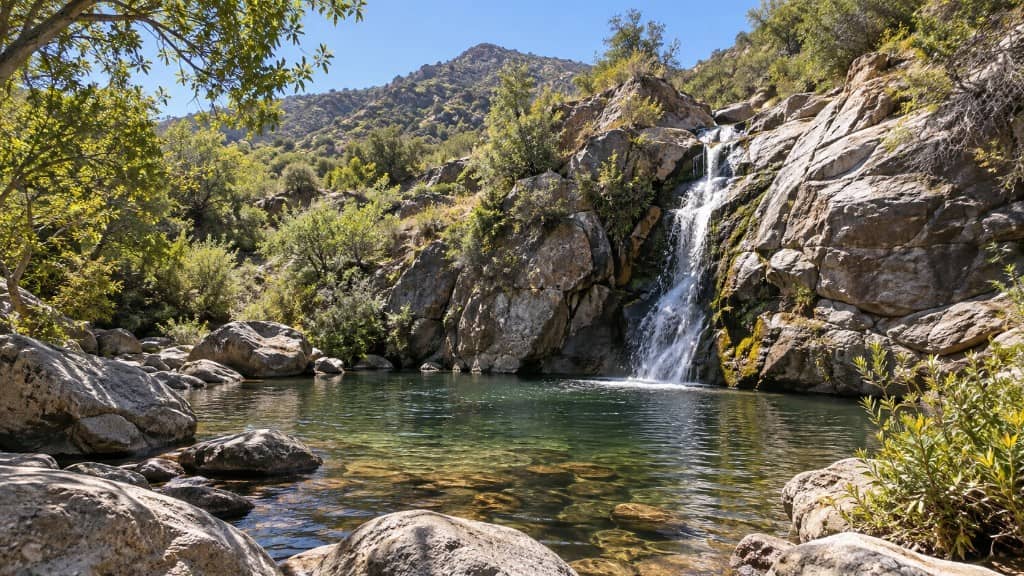
Cedar Creek Falls is a backcountry waterfall located in the Cleveland National Forest, roughly 35 miles northeast of San Diego near the community of Ramona. The falls drop into a deep granite pool called the Devil's Punchbowl, surrounded by canyon walls carved by the San Diego River Gorge. The scale surprises first-time visitors: you emerge from a chaparral-covered ridge and suddenly look down into a narrow green gorge with the sound of falling water far below.
This is not a casual roadside attraction. Reaching Cedar Creek Falls requires a permit, a car, and a genuine commitment to a hot, exposed, strenuous hike. The Forest Service formally introduced a visitor use permit system in 2012 after years of overcrowding, accidents, and costly search-and-rescue operations. That decision changed the character of the place significantly: the falls are less chaotic than they once were, and the experience is more controlled, though the terrain itself is no easier.
⚠️ What to skip
Permits are mandatory and must be booked in advance at Recreation.gov. No permits are sold at the trailhead. Groups are capped at 5 people per permit. The area can also be closed entirely during extreme heat events, sometimes for multiple weeks. Always check current closure orders on the Cleveland National Forest website before you drive out.
The Hike: What to Expect on the Trail
The standard route from the Ramona trailhead (San Diego River Gorge Trail) is approximately 6 miles out and back, with an elevation change of roughly 1,000 feet. Most of that elevation is packed into the final descent to the falls, which means you face a steep, rocky climb back out when you are already tired and often hot. The trail surface alternates between packed dirt, loose rock, and exposed granite slabs.
The first mile or two from the trailhead moves through open chaparral with sweeping views east toward the Ramona Valley. There is almost no shade on this section. The landscape smells of sage and dry grass in summer, and the silence is broken mainly by the wind and the occasional hawk circling overhead. By mid-morning, the sun is fully on the trail and temperatures can climb well above 90°F in summer months.
The gorge reveals itself gradually. As the trail descends toward the falls, the vegetation shifts and the air becomes noticeably cooler. The sound of Cedar Creek increases before you see anything. At the bottom, the Devil's Punchbowl is a dark granite pool with smooth, water-worn walls. On a good winter or spring visit after seasonal rains, the falls are loud, full, and genuinely impressive. In late summer, flows are considerably reduced.
💡 Local tip
Start before 8 a.m. if possible. The return climb to the trailhead faces south and gets brutal after 10 a.m. in warm months. Hikers regularly need emergency rescue here due to heat exhaustion, which is why the Forest Service closes the trail during heat waves.
Permits: How the System Works
The Cedar Creek Falls Visitor Use Permit Area operates on a quota system managed through Recreation.gov. Each permit covers a group of up to 5 people and is valid for a specific day. The current fee listed on the Cleveland National Forest trail page is $6 per permit. A proposed fee structure noted in a 2026 Federal Register notice would shift to $4 per person per day plus a $6 reservation transaction fee; as of this writing, that proposal has not yet been implemented. Confirm the current fee structure at Recreation.gov or the Forest Service website before booking.
Permits for popular weekend dates, particularly in spring when water flows are strongest, sell out quickly. If you are planning a Saturday or Sunday visit between February and May, book several weeks in advance. Weekday permits are easier to secure. No walk-up permits exist; arriving without a permit means turning back.
If permits are booked out, consider pairing the trip with other inland San Diego County hikes on the same day. The guide to best hikes in San Diego includes alternatives across a range of difficulty levels and access points.
When to Visit and How Weather Shapes the Experience
The falls are best visited between late February and early May. San Diego's Mediterranean climate concentrates most of its annual rainfall (roughly 10 to 11 inches total) in the winter months, and Cedar Creek responds accordingly. After a wet winter, the falls are forceful and the pool is deep enough to swim in safely. By July and August, the creek slows dramatically and the punchbowl can be shallow.
Summer visits are not recommended unless you are extremely heat-acclimated, start at dawn, and carry at least 3 liters of water per person. The trail offers almost no shade, and inland temperatures in the Ramona area regularly exceed 100°F in July and August. The Forest Service has issued multi-week closures of the area during heat events, citing search-and-rescue overload. This is not hyperbole: the backcountry here is genuinely dangerous in summer heat.
October and November offer a reasonable shoulder-season window: temperatures are moderate (highs in the mid-70s), crowds thin out compared to spring, and the trail is dry and firm underfoot. The falls will be at low flow, but the canyon itself is photogenic in the autumn light. Winter visits after rainfall are excellent, though the trail can have muddy sections and the descent to the pool requires care on wet rock.
ℹ️ Good to know
San Diego averages roughly 40 rainy days per year, with February typically the wettest month. Planning a cedar creek visit immediately after a significant rain event in February or March gives the best chance of seeing the falls at full strength.
Safety Rules and What the Forest Orders Prohibit
The Forest Service has imposed specific Forest Orders for the Cedar Creek Falls area that go beyond standard trail etiquette. Alcohol possession is prohibited within the designated alcohol prohibition zone at the falls, a rule introduced after injuries and rescues connected to intoxicated swimmers. Access to the cliffs surrounding Cedar Creek Falls is also closed to public entry; this affects the popular but dangerous practice of cliff-jumping, which has resulted in multiple fatalities and serious injuries over the years.
The punchbowl itself can be swum during appropriate conditions, but the depth and current vary significantly by season and recent rainfall. The granite walls around the pool are slippery. Visitors should assess conditions on arrival rather than assuming swimming is safe. Wearing water shoes or secure sandals with grip is sensible if you plan to enter the pool.
Pack out all trash. The permit system exists partly to protect this ecosystem, and waste is an ongoing management problem at popular backcountry sites. There are no facilities at the falls: no toilets, no water sources, no shade structures.
Getting There and Parking
Cedar Creek Falls requires a private vehicle. There is no public transit serving the Ramona trailhead, and no shuttle or ride-share service regularly operates to this location. From central San Diego, the drive takes roughly 45 to 60 minutes depending on your starting point. The route heads northeast via Highway 67 toward Ramona, then turns onto San Vicente Road, Ramona Oaks Road, and finally Thornbush Road to reach the trailhead parking area at approximately 15519 Thornbush Rd, Ramona, CA 92065.
The roads leading to the trailhead are paved and accessible to standard passenger vehicles. Parking is limited and fills early on spring weekends, which is another reason to arrive before 8 a.m. There is no fee for parking at the trailhead itself, separate from your permit cost, but verify this has not changed before your visit.
If you are combining this trip with broader San Diego trip planning, the getting around San Diego guide covers car rental options and transit networks that can help you structure your visit to inland and coastal attractions.
Photography and What You'll Actually See
The falls photograph best in soft morning light before 10 a.m., when the canyon is partially in shadow and the water picks up the cool tones of the granite. Midday sun creates harsh contrast between the bright rock and the dark pool. A polarizing filter helps cut glare on the water surface. The wide-angle shots from the rim above the punchbowl convey scale better than close-up shots at the base.
The trail approach also offers strong landscape photography opportunities: the ridgeline views over the Ramona Valley are expansive on clear days, and the chaparral has textural interest in any season. In spring, wildflowers appear along the trail margins, adding color to an otherwise dry-palette landscape.
For other photography-worthy outdoor spots around San Diego County, the best views in San Diego guide covers coastal, urban, and inland vantage points worth building a day around.
Who Should Think Twice Before Visiting
Cedar Creek Falls is not suitable for visitors who are not comfortable with sustained uphill hiking on rough terrain. The return from the falls involves a climb of roughly 1,000 feet over about 3 miles, often in full sun. Anyone with mobility limitations, heart or respiratory conditions exacerbated by heat and exertion, or a reluctance to carry substantial water should consider an alternative.
It is also worth being honest about children: older, physically fit kids (roughly 10 and up) can manage this trail, but it is not appropriate for young children or families expecting a casual nature walk. There are far better family waterfall options within San Diego County that do not require the same level of physical commitment.
Families looking for outdoor experiences better matched to younger children will find more suitable options in the San Diego with kids guide, which covers attractions scaled to different age groups and fitness levels.
Insider Tips
- Book your permit the moment the booking window opens on Recreation.gov for spring weekends. February and March dates at Cedar Creek Falls fill within hours of release, not days.
- Bring a trekking pole for the return climb, not the descent. The uphill section in heat is where people bonk. The pole helps more on the way out.
- The Devil's Punchbowl has a sandy entry point on the downstream side of the pool that is safer for wading than the slick granite slabs directly under the falls. Look for it rather than scrambling over the main rock face.
- Cell service is unreliable at the falls. Download the trail map offline before you leave Ramona. The GPS track also helps on the upper section of the trail where the path is less distinct.
- If you arrive at the trailhead and conditions look dangerous (unusually high heat, recent flash flooding, thick smoke from wildfires), turn back. The $6 permit loss is much better than a search-and-rescue situation. The Forest Service closure notifications are worth bookmarking on your phone.
Who Is Cedar Creek Falls For?
- Experienced day hikers comfortable with strenuous, exposed terrain in warm conditions
- Nature and landscape photographers looking for inland canyon and waterfall subjects
- Visitors who have already done the coastal attractions and want something genuinely different
- Small groups (up to 5) looking for a structured outdoor challenge without overnight camping
- Spring travelers who want to see San Diego County at its greener, wetter best
Nearby Attractions
Combine your visit with:
- Anza-Borrego Desert State Park
Anza-Borrego Desert State Park stretches across more than 600,000 acres of Colorado Desert in eastern San Diego County, making it one of the largest state parks in the United States. From spring wildflower carpets to ancient slot canyons and some of the darkest skies in Southern California, it rewards visitors who plan carefully and respect the terrain.
- Border Field State Park
Border Field State Park occupies the southwestern corner of the continental United States, where Pacific surf meets the U.S.–Mexico border fence. It offers coastal wetlands, a historic marble boundary monument, and views toward Friendship Park — the U.S.-side gathering space has been closed since 2020, so confirm current access before you go.
- Chicano Park
Chicano Park is a National Historic Landmark tucked beneath the San Diego–Coronado Bridge in Barrio Logan, where more than 80 monumental murals cover the concrete pillars of a freeway overpass. Free to enter and open daily, it is one of the most culturally layered outdoor spaces in the American Southwest.
- Cowles Mountain
Cowles Mountain is the highest point in the City of San Diego, rising 1,591 feet above sea level inside Mission Trails Regional Park. The main trail climbs 1.5 miles from the Golfcrest Drive trailhead, gaining roughly 950 feet of elevation, and rewards hikers with panoramic views stretching from the Pacific to the desert. Entry is completely free.