Mirador de San Miguel Alto: Granada's Highest Viewpoint
Perched at about 850 metres above sea level in the Albaicín/Sacromonte hills, the Mirador de San Miguel Alto offers one of Granada’s most elevated panoramic views. It is free, effectively always accessible, and rewards the uphill walk with unobstructed sightlines across the Alhambra, the Albaicín, and the Sierra Nevada beyond.
Quick Facts
- Location
- Calle Patio de la Alberca 36, Albaicín, Granada
- Getting There
- Bus N9 to 'Andarax 35 – San Miguel Alto' (5-min walk); or C31/C32 from Plaza Nueva to 'Cuesta del Chapiz 60' (15-min walk)
- Time Needed
- 45–90 minutes including the walk up and time at the top
- Cost
- Free – no ticket required
- Best for
- Sunrise and sunset photography, Alhambra panoramas, escaping the tourist circuit
- Official website
- turismo.granada.org/en/mirador-san-miguel-alto-viewpoint
What This Viewpoint Actually Is
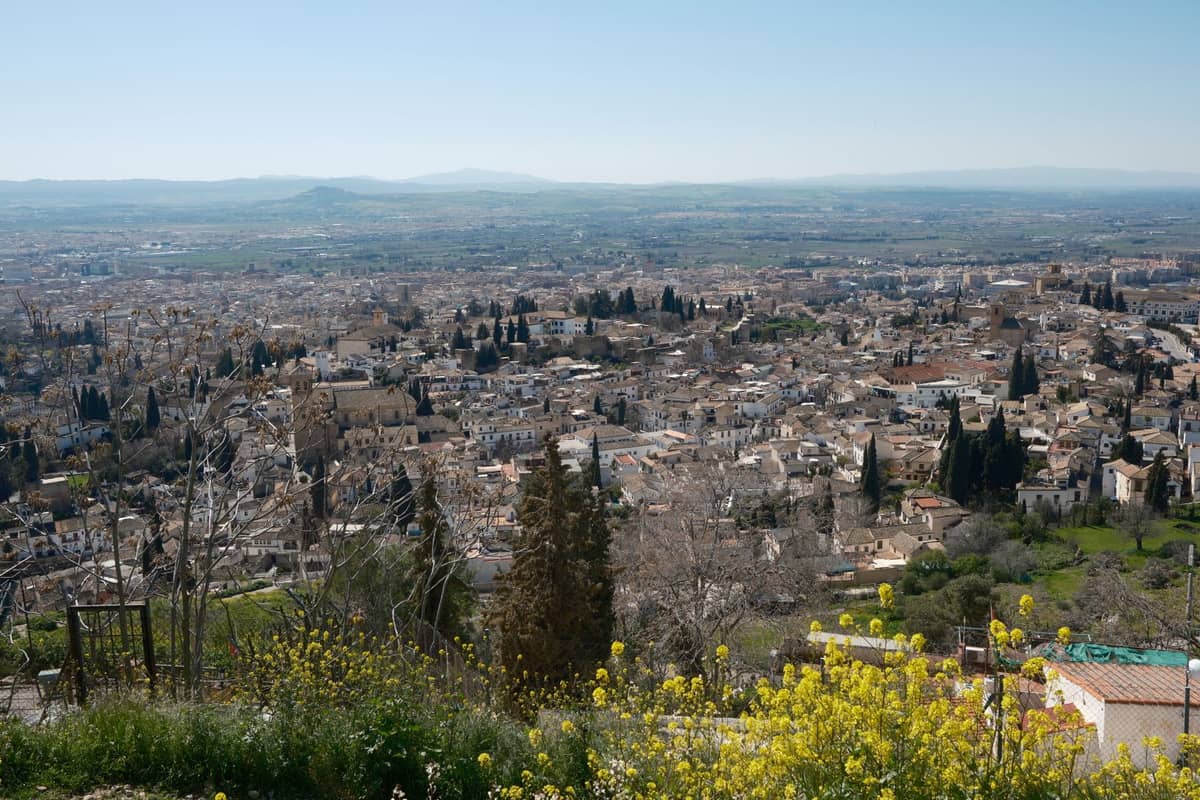
The Mirador de San Miguel Alto sits at about 850 metres above sea level on the upper slopes above the Albaicín and Sacromonte, making it one of the highest public viewpoints in Granada. That elevation figure matters: you are looking down at the Alhambra, not across at it. From most other miradors in the city, the Nasrid fortress meets you roughly at eye level. From San Miguel Alto, you see the full geometry of the palace complex spread below, with the white roofline of the Palacio de Carlos V clearly distinguishable, and the towers of the Alcazaba at the far western tip.
On clear days, the view extends south across the city and out toward the Sierra Nevada, where snowcapped peaks are often visible from late autumn through spring. The contrast between the rust-red walls of the Alhambra and the white peaks behind it is one of the more striking visual compositions you can find in Andalusia. To the northwest, the tightly packed white houses of the Albaicín cascade down their hillside in a way that is difficult to appreciate from street level.
ℹ️ Good to know
The viewpoint itself is an open public space with no fence, no ticket booth, and no facilities. There are no toilets, no cafe, and no shade structure at the top, and access is generally available at all hours. Plan accordingly, especially in summer.
How the View Changes Through the Day
Arrive before sunrise and you will often have the mirador entirely to yourself. The city below is still dark, punctuated by the amber streetlights threading through the Albaicín lanes, and the Alhambra glows from its floodlighting against a sky that shifts from deep blue to violet to orange. The air at this hour carries a damp, earthy smell from the hillside scrub, and in cooler months there is sometimes a thin mist sitting in the Darro valley below.
Morning light is the most photogenic. Between roughly 8 and 10am in summer, the low sun hits the Alhambra's southern walls at an angle that emphasises their texture and terracotta tone. The Sierra Nevada, if snow-covered, reflects white behind it. By mid-morning, other visitors begin arriving, and by late morning on weekends the small terrace can feel crowded for what is genuinely a compact space.
Midday in July or August is uncomfortable and not recommended. Temperatures in Granada regularly exceed 35°C in peak summer, there is no shade at the viewpoint, and the walk up is entirely exposed. The view is also flatter at high noon when shadows disappear. Sunset visits are popular and for good reason: the western light turns the Alhambra's walls a deep copper, and on clear evenings the Sierra Nevada holds the last colour long after the city has gone grey. Expect company at sunset, but the atmosphere tends to be relaxed rather than frenetic.
Tickets & tours
Live prices and dates from our booking partner. If you book, we may earn a commission at no extra cost to you.
Alhambra guided tour in Italian
From 49 €Instant confirmationFree cancellationAlhambra guided group tour with Nasrid Palaces and Generalife Palace
From 40 €Alhambra guided tour with Carlos V Palace, Generalife and Alcazaba
From 35 €Alhambra and Generalife skip-the-line private tour
From 65 €Instant confirmation
Getting There: The Uphill Reality
No route to this mirador is flat. The address is Calle Patio de la Alberca 36, and the approach from any direction involves a sustained uphill walk on uneven terrain. The official guidance recommends taking bus N9 from the Jardines del Triunfo area (near Avenida de la Constitución) to the stop 'Andarax 35 – San Miguel Alto', from which the viewpoint is roughly five minutes on foot. This is the most direct public transport option and cuts out the longest portion of the climb.
Alternatively, from Plaza Nueva you can take the C31 or C32 minibus to 'Cuesta del Chapiz 60' and walk up from there, which takes approximately 15 minutes and passes through the lower part of Sacromonte. This route is more scenic but considerably steeper in stretches. The C34 to 'Cno. del Sacromonte 39' is another option, though the walk from that stop is longer. Car or taxi access is only possible from the Murcia road side; taxis cannot reach the viewpoint from the Sacromonte valley approach.
⚠️ What to skip
The path is very steep and the surface is uneven in places. Flat-soled shoes or sandals without grip will make the ascent unpleasant. Avoid this walk in wet weather, when the stone and compacted earth surfaces become slippery.
The uphill walk takes most visitors between 15 and 25 minutes from the nearest bus stop depending on fitness and pace. It is not technically difficult, but people with limited mobility or joint problems should be aware that there are no handrails, no lift, and no alternative route. The viewpoint is not wheelchair accessible.
Historical and Cultural Context
The mirador takes its name from the Ermita de San Miguel Alto, a small chapel that stands adjacent to the viewpoint. The hermitage sits at the crest of the hill and has marked this elevated point in the landscape since the late 17th century, when it was first built over the former Torre del Aceituno. San Miguel, or Saint Michael the Archangel, holds particular significance in the religious geography of Granada: he is considered a protector of the city, and the chapel here was built partly to assert Christian presence on high ground following the Reconquista.
The hermitage itself is a modest whitewashed structure. It is not always open to the public, but its exterior and the small esplanade around it form part of the mirador space. The building predates most of what tourists see in central Granada, and its position was deliberately chosen to overlook the Alhambra hill across the valley. For more detail on the hermitage as a destination in its own right, see the Ermita de San Miguel Alto page.
The broader Sacromonte area surrounding the mirador has its own distinct identity in Granada's history, shaped by the gitano communities who settled in cave dwellings cut into the hillside from at least the 15th century onward. That heritage is still visible in the neighbourhood below, including the cave museum and the flamenco venues that operate in the evenings. The Museo del Sacromonte at the base of the hill puts this social and architectural history in context if you want to understand what you are walking through on the way up.
Photography: Practical Notes
The Mirador de San Miguel Alto is genuinely one of the better Alhambra photography positions in the city, precisely because of its elevation. A standard wide-angle lens captures the full Alhambra complex, the Albaicín hillside, and a portion of the Sierra Nevada in a single frame. The Mirador de San Nicolás, which is more famous and more crowded, sits at a similar distance from the Alhambra but at a lower elevation and gives a more lateral view of the Nasrid Palaces. San Miguel Alto gives you more of a plan view, which suits architectural composition.
Golden hour in the morning (roughly 7–9am in summer, later in winter) is the strongest light for the Alhambra's southern facade. Sunset light from the west falls more on the Albaicín than on the Alhambra from this angle, so evening visits are better for atmosphere and sky colour than for illuminated fortress walls. A telephoto lens (85–200mm equivalent) lets you isolate individual towers and pick out the contrast between the palace walls and the surrounding tree cover on the Alhambra hill.
💡 Local tip
Arrive at least 20 minutes before sunrise. The viewpoint is small, and on popular photography mornings (weekends, clear autumn days) the best standing positions fill quickly. The sunrise itself lasts only a few minutes of optimal light.
What to Bring and When to Go
The best months to visit are April through June and September through November. Spring brings comfortable temperatures (daytime highs around 22–27°C), the possibility of snow still visible on the Sierra Nevada, and green hillsides below the viewpoint. Early autumn has similar temperature advantages and very reliable clear skies. For more on timing a Granada trip, the best time to visit Granada guide covers seasonal conditions in detail.
Water is essential in any season. The walk is physical, and there is nowhere to buy anything once you leave the last houses below the mirador. In summer, bring more than you think you need. A light layer is worth carrying even in warm months: the exposed hilltop at about 850 metres has its own microclimate, and afternoon winds can be surprisingly cool once the sun drops.
There is no lighting on the path up. If you are planning a pre-dawn visit, bring a torch or use your phone's flashlight. The path is manageable in the dark but uneven enough that you will want to see where you are stepping.
Is It Worth the Walk?
This viewpoint is not for everyone. If you are looking for a comfortable, accessible mirador with a cafe nearby, the Mirador de San Nicolás in the Albaicín is the standard answer and justifiably popular. San Nicolás has bars directly adjacent, benches, and a flat approach from several directions. San Miguel Alto has none of those things.
What San Miguel Alto has instead is altitude, solitude on weekday mornings, and a perspective on the city that the lower viewpoints cannot match. The walk itself passes through a part of Sacromonte that most visitors never reach, with cave houses, small kitchen gardens, and views back down toward the Darro valley opening up as you climb. If the journey matters as much as the destination, this is a more interesting route than anything in the tourist centre.
People who dislike uphill walks, have limited mobility, visit in peak summer heat, or are primarily interested in being near restaurants and transport should skip this mirador in favour of lower alternatives. The elevation gain is real, the facilities are zero, and the Alhambra looks impressive from many places in Granada. San Miguel Alto is the right choice when you want the fullest possible view and are willing to earn it.
Insider Tips
- Weekday mornings before 9am are the quietest times by a significant margin. Weekend sunset visits are popular with locals and visitors alike, so arrive at least 30 minutes early if you want a clear position at the front of the viewpoint.
- The N9 bus saves the steepest portion of the climb. If you descend via the Sacromonte valley path rather than the way you came, the walk down passes cave dwellings and eventually brings you out near the Camino del Sacromonte, where you can catch another minibus such as the C34 back to Plaza Nueva.
- In winter and early spring, the Sierra Nevada snowpack can be extensive enough to dominate the background of every photo. January and February mornings after a clear night produce some of the most dramatic combinations of red Alhambra walls and white mountain behind.
- The hermitage chapel occasionally opens for services or local festivities. If you visit during a local saint's day, you may find a small ceremony taking place, which gives the mirador a very different character from its usual quiet role as a photography stop.
- There is no street lighting on the path. Pre-dawn visits require a light source. The last identifiable landmark before the path becomes purely rural is a small cluster of cave-house gates on the left side of the track going up from the Sacromonte valley.
Who Is Mirador de San Miguel Alto For?
- Photographers wanting the most elevated, unobstructed view of the Alhambra and Sierra Nevada in a single frame
- Early risers looking for a sunrise spot without competition from tour groups
- Walkers who want to combine a viewpoint with a genuine exploration of the upper Sacromonte neighbourhood
- Visitors on a second or third trip to Granada who have already seen the standard mirador circuit
- Travellers interested in the historical and cultural landscape of Sacromonte beyond the flamenco cave shows
Nearby Attractions
Other things to see while in Sacromonte:
- Abadía del Sacromonte
Perched on the slopes above Granada's cave district, the Abadía del Sacromonte is a 17th-century monastery complex built over sacred grottoes tied to the city's early Christian martyrs. It offers a rare combination of religious art, baroque architecture, underground cave chapels, and panoramic views of the Alhambra and the Vega — all within a short walk of the Albaicín.
- Cuevas del Sacromonte (Cave Houses)
Perched on the hillside above the Albaicín, the Cuevas del Sacromonte preserve eleven original cave dwellings that tell the story of the Roma and other communities who shaped one of Granada's most distinctive neighborhoods. The Museo Cuevas del Sacromonte offers a rare, grounded encounter with troglodyte domestic life, traditional crafts, and the cultural roots of flamenco, all within reach of the city center.
- Ermita de San Miguel Alto
Perched at the summit of the Albaicín hills above the Sacromonte neighbourhood, the Ermita de San Miguel Alto rewards the climb with one of the most complete panoramas in Granada. The Alhambra, the Sierra Nevada, and the rooftops of the old city spread out below, and unlike the famous Mirador de San Nicolás, the crowds rarely follow you this far up.
- Flamenco Shows in Sacromonte (Tablaos)
Sacromonte's whitewashed cave tablaos are where Granada's flamenco tradition feels most alive. This is not a polished theatre show. It is zambra performed in low-ceilinged grottoes carved into the hillside, with the Alhambra glowing on the ridge opposite and the smell of candle wax in the air. Here is everything you need to decide if it is worth your evening.
Planning a trip? Discover personalized activities with the Nomado app.