Ermita de San Miguel Alto: Granada's Highest Viewpoint Above the Alhambra
Perched at the summit of the Albaicín hills above the Sacromonte neighbourhood, the Ermita de San Miguel Alto rewards the climb with one of the most complete panoramas in Granada. The Alhambra, the Sierra Nevada, and the rooftops of the old city spread out below, and unlike the famous Mirador de San Nicolás, the crowds rarely follow you this far up.
Quick Facts
- Location
- Calle Patio de la Alberca 36, Sacromonte / Albaicín, Granada, Andalusia, Spain
- Getting There
- Bus N9 to 'Andarax 35 – San Miguel Alto' (5 min walk), or buses C31/C32 to 'Cuesta del Chapiz 60' (15 min walk uphill)
- Time Needed
- 30–60 minutes at the site; allow extra time for the uphill approach
- Cost
- Free (exterior and mirador). Guided walks may be available with local operators at varying prices; check current offers.
- Best for
- Sunrise and sunset panoramas, photography, escaping Alhambra crowds, quiet reflection
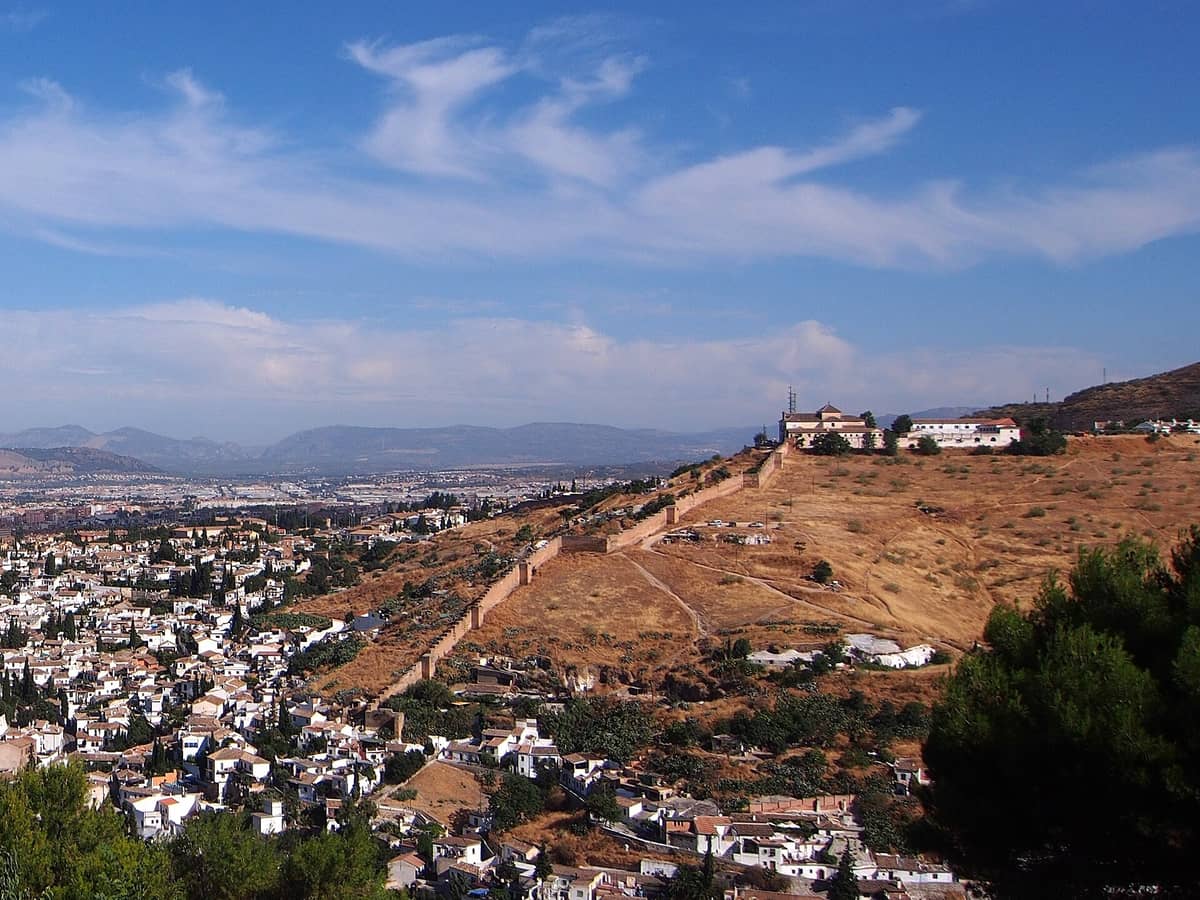
What You're Looking At From the Top
The Ermita de San Miguel Alto sits at the highest point of the Albaicín ridge, and the panorama from its terrace is, by any honest measure, one of the most complete views you can get of Granada without paying for a helicopter. The Alhambra palace complex stretches directly across the Darro valley to the south, its ochre towers close enough to make out individual battlements. Behind it, the Sierra Nevada rises sharply, and on clear winter mornings the snow-covered peaks form a backdrop that photographers spend entire trips chasing.
Turn around and the view shifts entirely: the rooftops of the Albaicín drop away below you in layers of terracotta and white render, with the bell towers of the old city marking the horizon to the west. On still evenings, you can hear the city far below, and when the wind drops, the smell of rosemary and dried earth from the hillside paths is surprisingly strong. It is a view you absorb slowly, not one that reveals itself immediately.
💡 Local tip
The terrace faces south and southwest. For the Alhambra-and-Sierra-Nevada composition, come in the morning when the light falls on the palace façades. For warm golden tones across the rooftops, arrive 45 minutes before sunset.
How It Changes Through the Day
At dawn, the site is almost always empty. The uphill walk keeps casual visitors away at that hour, and the silence at the top is close to total. The Alhambra catches the first light from the east and turns a deep amber before the rest of the city wakes up. This is when the photography conditions are best: no shadows from other visitors, no haze in the valley, and the snow on the Sierra Nevada shows its full detail.
Midday in summer is uncomfortable. Granada sits at about 738 metres above sea level, but July and August still push temperatures above 35°C, and the hilltop is fully exposed with almost no shade. The stone walls of the hermitage radiate heat. If you visit between June and August, the early morning or the hour before dusk are the only sensible windows.
Late afternoon on a weekday in spring or autumn is probably the sweet spot for most visitors. A small number of people are usually present, mostly locals who walk up from the Albaicín lanes, and the atmosphere is calm and unhurried. Weekends bring more visitors, particularly around sunset, but the numbers here never approach the near-gridlock you find at the Mirador de San Nicolás on the same evenings.
If you want to understand why this viewpoint sits in a different category from the better-known terraces below, read the full guide to Granada's viewpoints before you visit. The comparison matters for planning your time.
Tickets & tours
Live prices and dates from our booking partner. If you book, we may earn a commission at no extra cost to you.
Alhambra guided tour in Italian
From 49 €Instant confirmationFree cancellationAlhambra guided group tour with Nasrid Palaces and Generalife Palace
From 40 €Alhambra guided tour with Carlos V Palace, Generalife and Alcazaba
From 35 €Alhambra and Generalife skip-the-line private tour
From 65 €Instant confirmation
The Hermitage Itself: History and Architecture
The small whitewashed building at the summit is the Iglesia de San Miguel Alto, a hermitage rather than a parish church, and its origins are layered in the kind of history that Granada specialises in. The hilltop was occupied before the church existed: a Muslim tower stood here during the Nasrid period, using the elevation for defensive observation over the valley. After the Christian conquest of Granada in 1492, the site passed through different uses before the current structure began to take shape.
The first recorded mass was celebrated on 29 September 1673, the year the original temple was completed, a date that still anchors the church's most significant annual event. The building itself is modest and deliberately so: thick white walls, a simple bell, and an arched entrance that is kept closed outside of services. There is no grand interior to visit as a tourist. The architectural interest lies in the way the structure occupies its site, pressed against the rock of the hillside, with the viewing platform extending naturally from the churchyard.
Each year on or around 29 September, typically on the Sunday closest to that date, the Romería de San Miguel Arcángel brings a pilgrimage procession up the hill, when San Miguel is honoured as patron of the Albaicín. The event draws local families and devotees in a tradition that has continued for more than three centuries. If you happen to be in Granada around that date, the procession up the steep lanes is worth witnessing.
Getting There: The Practical Version
The approach is steep from any direction, and this is not a casual detour. From the city centre, the most direct public transport option is the N9 bus, which runs from the Jardines del Triunfo area toward San Miguel Alto. Get off at the "Andarax 35 – San Miguel Alto" stop and allow around five minutes of uphill walking to the mirador.
If you are already in the Albaicín, buses C31 or C32 from Plaza Nueva will take you to the "Cuesta del Chapiz 60" stop, from where it is a 15-minute walk uphill through the lanes. The C34 towards Sacromonte also serves this area and requires a longer walk. By car or taxi, vehicle access is only possible via the Carretera de Murcia; there is no through road from the Albaicín lanes.
⚠️ What to skip
The paths from the lower Albaicín involve significant elevation gain on uneven stone surfaces. Visitors with limited mobility, pushchairs, or wheeled luggage will find the approach genuinely difficult. The N9 bus option reduces but does not eliminate the walking challenge.
The walk up from the Sacromonte can be combined naturally with a visit to the Abadía del Sacromonte, which sits on the same hillside. Factor in at least half a day if you plan to visit both.
Photography at San Miguel Alto
The Alhambra-and-Sierra-Nevada framing is the headline shot, and it works best when there is snow on the peaks, which is most reliably present from late November through March and sometimes into April. A standard wide-angle lens captures the full sweep of the palace and the mountains behind. For detail shots of the Nasrid towers, a short telephoto brings the battlements close enough to read the shadow lines on the stonework.
The hermitage itself photographs well in late afternoon, when the low sun catches the white render and the bell arch. Include the terrace wall in the foreground for a sense of scale and place. Avoid shooting the Alhambra when the sun is behind it (late afternoon in winter), as the palace will be in silhouette unless that is your intent.
For context on what you are looking at across the valley, the Nasrid Palaces and the Alcazaba are both visible from this terrace. Understanding their layout before you visit makes the view considerably more meaningful.
Weather, Seasons, and When to Come
Spring (April to May) and autumn (September to October) are the most comfortable seasons for the uphill walk, with daytime temperatures typically in the low‑ to mid‑20s °C and relatively low precipitation. The light is warm and directional in both seasons, which benefits both the view and photography. April often still carries some snow on the Sierra Nevada, giving the panorama its most dramatic backdrop.
Winter visits are genuinely rewarding if the sky is clear. January means cold mornings at the top, sometimes below 5°C with wind chill, but the clarity of the air at altitude means the Sierra Nevada appears almost impossibly close. Bring a warm layer even if it feels mild in the city centre below. November has the highest monthly rainfall in Granada, and the hilltop in rain and low cloud offers nothing except a wet walk home.
For a fuller picture of how the seasons affect what you can do across the city, the best time to visit Granada guide covers the trade-offs honestly.
Who This Is and Isn't For
This viewpoint suits people who are willing to earn their panorama. The walk is not extreme, but it is real, and visitors expecting an easy stroll from a nearby car park will be disappointed. If you value a quiet, unhurried encounter with Granada's skyline over the social spectacle of a crowded sunset terrace, San Miguel Alto delivers consistently. It is also a genuinely free experience with no booking required, no queues, and no time limit.
Travellers who want the iconic viewpoint experience without the climb should consider the Mirador de San Nicolás instead. It is lower, more accessible, and draws far larger crowds. San Miguel Alto is a different kind of visit entirely.
Visitors with significant mobility limitations, or anyone travelling with young children in a pushchair, should be aware that the access paths are steep, uneven, and not adapted. The N9 bus reduces the walk but does not make the site fully accessible.
Insider Tips
- The N9 bus is far less well-known than the Albaicín minibuses. Most tourists take C31 or C32 and face a long climb; the N9 gets you within a five-minute walk of the top. Check current timetables with the local bus operator before you go, as frequency can vary by day and season.
- The terrace has no café, no water fountain, and no shelter from sun or wind. Bring water, especially in summer, and a wind layer in winter. The exposure at the top catches you off guard if you dressed for the temperature in the city below.
- If you visit on the Sunday closest to 29 September, the Romería de San Miguel Arcángel brings a local pilgrimage procession up the hill. The site will be busier than usual, but the event is one of the more authentic neighbourhood celebrations in Granada.
- The Alhambra is lit at night and the view from here after dark is striking. The access paths are unlit, so bring a torch or use your phone light, and go with someone else rather than alone on your first visit.
- For the Sierra Nevada snow framing, check the Junta de Andalucía snow reports or the Sierra Nevada ski resort webcams the day before your visit. A thin snowline looks flat in photos; wait for a proper covering if that shot matters to you.
Who Is Ermita de San Miguel Alto For?
- Photographers looking for an alternative to the oversubscribed San Nicolás terrace
- Early risers who want the Alhambra panorama in peace before the city wakes up
- Walkers combining a Sacromonte and Albaicín circuit with a natural high point
- Visitors in Granada between November and April who want snow-on-Sierra-Nevada views
- Travellers on a tight budget who want a free, bookable-anytime alternative to paid attractions
Nearby Attractions
Other things to see while in Sacromonte:
- Abadía del Sacromonte
Perched on the slopes above Granada's cave district, the Abadía del Sacromonte is a 17th-century monastery complex built over sacred grottoes tied to the city's early Christian martyrs. It offers a rare combination of religious art, baroque architecture, underground cave chapels, and panoramic views of the Alhambra and the Vega — all within a short walk of the Albaicín.
- Cuevas del Sacromonte (Cave Houses)
Perched on the hillside above the Albaicín, the Cuevas del Sacromonte preserve eleven original cave dwellings that tell the story of the Roma and other communities who shaped one of Granada's most distinctive neighborhoods. The Museo Cuevas del Sacromonte offers a rare, grounded encounter with troglodyte domestic life, traditional crafts, and the cultural roots of flamenco, all within reach of the city center.
- Flamenco Shows in Sacromonte (Tablaos)
Sacromonte's whitewashed cave tablaos are where Granada's flamenco tradition feels most alive. This is not a polished theatre show. It is zambra performed in low-ceilinged grottoes carved into the hillside, with the Alhambra glowing on the ridge opposite and the smell of candle wax in the air. Here is everything you need to decide if it is worth your evening.
- Mirador de San Miguel Alto
Perched at about 850 metres above sea level in the Albaicín/Sacromonte hills, the Mirador de San Miguel Alto offers one of Granada’s most elevated panoramic views. It is free, effectively always accessible, and rewards the uphill walk with unobstructed sightlines across the Alhambra, the Albaicín, and the Sierra Nevada beyond.
Planning a trip? Discover personalized activities with the Nomado app.