St. Michael's Church (Michaelskirche): Munich's Jesuit Masterpiece and Royal Crypt
Built between 1583 and 1597 as a Counter-Reformation statement, St. Michael's Church on Neuhauser Strasse is one of the most important Renaissance churches north of the Alps. Its soaring barrel vault, gilded interior, and the crypt holding King Ludwig II make it one of Munich's most architecturally significant stops, and there is normally no charge to enter.
Quick Facts
- Location
- Neuhauser Straße 6, 80333 München (Altstadt pedestrian zone, between Marienplatz and Karlsplatz)
- Getting There
- U-Bahn Karlsplatz (Stachus), lines U4/U5, then 3-minute walk east along Neuhauser Straße. Also 5-6 minutes on foot from Marienplatz.
- Time Needed
- 30–60 minutes for the nave and crypt; longer if attending a service or midday organ recital
- Cost
- Church: free. Crypt: generally free. Some guided tours or special events may be fee-based — verify at st-michael-muenchen.de
- Best for
- Architecture enthusiasts, history and royal history buffs, travelers seeking a quiet pause on the busy pedestrian zone
- Official website
- www.st-michael-muenchen.de
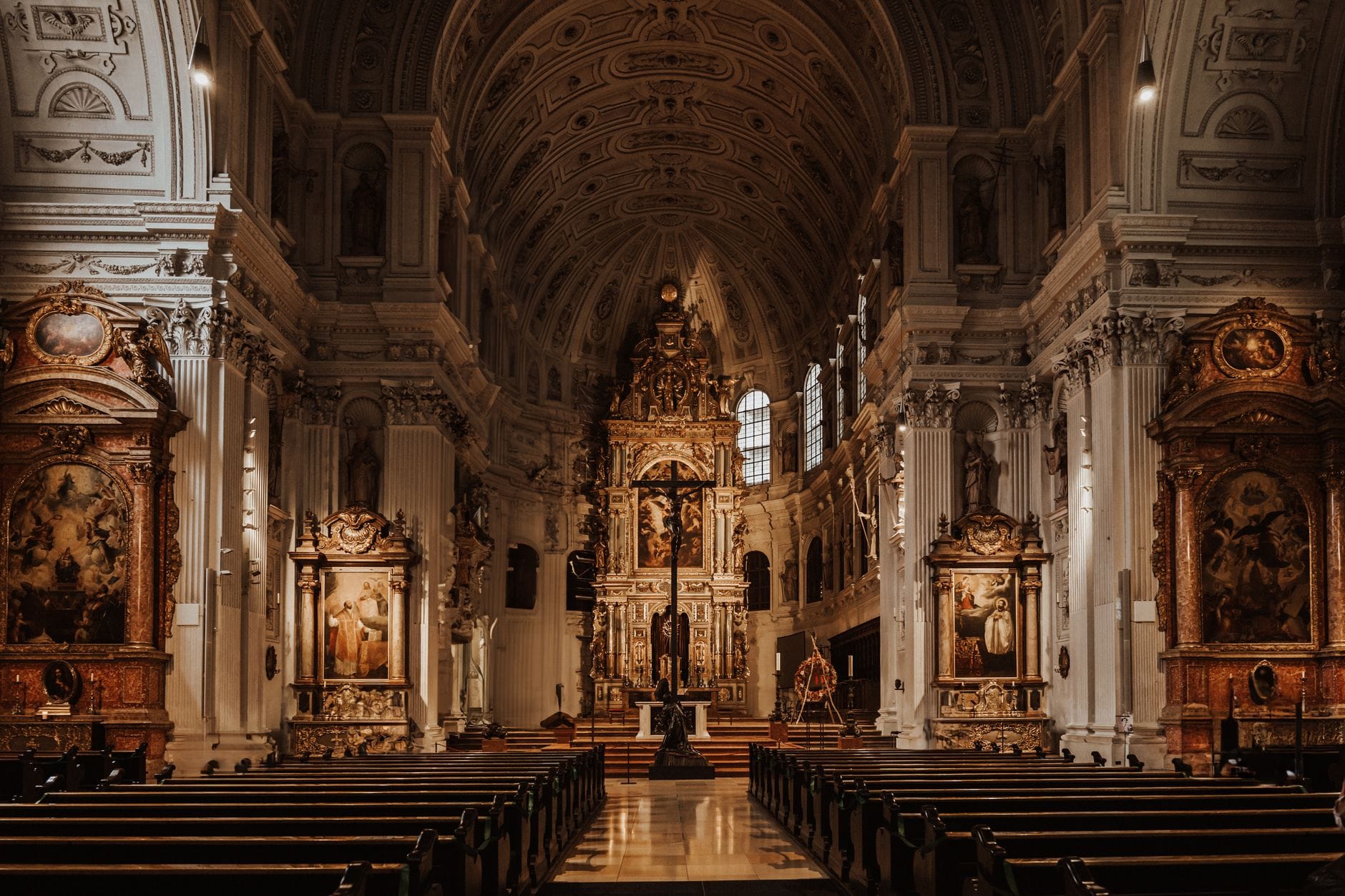
What Is St. Michael's Church?
St. Michael's Church, known in German as Michaelskirche or Jesuitenkirche St. Michael, stands on Neuhauser Straße in the heart of Munich's Altstadt pedestrian zone. It is the largest Renaissance church north of the Alps and a building whose proportions still surprise visitors who walk in expecting something modest. The nave opens up to a barrel vault about 20 metres wide, one of the largest of its kind, and the effect is one of sudden, structural clarity: more weight, more air, more silence than the street outside prepares you for.
The church sits roughly midway along the pedestrian zone that connects Marienplatz to Karlsplatz (Stachus), so most visitors encounter it between other stops rather than as a standalone destination. That positioning works in its favour: the facade appears abruptly as you pass shops and street performers, and the scale of it stops people mid-stride. The white-painted exterior, punctuated by arched windows and statue niches, signals Renaissance proportions before you step inside.
💡 Local tip
Opening hours vary by day. The church is typically open Monday and Friday from 09:30 to 19:00, Tuesday through Thursday plus Saturday from 7:30 to 19:00, and on Sundays from 7:30 until 22:00. The crypt is generally accessible Monday to Friday 09:30–16:30 and on weekends 09:30–14:30. Always check st-michael-muenchen.de before visiting, as times change around services and events.
Historical Context: A Counter-Reformation Power Statement
Duke Wilhelm V of Bavaria commissioned St. Michael's Church in 1583, commissioning it specifically as a Jesuit church at a moment when the Catholic Church was fighting hard to reclaim ground lost during the Protestant Reformation. The choice of the Jesuits, who were the Counter-Reformation's most intellectually rigorous and architecturally ambitious order, was deliberate. The building was intended to be a demonstration of Catholic confidence: large enough to hold substantial congregations for preaching, formal enough to project institutional authority, and ornate enough to move the faithful.
Construction ran from 1583 to 1597. Legend holds that the collapse of the tower in 1590, while the church was still being built, was interpreted as a sign to enlarge the structure rather than scale it back. Whether or not that story is accurate, the final dimensions were indeed grand: the vault that replaced the planned design became one of the widest barrel vaults in the German-speaking world. The church was consecrated in 1597 in honour of the Archangel Michael, whose role as heavenly defender against evil fit the Counter-Reformation programme precisely.
The building went on to exert enormous influence over Baroque church architecture across southern Germany and Austria. When later architects in Bavaria needed a template for a large, formal, Latin-cross church, they came back to St. Michael's proportions. That historical role makes it more than a church that happens to be old. It is effectively the architectural ancestor of dozens of buildings you will see throughout the region.
Tickets & tours
Live prices and dates from our booking partner. If you book, we may earn a commission at no extra cost to you.
Luggage Storage in Munich
From 6 €Instant confirmationFree cancellationOne hour city sightseeing bus tour in Munich
From 21 €Instant confirmationFree cancellationMunich Third Reich walking tour
From 32 €Instant confirmationFree cancellationRomantic Road Day Trip to Rothenburg and Harburg
From 74 €Instant confirmationFree cancellation
The Interior: What to Look For
Entering through the main doors off Neuhauser Straße, the first thing you notice is the barrel vault stretching ahead of you, cream-white and uninterrupted, without the forest of columns that supports most large Gothic churches. The nave is unusually wide relative to its height, which makes the space feel more ceremonial hall than soaring cathedral. Natural light enters through the clerestory windows along the upper walls, and in the morning hours it falls in long diagonal bands across the stone floor.
The high altar at the east end features a large painting by Christoph Schwarz depicting St. Michael defeating the rebel angels, which is thematically fitting for a church dedicated to St. Michael. The side chapels along the nave are richly decorated and worth examining individually; each contains altarpieces and devotional details that reward slow looking. The overall colour palette is restrained compared to many Bavarian Baroque interiors: more white plaster and gilt accents than the heavily frescoed ceilings you find elsewhere in Munich.
The organ, positioned in the west gallery above the entrance, is used for regular musical programmes. If you visit midday on a weekday, it is worth checking whether a midday recital is scheduled. The acoustics inside the barrel vault carry music cleanly across the full length of the nave. For more of Munich's musical and ecclesiastical architecture, the nearby Theatinerkirche on Odeonsplatz offers an interesting stylistic comparison, being a full Baroque church built roughly 80 years later.
ℹ️ Good to know
Photography for personal, non-commercial use is generally permitted inside the church, but flash photography and tripods are typically not allowed. Be mindful of ongoing services or prayer — the church is an active place of worship, not a museum.
The Wittelsbach Crypt: Ludwig II and the Royal Dead
Beneath the church lies the Wittelsbach dynasty crypt, which contains the remains of more than 40 members of Bavaria's ruling family. The crypt is accessed via a staircase inside the church and is open during the hours noted above, generally without an admission charge, though this should be confirmed before visiting.
The single most-visited tomb here belongs to King Ludwig II of Bavaria, who died in 1886 under circumstances that remain genuinely contested by historians. Ludwig built Neuschwanstein Castle and several other extraordinary structures; his architectural obsessions, combined with the circumstances of his death by apparent drowning just days after being declared mentally unfit to rule, have kept him a figure of popular fascination ever since. A modest wreath or fresh flowers often marks his sarcophagus, left by admirers. The crypt atmosphere is cool and dim regardless of season, with stone arches and low lighting that feel appropriate to the space.
Other notable interments include Duke Wilhelm V, who commissioned the church, and several further generations of Wittelsbachs. For visitors with an interest in Bavarian royal history, the crypt offers more direct contact with that history than any museum display can match. There are no ropes or barriers around most of the sarcophagi; you stand close to the stone.
How the Experience Changes by Time of Day
Early morning, particularly before 9:00 on weekdays, the church is used primarily by local parishioners for Mass. The atmosphere at this hour is quieter and more devotional, with incense sometimes lingering from earlier services. There are almost no tourists, and the light through the upper windows is cool and directional. If you are in the neighbourhood for breakfast, arriving early rewards you with the interior at its most uninterrupted.
By late morning and through the early afternoon, the pedestrian zone outside is at its most crowded, and the church absorbs a steady flow of visitors pausing from shopping or sightseeing. This is the time when the interior is most populated, which affects both the acoustic atmosphere and the ease of moving slowly through the side chapels. The crypt is typically least crowded in the first hour after it opens each morning.
Late afternoon and early evening, particularly in summer when light lasts longer, are underrated times to visit. The angle of light through the western windows changes the interior noticeably, and the evening crowd in Munich tends to be concentrated in the beer halls and parks rather than churches. On Sundays the church is open until 22:15, which makes an evening visit genuinely possible and unusual compared to most comparable attractions.
⚠️ What to skip
The church closes portions of the nave and occasionally the crypt entirely during services, funerals, or special liturgical events. If you are visiting specifically to see the crypt, check the church's official schedule in advance. Weekend mornings in particular have regular services that may temporarily restrict access to parts of the interior.
Getting There and Practical Walkthrough
St. Michael's Church sits at Neuhauser Straße 6, directly on Munich's main pedestrian shopping street. The U-Bahn stop Karlsplatz (Stachus), served by lines U4 and U5, puts you about three minutes' walk from the entrance. From Marienplatz it is a five-to-six minute walk west through the pedestrian zone. There is no parking immediately adjacent; the surrounding streets are within Munich's paid and restricted zones, making public transport the practical choice.
The church is on level ground on a flat pedestrian street, and barrier-free wheelchair access is officially indicated. For current details on step-free access to the crypt specifically, it is worth contacting the church directly. Visitors with mobility considerations planning a wider Altstadt itinerary should note that the surrounding pedestrian zone is also broadly flat and free of traffic.
What to bring: the interior is cool year-round and noticeably cold in winter, so a light layer is advisable even in summer. Shoulders and knees should be covered as a basic courtesy in an active place of worship; a scarf or jacket tied around the waist works if you are caught short. The stone floors can be hard on knees and feet, so comfortable shoes matter more than many visitors expect.
Is It Worth Your Time?
St. Michael's Church is not overhyped. It genuinely delivers architectural scale and historical substance that are unusual for a free, 30-minute visit in a central urban location. The barrel vault is a real achievement of structural engineering, and the crypt is one of the few places in Munich where you can stand in direct proximity to figures from Bavarian history without paying museum prices. Compared to other central Munich churches, it is more architecturally ambitious than the Asamkirche (which is smaller and more intensely decorative) and more historically layered than most.
That said, if your interest is purely in visual spectacle and Baroque excess, the Theatinerkirche or the Frauenkirche may feel more rewarding. St. Michael's aesthetic is more restrained: more Renaissance rationalism than full Baroque emotion. Visitors who prefer that register will find it appealing; those who come expecting gilded ceilings and fresco overload may feel it underwhelms. It is also a genuinely active parish church, which means noise, crowds near the pews during services, and periods when sections are closed.
Travelers on a tight schedule who have already seen the Frauenkirche and Odeonsplatz could reasonably skip this one. But for anyone with 30 spare minutes on Neuhauser Straße and an interest in architecture, Bavarian royal history, or simply a cool, quiet break from the pedestrian zone, it earns its place on the list.
Insider Tips
- The crypt is least crowded in the first 30 minutes after it opens each morning. Weekday mornings are noticeably quieter than weekend mornings, which have regular services that can temporarily close access.
- Sunday evening access until 22:15 is genuinely rare for a major historic church in central Munich. An evening visit after dinner, when the pedestrian zone has quieted and the interior is lit differently, offers a very different experience from the midday rush.
- Check the official website for organ recital schedules. The barrel vault's acoustics carry music unusually well across the full nave, and these recitals are often free or very low cost.
- The bronze statue of St. Michael defeating the devil above the main entrance portal is worth examining before you go in. The figural detail is high quality and easy to miss when you are focused on getting through the door.
- If you are visiting with an interest in Ludwig II, the crypt here pairs well with a day trip to Neuschwanstein; seeing the tomb first and the castle second (or vice versa) gives the biography more shape than either visit alone provides.
Who Is St. Michael's Church (Michaelskirche) For?
- Architecture enthusiasts who want to understand the structural transition from Renaissance to Baroque in southern Germany
- History travelers with an interest in the Wittelsbach dynasty and Bavarian royal history, particularly Ludwig II
- Visitors looking for a free, covered attraction in the Altstadt that works in any weather
- Travelers who want a quiet pause during a busy day on the pedestrian zone
- Church and sacred music enthusiasts who may catch an organ recital in exceptional acoustics
Nearby Attractions
Other things to see while in Altstadt (Old Town):
- Asamkirche
Squeezed into a narrow slot on Sendlinger Strasse, the Asamkirche is a privately built late Baroque church that packs more ornamental intensity into 22 metres than most cathedrals manage in a hundred. Built by the Asam brothers between 1733 and 1746, it is free to enter and sits in the heart of Munich's pedestrian zone.
- Cuvilliés Theatre
Hidden within the Munich Residenz complex, the Cuvilliés Theatre is an 18th-century Rococo opera house of extraordinary refinement. Its gilded tiers, crimson velvet boxes, and carved ivory ornaments make it one of the most visually concentrated rooms in all of Germany.
- Deutsches Museum
The Deutsches Museum sits on its own island in the Isar river and claims a place among the largest science and technology museums on earth. With 125,000 exhibited objects spanning aviation, mining, chemistry, musical instruments, and far more, it rewards careful planning rather than a casual stroll.
- Feldherrnhalle
Standing at the southern end of Odeonsplatz, the Feldherrnhalle is one of Munich's most architecturally striking and historically loaded monuments. Built between 1841 and 1844, it witnessed the gunfire that ended Hitler's failed coup and remains freely accessible at any hour. Few structures in the city compress so much of Bavaria's and Germany's history into a single loggia.
Planning a trip? Discover personalized activities with the Nomado app.