Mercado Jamaica: Inside Mexico City's 24-Hour Flower Market
Mercado Jamaica is one of Mexico City's largest flower markets, operating 24 hours a day with roughly 1,150 vendors selling over 5,000 types of flowers and ornamental plants. Free to enter and directly served by Metro Jamaica (Line 9), it offers one of the most sensory and photogenic market experiences in the city.
Quick Facts
- Location
- Avenida Congreso de la Unión & Avenida Morelos, Jamaica, Venustiano Carranza, Mexico City
- Getting There
- Metro Jamaica — Line 9 (direct access) and Line 4 (short walk)
- Time Needed
- 1–2 hours for a thorough walk; 30 minutes if browsing quickly
- Cost
- Free entry; purchases in Mexican pesos (MXN)
- Best for
- Photography, flower buyers, early risers, cultural immersion
- Official website
- mexicocity.cdmx.gob.mx/venues/jamaica-market/?lang=en
What Mercado Jamaica Is
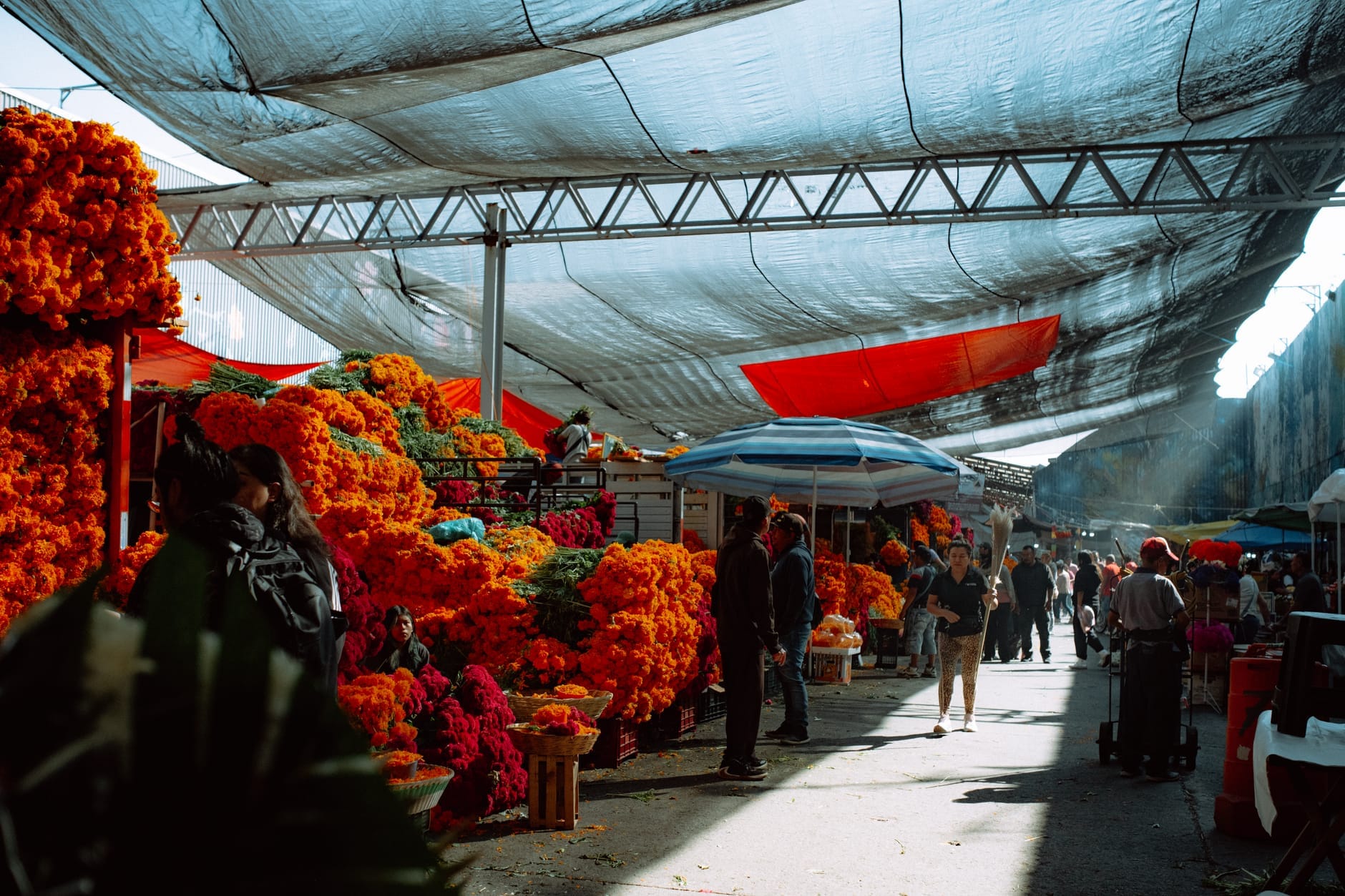
Mercado Jamaica is a major wholesale and retail flower market in Mexico City, occupying an entire city block in the Venustiano Carranza borough, southeast of the historic center. The complex consists of three large covered naves, each the size of a warehouse, packed wall to wall with cut flowers, potted plants, ornamental trees, wreaths, altar arrangements, and every variation of tropical foliage you can name. Approximately 1,150 vendors operate here, and the collective stock runs to about 5,000 types of flowers and ornamental plants.
Unlike most markets in Mexico City that follow standard daytime hours, Mercado Jamaica is generally described as operating 24 hours a day, 365 days a year, a fact that makes it unusual among the city's public markets. Wholesale buyers arrive in the early hours before dawn, loading trucks with bulk orders. By mid-morning the retail crowd fills the aisles. By afternoon, the pace slows to a comfortable stroll. Every hour of the day produces a slightly different version of the same place.
💡 Local tip
Arrive before 8 a.m. for the full wholesale spectacle: carts loaded with gladioli, vendors calling prices across the aisle, and the sharpest selection of the day's stock. The market is still worth visiting at any hour, but early morning is its most cinematic.
A Trading Site Five Centuries in the Making
The land the market occupies has been documented as a trading zone since pre‑Hispanic times, when the area sat near the eastern edge of the interconnected lakes of ancient Mexico‑Tenochtitlán. Historical codices record commercial activity here predating Spanish colonization, which means the impulse to trade flowers and produce at this spot has deep roots in the city's pre-Hispanic economy.
The current reinforced-concrete market complex opened in 1957, as part of a mid‑20th‑century initiative to modernize Mexico City's main public markets. Mercado Jamaica was built alongside the reconstruction of markets like La Merced and Sonora during a period of rapid urban expansion. The utilitarian architecture of the naves reflects that era: functional, wide-aisled, and designed for volume rather than aesthetics. What makes the space beautiful is what the vendors have done with it since.
The flower trade here is not incidental to daily life in Mexico City; it is woven into it. The market supplies flowers for weddings, quinceañeras, Día de Muertos altars, church offerings, and ordinary household bouquets. If you want to understand how flowers function in Mexican culture beyond their decorative role, walking through Jamaica during a major holiday is instructive. For context on that dimension, the Day of the Dead guide for Mexico City explains how cempasúchil marigolds, sold in enormous quantities here, figure into ofrenda traditions.
Tickets & tours
Live prices and dates from our booking partner. If you book, we may earn a commission at no extra cost to you.
Puebla and Cholula guided tour from Mexico City with optional lunch
From 43 €Instant confirmationFree cancellationXochimilco, Coyoacan and Frida Kahlo Museum with skip-the-line tickets
From 63 €Instant confirmationFree cancellationMexico City exploration game and tour in Chimalistac
From 10 €Instant confirmationFree cancellationCuernavaca and Taxco Guided Tour with Optional Lunch
From 40 €Instant confirmationFree cancellation
How the Market Looks, Smells, and Sounds
Walking into the first nave from the Metro Jamaica exit, the smell hits before the visual does. It is green and wet and faintly sweet, layered with the earthier notes of cut stems sitting in plastic buckets. The floors are perpetually damp. Vendors spray their stock throughout the day, and the mist drifts across the aisles. In the early morning, when deliveries are arriving, you also get diesel from the loading zone and the sharp smell of plastic wrapping being cut open.
The color palette shifts depending on the season and which holidays are approaching. Around February, red and pink roses dominate so completely that entire sections of the market become almost monochromatic. In October, marigolds in orange and yellow pile up in quantities that are staggering. During quieter months, you get the full range at once: proteas, heliconias, birds of paradise, orchids, sunflowers, gerberas, and dozens of varieties that do not have straightforward English translations.
Noise inside the market is constant but not overwhelming. Vendors negotiate in quick, clipped exchanges. Carts with squeaky wheels pass through the aisles. Somewhere in the background, a radio plays. The sound environment is that of a working market, not a tourist attraction, which is part of what makes it worth visiting.
ℹ️ Good to know
Photography is generally tolerated, but asking vendors before pointing a camera at them is standard courtesy. Most are receptive, especially if you have shown serious interest in their stock. Long light in the early morning creates excellent conditions for shooting the packed stalls from low angles.
Getting There and Moving Through the Market
The most direct approach is Metro Line 9 to the Jamaica station, which has exits directly under and in front of the market building. From the station exit, the main nave entrance is immediately visible. Line 4 also serves Jamaica and involves a slightly longer walk of a few minutes. The market's address at the corner of Avenida Congreso de la Unión and Avenida Morelos makes it easy to locate by ride-hailing app as well.
The three naves are connected internally, so you can walk the entire market without returning to the street. Interior aisles are wide enough to accommodate foot traffic and vendor carts simultaneously, but during busy periods, especially weekend mornings, the pace is dictated by the crowd rather than your own preference. If you have mobility considerations, note that official sources do not confirm step-free access throughout; the market was built in 1957 and may have uneven surfaces, raised thresholds between sections, and areas where carts create temporary obstacles.
Jamaica is located in Venustiano Carranza, the same borough that contains Mexico City's Benito Juárez International Airport (MEX). The neighborhood is east of the historic center and does not form part of the main tourist corridor between Roma, Condesa, and Polanco. If you are structuring a day around multiple stops, pairing Jamaica with a visit to the Templo Mayor or Mercado de San Juan to the west makes logical geographic sense.
Best Times to Visit and What Changes by Hour
The 24-hour schedule is not just a technical detail; it produces meaningfully different experiences depending on when you arrive. Between midnight and 6 a.m., the market operates in wholesale mode. Trucks pull up to the loading docks, bulk orders move fast, and the vendors in operation are there to transact, not converse. It is raw and especially interesting for anyone who wants to see how a major city's flower supply chain actually functions. That said, navigating the area around the market at 3 a.m. requires awareness of your surroundings.
From roughly 7 a.m. to noon, the market is at its fullest and most photogenic. Retail customers mix with late wholesale buyers, the full stock is on display, and vendors are engaged and communicative. This is the window most visitors describe as the best balance of energy, selection, and accessibility.
Afternoons are quieter. Stock thins out, some stalls wrap up for the day, and the sensory intensity drops. It is a more relaxed visit but less representative of what makes the market distinctive. Evening brings a second wind as vendors restock for the following morning's wholesale activity.
⚠️ What to skip
In the rainy season (roughly May to October), afternoon thunderstorms are common. The covered naves protect you from rain, but the approach from the Metro and the loading areas outside can flood quickly. Wear closed shoes with grip. Morning visits reduce the chance of encountering heavy rain.
If you are planning a broader market day in Mexico City, the street food guide for Mexico City covers the food stalls operating in and around markets like Jamaica, where prepared food vendors often set up near the main entrances.
What to Buy, What to Expect to Pay
Prices at Jamaica are generally lower than at florists in tourist-heavy neighborhoods, but the market operates on a sliding scale based on quantity and your negotiation. Wholesale prices apply to bulk purchases; retail prices are higher but still competitive. A large mixed bouquet that would cost several hundred pesos at a Polanco florist typically costs a fraction of that here, though the exact amount varies by season, flower type, and the individual vendor.
Beyond cut flowers, vendors sell potted plants, seeds, hanging baskets, floral foam, vases, and the full toolkit of event decoration. Sections specializing in artificial flowers and altar supplies occupy parts of the outer naves. If you are in Mexico City around a major holiday and want to understand what goes into a proper Día de Muertos ofrenda or a wedding centrepiece, watching vendors assemble custom orders is informative in itself.
Transactions are in Mexican pesos. Card acceptance among individual vendors is limited; carry cash. There are ATMs nearby, including at the Metro station.
For travelers interested in the full range of Mexico City's market culture, the free things to do in Mexico City guide covers several public markets, including this one, where entry costs nothing and the experience is entirely dependent on your curiosity rather than your budget.
Who Should Reconsider Visiting
Mercado Jamaica is a working wholesale and retail market, not a curated experience. The floors are wet, the aisles can be congested, and the vendors are focused on selling to regular customers rather than guiding tourists. Travelers expecting the polished aesthetic of a gourmet food hall or a design market will find it mundane. The market also requires a dedicated trip to a neighborhood that is not adjacent to most of the city's other major attractions, which means it demands some planning.
If you have limited time in Mexico City and are choosing between this and a major museum or archaeological site, those alternatives offer more concentrated cultural context. Mercado Jamaica rewards visitors who have already seen the headline attractions and want something that feels less mediated, or travelers who have a specific reason to be here, whether buying flowers, photographing markets, or simply understanding how the city actually supplies itself.
Insider Tips
- Arrive on a weekday between 6 and 9 a.m. to watch bulk buyers negotiate with wholesalers. The energy and the stock selection are both at their peak, and the aisles are still navigable before the weekend retail crowd arrives.
- Ask vendors about seasonal availability before committing to a bouquet. Some flowers are available year-round; others peak around specific holidays. Vendors who work here daily know exactly what will last the longest after purchase.
- The food stalls near the market entrances, particularly toward Avenida Morelos, serve early-morning breakfasts oriented toward vendors and delivery workers rather than tourists. The tamales and atole available before 8 a.m. are priced accordingly.
- For Day of the Dead (late October to early November), the market transforms almost entirely into a marigold operation. If you plan to visit during that period specifically for the cempasúchil spectacle, come in the last two weeks of October when the peak supply arrives.
- If you intend to carry flowers home or back to your hotel, ask vendors for agua (water tubes) or simply confirm how long cut stems will stay fresh without water. Many vendors wrap bouquets with damp newspaper as standard practice.
Who Is Mercado Jamaica For?
- Photographers looking for color, texture, and unscripted market activity
- Travelers interested in the supply chains and rituals behind Mexican holiday culture
- Early risers who want a genuine working-city experience before the tourist circuit wakes up
- Anyone buying flowers for a special occasion, event, or Day of the Dead altar
- Repeat visitors to Mexico City who have already covered the major landmarks
Nearby Attractions
Combine your visit with:
- Acuario Inbursa
Built beneath Plaza Carso in the Nuevo Polanco district, Acuario Inbursa holds 1.6 million litres of seawater and roughly 14,000 specimens across more than 230 species. It opened in 2014 and remains one of the most technically ambitious aquariums in Latin America. Here is what the visit actually involves, and whether it is worth your time.
- Arena México
Inaugurated in 1956 and holding up to roughly 16,800 spectators, Arena México is the home of CMLL and the most storied lucha libre venue in the world. Matches run on Tuesday, Friday, and Sunday evenings in Colonia Doctores, making it one of the most accessible live spectacles in Mexico City.
- Basilica of Our Lady of Guadalupe
The Basilica of Our Lady of Guadalupe is one of the most visited Catholic shrines on earth, receiving over 20 million pilgrims and visitors each year. Built around the 1531 apparition site on Tepeyac Hill, it holds the venerated tilma of Juan Diego and offers a rare encounter with living Mexican faith at its most intense.
- Cineteca Nacional
The Cineteca Nacional de México is the country's national film archive and its most important arthouse cinema complex. Rebuilt after a devastating 1982 fire and transformed in 2012 into a world-class cultural campus, it combines 10 indoor screens, a large open-air screening forum, galleries, a bookshop, and restaurants in a single destination that attracts cinephiles, students, and casual visitors alike.
Planning a trip? Discover personalized activities with the Nomado app.