Mazamitla: The Pine-Forest Pueblo Mágico Worth the Drive from Guadalajara
Perched at about 2,200 meters in the Sierra del Tigre, Mazamitla is a designated Pueblo Mágico roughly 124 km south of Guadalajara. Cobblestone lanes, log-cabin architecture, pine-scented air, and a slower pace of life make it a genuine contrast to the city — especially on a cool weekend morning.
Quick Facts
- Location
- Mazamitla, Jalisco, Mexico — about 124 km south of Guadalajara city center
- Getting There
- Bus from Nueva Central Camionera (Guadalajara bus station) with Autotransportes Mazamitla; or private car via highway
- Time Needed
- Full day minimum; overnight stay strongly recommended to experience evenings and early mornings
- Cost
- Free to enter the town; individual adventure parks, tours, and cabins charge their own fees
- Best for
- Weekend escapes, cooler mountain air, couples, nature walks, traditional Mexican architecture
- Official website
- mazamitlamagico.com.mx
What Is Mazamitla, and Why Do People Go?
Mazamitla is a small mountain town in the southeast of Jalisco, sitting at about 2,200 meters above sea level in the forested Sierra del Tigre range. It was designated a Pueblo Mágico in 2005 by Mexico's federal Secretariat of Tourism, a label given to towns recognized for their cultural heritage, natural environment, or historic character. The Pueblo Mágico program has its critics — some destinations feel overly polished for tourism — but Mazamitla earns its designation through something more tangible: it genuinely looks and feels different from everywhere else in the region.
The name itself comes from Nahuatl: a compound of mazatl (deer), mitl (arrow), and tlan (place), roughly translating to "place where arrows are made to hunt deer." That etymology tells you something about the town's roots in pre-Hispanic highland culture, though the architecture you see today — wooden balconies, log-facade storefronts, terracotta rooflines — reflects a style closer to the Spanish colonial mountain vernacular of the 17th and 18th centuries.
People come here from Guadalajara for a specific kind of relief: cooler temperatures, pine-scented mountain air, slow food, and the quiet that a town of this size actually delivers. If you are planning a broader trip, the day trips from Guadalajara guide covers Mazamitla alongside other destinations worth the drive.
The Town Center: Cobblestones, Wooden Balconies, and Mist
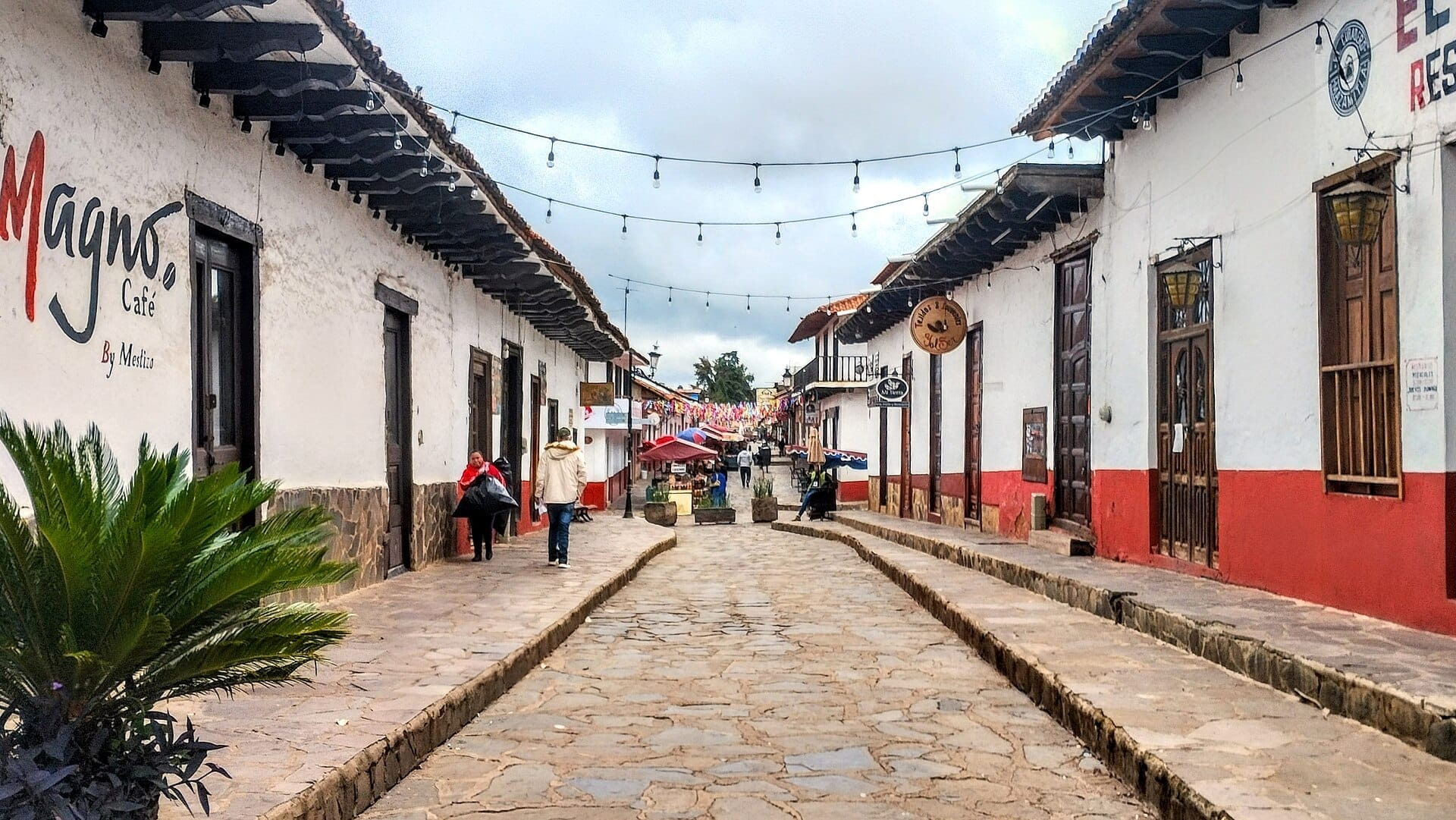
The plaza principal is the natural starting point. Surrounded by portales (covered arcades), the square anchors a compact town center where most of what you want to see is within a 15-minute walk. On weekend mornings, local vendors set up along the surrounding streets selling jarabe tapatío-branded ceramics, local cheeses, cajeta (goat milk caramel), and hand-knitted wool goods. The air at this elevation has a noticeable bite to it, even in spring.
The architecture is the main visual draw. Many facades are built with dark timber beams and rough-hewn wood planks, giving the town a log-cabin character unusual in Mexican colonial settings. Flower boxes overflow from second-story balconies, and the streets are paved with smooth stone that darkens and glistens after the frequent afternoon rains. In the early morning, mist often clings to the hillsides visible above the town, particularly between June and September.
💡 Local tip
Arrive before 10 a.m. on a Saturday or Sunday to walk the streets before the day-tripper crowds fill the plaza. The atmosphere between 7–9 a.m. — locals heading to market, bakeries just opening, fog still in the trees — is the version of Mazamitla worth planning for.
The church on the plaza, dedicated to Saint Christopher (San Cristóbal), follows a straightforward colonial design but its setting — framed by mountains and pine trees on all sides — gives it a visual weight that more elaborate urban churches sometimes lack. The interior is modest, the exterior is photogenic in morning light.
Tickets & tours
Hand-picked options from our booking partner. Prices are indicative; availability and final rates are confirmed when you complete your booking.
Lake Chapala and Ajijic guided tour from Guadalajara
From 68 €Instant confirmationFree cancellationGuadalajara and Tlaquepaque guided tour
From 73 €Instant confirmationFree cancellation
Natural Setting: Forests, Waterfalls, and Mountain Trails
The Sierra del Tigre forest surrounding Mazamitla is the other reason people make the trip. Coniferous trees, including pines and other high-elevation species, cover the slopes at this elevation, and the landscape feels genuinely wild compared to the agricultural plains between here and Guadalajara. Several natural attractions lie within a few kilometers of town — cascades, forest trails, and lookout points — though most require transport or a significant walk on uneven terrain.
Adventure tourism operators in and around town offer activities including zip-lining, horseback riding, ATV trails, and guided forest walks. Pricing and quality vary significantly by operator; asking at your accommodation for a current recommendation tends to produce more reliable results than booking blindly online. These activities are the main draw for domestic tourists with families.
⚠️ What to skip
Altitude note: Mazamitla sits at approximately 2,200 m above sea level. Visitors arriving directly from sea-level destinations may notice mild breathlessness or fatigue for the first few hours. This is not typically a problem for visitors already acclimatized to Guadalajara's 1,550 m elevation, but it is worth keeping in mind if you plan strenuous activity on your first day.
Trail conditions vary significantly by season. During the rainy season (June to September), forest paths can become muddy and slippery, and afternoon thunderstorms are frequent. The upside is that the landscape is at its greenest and waterfalls are at full flow. The dry months (November through April) offer cleaner hiking conditions but a drier, less lush visual. November through February also brings the coldest nights, with temperatures dropping close to freezing at elevation — pack accordingly.
Food and Drink: What to Eat in Mazamitla
The food culture in Mazamitla centers on mountain comfort: warming dishes, dairy products from the surrounding region, and meats cooked over wood fire. Birria (spiced braised meat, traditionally goat or beef) is widely available, and the local version tends to be richer and less commercialized than what you find in Guadalajara's tourist-facing restaurants. Carnitas, pozole, and tlayudas also appear regularly on menus around the plaza.
Local sweet shops and small dairy producers sell cajeta de Mazamitla, a regionally specific goat milk caramel that has a slightly smokier, less sweet character than industrial versions. It is sold in small jars and travels well. Queso regional (a mild local cheese) is another worth picking up at the market. Both make straightforward, practical souvenirs.
Hot drinks are taken seriously here. Café de olla (coffee brewed with cinnamon and piloncillo in a clay pot) and champurrado (a thick corn-masa chocolate drink) are commonly served from early morning. On a cold mountain morning, these are not optional extras — they are the practical choice.
How Mazamitla Changes by Time of Day
Morning is the town at its best. Between 7 and 10 a.m., the light is soft, the streets are quiet, and the smell of wood smoke from breakfast fires mixes with the pine resin in the air. Bakeries open early and the best fresh bread sells out quickly on weekends. The plaza is nearly empty, and the mountains are visible above the rooflines before the clouds settle in.
Midday brings the bulk of day visitors, particularly on Saturdays and Sundays. The plaza fills with families, restaurant lines form, and parking near the center becomes difficult. If you are doing Mazamitla as a single-day trip from Guadalajara, be aware that the experience between noon and 4 p.m. on a holiday weekend is a different proposition from what you might have pictured.
Late afternoon and evening are when the town returns to itself. Day-trippers leave, the air cools quickly, and the restaurants around the plaza shift to a quieter dinner service. If you are staying overnight in one of the town's cabin-style accommodations, the evening — fireplace lit, sounds of the forest audible from outside — is the most memorable part of the trip.
Getting There from Guadalajara
Mazamitla is roughly 124 km south of Guadalajara by road. By private car, the drive typically takes between 2 and 2.5 hours depending on traffic and the route taken, passing through agricultural lowlands before the road climbs into the Sierra del Tigre through a series of switchbacks. The final approach into town requires navigating narrow mountain roads.
By public bus, Autotransportes Mazamitla operates services departing from Guadalajara's Nueva Central Camionera (the main bus terminal). Verify current schedules and fares directly with the terminal before travel, as these change periodically. For context on getting around the Guadalajara region more broadly, the getting around Guadalajara guide covers transport options in detail.
ℹ️ Good to know
Mazamitla does not have a Guadalajara metro or BRT connection — all routes require either a direct bus from the central bus station or a private vehicle. Ride-hailing apps (Uber, DiDi) do not reliably operate on routes this far outside the city. Plan accordingly.
Practical Details: What to Bring and What to Expect
Clothing matters more here than for most Jalisco destinations. Even in summer, evenings drop noticeably at 2,200 m — a light jacket is the minimum; a proper warm layer is smarter. Between November and February, overnight temperatures can approach freezing, and a heavy coat plus warm layers are necessary for evening walks. Waterproof footwear or sturdy trail shoes are worth it for any forest excursions, particularly in the rainy season.
Cash is the dominant payment method for market vendors, smaller restaurants, and local artisans. Some cabin operators and larger restaurants accept cards, but do not count on it. ATM availability in Mazamitla is limited; arriving with enough pesos for your expected spend is the straightforward approach.
Mobile connectivity can be patchy in parts of the forest outside town. This is generally not a problem for a relaxed weekend trip, but it is worth flagging if you are working remotely or need constant access. If you are considering Guadalajara as a base for remote work, the digital nomad guide to Guadalajara covers connectivity and workspaces in the city itself.
Accessibility: The town center has some cobblestone streets and uneven surfaces that can be challenging for wheelchairs or mobility aids. Natural attractions outside town involve slopes, dirt paths, and unpaved terrain. Standardized accessibility infrastructure is not documented for the destination, and travelers with significant mobility limitations should research specific sites carefully before planning visits.
Who Should Think Twice
Mazamitla is a slow destination by design. Travelers looking for museums, significant pre-Hispanic ruins, or urban energy will find very little here. If your time in Jalisco is limited and you have not yet seen the Hospicio Cabañas murals or explored Tlaquepaque, those are likely better uses of a day trip. Mazamitla rewards people who want to slow down — it frustrates people who want to check boxes.
Anyone visiting solely on a busy holiday weekend without an overnight reservation should also temper expectations. The charm of the place is genuinely harder to access when the streets are packed and restaurant waits stretch past an hour. The destination works best for people who stay at least one night and get into the town's rhythm.
Insider Tips
- Book cabin accommodation well in advance for holiday weekends (Semana Santa, Día de Muertos, Christmas–New Year). These periods sell out weeks ahead and prices increase significantly.
- The weekly tianguis (informal street market) draws local vendors selling produce, cheeses, and crafts not available in the permanent shops around the plaza. Ask locally for the current day and location.
- For the best views of the surrounding pine forest and valley, walk uphill from the plaza toward the outskirts of town rather than taking a vehicle tour. The early morning light on the tree line from the upper streets is worth the climb.
- Cajeta from small local producers found at the market is noticeably different from supermarket versions — look for jars sold directly by families at stalls rather than packaged goods in tourist shops.
- If driving from Guadalajara, consider taking the return journey via a different route to see more of the Sierra del Tigre landscape. Ask locally about road conditions before choosing a route, particularly after heavy rain.
Who Is Mazamitla (Pueblo Mágico) For?
- Couples looking for a quiet mountain weekend escape from Guadalajara
- Families with children interested in outdoor activities (horseback riding, zip-lining, forest walks)
- Food travelers interested in regional Jaliscan mountain cuisine and local dairy products
- Architecture and photography enthusiasts drawn to traditional wooden mountain-town aesthetics
- Anyone who needs a genuine temperature drop and a few days away from urban noise
Nearby Attractions
Combine your visit with:
- Ajijic (Lake Chapala Village)
Ajijic sits on the north shore of Lake Chapala, about an hour south of Guadalajara. With pre-conquest roots, cobblestone streets lined with art galleries, and one of Mexico's largest expat communities, it offers a completely different pace from the city. There is no admission fee to visit, and the town is accessible year-round.
- Bosque de La Primavera
Just 12 km west of Guadalajara, Bosque de La Primavera is a 30,500-hectare protected forest area offering hiking, birdwatching, hot springs, and rare ecological zones. It is one of the few places near a major Mexican city where you can genuinely disconnect from urban noise within 30 minutes.
- Bosque Los Colomos
Spanning roughly 92 hectares in northwestern Guadalajara, Bosque Los Colomos is a protected urban forest with ponds, pine-scented trails, and a Japanese garden donated by the city of Kyoto. Admission is free, and the park draws everyone from pre-dawn joggers to Sunday families.
- Japanese Garden — Bosque Los Colomos
Tucked inside the 93-hectare urban forest of Bosque Los Colomos, the Jardín Japonés is a formal Japanese-style garden donated by the people of Kyoto in 1994. It offers koi ponds, stone lanterns, arched bridges, and the kind of deliberate stillness that is genuinely hard to find in a city of over 1.5 million people.