Malmö, Sweden: The Day Trip That Earns Its Place
Just 35 minutes from Copenhagen Central Station via the Øresund Bridge, Malmö is a full Swedish city with its own architectural identity, beaches, and food culture. It rewards travelers who want more than a checkbox and punishes those who rush.
Quick Facts
- Location
- Malmö, Skåne County, Sweden — across the Øresund Strait from Copenhagen
- Getting There
- Direct Øresundståg/DSB train from Copenhagen Central Station to Malmö Central Station, approx. 35 minutes
- Time Needed
- Full day (6–8 hours) to do it properly; half-day works only for the city centre
- Cost
- No general admission to enter the city; train fares and individual attraction fees apply (currency: Swedish kronor, SEK)
- Best for
- Architecture enthusiasts, design travelers, anyone wanting a second Scandinavian city on one trip
- Official website
- malmo.se
What Malmö Actually Is — and Why That Matters
Malmö is not a theme park, a single monument, or a curated tourist district. It is a real Swedish city with a population of around 368,000, a functional downtown, a university, working docks, and neighborhoods that have nothing to do with tourism. That distinction is worth stating plainly, because it shapes how the day goes. Visitors who arrive expecting a polished attraction loop will be confused. Visitors who arrive prepared to walk a real city will have a genuinely different experience from anything Copenhagen offers.
The city received its city privileges in 1353, making it older than many visitors assume. For centuries, Malmö was one of Denmark's largest cities, a fortified port controlling herring trade on the Øresund. It became Swedish in 1658 under the Treaty of Roskilde, and the shift is still legible in the architecture: the medieval street grid of the old town, Stortorget square, and Malmöhus slott (Malmö Castle) all carry that pre-Swedish, Danish-era character, while the waterfront and the Western Harbour district are among the most deliberately modern urban environments in Scandinavia.
ℹ️ Good to know
Currency note: Malmö is in Sweden, which uses the Swedish krona (SEK), not the Danish krone (DKK). The two currencies are not interchangeable, and most Malmö businesses will not accept DKK. Bring Swedish cash or use a card with no foreign transaction fees.
Getting There: The Train Across the Øresund Bridge
The journey itself has become part of the appeal. Direct Øresundståg and DSB trains run from Copenhagen Central Station (København H) to Malmö Central Station in approximately 35 minutes. Trains run frequently throughout the day and into the evening. The crossing over the Øresund Bridge is visible from the window on the right side of the train heading toward Malmö: a long cable-stayed bridge followed by an artificial island and then a tunnel emerging on the Swedish coast.
Be aware that this is an international border crossing, even though passport checks are not always conducted. Scandinavian countries have reinstated border controls at various points in recent years, particularly on the Danish side at Kastrup. Carry valid ID or a passport. Ticket zones differ from Copenhagen's standard metro zones, so purchase a specific Copenhagen-to-Malmö cross-border ticket at the station or through the DSB app rather than assuming a Copenhagen City Pass covers it.
⚠️ What to skip
The Copenhagen Card does not cover the Malmö train journey. Purchase a separate cross-border ticket for travel to and from Malmö. Check current fares and border control requirements with DSB or Skånetrafiken before travel, as conditions can change.
By car, you drive east from Copenhagen on the E20 motorway and cross the Øresund Bridge directly into Sweden — toll fees apply in both directions. The drive takes roughly 30–40 minutes depending on traffic and toll queue times. Most visitors arriving from Copenhagen find the train simpler. For context on getting around the broader Copenhagen region, see the guide on getting around Copenhagen.
Tickets & tours
Hand-picked options from our booking partner. Prices are indicative; availability and final rates are confirmed when you complete your booking.
Copenhagen to Malmo one-day tour
From 56 €Instant confirmationFree cancellation1-hour boat harbour tour in Copenhagen
From 26 €Instant confirmationFree cancellationSmall group 3-hour walking tour in Copenhagen
From 45 €Instant confirmationFree cancellationFull-day tour to Forest Tower and Forgotten Giants from Copenhagen
From 110 €Instant confirmationFree cancellation
The Old Town and Stortorget: Where to Start
Malmö Central Station deposits you a short walk from the city centre. The medieval old town — roughly bounded by the canal system that once served the fortress — is the logical starting point. Stortorget, the main square, is a large historic market square in Scandinavia. The Town Hall on its north side dates to the 1540s, though it was heavily renovated in the 19th century. The equestrian statue at the square's center depicts King Karl X Gustav, the Swedish king whose campaigns forced Denmark to cede Malmö and the surrounding province of Skåne.
In the morning, the square is calm. Market stalls sometimes operate here, depending on the day of the week and season. By midday it fills with office workers and students from the nearby university. The paving stones reflect heat in summer and hold a grey stillness in winter. Neither version is wrong — they are just different cities.
Malmöhus slott, the 16th-century castle a few minutes' walk to the west, contains several museums under one complex: natural history, city history, and an art museum. The castle grounds include a moat and ramparts that are free to walk. The interior museums charge admission in SEK. If museums are not your priority, the exterior alone repays fifteen minutes and gives a sense of scale that the surrounding city does not otherwise reveal.
The Western Harbour and Turning Torso: Malmö's Contemporary Face
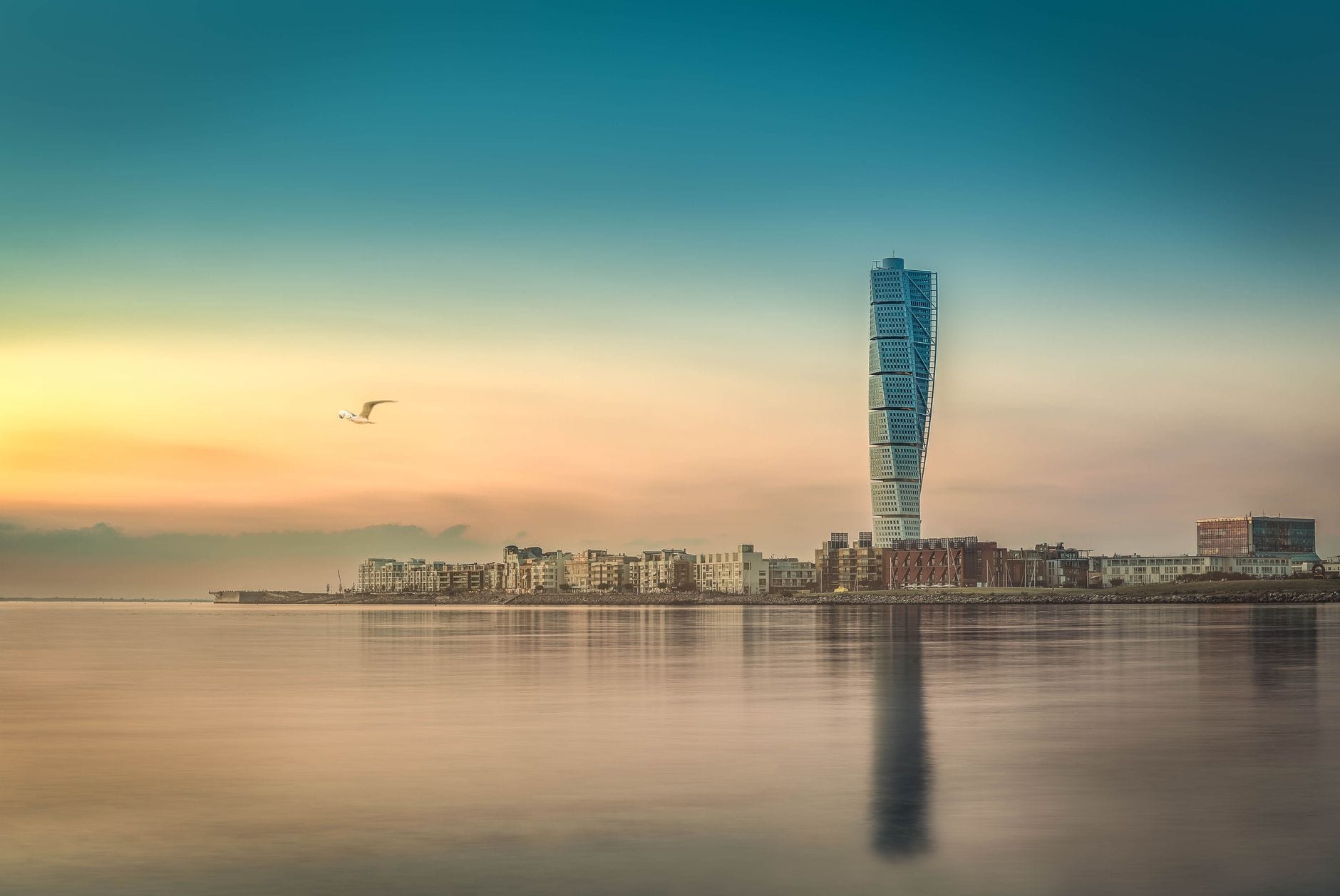
The district called Västra Hamnen — the Western Harbour — is the most photogenic and architecturally coherent part of modern Malmö. It was developed on a former shipyard site from the early 2000s onward, with explicit sustainability goals: the district aimed to run on 100% locally produced renewable energy. Whether it fully achieved that goal in practice has been a subject of ongoing debate among urban planners, but the physical result is a waterfront neighborhood of low-carbon design principles, car-reduced streets, and a seafront promenade that is genuinely pleasant to walk.
The Turning Torso tower dominates the skyline. Designed by Santiago Calatrava and completed in 2005, it is a residential skyscraper of 54 floors that rotates 90 degrees from base to top. At 190 meters, it remains Sweden's tallest building. It is not open to the public for observation — it is private housing — but it is visible from most of the waterfront and from across the strait in Copenhagen on clear days. From the base, the twist is most dramatic when you look straight up.
The Western Harbour promenade is excellent for walking in good weather and borders a genuine beach — Ribersborg, a long stretch of sand and shallow water with historic bathhouses at its eastern end. In summer this beach draws Malmö residents in numbers, and the contrast between the contemporary architecture behind it and the flat open water in front of it is striking. For comparison, Copenhagen's own waterfront infrastructure is explored in the Islands Brygge Harbour Bath guide.
Food, Fika, and What to Eat in Malmö
Malmö has a well-developed food scene that reflects both its Swedish identity and its significant multicultural population — the city has one of the highest proportions of foreign-born residents of any major Swedish city. The result is a range of restaurants that spans from traditional Swedish smörgåsbord and fika cafés to Middle Eastern, Southeast Asian, and North African cooking. Möllevångstorget, a square in the southern part of the city center, is the informal center of Malmö's immigrant food culture and hosts a produce market on weekday mornings.
For a specifically Swedish experience, look for a konditori — a traditional Swedish pastry café — and order a kanelbulle (cinnamon roll) with coffee. This is not a tourist performance; it is simply what people here do at mid-morning. Lunch options around the old town and Lilla Torg (a smaller, cobblestoned square near Stortorget) cover most price ranges. Avoid the most tourist-facing restaurants immediately adjacent to Lilla Torg's oldest buildings, which tend to charge above average for uninspired food. Walk one street back and the quality-to-price ratio improves quickly.
Practical Walkthrough: How a Day in Malmö Unfolds
A logical sequence for a full day: take an early train from Copenhagen (aim for departure before 9:00), arrive at Malmö Central, walk south and east through the canal district to Stortorget and Lilla Torg, continue to Malmöhus slott and its grounds, then walk north and west through the university neighborhood toward Västra Hamnen and the Turning Torso. Spend the early afternoon on the waterfront and, in warmer months, at Ribersborg beach. Return to the old town via the Davidshallsbron bridge corridor for a late afternoon coffee, then catch a train back to Copenhagen.
In terms of distance, this covers roughly 5–7 kilometers of walking. Malmö is flat, with no significant elevation changes, and the cycling infrastructure is excellent for those who rent bikes. The city is compact enough that almost every area of interest is reachable on foot from the center, though the beach and Western Harbour require a 20–25 minute walk from Stortorget.
Malmö works well as part of a broader exploration of the Copenhagen region. Travelers using a structured itinerary might also look at the day trips from Copenhagen guide for comparisons with other options like Helsingør or Roskilde, or the 2-day Copenhagen itinerary to decide whether Malmö fits their schedule.
Weather, Seasons, and When to Go
Malmö sits at nearly the same latitude as Copenhagen and shares the same oceanic climate: cool, often overcast, with reliable rain at any time of year. Summer (June to August) is the most comfortable period for walking and beach use, with temperatures typically in the 18–23°C range. The Western Harbour and Ribersborg are at their best on sunny summer days. Spring and autumn are workable but require a waterproof layer. Winter visits are atmospheric — the old town in particular acquires a different texture in low winter light — but opening hours at smaller attractions may be reduced.
The city is notably less crowded than Copenhagen's tourist core throughout the year, which is one of its practical advantages. Even in July, Stortorget does not reach the pedestrian density of Copenhagen's Strøget. For travelers who find peak-season Copenhagen overwhelming, Malmö offers a comparable Scandinavian urban experience without the same concentration of tour groups.
💡 Local tip
Check the weather on both sides of the strait before leaving. Copenhagen and Malmö can experience genuinely different local weather on the same day due to the maritime geography of the Øresund. A grey morning in Copenhagen sometimes clears to partial sun on the Swedish side by midday.
Who Should Skip Malmö
Malmö is not for every traveler. If your Copenhagen itinerary is already full and you are trying to squeeze in Malmö on the same day you visit Kronborg Castle or Louisiana Museum of Modern Art, something will be rushed and probably unsatisfying. Malmö needs at least half a day to make sense; a 90-minute visit adds a border crossing but not much else.
Travelers who want a densely curated museum experience will find Copenhagen's options richer and more concentrated. Travelers who dislike walking without a defined endpoint — a specific monument to tick off — may find Malmö's appeal harder to locate. And travelers on a very tight budget should factor in the cross-border train fare in SEK, the currency conversion, and individual attraction costs, which add up faster than a Copenhagen-only day.
Insider Tips
- Buy your cross-border train ticket through the DSB app or Skånetrafiken's website before arriving at Copenhagen Central Station — the ticket machines have queues during peak morning hours and the apps usually offer a straightforward cross-border option.
- Lilla Torg is picturesque but prices at its most prominent restaurants are inflated. Walk one block in any direction to find better value. The streets immediately south of Stortorget have a more local mix of lunch spots.
- The Ribersborg bathhouse (Ribersborgs kallbadhus) at the end of the beach pier is a functioning cold-water bathhouse open to the public, separated by gender on different sides. Admission is modest and charged per person. It is distinctly Swedish and worth the 25-minute walk from the old town if the weather is remotely cooperative.
- If you are in Malmö on a weekday morning, Möllevångstorget market starts early and is mostly over by noon. It is primarily a produce and everyday goods market used by locals — not a tourist market — and gives an accurate read on the city's multicultural character.
- The Turning Torso is private housing and has no public observation deck or visitor access. You do not need to go to its base to photograph it well; the view from the Västra Hamnen seafront promenade, roughly 400 meters to the south, gives better context and framing.
Who Is Malmö, Sweden For?
- Architecture and design travelers interested in both medieval urban planning and contemporary sustainable development
- Copenhagen visitors who want to add a second Scandinavian country to their trip without a major detour
- Travelers who prefer walking real cities over managed tourist routes
- Beach and waterfront visitors traveling in summer who want an alternative to Copenhagen's harbour baths
- Food-curious travelers interested in Swedish fika culture and Malmö's multicultural restaurant scene
Nearby Attractions
Combine your visit with:
- Amager Strandpark
Amager Strandpark (Amager Beach Park) is Copenhagen's largest beach, offering a total of 4.6 km of sandy shoreline along the city's southeastern coast. Free to enter and easily reached by metro, it combines a natural shoreline with a 2 km artificial island and sheltered lagoon opened in 2005, making it a genuine summer destination for locals and a quiet surprise for visitors expecting a landlocked Scandinavian capital.
- Arken Museum of Modern Art
Located on the Ishøj coastline south of Copenhagen, ARKEN Museum of Modern Art combines a dramatically sculptural building with a serious contemporary art program. The journey out of the city is part of the experience, and the landscape setting changes everything about how you engage with the art.
- Bakken
Dyrehavsbakken, known simply as Bakken, has been drawing visitors to the forests north of Copenhagen since 1583, making it the oldest operating amusement park on earth. Unlike polished theme parks, it mixes rickety roller coasters, carnival stalls, and open-air restaurants inside a UNESCO-recognized deer park, with free entry to the grounds.
- The Blue Planet – National Aquarium Denmark
The Blue Planet, Denmark's National Aquarium, sits in Kastrup on the Øresund coast with 7 million liters of water, 450 species, and a striking spiral building that's worth examining before you even step inside. This guide covers what to expect from the exhibits, the best times to visit, and how to get there without confusion.