Linnahall: Tallinn's Brutalist Giant and Its Unexpected Views
Built for the 1980 Moscow Olympics sailing events and now largely unused and decaying, Linnahall is a monumental piece of Soviet-era architecture on Tallinn's waterfront. The rooftop terraces are freely accessible and offer some of the most unusual panoramas in the city, stretching across the Baltic Sea toward Helsinki.
Quick Facts
- Location
- Sadama tn 1, 10111 Tallinn, Estonia (harbourfront just beyond the northern edge of Old Town)
- Getting There
- 10–15 min walk from Tallinn Old Town; buses and trams serving the port area stop within a short walk
- Time Needed
- 30–60 minutes for the exterior and rooftop terraces
- Cost
- Free – exterior and rooftop access currently requires no ticket
- Best for
- Architecture lovers, Soviet history, photography, atmospheric walks
What Linnahall Actually Is
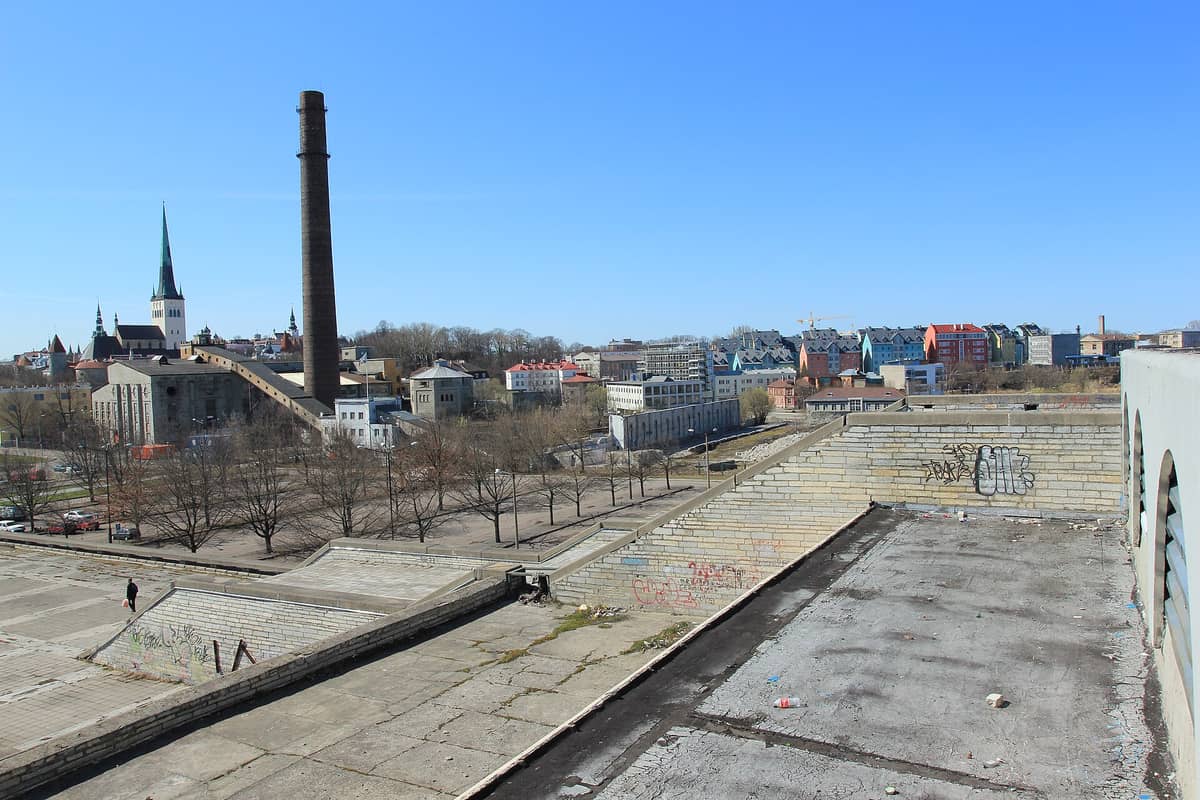
Linnahall is a vast, stepped concrete structure sitting on Tallinn's waterfront between the Old Town and the ferry terminals. Opened in 1980 under the name V. I. Lenin Palace of Culture and Sport, it was built to host the sailing events of the Moscow Summer Olympics held in Tallinn. Few venues built for that Games have aged more dramatically, or more photogenically.
Designed by Estonian architects Raine Karp and Riina Altmäe, the complex was conceived as a multi-use cultural and sports hub. At its peak it housed a 5,000-seat amphitheatre, a 3,000-seat ice hall, restaurants, and various public spaces. The building took on the name Linnahall, meaning "city hall" in Estonian, by the late 1980s, and the name became official after Estonian independence in 1991. Its Soviet-era function faded quickly after that, and today the interior is effectively closed to casual visitors, with access only possible on occasional guided tours while a long-debated reconstruction is discussed.
The structure sits in a conceptual grey zone: too historically significant to demolish, too expensive and politically complex to restore quickly. That limbo is precisely what makes it worth visiting. For travelers curious about how Estonia processes its Soviet past, Linnahall sits alongside sites like the Vabamu Museum of Occupations and Freedom and the KGB Prison Cells as a place where that history is still physically present, unmediated by museum lighting.
The Experience: Walking the Terraces
The approach from the Old Town sets the mood. You cross under the raised highway and the scale of the structure reveals itself gradually: a low, horizontal mass of weathered grey concrete that seems to grow out of the ground like a stepped pyramid. There are no signs directing you, no ticket booth, and no staff. You simply find a staircase and start climbing.
The terraces ascend in broad flat steps, each one wide enough to walk across comfortably. The concrete is heavily worn, with moss and lichens colonising the joints, and in wet weather the surfaces become slippery in places. On the upper levels the wind off Tallinn Bay, opening toward the Gulf of Finland, arrives without warning, cold and direct even in summer. The views that open up are genuinely worth the climb: the Baltic Sea stretches north toward Finland, the ferry terminals and cruise ships line the harbour below, and the spires of the Old Town sit to the south.
⚠️ What to skip
Wear shoes with grip. The concrete terraces can be genuinely slippery after rain, and there are no handrails on several sections. The structure is not maintained for visitor safety in the conventional sense.
The amphitheatre on the western side is the most dramatic interior space visible from outside, a deep concrete bowl that once held around 5,000 people for open-air concerts and events. You can look down into it from the upper terraces. It is empty now, and the acoustics of the wind through it create an oddly musical effect on gusty days.
Tickets & tours
Hand-picked options from our booking partner. Prices are indicative; availability and final rates are confirmed when you complete your booking.
Self-guided Discovery Walk of Tallinn city contrasts beyond the medieval walls
From 26 €Instant confirmationFree cancellationTallinn's art and culture tour with a local
From 62 €Instant confirmationFree cancellationHistorical walking tour of Tallinn with a local
From 599 €Instant confirmationFree cancellationIntroductory walking tour of Tallinn with a local guide
From 109 €Instant confirmationFree cancellation
Time of Day: How the Experience Changes
Early morning is the most atmospheric time. Before 8 a.m. the terraces are often completely empty, and the combination of low light, sea mist, and total quiet makes the place feel like the set of a film that hasn't been made yet. Photographers working in black and white will find the light particularly useful in these hours, with long shadows cutting across the stepped concrete.
By midday in summer, the spot draws a steady but rarely crowded stream of visitors: architecture students, tourists who read the same articles about brutalism, and locals who come here for lunch breaks with a sea view. The openness of the terraces means it never feels packed. In winter the population drops to almost nothing outside of weekends, and snow on the concrete steps creates a surreal landscape that rewards the effort of coming.
Sunset from the western-facing terraces in summer, when Tallinn's long evenings stretch past 10 p.m., is a genuinely special experience. The light turns the grey concrete amber and peach, the ferries move slowly across the water below, and the Old Town spires catch the last of the sun. This is the time that most photographs you have seen of Linnahall were taken.
💡 Local tip
For the best light and fewest people, arrive just after sunrise in summer or in the hour before sunset. Both windows offer dramatically different versions of the same view.
Architectural and Historical Context
Linnahall belongs to a specific strand of late Soviet civic architecture that sought to project confidence and permanence through massive scale and minimal ornament. The building is almost entirely horizontal, with almost no vertical elements except the stairwells. From certain angles it reads less as a building and more as a landform, a series of terraces carved into the shoreline. That quality, impressive in 1980 and unsettling now, is what attracts architects and urbanists from across Europe.
The choice to hold the Moscow Olympics sailing events in Tallinn was itself significant. The city had a long maritime tradition and the facilities were considered the best available in the Soviet Union. The construction of Linnahall and the accompanying marina infrastructure transformed this stretch of waterfront. What had been a relatively open shoreline became anchored by a structure intended to signal Soviet modernity to the international visitors arriving for the Games.
Understanding Linnahall in context means understanding the broader arc of Tallinn's Soviet history. The Tallinn Soviet history guide covers this period in detail, including other architectural and institutional traces of the occupation era that are still visible across the city.
Photography at Linnahall
The building is one of the most photographed structures in Tallinn outside the Old Town, and for good reason. The geometry is extraordinary: wide horizontal bands of concrete, deep shadow lines, and the constant presence of the sea and sky as backdrop. Wide-angle lenses work well on the lower terraces to capture the full sweep of the stepped facade. From the upper levels a telephoto lens can isolate the harbour activity below against the concrete foreground.
The amphitheatre bowl, viewed from above, is one of the most striking compositions on the site. The circular form of the seating creates a graphic contrast with the rectangular terraces around it. In summer, when occasional groups of skateboarders or urban explorers occupy the space below, the scale of the structure becomes apparent in a way that empty concrete alone does not convey.
💡 Local tip
Drone photography over Linnahall is subject to Estonian aviation regulations and restrictions around the nearby harbour and port areas. Check current rules before flying.
Getting There and Practical Notes
Linnahall sits at Sadama tn 1, immediately north of the Old Town and adjacent to the main harbour. The walk from Viru Gate takes around 10 to 15 minutes on foot. You pass under the coastal highway and the structure appears ahead of you. There is no formal entrance: access points are at ground level on the harbour-facing side.
Local buses and tram line 2 serving the port and ferry terminal area stop within a short walk of the site. If you are arriving in Tallinn by ferry from Helsinki and want to see Linnahall immediately, it is visible from the terminal and reachable in just a few minutes on foot. Details on public transport options across the city are covered in the getting around Tallinn guide.
The interior of the building is closed to casual visitors and is not accessible through any unsupervised channel. Do not attempt to enter without joining an official guided tour. The exterior terraces and roof are fully open to walk around and no permission or ticket is currently required. The site has no staffing, no toilets, and no food or drink facilities on site. Come prepared.
Accessibility is a genuine limitation. The roof terraces are reached via multiple flights of concrete stairs with no lift access and limited or no handrail provision on several sections. Visitors with mobility limitations will find access to the upper levels difficult or impossible. The ground-level exterior is more navigable but still involves uneven surfaces.
Who Should Skip Linnahall
Linnahall is not for everyone, and it is worth being honest about that. If your interest in Tallinn is primarily the medieval Old Town, the churches, and the amber-lit Christmas market atmosphere, this brutalist hulk on the waterfront will feel like a detour into a different city entirely. It is cold, windswept, and physically demanding to navigate properly. There is nothing to buy, nothing to eat, and nothing explained.
Families with young children should think carefully about the combination of unfenced heights, slippery surfaces, and absence of facilities. If you are working with very limited time in Tallinn, other viewpoints offer easier access with comparable or better city views. The Kohtuotsa viewing platform and the Patkuli viewing platform both deliver Old Town panoramas with far less physical effort.
Insider Tips
- The western side of the terraces, facing the open sea, catches the strongest wind. In winter or on gusty autumn days, the eastern terraces facing the Old Town are far more sheltered and still offer excellent views.
- Skateboarders occasionally use the lower amphitheatre area, particularly on weekend afternoons in summer. This adds life and scale to an otherwise empty space, and makes for better photographs than a purely deserted structure.
- If you are walking from the Old Town, approach via the harbour boulevard rather than cutting through the car park. The frontal approach from the sea side gives you the full architectural impact of the facade rather than arriving at the service side.
- The reconstruction debate around Linnahall has been ongoing for years. Check local news before visiting: if renovation work has finally begun, access to parts of the terraces may be restricted.
- Combine the visit with the nearby ferry terminal area. The contrast between the decaying Soviet monument and the busy modern port operating just meters away is one of the more striking urban juxtapositions in Tallinn.
Who Is Linnahall For?
- Architecture and design enthusiasts with an interest in brutalism and Soviet-era civic buildings
- Photographers looking for dramatic geometry and sea-view backdrops away from the Old Town crowds
- Travelers with an interest in Soviet and Cold War history who want physical, unmediated encounters with that era
- Urban explorers comfortable navigating unmaintained outdoor spaces
- Visitors who want a free, crowd-light viewpoint over the Baltic Sea and harbour
Nearby Attractions
Combine your visit with:
- Aegna Island
Aegna Island sits 14 km off the Tallinn coast in the Bay of Tallinn, reachable in about 30 minutes by boat. The entire island is a protected landscape conservation area, covered in dense forest, glacial boulders, and coastal meadows. Entry to the island is free, making it one of the most rewarding half-day escapes from the city.
- Estonian Open Air Museum
Spread across 72 hectares of coastal forest in Tallinn's Haabersti district, the Estonian Open Air Museum (Eesti Vabaõhumuuseum) reconstructs rural and fishing life from the 18th and 19th centuries. Twelve farmyards, a working tavern, a church, mills, a schoolhouse, a fire station, and net sheds make this Estonia's largest and most immersive open-air history experience.
- Glehn Park
Glehn Park is a free, forested public park in Tallinn's suburban Nõmme district, built around a 19th-century castle by the eccentric Baron Nikolai von Glehn. With natural woodland trails, stone carvings, and a refreshing distance from the Old Town crowds, it rewards visitors who want something genuinely different from the medieval core.
- Jägala Waterfall
Standing 8 metres tall and stretching over 50 metres wide, Jägala Waterfall is Estonia's largest natural waterfall. Located just 25 kilometres east of Tallinn on the Jägala River, it is free to visit year-round and rewards visitors differently in every season, from frozen curtains of ice in winter to a thundering torrent in spring snowmelt.