Lighthouse Park, West Vancouver: Old-Growth Forest, a Historic Lighthouse, and Real Coastal Wilderness
Lighthouse Park is a 75-hectare reserve of largely unlogged coastal forest on the western tip of the North Shore, anchored by the 1912 Point Atkinson Lighthouse. With free entry, dramatic ocean views, and trails ranging from gentle woodland walks to scrambles across wave-cut granite, it offers a quality of natural experience that is rare this close to a major city.
Quick Facts
- Location
- 4902 Beacon Lane, West Vancouver, BC — western tip of the North Shore, approximately 30–40 minutes from downtown Vancouver by car
- Getting There
- TransLink Bus 250 from downtown Vancouver toward Horseshoe Bay; alight at the Marine Drive/Beacon Lane stop, then walk down Beacon Lane to the park entrance
- Time Needed
- 1.5 to 3 hours depending on trail choice; allow extra time if you plan to sit at the lighthouse point
- Cost
- Park entry is free. Pay parking applies year-round in the Lighthouse Park lot (accessible parking placard holders exempt). Specific hourly rates: verify on-site or at westvancouver.ca before visiting
- Best for
- Trail walkers, nature photographers, families with older children, anyone wanting genuine old-growth forest within the city region
- Official website
- westvancouver.ca/parks-recreation/parks-trails/lighthouse-park
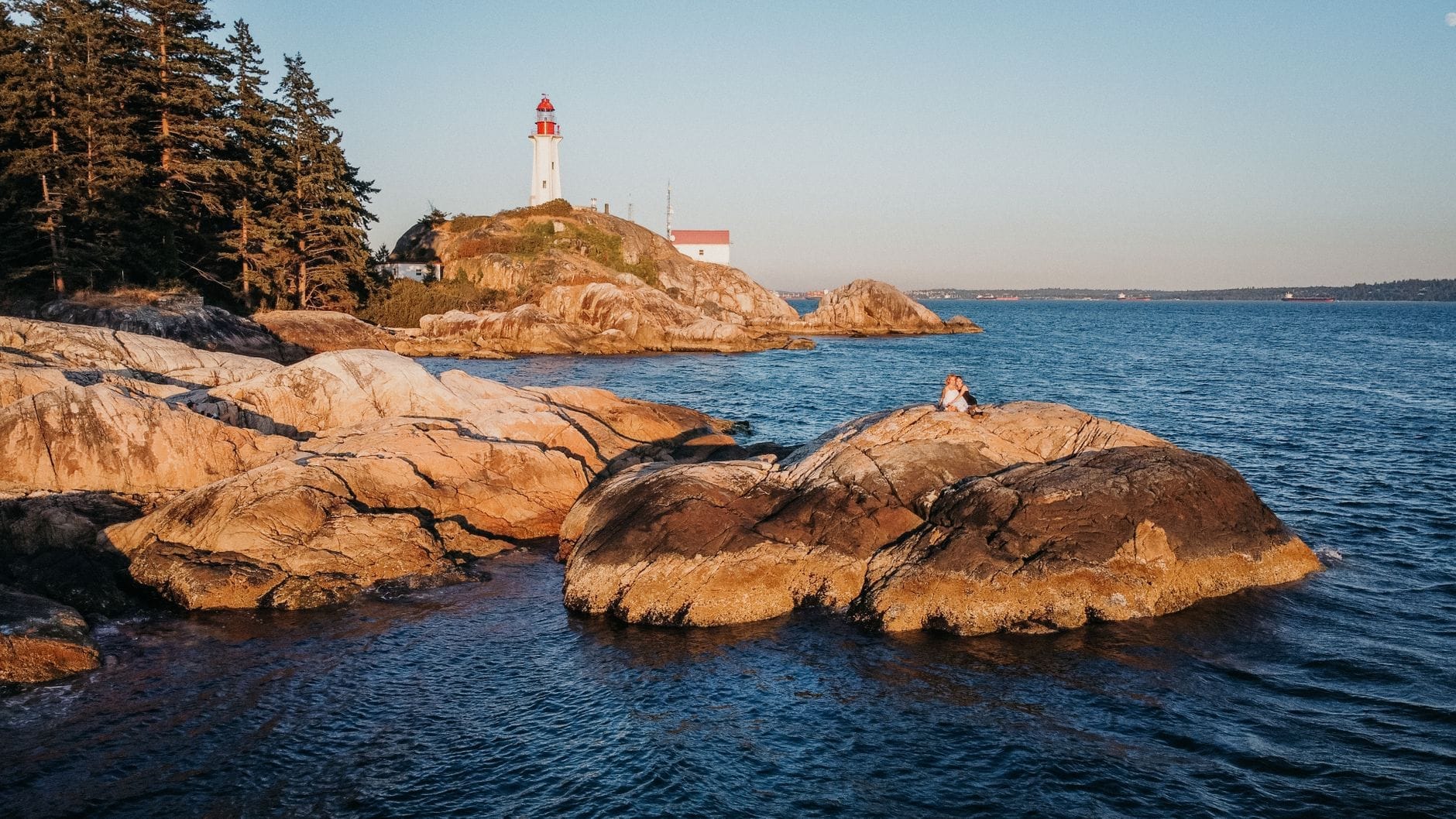
About Lighthouse Park
Lighthouse Park sits at Point Atkinson on the southwestern edge of West Vancouver, where the open water of the Strait of Georgia meets Howe Sound. The 75-hectare reserve is one of the last sizable stands of largely unlogged coastal temperate rainforest in the lower mainland, which means you are walking among Douglas firs and western red cedars that predate the city of Vancouver itself. That distinction matters: this is not a manicured park with paved paths and interpretive signs at every turn. It is a genuine piece of Pacific coastal wilderness that happens to be accessible from downtown Vancouver in under an hour.
At the end of the trail network stands the Point Atkinson Lighthouse, a hexagonal concrete tower built in 1912 that replaced the original wooden lighthouse erected here in 1874. The site was declared a National Historic Site of Canada in 1994, recognizing both the architectural integrity of the 1912 structure and the lighthouse's continuous service guiding marine traffic through the approaches to Burrard Inlet. The lighthouse is staffed by the Canadian Coast Guard and not open for interior tours, but its setting on wind-scored granite slabs above churning ocean swells is reward enough for the walk.
ℹ️ Good to know
Park hours are 07:00 to 22:00 daily, year-round. Entry is free. Pay parking is in effect at the Lighthouse Park lot year-round — arrive early on sunny weekends, as spaces fill by mid-morning.
The Trail Network: What to Expect Underfoot
Lighthouse Park has roughly 8 kilometers of interconnected trails, ranging from wide, relatively even forest paths to narrow routes that drop steeply to the shoreline over exposed tree roots and bare rock. None of the trails are paved. The terrain alternates between soft forest floor carpeted in ferns and moss, and sections where the path gives way entirely to polished granite bedrock. Trail markers exist at key intersections, but the network is dense enough that a trail map from the District of West Vancouver is worth downloading before you arrive.
The most direct route to the lighthouse follows the main trail from the parking area to the point, a walk of roughly 1.2 kilometers each way with moderate elevation change. Most fit adults cover it in 20 to 25 minutes. Side trails branch off to viewpoints above the water, small rocky coves accessible only at lower tides, and deeper forest loops that let you spend an hour without seeing another person. The trails in the interior forest are noticeably cooler and darker than the exposed shoreline sections — useful information if you are visiting in summer heat.
⚠️ What to skip
Trails involve uneven surfaces, roots, and rock scrambles. Many sections are not accessible for wheelchairs or strollers. Wear closed-toe shoes with grip; the granite near the water becomes slippery when wet or covered in sea spray.
Tickets & tours
Hand-picked options from our booking partner. Prices are indicative; availability and final rates are confirmed when you complete your booking.
Grouse Mountain and Capilano Suspension Bridge Park tour
From 252 €Instant confirmationFree cancellationVancouver Art Gallery Tickets
From 19 €Instant confirmationFree cancellationVancouver Stanley Park cycling tour
From 56 €Instant confirmationFree cancellationWhistler, Shannon Falls and Sky Gondola tour from Vancouver
From 135 €Instant confirmationFree cancellation
How the Experience Changes by Time of Day
Early morning, particularly on weekdays, Lighthouse Park operates at a different register entirely. The parking lot is quiet, the forest canopy holds the remnant cool of the night, and the sounds are mostly wind through Douglas fir crowns and the distant low of a foghorn if visibility is down. The light at that hour, filtered through old-growth canopy, has the quality that photographers spend whole mornings chasing. If you can arrive before 09:00, you will often have major viewpoints to yourself.
By late morning on a clear summer weekend, the parking lot fills rapidly and the main trail to the lighthouse sees steady foot traffic. This is not a problem in the deeper trail network, but the immediate area around the lighthouse point can become congested. On sunny long-weekend afternoons, the flat granite slabs near the water double as informal sunbathing spots, and the atmosphere shifts toward a relaxed, social gathering more than a wilderness experience.
Winter visits are underrated. Rainfall is frequent from October through March, but storms produce the most dramatic ocean conditions: swells breaking hard against the granite point, spray visible from a safe distance above, and cloud formations over the Strait that change by the minute. The forest smells intensely of wet cedar and decomposing leaf matter after rain. Trails will be muddy in places and the rock near the water will be genuinely slick — take this seriously and stay on established paths. The park is open year-round, and a clear winter morning with low tide and no crowds is arguably the best version of this place.
The Forest Itself: Why It Matters
The trees here are the main event, even if the lighthouse gets top billing. Old-growth coastal rainforest this close to a large metropolitan area has been almost entirely cleared throughout the lower mainland, which makes Lighthouse Park ecologically unusual as well as visually striking. The Douglas firs in the older sections of the park reach diameters that require two or three people to encircle, and several of the western red cedars show the characteristic buttressed bases and fibrous bark of trees several centuries old.
The forest floor rewards attention: sword ferns, salal, and Oregon grape form a dense understory, and fallen logs in advanced stages of decomposition host their own layered communities of fungi, mosses, and invertebrates. Bald eagles are a realistic sighting year-round, particularly above the shoreline. Great blue herons work the tide-exposed rocks, and river otters have been observed in the coves. This is not a zoo or a wildlife guarantee, but the habitat is genuine enough that wildlife encounters are common rather than exceptional.
If the old-growth forest context interests you beyond a single visit, the trails at Pacific Spirit Regional Park near UBC offer a contrasting forest experience on the south side of the city, while the hiking near Vancouver guide covers the full range of trail options across the region.
Point Atkinson Lighthouse: Historical Context
The lighthouse at Point Atkinson has operated since 1874, making it one of the oldest active navigation aids on the BC coast. The original structure was a wooden tower with a detached keeper's dwelling. The current hexagonal concrete tower was completed in 1912. The buildings on the station grounds, including the keeper's cottage, remain in use by the Coast Guard and are not open to visitors, but the grounds immediately around the tower can be approached on foot.
From the granite point below the lighthouse, the view takes in the open Strait of Georgia to the west, the entrance to Howe Sound to the northwest, and on clear days the peaks of Vancouver Island across the water. Container ships and bulk carriers moving toward the Port of Vancouver pass within visible range. It is a view that makes the scale of the Pacific coast suddenly legible in a way that city viewpoints, however impressive, do not quite manage.
For more North Shore perspectives, the North Shore combines Lighthouse Park with attractions like Lynn Canyon Suspension Bridge and Grouse Mountain into a full day or two of exploration.
Getting There and Practical Logistics
By car, Lighthouse Park is reached from downtown Vancouver via the Lions Gate Bridge, west through West Vancouver on Marine Drive, past Caulfeild Cove, with a left turn onto Beacon Lane. Follow the road to the parking lot at the end. The drive takes roughly 40 minutes from downtown under normal conditions, longer during morning rush hour if you are heading westbound on Marine Drive.
By transit, take TransLink Bus 250 from downtown Vancouver (boarding on Georgia Street near Burrard) in the direction of Horseshoe Bay. The bus travels across the Lions Gate Bridge and along Marine Drive. Alight at the Lighthouse Park stop, then walk down Beacon Lane to the park entrance, approximately 10 to 15 minutes on foot. The bus frequency varies by time of day and day of week, so check the TransLink trip planner before you travel. Note that no buses are permitted down Beacon Lane or into the parking lot itself.
Parking fills quickly in good weather, particularly on weekends from May through September. If the lot is full, the District of West Vancouver does not provide overflow parking nearby, so transit or an early arrival is the practical solution. Washroom facilities consist of portable toilets in the parking lot area and near the lighthouse station grounds; the lower flush washrooms in the park are closed due to end-of-life septic infrastructure.
💡 Local tip
Photography tip: position yourself on the granite slabs to the north of the lighthouse point in the final hour before sunset. The light catches the concrete tower from the west and the ocean surface to the northwest simultaneously. On overcast days, the flat light is actually better for forest photography than bright sunshine, which creates harsh shadow patterns under the canopy.
Who Will Get the Most from Lighthouse Park — and Who Might Not
Lighthouse Park works best for visitors who are willing to walk on uneven natural terrain and are not primarily looking for manicured scenery or interpretive programming. The trails are real trails, not paved walkways, and the experience is correspondingly rougher and more rewarding than a typical urban park visit. Families with younger children can enjoy the park on the main trail to the lighthouse, but the shoreline sections involve exposed rocks and drops to the water that require supervision.
Visitors who are mobility-limited or using wheelchairs will find most of the trail network inaccessible due to roots, grades, and rock surfaces. The parking lot and the initial flat section near the entrance are manageable, but the trails deteriorate for wheeled access fairly quickly. This is worth knowing before making the trip out from the city.
Those expecting dramatic human-made attractions or a polished visitor experience may find the park underwhelming. The lighthouse is impressive from the outside but cannot be entered. There is no visitor centre, no café, no interpretive exhibits on-site. What the park offers is straightforward: old forest, ocean rock, and the kind of quiet that is genuinely hard to find this close to a large metropolitan area. That is either exactly what you want or a reason to look elsewhere.
Travelers looking for a broader overview of outdoor options in the city can start with the things to do in Vancouver guide or, if budget is a factor, the free things to do in Vancouver guide, since Lighthouse Park's free admission makes it one of the better-value half-days in the region.
Insider Tips
- The trail marked 'East Beach Trail' leads to a small cove with flat rocks directly above the waterline — far fewer people make it there compared to the main lighthouse point, and it offers an unobstructed view south toward the city skyline on clear days.
- Arrive by 08:30 on summer weekends if you are driving. By 10:00, the parking lot is regularly full. Alternatively, take Bus 250 and sidestep the problem entirely — the walk down Beacon Lane from the bus stop adds only 10 to 15 minutes.
- Carry water and a snack. There are no food vendors at or near the park. The nearest services are back on Marine Drive in the Caulfeild area.
- A tide table is worth checking before you go. Low tide exposes rock shelves and tidal pools along the shoreline that are completely submerged at high tide, and the approach to some of the better shoreline viewpoints is easier on a falling tide.
- In October and November, the forest floor fungi are at their peak. The variety of species visible on and around fallen old-growth logs during wet autumn weather is striking even to non-specialists — chanterelles, turkey tail brackets, and bioluminescent honey fungus have all been recorded in the park.
Who Is Lighthouse Park For?
- Trail walkers and hikers wanting forest terrain without driving to the mountains
- Nature and landscape photographers, especially in early morning light or storm conditions
- Families with children aged 6 and up who are comfortable on uneven paths
- Visitors interested in Canadian maritime history and lighthouse architecture
- Anyone wanting genuine old-growth coastal rainforest within the Vancouver city region
Nearby Attractions
Other things to see while in North Shore:
- Capilano Suspension Bridge
Stretching 137 metres across and hanging 70 metres above the Capilano River in North Vancouver, the Capilano Suspension Bridge is one of Canada's most visited attractions. This guide covers what the experience is actually like, how to time your visit, and whether the price of admission is worth it for your travel style.
- Cypress Mountain
Perched within Cypress Provincial Park on Vancouver's North Shore, Cypress Mountain Ski Area puts over 600 skiable acres and 61 runs within 30 minutes of downtown. From Olympic-pedigree terrain to family-friendly snow tubing, it delivers genuine mountain experience without a full resort trip.
- Deep Cove
Deep Cove is a compact waterfront community in the District of North Vancouver, set where the mountains meet Indian Arm. Free to enter and easy to reach by car or transit, it offers kayaking, the Quarry Rock trail, and a walkable village strip within about 30 minutes of downtown Vancouver.
- Grouse Grind
The Grouse Grind is a 2.5 km trail on the south slope of Grouse Mountain in North Vancouver, gaining 800 metres in elevation across 2,830 steps. Free to hike up, it demands real fitness and rewards you with sweeping city views at the top. Descent is by paid gondola only.