John F. Kennedy Presidential Library and Museum: Boston's Most Powerful Presidential Memorial
Perched on a 10-acre waterfront site at Columbia Point, the John F. Kennedy Presidential Library and Museum is one of the most architecturally striking and emotionally resonant attractions in Boston. Designed by I. M. Pei and dedicated in 1979, it combines a serious presidential archive with a carefully curated museum experience that follows Kennedy's life, presidency, and legacy.
Quick Facts
- Location
- Columbia Point, Boston, MA 02125 (on Boston Harbor, near UMass Boston)
- Getting There
- MBTA Red Line to JFK/UMass Station, then free shuttle bus to Columbia Point. Free on-site parking also available.
- Time Needed
- 2 to 3 hours. Last admission is at 3:30 p.m.; exhibits close at 5:00 p.m.
- Cost
- Adults $18, Seniors 62+ $16, College students $14 (with ID), Youth 13–17 $10, Children 12 and under free. Verify current prices at jfklibrary.org.
- Best for
- History enthusiasts, architecture lovers, students of American politics, and families with older children
- Official website
- www.jfklibrary.org
Why This Museum Stands Apart
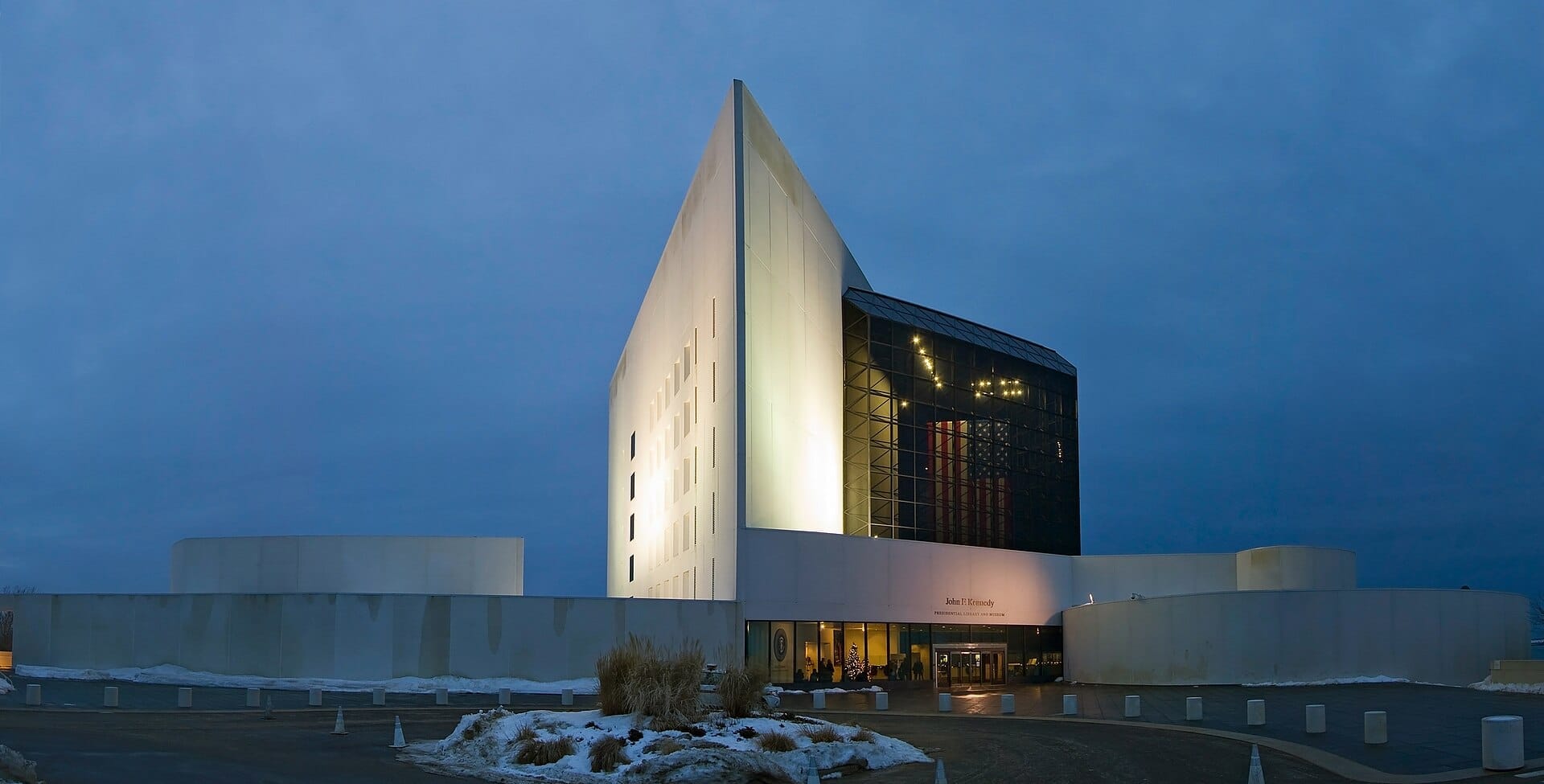
The John F. Kennedy Presidential Library and Museum is not a place that hedges. From the moment you arrive on Columbia Point and see I. M. Pei's stark white concrete-and-glass pavilion rising against Boston Harbor, the building announces itself as a serious piece of architecture in conversation with a serious subject. Most presidential libraries feel like well-funded gift shops attached to a display case. This one feels like a reckoning.
Kennedy served as the 35th President of the United States, and his administration, cut short by assassination in November 1963, remains one of the most studied and debated in American history. The museum does not flinch from that history. It covers the Cuban Missile Crisis in genuine depth, addresses Cold War anxieties with primary documents and recordings, and traces the civil rights pressures Kennedy navigated in the early 1960s. For visitors who grew up in the post-JFK era, it reframes a story often softened by nostalgia.
💡 Local tip
Last admission is at 3:30 p.m. even though exhibits officially close at 5:00 p.m. Arrive by 1:00 p.m. at the latest if you want to move through the full museum at a comfortable pace.
The Building Itself: I. M. Pei's Masterwork on the Water
Dedicated on October 20, 1979, after a 15-year site search and design process, the building is one of I. M. Pei's most recognized works in the United States. The structure centers on a 115-foot glass pavilion that frames a direct view of Boston Harbor and the city skyline beyond. Pei used sharp geometric forms, a trademark of his work, to create a building that reads as monumental without becoming oppressive.
The 10-acre site on Columbia Point was chosen partly because of Kennedy's personal connection to the sea and to Massachusetts, and the waterfront setting amplifies that symbolism. On clear days, the harbor light through the glass pavilion creates long, shifting reflections across the floor. Late morning, roughly 10:00 to 11:30 a.m., is when this effect is most pronounced and the interior feels luminous rather than merely well-lit.
The exterior is worth spending time with before you go inside. Walk the perimeter if weather allows. The interplay of white concrete planes, the circular tower, and the glass atrium is best understood from the south side of the building, where the full geometric composition is visible in one frame. This is also the best angle for photographs without crowds in the shot.
ℹ️ Good to know
The building sits adjacent to the University of Massachusetts Boston campus. If you drive, free on-site parking is available in the on-site lot.
Tickets & tours
Hand-picked options from our booking partner. Prices are indicative; availability and final rates are confirmed when you complete your booking.
Boston Summer Night Trolley Tour and River Cruise
From 27 €Instant confirmationFree cancellationLEGOLAND Discovery Center Boston tickets
From 26 €Instant confirmationFree cancellationGhosts and Gravestones tour of Boston
From 39 €Instant confirmationFree cancellationBest of Boston tour
From 182 €Instant confirmationFree cancellation
What You'll Actually See Inside
The museum is organized chronologically, beginning with Kennedy's early life in Massachusetts and moving through his Navy service in World War II, his Senate career, and the 1960 presidential campaign. The campaign section is particularly strong, using original footage of the Kennedy-Nixon television debates to illustrate how the medium of television reshaped American politics in ways still visible today. The contrast between the two candidates on screen, one relaxed and camera-ready, the other visibly uncomfortable, is striking in its directness.
The Cuban Missile Crisis exhibit is the emotional and intellectual core of the museum for many visitors. Original audio recordings of the ExComm meetings, where Kennedy and his advisors debated options that included a full nuclear exchange, are presented with enough context that the weight of what you're hearing lands properly. These are not dramatizations. They are the actual deliberations, and hearing them in the physical space of a museum dedicated to Kennedy gives them a different quality than encountering them online.
The Oval Office recreation is detailed and accurate to the Kennedy administration period. Younger visitors, and many adults, find this section particularly useful for grounding the abstract politics of the era in physical space. There are also exhibits covering the space program and the founding of the Peace Corps, both programs closely identified with the Kennedy administration's vision of civic engagement.
The museum dedicates significant space to Jacqueline Kennedy, covering her role in restoring the White House's historic interiors and her work as a cultural figure in her own right. For visitors interested in the broader political history of the period, the Boston Tea Party Ships and Museum offers a complementary perspective on how Massachusetts shaped American democratic traditions centuries earlier.
How the Experience Changes by Time of Day
Weekday mornings, especially Tuesday through Thursday before noon, are the quietest times to visit. School groups typically arrive between 9:30 and 11:00 a.m. and move through the early galleries in organized clusters, so if you are an independent adult visitor, arriving at opening at 10:00 a.m. and moving at a deliberate pace usually means you stay ahead of any group noise. By early afternoon, around 1:00 p.m., the school groups have typically cleared and the museum has a calmer atmosphere.
Weekend afternoons from roughly 1:00 to 3:00 p.m. are the busiest periods. The Cuban Missile Crisis audio stations, where visitors can pick up headsets and listen to recordings, have limited equipment and queues form during peak hours. If this section matters to you, either arrive early or visit on a weekday.
The glass pavilion at the museum's heart, which functions as a final gallery and gathering space, looks different depending on the light. On overcast days it feels meditative and slightly somber, which suits the subject matter. On bright days, particularly in summer, the harbor view becomes the dominant impression, and visitors tend to linger longer at the windows. Either version is worth experiencing.
Getting There and Practical Logistics
The MBTA Red Line is the most straightforward public transit option. Take the Red Line to JFK/UMass Station, which sits on both the Ashmont and Braintree branches of the line. From the station, a free shuttle bus connects to the Columbia Point campus area where the library is located. Check the MBTA website and the library's Plan Your Visit page for current shuttle schedules, as these can change seasonally.
If you are combining the JFK Library with other Boston attractions, a practical itinerary pairs it with the Museum of Fine Arts Boston in the Fenway area on the same day, as both are significant time investments that reward deliberate visitors. The Red Line makes the connection straightforward, though transit time adds up.
Drivers will find the Columbia Point location convenient by Boston standards. Free parking on-site removes one of the most common complaints about visiting Boston attractions. The lot is large enough to accommodate weekend visitor volumes without significant wait times on most days, though peak summer weekends can fill the lot by midday.
⚠️ What to skip
All visitors pass through a security screening with a metal detector upon entry. This is standard procedure and moves quickly, but allow a few extra minutes if you are carrying large bags or camera equipment.
Accessibility and Family Considerations
The building is fully accessible for visitors with mobility limitations. Accessible restrooms are available throughout the facility. The library's website lists additional accommodation options including assistive listening devices and other services for visitors with disabilities; contacting the museum in advance is recommended if you have specific requirements.
Children under 12 enter free, which makes this a affordable family outing compared to many Boston museums. However, the content is most engaging for children aged 10 and older who have some grounding in American history. Younger children can find the audio-heavy exhibits difficult to follow, and the subject matter, including assassination and nuclear crisis, requires parental discretion.
For families visiting Boston with younger children alongside older ones, a day that combines the JFK Library with the Boston Children's Museum in the Seaport makes logistical sense, splitting the day between an exhibit designed for adults and one built specifically for younger visitors.
Who Should Reconsider
The Columbia Point location is a genuine inconvenience for visitors staying in the center of Boston without a car. It sits outside the main tourist corridor, and the transit connection, while functional, requires a transfer and shuttle that adds travel time most visitors don't fully account for. If you have only one day in Boston, the JFK Library competes with the Freedom Trail, the harbor, and Beacon Hill for your hours, and those central attractions require less logistical planning.
Visitors looking primarily for an outdoor or walkable Boston experience will find the waterfront setting here less immersive than, for instance, the Boston Harborwalk or the Charles River Esplanade. The JFK Library's appeal is fundamentally interior and intellectual.
Visitors who prefer interactive, high-stimulus museum formats may find the experience more reading-heavy and audio-dependent than they expect. This is a museum that rewards patience and attention. It is not a passive walk-through.
Insider Tips
- The museum's research archive is one of the most significant presidential document collections in the country. Scholars and serious researchers can arrange access to archival materials through the library's research division. This is separate from the public museum experience and requires advance scheduling through the official website.
- The outdoor area around the building offers one of the better views of Boston Harbor and the city skyline available from the southern side of the peninsula. Bring a camera and walk toward the water after your museum visit, particularly in the late afternoon when the light hits the skyline from the west.
- Tickets can be purchased in advance through the library's official ticketing partner. On summer weekends and during school vacation weeks, buying tickets ahead removes the uncertainty of walk-up availability, though sell-outs are not common on weekdays.
- The museum gift shop carries an unusually strong selection of serious books on Kennedy, the Cold War, and 1960s American politics, not just souvenir merchandise. If you are interested in going deeper on any exhibit topic, browsing the book section before leaving is worth the ten minutes.
- Parking at Columbia Point is free, but the lot entrance and shuttle pickup points are not immediately obvious if you are visiting for the first time. Download the library's directions PDF or check Google Maps specifically for the parking lot entrance off Mt. Vernon Street rather than defaulting to the building's main address, which can route drivers less efficiently.
Who Is John F. Kennedy Presidential Library and Museum For?
- History enthusiasts with a serious interest in American political history and the Cold War era
- Architecture lovers who want to experience one of I. M. Pei's most significant American buildings
- Students and educators studying the Kennedy administration, civil rights, the Space Race, or the Cuban Missile Crisis
- Families with children aged 10 and older who have some background in American history
- Visitors with a car or willingness to navigate the Red Line and shuttle for a destination-worthy experience outside the main tourist corridor
Nearby Attractions
Combine your visit with:
- Arnold Arboretum
Founded in 1872, the Arnold Arboretum is the oldest public arboretum in North America — a free, 281-acre landscape in Jamaica Plain managed by Harvard University. With over 15,000 accessioned plants and sweeping hillside views, it draws botanists, dog walkers, and curious visitors in equal measure across all four seasons.
- Blue Hills Reservation
Ten miles south of downtown Boston, Blue Hills Reservation spreads across more than 7,000 acres of forested hills, rocky ridgelines, and glacial wetlands. Free to enter and open year-round from dawn to dusk, it offers 125 miles of trails ranging from easy pond-side loops to a genuine summit climb at 635-foot Great Blue Hill.
- Boston Duck Tours
Boston Duck Tours puts you aboard a replica World War II DUKW amphibious vehicle for an 80-minute circuit of the city's most historic landmarks, finishing with a splash into the Charles River. Running seasonally from late March through late November, it's one of the few tours in Boston that covers both street-level sights and a Charles River perspective in a single trip.
- Boston Harbor Islands
Boston Harbor Islands National and State Park puts 34 islands and peninsulas within easy ferry reach of downtown Boston. From Civil War earthworks on Georges Island to the oldest lighthouse station in the United States on Little Brewster, the park rewards visitors who are willing to trade the city's brick sidewalks for salt air and open water.