Jægersborg Dyrehave: Copenhagen's Ancient Deer Park and Royal Hunting Forest
Jægersborg Dyrehave is an 11 km² royal forest north of Copenhagen where around 2,100 red and fallow deer roam freely across ancient beech woodland. A UNESCO World Heritage Site since 2015, it is free to enter, open year-round, and reachable in around 20 minutes by S-train from the city centre.
Quick Facts
- Location
- Dyrehaven, 2930 Klampenborg, Denmark — approx. 13 km north of central Copenhagen
- Getting There
- Klampenborg Station (S-train line C or Øresundstog from Copenhagen Central); short walk to the main park entrance
- Time Needed
- 2–4 hours for a leisurely walk; a full day if you explore the park and visit Bakken amusement park
- Cost
- Free (open public forest); separate fees may apply for Bakken amusement park and Hermitage Lodge guided tours
- Best for
- Nature walks, wildlife spotting, cycling, family outings, escaping the city without leaving Greater Copenhagen
- Official website
- parforce.dk/en/visit-verdensarvsomraadet/visit-jaegersborg
What Jægersborg Dyrehave Actually Is
Jægersborg Dyrehave, known to most Danes simply as Dyrehaven, is a royal hunting forest covering around 11 km² of ancient beech woodland and open grassland north of Copenhagen. The park area was first fenced in the 17th century to establish a private royal deer ground, and it was under King Christian V that the par force hunting landscape and star-shaped road system were developed. It was opened to the public in 1756, making it one of the earliest publicly accessible green spaces in Scandinavia. In 2015, UNESCO inscribed it as part of the 'Par force hunting landscape in North Zealand' World Heritage Site, recognising its remarkably preserved 17th and 18th-century star-shaped road system, which was designed to funnel game towards hunters on horseback.
Today the park is managed by the Danish Nature Agency (Naturstyrelsen) and is free to enter with no fixed closing hours. It functions simultaneously as a working wildlife reserve, a recreational landscape, and a piece of living architectural history. The star-shaped avenues radiating from central points in the forest are not decorative — they were precise hunting tools, and walking them today gives a quiet sense of how deliberately this landscape was shaped.
ℹ️ Good to know
Access is free year-round and there are no ticket gates or timed entry. Simply walk from Klampenborg Station into the park, following posted rules on wildlife protection, dogs, and permitted activities.
The Deer: What to Expect and When to Look
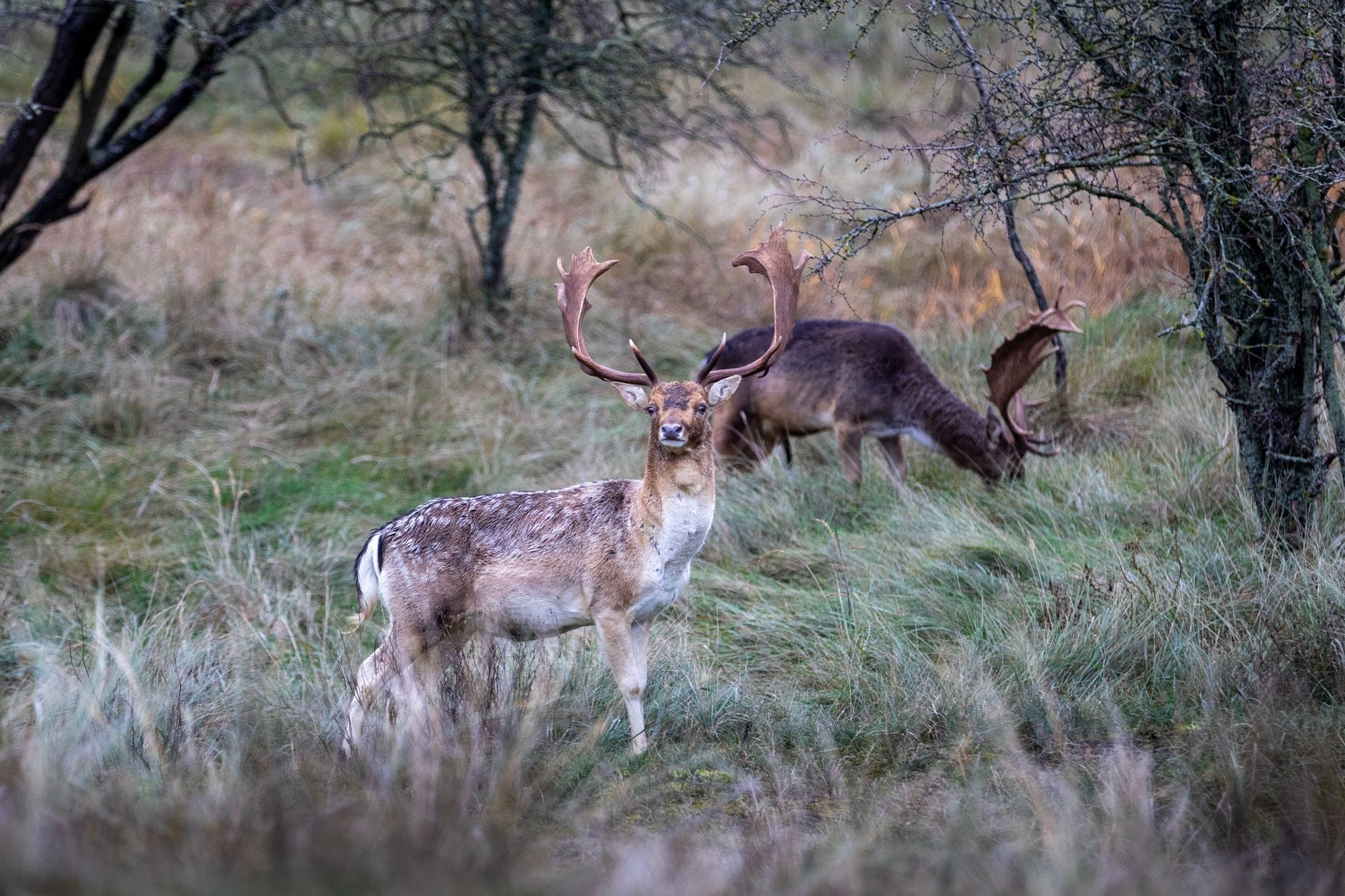
The park is home to approximately 2,100 red deer and fallow deer, making it one of the largest free-roaming deer populations in Northern Europe within a single enclosed landscape. Encounters are common but not guaranteed — the deer move across a large area, and sightings depend on time of day and season. Early mornings, particularly in spring and autumn, offer the best conditions. The deer tend to congregate in open clearings and along the broader avenues in low light, when foot traffic is minimal and the beech canopy filters a pale, diffused glow across the grass.
The autumn rut, typically running through September and into October, is the single most dramatic period to visit. Male red deer bellow across the forest in the early morning, a sound that carries surprisingly far through the trees and is genuinely arresting if you are not expecting it. Fallow deer with their flattened antlers move in larger, more skittish groups and can be spotted grazing near the Hermitage Lodge area and around the lower woodland edges. By midday in summer, the deer have largely retreated into deep woodland shade, so arriving before 9am significantly increases your chances of a good encounter.
Keep a respectful distance — these are wild animals, not farmed ones. Dogs must be kept on a lead throughout the park, and approaching deer closely, especially does with young fawns in spring, is strongly discouraged. The deer are accustomed to human presence but not tame.
💡 Local tip
For the best deer sightings: arrive at or just after sunrise, head toward the open meadow areas around the Hermitage Lodge, and move quietly. Weekday mornings are dramatically quieter than weekend afternoons.
Tickets & tours
Hand-picked options from our booking partner. Prices are indicative; availability and final rates are confirmed when you complete your booking.
1-hour boat harbour tour in Copenhagen
From 26 €Instant confirmationFree cancellationSmall group 3-hour walking tour in Copenhagen
From 45 €Instant confirmationFree cancellationCopenhagen to Malmo one-day tour
From 56 €Instant confirmationFree cancellationFull-day tour to Forest Tower and Forgotten Giants from Copenhagen
From 110 €Instant confirmationFree cancellation
The Landscape: Beech Forest, Open Meadows, and a Hunting Lodge
The forest interior is dominated by old-growth beech trees, some of considerable age and girth, with smooth grey bark and a canopy that in summer forms an almost complete ceiling of pale green light. The undergrowth is relatively sparse compared to younger woodland — old beech forests shade out most ground cover — which gives the park an open, parklike quality even deep within the trees. In autumn, the transformation is total: the canopy turns copper and gold, and fallen leaves accumulate in thick layers across the avenues, muffling footsteps and giving the whole landscape a hushed, cushioned quality.
Near the centre of the park stands the Eremitageslottet, the Hermitage hunting lodge, built in the 18th century on a raised position with views across the surrounding forest. The building itself is relatively small and austere by royal standards — a pale, cream-coloured structure with a formal simplicity that suits the practical purpose it was built for. Guided tours of the interior run on specific summer dates; check the official Parforce website for current scheduling, as tour dates change year to year. From the outside, the lodge can be viewed freely at any time, and the elevated ground around it is one of the better vantage points in the park.
The star-shaped road network, a key element of the UNESCO designation, is easier to appreciate on a map than on the ground, but cycling or walking the longer avenues gives a tangible sense of the scale of royal ambition behind the original design. For a broader understanding of how this landscape fits into Copenhagen's architectural heritage, the Copenhagen design and architecture guide provides useful context on how the city's built and natural environments developed in parallel.
Getting There and Moving Around Inside
The most straightforward route from central Copenhagen is the S-train on line C or the Øresundstog regional train to Klampenborg Station. The journey takes about 20 minutes from Copenhagen Central Station. From Klampenborg, the main park entrance is a short, flat walk — you can see the forest edge almost immediately from the station platform. Klampenborg Station also sits directly adjacent to Bakken amusement park, so you will pass through Bakken's approach on your way into the deer park proper.
An alternative entry point is Skodsborg Station on the north side of the park, useful if you want to walk or cycle a longer route through the park from north to south. Several car parking areas are located near the King's Gate (Fortunen), Hjortekær, Springforbi gate, and near Bakken — practical if you are arriving from elsewhere in the Copenhagen region rather than the city centre.
Cycling is an excellent way to cover more of the park's 11 km² without exhausting yourself. The broad avenues are well-suited to bikes, and you can bring your bicycle on the S-train outside peak hours. If you plan to combine the visit with a cycling day around Copenhagen, the route along the coast from the city to Klampenborg is a popular and manageable option.
The main avenues near the entrances are paved or compacted gravel, making them accessible for pushchairs and light wheelchairs. Deeper forest tracks become rougher and uneven, so wheelchair accessibility is limited beyond the central areas. Seven information centres with maps are distributed across the World Heritage area, which helps with orientation in a landscape that can feel disorienting without clear landmarks.
Bakken: The Amusement Park Next Door
Just inside the main Klampenborg entrance sits Bakken, which claims to be the world's oldest operating amusement park, dating to 1583. It is a distinctly different experience from the quiet forest beyond — loud, colourful, and aimed squarely at families and groups looking for traditional fairground entertainment. Bakken operates seasonally (generally spring through autumn) and charges its own admission or pay-per-ride fees.
If you have young children or are looking for a contrast between wild nature and old-fashioned amusement, combining Bakken with a deer park walk is a practical half-day plan. The two attractions sit immediately next to each other, and transitioning between them takes minutes. For more detail on the park itself, see the Bakken amusement park guide.
Seasonal Experience: How the Park Changes Through the Year
Spring (April to May) brings fresh green leaf cover to the beeches and the appearance of new fawns. The forest floor, briefly visible before the canopy closes in, catches morning light well, and the deer are active and visible as they feed on new grass. Weekends in May can attract significant numbers of Copenhagen residents escaping the city, particularly when weather is warm.
Summer (June to August) is when the forest is at its most lush but also its most crowded on warm weekends. The deer retreat into shade during the middle of the day. This is also when Bakken is at full capacity and the entrance area near Klampenborg becomes congested. Early morning visits are especially valuable in summer. Copenhagen's long summer days mean you can arrive at 6am and have the forest largely to yourself for two or three hours.
Autumn is, by most measures, the best season. The rut brings dramatic wildlife behaviour, the canopy colour is exceptional, and crowds thin out compared to summer peaks. October specifically combines the tail end of the rut with peak foliage colour. For more on what Copenhagen offers in this season, see the guide to Copenhagen in October.
Winter (December to February) strips the beeches bare, exposing the full geometry of the star-shaped avenue network and the structural form of the old trees. The park is far quieter, and deer sightings can actually be easier in open woodland with reduced cover. Frost and snow transform the landscape considerably. Dress warmly and wear waterproof footwear — the ground holds moisture and can be muddy even on dry days after rainfall.
⚠️ What to skip
The park has no cafes or food stalls inside the forest itself (beyond the Bakken area at the entrance). Bring water and snacks if you plan to walk for more than an hour, especially in summer or on cold winter days.
Photography and Practical Notes
The park rewards photographers who are patient and early. The combination of old-growth beech trees, free-roaming deer, and a geometric road system gives you three very different compositional subjects within the same landscape. A 200mm or longer lens is useful for deer without disturbing them. In autumn, the low angle of the morning sun through the avenue tunnels creates strong directional light that works especially well for forest shots. On overcast days, the even light is actually preferable for close-up deer photography, as it eliminates harsh shadows.
The park is free and fits naturally into a broader day around Copenhagen's northern sights. It pairs well with a visit to Ordrupgaard museum nearby, or as part of a longer day trip that continues up the coast. If you are planning multiple free or low-cost activities, the free things to do in Copenhagen guide lists other no-cost options across the city.
The park is not the right choice for visitors primarily interested in urban sights, design culture, or restaurant experiences — there is nothing inside the forest to eat or buy beyond the Bakken entrance zone, and the experience is entirely outdoors. In persistent heavy rain, the forest paths become muddy and the deer are harder to spot. The park does not lose its appeal entirely in rain, but wet weather reduces the quality of the experience noticeably.
Insider Tips
- Walk away from the Klampenborg entrance as quickly as possible. The area around Bakken is busy and gives no sense of the forest. Head 15 minutes along any of the main avenues and the noise drops sharply.
- The Hermitage Lodge clearing is one of the most reliable spots to see deer in the open, particularly in the hour after sunrise. The elevated ground here also gives the best sense of the park's scale.
- The S-train runs frequently and takes about 20 minutes from Copenhagen Central. There is no need to hire a car or take a taxi — arriving by train also means you can have a beer at Bakken on the way back without worrying about driving.
- Seven orientation boards are distributed across the World Heritage area with maps and route information. Locate one near your entry point before heading deeper into the forest — the avenue network can be disorienting without a visual reference.
- Horseback riding in the park is allowed only with a permit purchased through the Danish Nature Agency website. If you are interested in riding through the forest, this must be arranged before your visit.
Who Is Jægersborg Dyrehave (Deer Park) For?
- Nature lovers and wildlife watchers who want free-roaming deer encounters without travelling far from a European capital
- Families with children looking for a half-day of outdoor space, potentially combined with Bakken amusement park
- Cyclists wanting a scenic, car-free forest route accessible by public transport
- Photographers seeking old-growth forest light, deer, and a UNESCO-listed geometric landscape in a single location
- City visitors who want an hour or two of genuine quiet woodland without booking anything or paying anything
Nearby Attractions
Combine your visit with:
- Amager Strandpark
Amager Strandpark (Amager Beach Park) is Copenhagen's largest beach, offering a total of 4.6 km of sandy shoreline along the city's southeastern coast. Free to enter and easily reached by metro, it combines a natural shoreline with a 2 km artificial island and sheltered lagoon opened in 2005, making it a genuine summer destination for locals and a quiet surprise for visitors expecting a landlocked Scandinavian capital.
- Arken Museum of Modern Art
Located on the Ishøj coastline south of Copenhagen, ARKEN Museum of Modern Art combines a dramatically sculptural building with a serious contemporary art program. The journey out of the city is part of the experience, and the landscape setting changes everything about how you engage with the art.
- Bakken
Dyrehavsbakken, known simply as Bakken, has been drawing visitors to the forests north of Copenhagen since 1583, making it the oldest operating amusement park on earth. Unlike polished theme parks, it mixes rickety roller coasters, carnival stalls, and open-air restaurants inside a UNESCO-recognized deer park, with free entry to the grounds.
- The Blue Planet – National Aquarium Denmark
The Blue Planet, Denmark's National Aquarium, sits in Kastrup on the Øresund coast with 7 million liters of water, 450 species, and a striking spiral building that's worth examining before you even step inside. This guide covers what to expect from the exhibits, the best times to visit, and how to get there without confusion.