Ireland's Eye: The Uninhabited Island Off Howth Worth the Short Crossing
Ireland's Eye (Inis Mac Neasáin in Irish) is a small, uninhabited island sitting just north of Howth Harbour in County Dublin. Reachable by a 15-minute boat ride, it offers a ruined early medieval church, a Napoleonic-era Martello tower, dramatic coastal rock formations, and colonies of seabirds. There are no facilities, no toilets, and no easy terrain — but for those prepared, the reward is complete solitude within sight of Dublin city.
Quick Facts
- Location
- Off Howth Head, County Dublin — accessible only by boat from Howth Harbour
- Getting There
- DART to Howth station, then a short walk to the harbour. Boat services operate seasonally from Howth Harbour (approx. 15 minutes crossing)
- Time Needed
- 2.5 to 4 hours including the crossing and exploration on foot
- Cost
- Island entry is free. Boat fare is charged by private operators; around €20 per person (verify with operators before travelling)
- Best for
- Wildlife watchers, sea swimmers, photographers, and anyone wanting genuine island solitude near Dublin
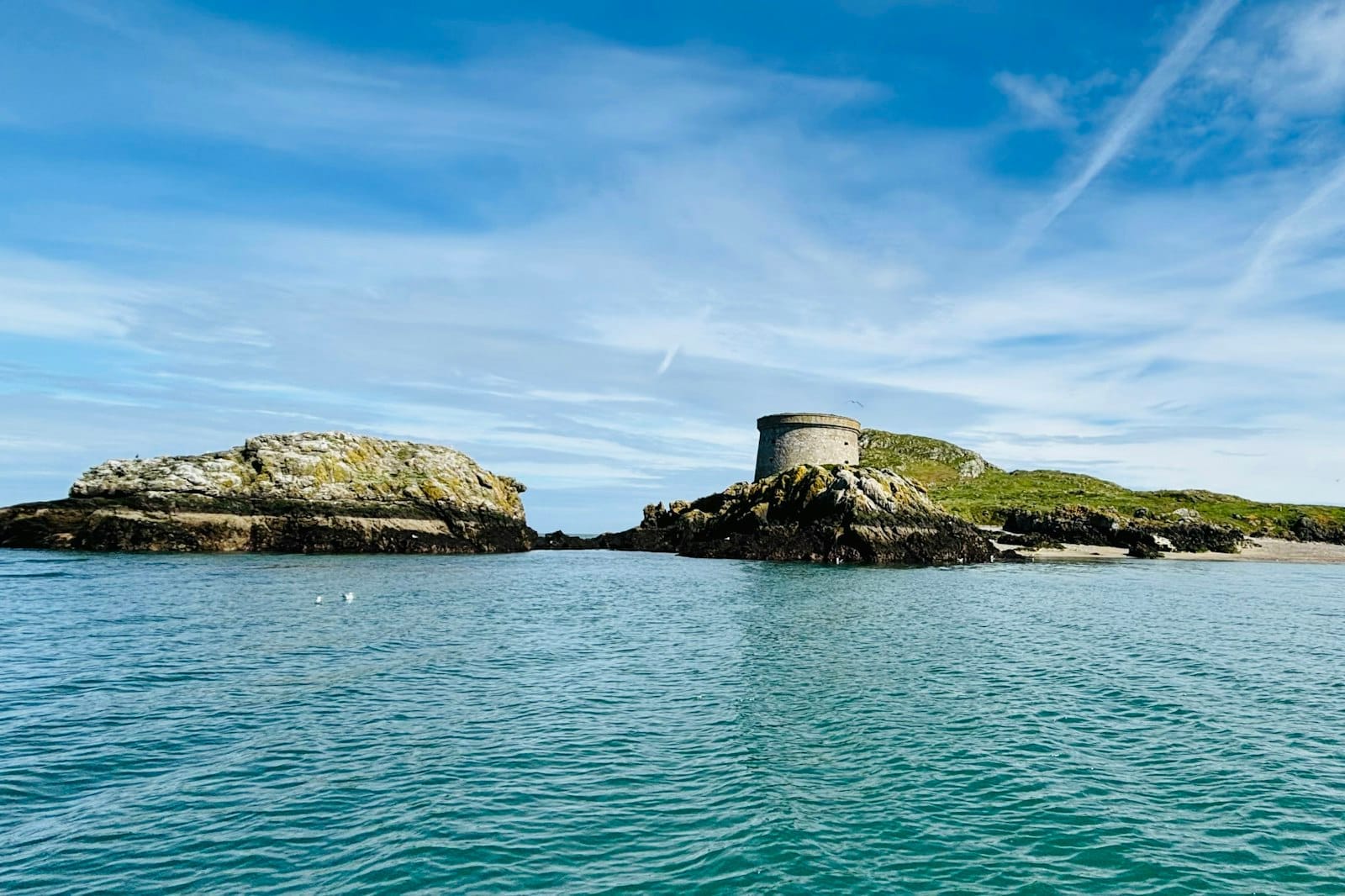
What Ireland's Eye Actually Is
Ireland's Eye, known in Irish as Inis Mac Neasáin, is a small uninhabited island that sits roughly a kilometre north of Howth Harbour in County Dublin. It lies within Fingal and is part of the Howth Castle and Estate, and is classified as a Special Protection Area under EU birds and habitats legislation, primarily because of its breeding seabird colonies. It is not a manicured nature reserve with boardwalks and interpretation panels. There are no cafes, no toilets, no shelter structures, and no paths in any formal sense. What the island does offer is a rare thing within easy reach of a European capital: genuine wildness.
The island covers roughly 30 hectares and is dominated by rough grassland, rock, heather, and dense bracken on its higher ground. Its western side slopes relatively gently toward a stony landing beach, while the eastern side rises into the cliff stack known as the Stack of Ireland — a sheer column of rock that seabirds use for nesting and that gives the island its most dramatic silhouette when viewed from the Howth Cliff Walk.
⚠️ What to skip
There are no toilet facilities anywhere on the island. There is no fresh water. No food or drink is available. Bring everything you need, and take all rubbish back with you.
The Crossing: Getting Out There
Boat services to Ireland's Eye run seasonally from Howth Harbour, typically from spring through early autumn, weather permitting. The crossing takes around 15 minutes. Services are operated by private companies; check locally at the harbour for current operators, schedules, and fares. As of 2026, one visitor reported paying around €20 per person, though prices vary by operator and season and should be verified directly before travelling.
The boat drops passengers on a small stony beach on the island's western shore. Depending on tidal conditions, you may step directly onto dry stone or wade through a few inches of water. Waterproof footwear is a practical advantage here. The boatman will typically agree a pick-up time with the group — usually 1.5 to 2 hours later, though some operators offer flexible returns for smaller parties. Pay attention to the agreed time, as missing the last boat is not a comfortable situation.
To reach Howth Harbour, take the DART from Dublin city centre to Howth, the terminus of the coastal rail line. The harbour is a short walk from the station. For context on the wider Howth area and what else the peninsula offers, the Howth neighbourhood guide covers restaurants, the cliff walk, and the village in detail.
Tickets & tours
Hand-picked options from our booking partner. Prices are indicative; availability and final rates are confirmed when you complete your booking.
Giant's Causeway, Dark Hedges, and Belfast Tour from Dublin
From 85 €Instant confirmationFree cancellationDublin self-guided audio tour
From 10 €Instant confirmationBird of Prey, Cliffs of Moher and Aillwee Cave from Dublin
From 201 €Instant confirmationFree cancellationGame of Thrones Studio tour with return transfer from Dublin
From 63 €Instant confirmationFree cancellation
History Embedded in the Rock
The island's Irish name, Inis Mac Neasáin, means 'Island of the Sons of Nessan', a reference to a monastic settlement established here during the early medieval period. The ruins of Cill Mac Neasáin, a small church attributed to this community, still stand on the island's western end. The structure dates to roughly the 6th to 8th centuries, with some sources placing its foundation around 700 AD. The walls are low and largely roofless, but the stonework is coherent enough to give a clear sense of the building's modest rectangular plan. Standing there on a quiet day, with only the sound of wind and surf, it is not difficult to understand why early Christian monks chose remote places for contemplation.
At the northern end of the island stands a Martello tower, built in 1803 as part of a network of coastal defensive fortifications erected across Ireland and Britain during the Napoleonic Wars. The towers were designed to resist artillery and slow a potential French landing force. The one on Ireland's Eye is in reasonable structural condition but not open to visitors. It reads as a striking silhouette against the sky when approached from the south, its cylindrical form sitting above the bracken line.
If towers of this era interest you, the James Joyce Tower at Sandycove on the south side of Dublin Bay is another Martello structure from the same period — and one you can go inside.
Wildlife: The Real Reason Many People Come
Ireland's Eye is designated as a Special Protection Area for birds. The island hosts breeding colonies of razorbills, guillemots, herring gulls and kittiwakes, concentrated on the sea stack on the eastern cliffs, and also supports nationally important numbers of gannets. During the summer breeding season (roughly April to August), the noise from these colonies is audible before the boat even reaches the landing beach: a layered, rasping, overlapping cacophony of calls that echoes off the rock face. It is one of those wildlife experiences that catches many visitors off guard in the best possible way.
Grey seals are frequently seen hauled out on rocks around the island's shoreline, particularly near the northern and eastern shores. They are generally unbothered by boat traffic but will move if approached too closely on foot. Peregrine falcons have been recorded on the island. In spring, the grassland around the ruined church can hold a surprising density of passerines on migration. Bring binoculars if wildlife is the primary draw.
💡 Local tip
The cliffs on the eastern side hold the densest seabird activity. If the boat passes that side on approach, you will get closer views of the stack colonies from the water than from land. Ask the operator if a circuit of the island is possible before landing.
What the Experience Actually Feels Like on the Ground
The landing beach is gravelly and uneven, and the transition from boat to shore requires some care. From the beach, most visitors make their way toward the ruined church first, since it sits close to the western landing area and requires the least elevation gain. The grass around the ruin is tufted and wet underfoot after any rain. The ground is not flat anywhere on the island. Paths are informal, worn in by previous visitors rather than constructed, and can be slippery in damp conditions.
Moving toward the higher central ground, the bracken becomes denser and in late summer can reach chest height in places. The summit area offers a panoramic view that is genuinely rewarding: Howth village below to the south, the full arc of Dublin Bay opening to the left, the Wicklow Mountains visible on a clear day to the south, and the Mourne Mountains sometimes discernible far to the north. It is one of the better vantage points in the Dublin area precisely because you are offshore, looking back at the land from the sea.
On a calm summer morning, the island can hold a dozen or so visitors at any one time and still feel uncrowded. By mid-afternoon on a fine weekend in July, numbers increase, though the size of the island and the informality of movement means it rarely feels congested. Early crossings, typically the first boat of the day, deliver the quietest experience and the best light for photography.
Practical Preparation: What to Bring and What to Expect
Footwear is the single most important preparation decision. The terrain combines wet grass, seaweed-covered rocks near the shore, and uneven rough ground inland. Sturdy walking shoes or boots with ankle support and a waterproof membrane are the practical choice. Trainers or sandals are workable in dry conditions but will be uncomfortable within minutes of any rain or tidal spray.
Weather on the island is exposed in a way that Howth village is not. Wind speeds are typically several kilometres per hour higher out on the water, and the island offers almost no natural windbreak. A light waterproof layer is worth carrying even on sunny mornings. Sunscreen matters on clear days because the coastal light and water reflection intensify UV exposure. Pack water and food for the duration of your visit.
The island is not accessible for visitors with mobility difficulties given the uneven terrain and boat landing conditions. If you are planning a trip to Howth more broadly, the Howth Cliff Walk offers views toward Ireland's Eye from the mainland and is an alternative for those who want the coastal scenery without the crossing.
Who Should Think Twice
Ireland's Eye is not an attraction in the conventional sense. There is no interpretation, no infrastructure, and no protection from the elements. Visitors who prefer structured visitor experiences, those with limited mobility, or anyone travelling with very young children who cannot manage rough ground independently should weigh the practicalities carefully. The boat crossing itself is a small open vessel and can be uncomfortable in any swell. People prone to seasickness should note that while the crossing is short, conditions in the bay can be choppy.
The island is also not worth visiting in poor weather. Low cloud reduces the views to near zero, rain makes the slopes genuinely slippery, and the wildlife activity on the cliffs becomes harder to observe. On those days, Howth Harbour itself, the village, and the surrounding headland offer plenty of interest without the added exposure.
Insider Tips
- Book the first boat of the day. The island is at its quietest in the first hour after landing, the light is better for photography, and you avoid the groups that build up by mid-morning in summer.
- Walk the perimeter of the island rather than cutting straight to the summit. The southern and northern shorelines have the best seal sightings, and the rock formations near the water's edge are more interesting than the interior bracken.
- Bring a bin bag. The island has no waste facilities, and wind scatters litter quickly. Carrying out your own rubbish, and picking up what you find, is an unwritten norm among regular visitors.
- Ask the boat operator whether conditions allow a loop around the eastern cliff stack before landing. From the water you will see the seabird colonies far more clearly than from any point on land.
- If the sky is clear, face north from the summit. On exceptional days the Mourne Mountains in County Down are visible across the Irish Sea — a perspective that makes the geography of the east coast suddenly legible.
Who Is Ireland's Eye Island For?
- Wildlife and birdwatching enthusiasts, particularly during the spring and summer breeding season
- Photographers looking for coastal and seabird subjects with an uninhabited island backdrop
- Hikers and walkers wanting a short but genuinely wild experience within reach of Dublin on a day trip
- History-minded visitors interested in early medieval monastic remains and Napoleonic coastal defences
- Sea swimmers: the waters off the landing beach are swimmable in summer, and the isolation makes for an unusually peaceful dip
Nearby Attractions
Other things to see while in Howth:
- Howth Cliff Walk
The Howth Cliff Walk traces the dramatic headland of Howth Head north of Dublin, offering four marked loop routes ranging from 6 to 12 kilometres. Free to access year-round and reachable by DART from the city centre, it delivers sea cliffs, heathland, and panoramic views of Dublin Bay without requiring a car or a guide.
- Howth Harbour & Seafood Trail
Perched on a rocky peninsula about 14 km north of Dublin city centre, Howth Harbour is a working fishing port where trawlers unload at dawn and seafood restaurants fill by noon. Whether you come for a self-guided wander along the quays or a guided craft beer and seafood trail, the harbour rewards visitors who make the 30-minute DART journey from the city.