Holy Spirit Church, Tallinn: What to Know Before You Visit
The Holy Spirit Church (Püha Vaimu kirik) is one of Tallinn's oldest and most photographed medieval buildings, standing just steps from Town Hall Square. With its ornate exterior clock, Gothic interior, and deep Lutheran heritage, it rewards visitors who take the time to step inside.
Quick Facts
- Location
- Pühavaimu 2, Tallinn Old Town (Vanalinn), 3-minute walk from Town Hall Square
- Getting There
- No tram or bus stops directly outside; walk from Viru Gate or Town Hall Square. No parking on-site.
- Time Needed
- 30–45 minutes
- Cost
- Adults €1.50 / Children under 10 free / Seniors & children €1.50 (free with Tallinn Card)
- Best for
- Medieval history, architecture, photography, quiet reflection mid-morning
- Official website
- http://www.puhavaimu.ee
What Is the Holy Spirit Church?
The Holy Spirit Church (Estonian: Püha Vaimu kirik) is a medieval Gothic Lutheran church on Pühavaimu Street in Tallinn's Old Town, first documented in records dating to around 1319. One of the oldest continuously used religious buildings in the city, it sits close enough to Town Hall Square to be reached in under three minutes on foot, yet it occupies a quieter lane where the density of tour groups thins out considerably.
Unlike Tallinn's larger churches, the Holy Spirit Church has a compact footprint. From the outside it reads as a modest white-rendered building wedged between taller neighbours, but its north façade facing the street carries the detail that stops almost every passing visitor: an elaborately carved and painted wooden clock, considered the oldest public clock in Tallinn. The clock face dates from the late 17th century, and its hand-painted casing, with its blue-and-gold folk motifs, is immediately recognizable in photographs of the Old Town.
💡 Local tip
The famous painted clock is on the building's street-facing north wall. If you arrive from Town Hall Square through the narrow lane, you'll see it directly in front of you. Position yourself slightly to the left for a clean photograph without other visitors in the frame.
A Brief History Worth Knowing
The church's origins are bound up with Tallinn's civic history rather than purely ecclesiastical concerns. It began as a chapel attached to the Town Hall almshouse, serving the poor and the townspeople of the lower town (as distinct from the German nobility on Toompea hill). That social distinction matters: the Holy Spirit Church was, from the beginning, a congregation church for the common people of medieval Tallinn.
It holds a specific place in Estonian cultural memory because it was the site of the first public sermons in the Estonian language, begun in the 1530s shortly after the Reformation reached the region. Before this, church services in Tallinn were conducted in Low German or Latin, languages inaccessible to most of the local population. That shift marked a practical turning point: for the first time, ordinary Estonians could hear scripture in their own tongue. The church has been Lutheran ever since and is registered as a national cultural heritage monument (heritage number 1196).
If the broader sweep of medieval Tallinn interests you, the Tallinn medieval history guide puts the Holy Spirit Church into context alongside the city walls, Toompea Castle, and the guild buildings that defined the Old Town's social hierarchy.
Tickets & tours
Hand-picked options from our booking partner. Prices are indicative; availability and final rates are confirmed when you complete your booking.
Self-guided Discovery Walk of Tallinn city contrasts beyond the medieval walls
From 26 €Instant confirmationFree cancellationTallinn's art and culture tour with a local
From 62 €Instant confirmationFree cancellationHistorical walking tour of Tallinn with a local
From 599 €Instant confirmationFree cancellationIntroductory walking tour of Tallinn with a local guide
From 109 €Instant confirmationFree cancellation
The Interior: What You Actually See Inside
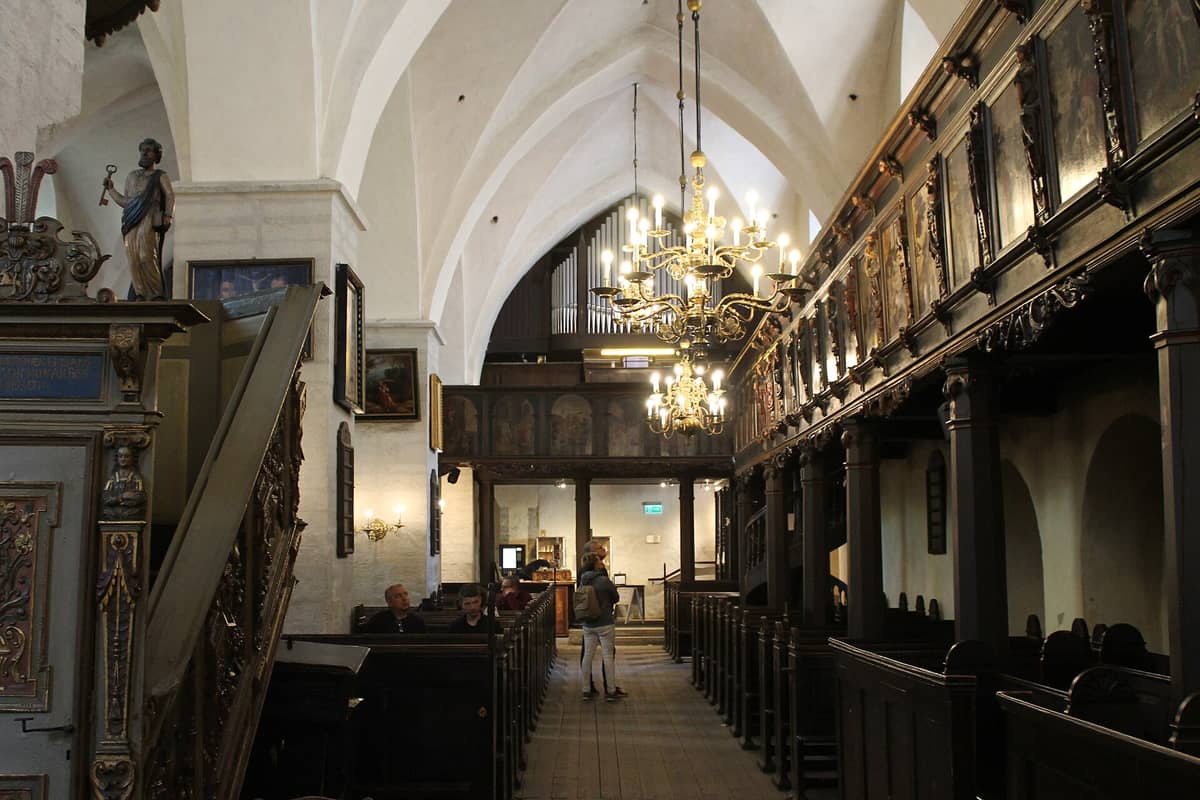
Step through the low doorway and the first thing you notice is the scale: the interior is smaller than you expect after visiting Tallinn's other Old Town churches. The nave is single-aisled, with whitewashed walls that focus attention on the furnishings rather than the architecture itself. The light is cool and even, the stone floor uneven underfoot.
The centerpiece is the carved wooden altarpiece by Bernt Notke, completed in the late 15th century. Notke, a Lübeck master, also created the famous Dance of Death painting now held at the Niguliste Museum nearby. The Holy Spirit altarpiece is a triptych depicting the Pentecost, with painted panels still retaining much of their original pigment after more than five centuries. The craftsmanship, particularly in the facial expressions of the figures, is remarkably detailed for a work of this age, and it holds up well under close inspection.
The church also contains carved wooden pews, a pulpit, and several historic epitaphs mounted on the walls. There is no dramatic vaulting or soaring vertical space here. The effect is intimate rather than grand: you are looking at medieval devotional art in the setting for which it was made, at roughly the same viewing distance the original congregation would have used.
ℹ️ Good to know
Photography is generally permitted inside without flash. The interior light is low, particularly on overcast days, so if you want usable photographs of the altarpiece, a camera or phone with good low-light performance helps significantly.
Opening Hours, Prices, and Seasonal Variations
Opening hours shift substantially by season, which is worth knowing before you build an itinerary around a visit.
- 1 May – 21 October: Monday to Saturday, 10:00–18:00
- 22 October – 30 April: Monday to Friday, 11:00–14:00; Saturday 10:00–16:00; Sunday 10:00–14:00
- 15 December – 10 January: Monday to Friday 10:00–18:00; Saturday 10:00–16:00; Sunday 10:00–14:00
Admission as of early 2025 is €1.50 for adults, seniors, and children, and free for children under 10 and Tallinn Card holders. These are modest fees by any standard, and the church is small enough that even 30 minutes is sufficient to see everything properly. Services are held regularly and the schedule may affect access during those windows; check the parish website at puhavaimu.ee before visiting on a Sunday morning.
⚠️ What to skip
The winter opening window (22 October to 30 April) is very narrow on weekdays: just 11:00–14:00. If you are visiting Tallinn in the colder months, plan to arrive before 13:00 to be sure you get inside. Arriving at 14:05 to a locked door is a common frustration among visitors who relied on outdated information.
How the Experience Changes by Time of Day
The street outside the Holy Spirit Church is at its quietest in the first hour after opening. Mid-morning on a weekday, you can expect the lane to be nearly empty: the large cruise-ship tour groups tend to cluster at Town Hall Square and the major viewpoints first, filtering through to smaller streets later in the day. Arriving between 10:00 and 11:00 in summer often means having the interior almost to yourself.
By early afternoon, particularly on days when cruise ships are in port, the lane fills with guided groups moving through on tight schedules. The interior is small enough that a single group of 15 people changes the atmosphere entirely. The acoustic in the church carries whispered conversations clearly, which can make it hard to linger in front of the altarpiece when a guided tour is in progress.
For the clock photograph, overcast light is actually more useful than direct sunlight, which can create harsh shadows across the carved woodwork. Morning light in summer hits the north-facing wall at a low, raking angle that can work well for textural detail. In winter, the shortened hours and frequent overcast skies in Tallinn mean the clock is best photographed close to midday.
Getting There and Fitting It Into Your Day
The Holy Spirit Church sits at the northern edge of the medieval street grid, a short walk from both Town Hall Square and the Viru Gate, which is the most common entry point to the Old Town from the modern city centre. From Viru Gate, walk straight along Viru Street until it opens onto Town Hall Square, then take the short lane on the north side of the square toward Pühavaimu Street. The church is visible almost immediately.
The church pairs naturally with a circuit that includes the Tallinn Town Hall and the Town Hall Pharmacy on the square, then continues north toward the Dominican Monastery passage and the city wall. The whole loop is walkable in two to three hours at a comfortable pace.
If you're planning a full day in the Old Town, the Tallinn Old Town walking tour guide sequences the major landmarks in a logical order that avoids backtracking. The Holy Spirit Church appears early in that route, which is also the right approach for timing: visit before the crowds build.
Practical Notes on Dress, Accessibility, and What to Bring
This is an active place of worship, not just a tourist attraction. Modest dress is appropriate: shoulders covered, no shorts that are overly short. The standard is not rigidly enforced, but it is worth respecting given that the church holds regular services and is a working parish.
The entrance involves a low stone threshold and the interior floor is original stone, uneven in places. The space is not large, so navigating with a pushchair is manageable but slightly awkward. Specific wheelchair access information is not formally documented in public listings; visitors with mobility requirements should contact the parish directly via puhavaimu.ee before visiting to confirm current arrangements.
There is no parking associated with the church and the surrounding Old Town streets are largely pedestrianised. If you are arriving by public transport, the nearest useful stops are on the edges of the Old Town, from which it is a 10 to 15 minute walk. Taxis and Bolt can drop you at the Viru Gate end, from which the walk to the church is about five minutes.
Insider Tips
- If you want the clock photograph without other visitors in frame, arrive right at opening time on a weekday. By 10:15 in summer, the lane is still quiet enough to work with.
- The altarpiece by Bernt Notke is better understood if you also visit the Niguliste Museum, which holds his Dance of Death painting. Seeing both works on the same day reveals a lot about how one master shaped the visual culture of 15th-century Tallinn.
- During the winter season the weekday opening window is just three hours (11:00–14:00). If your Tallinn trip spans multiple days, save this church for a morning when you can definitely arrive before 13:00.
- Services are held in Estonian. If you happen to be present during a service, wait respectfully near the door rather than walking through the nave to examine the altarpiece. The congregation is small and the space is intimate.
- The Tallinn Card covers a number of Old Town attractions and museums, and entrance to Holy Spirit Church is currently included; the card's coverage list is updated periodically.
Who Is Holy Spirit Church For?
- Visitors with a specific interest in medieval Northern European church art, particularly the Bernt Notke altarpiece
- History-focused travellers who want to understand the Reformation's impact on Estonian identity and language
- Photographers looking for the Old Town's most distinctive clock façade
- Anyone who finds Tallinn's larger churches overwhelming and prefers an intimate, unhurried interior
- Travellers doing a full Old Town walking circuit who want to understand the social geography of medieval Tallinn
Nearby Attractions
Other things to see while in Tallinn Old Town:
- Alexander Nevsky Cathedral
Rising above Toompea Hill with five gilded onion domes and a facade that dominates every Old Town panorama, Alexander Nevsky Cathedral is Tallinn's most visually assertive building. Built between 1895 and 1900, it remains an active Orthodox place of worship and a window into the city's layered Russian and Estonian history.
- Danish King's Garden
Tucked into the western slope of Toompea hill, the Danish King's Garden is a small, free public park woven into Tallinn's medieval fortifications. Open around the clock and steps from the Old Town's main streets, it offers a rare moment of calm alongside ancient towers and stone walls with an 800-year-old backstory.
- Fat Margaret
Fat Margaret (Paks Margareeta) is a squat, round cannon tower that has guarded the northern gate of Tallinn's Old Town since the early 16th century. Today it houses the Estonian Maritime Museum, with exhibits on seafaring history and a rooftop terrace overlooking the harbour. It is one of the few surviving medieval structures in Tallinn where you can explore both the architecture and a well-curated permanent collection under the same roof.
- Freedom Square
Freedom Square sits at the southern edge of Tallinn Old Town, anchoring the city's civic identity with the striking War of Independence Victory Column. Open around the clock and free to enter, it serves as a gathering point for national celebrations, winter markets, and everyday Tallinn life.