Hoa Lư Ancient Capital: Vietnam's First Royal City in Stone and Silence
Hoa Lư was Vietnam's first independent imperial capital, established in 968 AD among dramatic limestone karst formations in what is now Ninh Bình province. Two surviving temple complexes dedicated to the Đinh and Lê dynasties stand where palaces once rose, making this one of the most historically significant sites in northern Vietnam.
Quick Facts
- Location
- Trường Yên, Hoa Lư District, Ninh Bình Province — approx. 90 km south of Hanoi
- Getting There
- Bus from Hanoi's Giáp Bát or Mỹ Đình stations to Ninh Bình city; then taxi or xe ôm (motorbike taxi) ~12 km to site. Some day-tour buses go direct.
- Time Needed
- 2 to 3 hours for the temple complexes; half a day if combined with a walk through the valley
- Cost
- Entrance fee applies; verify current rate at the gate (approximately 20,000–30,000 VND for foreigners as of recent years — confirm before visiting)
- Best for
- History seekers, architecture enthusiasts, photographers, and travelers combining with Tràng An or Tam Cốc
What Hoa Lư Actually Is — and Why It Matters
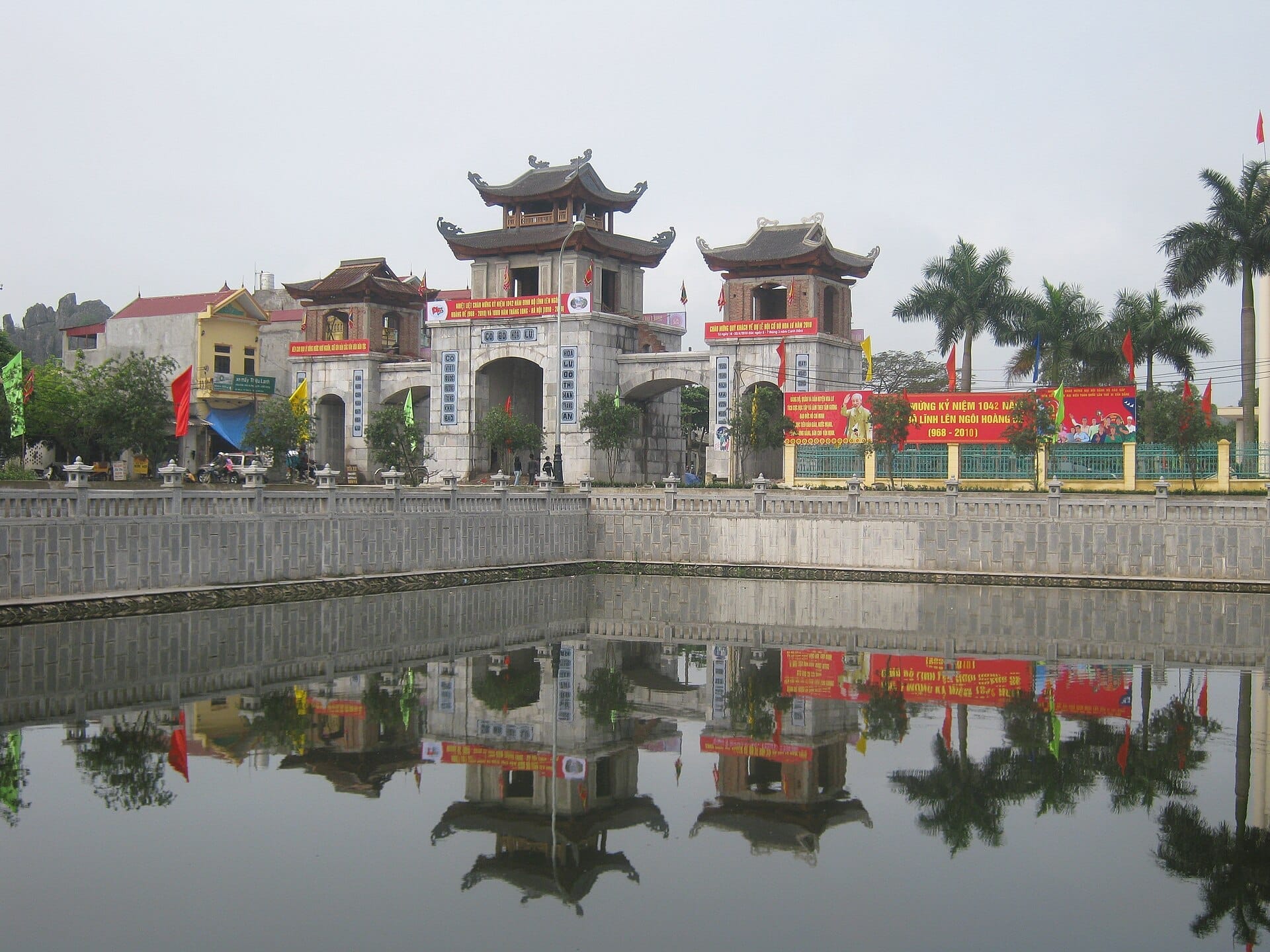
Before Hanoi was Hanoi, there was Hoa Lư. In 968 AD, Emperor Đinh Tiên Hoàng unified Vietnam's fragmented kingdoms and chose this location — a natural fortress formed by a horseshoe of towering karst limestone mountains — as the seat of the first centralized Vietnamese state. For 42 years, Hoa Lư served as the political and military heart of the nation. When the capital moved north to Thăng Long (today's Hanoi) in 1010 under Emperor Lý Thái Tổ, Hoa Lư was gradually abandoned, and its royal palace complex eventually disappeared.
What survives today are two temple complexes, each built on the foundations of former palace grounds: Đền Vua Đinh (Temple of King Đinh) and Đền Vua Lê (Temple of King Lê). These are not the original structures — the current buildings date from the 17th century — but they sit on ground that once held throne rooms and royal courts, and they are charged with that history in a way that feels concrete rather than abstract.
ℹ️ Good to know
Hoa Lư is often packaged with the Tràng An Landscape Complex or Tam Cốc boat trips on day tours from Hanoi. The sites are geographically close, but each deserves separate attention. Rushing Hoa Lư to catch a boat tour shortchanges one of Vietnam's most important historical sites.
The Two Temple Complexes: What You Will See
Đền Vua Đinh — Temple of King Đinh
The larger of the two compounds, Đền Vua Đinh sits at the end of a broad courtyard framed by ancient trees whose roots have spread across the stone paving. The entrance gate is flanked by stone dragon carvings that show the aesthetic confidence of the Lê dynasty restoration period. Inside, the main hall houses a bronze statue of Emperor Đinh Tiên Hoàng flanked by his three sons. The incense smoke inside is real and constant — local worshippers still come here, not just tourists.
Look at the carved wooden panels and roof beams closely. The craftsmanship is dense and precise, featuring dragons, phoenixes, and lotus motifs that appear across Vietnamese religious architecture but carry specific dynastic symbolism here. The stone stele in the courtyard records the history of the site; a translation panel nearby provides context in English, though the translation is basic and you will want to read more before arriving.
Đền Vua Lê — Temple of King Lê
A short walk or easy drive separates the two complexes. Đền Vua Lê is smaller and receives fewer visitors, which gives it a quieter, more contemplative atmosphere. It honors Emperor Lê Đại Hành, who founded the Early Lê dynasty and ruled from Hoa Lư after Đinh Tiên Hoàng's assassination in 979 AD. The inner sanctum holds a statue of the emperor alongside his queen, Dương Vân Nga, whose political role during the transition between dynasties remains a subject of historical debate in Vietnam.
The surrounding grounds feel less manicured than the Đinh complex, with tall bamboo and broad-leafed trees pressing close to the temple walls. In the early morning, the light through the tree canopy is sharp and photogenic. By midday, the shade makes the space feel cool even in summer.
Tickets & tours
Live prices and dates from our booking partner. If you book, we may earn a commission at no extra cost to you.
Full-day Tam Coc & Hoa Lu ancient capital tour
From 94 €Instant confirmationFree cancellationNinh Binh day tour with Hoa Lu, Trang An and Hang Mua from Hanoi
From 39 €Instant confirmationFree cancellationHoa Lu, Tam Coc and Mua Cave from Hanoi with Buffet Lunch
From 48 €Instant confirmationFree cancellationHoa Lu, Tam Coc, and Hang Mua day trip from Hanoi
From 59 €Instant confirmationFree cancellation
The Landscape: Why the Location Was Chosen
The karst topography surrounding Hoa Lư is not incidental. The ancient court chose this location precisely because the limestone mountains created a near-impenetrable natural barrier on three sides, dramatically reducing the need for constructed defenses. From inside the valley, you can look up at 200-meter vertical cliff faces that would have made any military assault from the outside extremely costly. It is one of the clearest examples anywhere in Southeast Asia of a capital city selected for strategic geography over agricultural convenience.
This same landscape forms the backdrop of the Tràng An Landscape Complex, a UNESCO World Heritage site that begins just kilometers from the temples. Visiting both on the same day is physically manageable and contextually rewarding — Tràng An gives you the waterways and caves; Hoa Lư gives you the human history that explains why anyone was here in the first place.
How the Site Changes Through the Day
Arriving before 8:30 AM is strongly worth the early start. The site receives tour groups from Hanoi that typically arrive between 9:30 and 11 AM, and the temple courtyards are not large. In the first hour after opening, the grounds belong almost entirely to local visitors — elderly residents who come to pray, a few Vietnamese families, and the occasional independent traveler. The smell of incense is strong, the air is still cool, and the karst peaks behind the temples catch the early-morning light at an angle that does not appear later in the day.
By midday, the tour-group volume peaks. The experience becomes noisier and more compressed, with guides speaking loudly in multiple languages simultaneously. If you arrive at this time, focus on the Đền Vua Lê complex — it gets a fraction of the foot traffic of its counterpart and stays calmer throughout the day.
By 3 PM, the groups thin out again. Late-afternoon light on the cliff faces is dramatic, and the walk between the two complexes is pleasant when the heat drops. The site typically closes in the early evening; verify current hours locally, as they can vary seasonally.
💡 Local tip
Wear shoes with grip. The stone pathways inside both temple complexes can be slick after rain, and several threshold steps are worn smooth from centuries of foot traffic. Sandals with thin soles make this uncomfortable.
Getting Here from Hanoi and Ninh Bình City
Hoa Lư is not directly accessible by public bus from Hanoi in a simple single connection. The most common independent route is a bus from Hanoi (Giáp Bát or Mỹ Đình terminal) to Ninh Bình city, a journey of roughly 2 to 2.5 hours depending on traffic, followed by a local taxi or motorbike taxi to the Hoa Lư site, approximately 12 km northwest of the city center. For more detail on transport logistics, the Ninh Bình from Hanoi guide covers bus options, train alternatives, and realistic travel times.
Organized day tours from Hanoi remain the most convenient option for travelers without much time. They handle transport, often include Tràng An or Tam Cốc alongside Hoa Lư, and typically cost significantly less than private car hire. The trade-off is a fixed schedule that limits how long you spend at each site.
If you plan to stay overnight in Ninh Bình — which allows for a much more relaxed pace — the Tam Cốc area offers accommodation close to both Hoa Lư and the boat-tour departure points. Staying local lets you visit Hoa Lư at opening time before the day-trip crowds arrive from Hanoi.
Photography, Dress Code, and Practical Notes
Both temples are active places of worship, not museum exhibits. Dress modestly: shoulders and knees covered is the standard expectation. A light scarf or thin long-sleeve layer is enough for most visitors in warm months. Remove shoes before entering the main halls — signs indicate where this is required, though local behavior will guide you clearly enough.
Photography is generally permitted in the courtyards and exterior spaces. Inside the main sanctuaries, use judgment — some areas near altars are considered off-limits for cameras, and taking photos while worshippers are actively praying is disrespectful regardless of posted rules. The most rewarding photography happens in the courtyards and from the path between the two complexes, where you can frame the ancient gate architecture against the karst cliffs rising directly behind.
Ninh Bình province as a whole benefits from the October-to-April window for travel: cooler temperatures, lower humidity, and clearer skies over the karst formations. The summer months bring heavier rain and significant heat, though the rice fields in the valley floor turn intensely green from June through August — a different but equally compelling visual landscape. For broader timing advice, the best time to visit Hanoi guide includes seasonal notes applicable to the Ninh Bình day-trip corridor.
Honest Assessment: Is Hoa Lư Worth It?
Hoa Lư is not a site that announces itself dramatically. There are no massive stone complexes, no towering monuments, no sweeping museum displays. What it offers is more subtle: a close encounter with a specific, well-documented moment in Vietnamese history, delivered through architecture that is genuinely beautiful even if not original to the era it commemorates. Travelers who come expecting a Southeast Asian Angkor will be underwhelmed. Travelers who arrive with some knowledge of the Đinh and Early Lê dynasties will find the site rewards that preparation.
The surrounding natural landscape is what elevates the experience beyond the purely historical. Standing in the Đinh temple courtyard and looking up at the vertical karst walls that ring the valley, the logic of the ancient court's choice becomes viscerally clear. That combination of human decision-making and geological drama is rare anywhere in the world.
Travelers who find temple architecture repetitive after several weeks in Vietnam, or who are primarily interested in natural scenery, may prefer to weight their time toward Tràng An or the boat routes at Tam Cốc. But for anyone with a serious interest in Vietnam's pre-colonial history, Hoa Lư is one of the most important sites in the country.
Insider Tips
- The path between Đền Vua Đinh and Đền Vua Lê passes through a narrow valley corridor with rice paddies on one side and cliff faces on the other. Walk it rather than riding — the 10-minute walk reveals details no vehicle path shows.
- Bring small-denomination VND for offerings boxes at the temple if you wish to contribute — this is a living worship site and those funds support the monks and upkeep, not a commercial operator.
- The stone dragon sculpture at the base of the steps in Đền Vua Đinh is one of the oldest surviving examples of Đinh-era decorative stonework. Most visitors walk past it quickly; it deserves a slow look.
- If you have a guide or join a tour, ask specifically about Dương Vân Nga — the queen who appears in the Đền Vua Lê complex. Her story cuts across both dynasties and is one of the most politically dramatic figures in early Vietnamese history. Many standard tour scripts skip her entirely.
- The mountain immediately behind the Đinh temple complex has a climbable trail leading to a viewpoint over the entire Hoa Lư valley. It is steep and requires reasonable fitness, but the perspective from above — the ancient capital laid out in the valley bowl below — is completely different from anything you see at ground level.
Who Is Hoa Lư Ancient Capital For?
- History-focused travelers who want to understand Vietnam before the French colonial period
- Architecture enthusiasts interested in 17th-century Vietnamese religious woodcarving and stone craft
- Photographers looking for temple architecture framed by dramatic karst landscapes
- Day-trippers from Hanoi combining the site with Tràng An or Tam Cốc into a full regional itinerary
- Travelers who prefer sites with genuine local worship activity over purely tourist-facing attractions
Nearby Attractions
Other things to see while in Ninh Bình:
- Bích Động Pagoda
Bích Động Pagoda is a three-tiered Buddhist temple complex built directly into a karst cliff in Ninh Bình province, roughly 100 km south of Hanoi. Originating in 1428 with major reconstruction in the early 18th century, it layers religious history, natural drama, and river scenery into one of northern Vietnam's most rewarding half-day excursions.
- Mua Cave & Hang Mua Peak
Hang Mua Peak, the high point of the Mua Cave complex in Ninh Binh, rewards a steep 500-step ascent with an uninterrupted 360-degree panorama over rice paddies, karst limestone mountains, and the winding Ngo Dong River. It is one of the most photogenic viewpoints in northern Vietnam, and one of the most honest: the views genuinely deliver.
- Tam Coc
Tam Coc draws visitors with its slow boat rides through three natural limestone caves, surrounded by flooded rice paddies and vertical karst peaks. It sits at the heart of Ninh Binh province, about 100 km south of Hanoi, and pairs well with nearby temples and cycling routes.
- Trang An Landscape Complex
Trang An Landscape Complex in Ninh Binh is Vietnam's first site recognized by UNESCO for both its natural and cultural values. Visitors explore a labyrinth of limestone karsts, river caves, and centuries-old temples by flat-bottomed rowboat, in one of northern Vietnam's most atmospheric landscapes.
Planning a trip? Discover personalized activities with the Nomado app.