Mua Cave & Hang Mua Peak: The Climb Worth Every Step
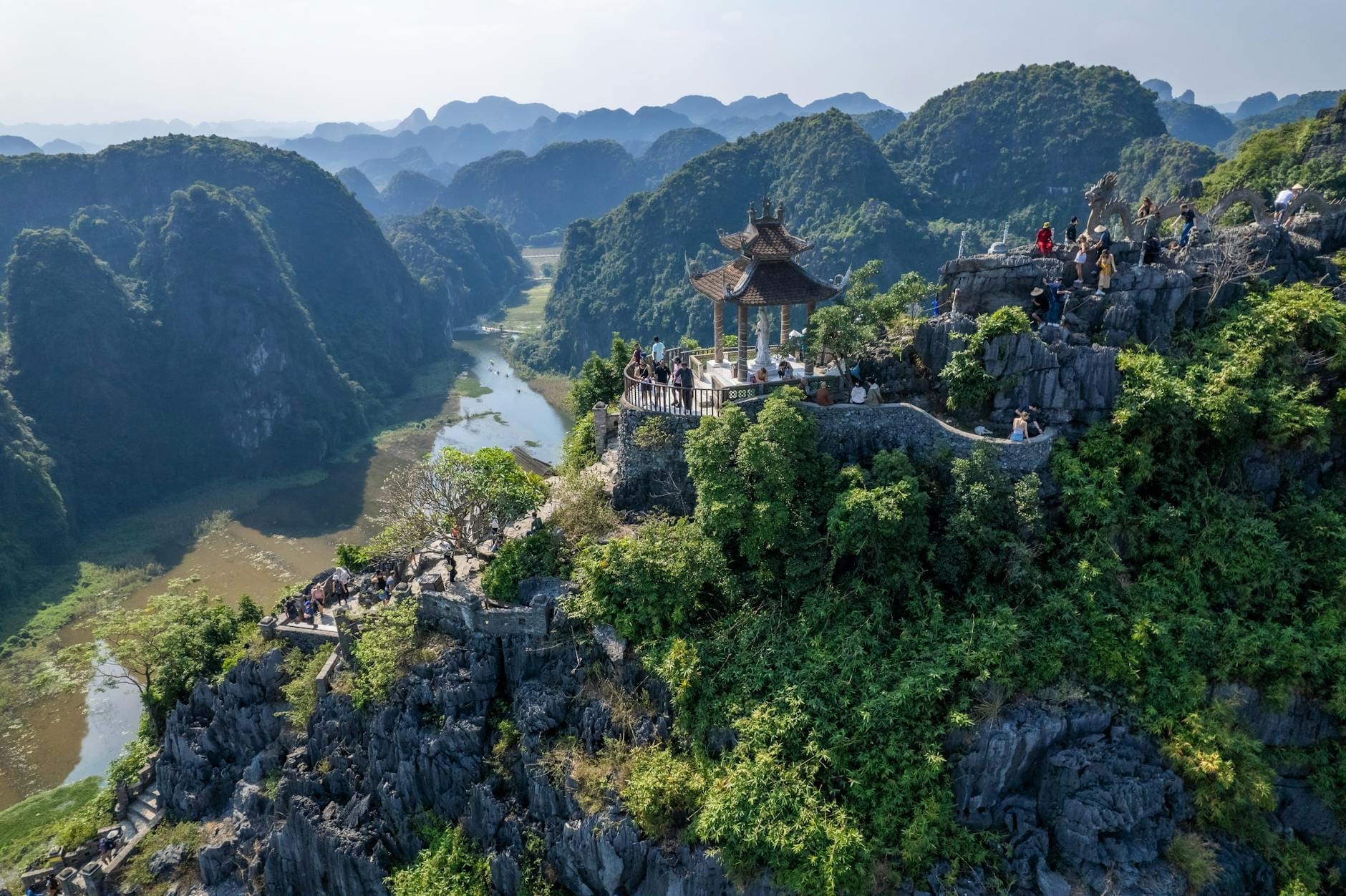
Hang Mua Peak, the high point of the Mua Cave complex in Ninh Binh, rewards a steep 500-step ascent with an uninterrupted 360-degree panorama over rice paddies, karst limestone mountains, and the winding Ngo Dong River. It is one of the most photogenic viewpoints in northern Vietnam, and one of the most honest: the views genuinely deliver.
Quick Facts
- Location
- Khe Dau Ha Village, Ninh Binh Province, ~15 km from Ninh Binh city centre
- Getting There
- Motorbike taxi or hired scooter from Ninh Binh city (15–20 min); Grab available from Ninh Binh train station
- Time Needed
- 2–3 hours including the climb and cave walk
- Cost
- Entrance fee applies; verify current rates on arrival as prices are subject to change
- Best for
- Sunrise photography, hikers, panoramic views, landscape lovers
What Mua Cave Actually Is
The name can mislead first-time visitors. Mua Cave (officially part of the Mua Cave Eco-Tourism Site, sometimes written as Hang Mua) is not primarily a cave attraction. The cave itself is a shallow limestone grotto at the base of a karst peak, decorated with stalactites and a small shrine. What draws the crowds is the peak above it: Hang Mua, reached by a stone staircase of 486 steps cut directly into the mountainside, offering one of the most complete panoramas in all of Ninh Binh Province.
The complex sits on the edge of Tam Coc, the boat-trip valley that most visitors associate with Ninh Binh. From river level, the karst scenery is intimate and enclosed. From Hang Mua Peak, you see the same landscape from above: a broad, flat basin of rice fields divided by limestone outcrops, the Ngo Dong River cutting silver threads through the green, and on clear days, the full arc of the surrounding mountains.
ℹ️ Good to know
Mua Cave is often bundled with a Tam Coc boat trip. If you're doing both in one day, tackle Hang Mua Peak first thing in the morning before the heat builds and the boat queues fill up.
The Climb: What to Expect Step by Step
The staircase begins at the base of the karst massif, past the cave grotto and a large reclining Buddha statue set into the rock face. The steps are stone, uneven in places, and steep enough that most visitors use their hands on the railings for the upper third. The ascent takes between 15 to 30 minutes depending on fitness and the number of stops you take, and you will stop: the view opens progressively as you climb, with each hairpin turn revealing a wider slice of the valley below.
At the summit, a small dragon statue marks the highest accessible point. The platform is not large, and on popular mornings it fills quickly with people angling for photographs. The railings here are solid, but the drop is sheer on the northern face, so children and anyone uneasy with heights should go carefully. Wind speed at the top can be surprisingly strong even on calm days below.
The descent uses the same staircase. Knees feel it more on the way down than on the way up. Trekking poles are worth bringing if you carry them anyway; sandals are a genuine liability on the wet stone steps that accumulate moisture in the morning.
⚠️ What to skip
The steps become slippery after rain. If the weather is wet or misty, factor in significantly more time and wear closed-toe shoes with grip. Flip-flops have caused falls here.
Tickets & tours
Live prices and dates from our booking partner. If you book, we may earn a commission at no extra cost to you.
Hoa Lu, Tam Coc and Mua Cave from Hanoi with Buffet Lunch
From 48 €Instant confirmationFree cancellationFull-Day Guided Tour of Hoa Lu, Trang An, and Mua Cave with Lunch
From 48 €Instant confirmationFree cancellationBai Dinh Pagoda, Mua Cave and Trang An Guided Tour with Buffet Lunch
From 36 €Instant confirmationFree cancellation1-Day Trip to Ninh Binh, Hoa Lu, Trang An and Mua Cave from Hanoi
From 48 €Instant confirmationFree cancellation
How the Experience Changes by Time of Day
Sunrise is the reason serious photographers make the effort to arrive early. The light at 5:30–6:30 am hits the karst peaks at a low angle, throwing long shadows across the rice paddies and turning the mist in the valley a pale gold. The air is cooler, the tourist numbers are thin, and the silence at the summit is close to complete except for birdsong and the occasional distant sound of a boat engine on the river below.
By 8:30–9:00 am, coach groups from Hanoi begin arriving. The ticket area fills, the path up the mountain becomes a single-file procession, and the summit gets genuinely crowded between 10:00 am and noon. Midday in summer (May through September) is punishing: direct sun, temperatures above 35°C, and haze that flattens the landscape into washed-out tones. The panorama still impresses, but the photographs rarely match the morning ones.
Afternoon light, from around 3:30 pm onward, offers a second window worth considering. The tour groups have largely cleared, the temperature drops a few degrees, and the low western sun gives the limestone a warm amber cast. The site typically closes in the early evening, so check current opening hours before planning a late visit.
The Landscape Below: Why This View Matters
The panorama from Hang Mua Peak overlooks the same geological formation that defines the wider Ninh Binh region: a karst limestone landscape shaped over hundreds of millions of years by the dissolution of rock by water. The result is an intricate pattern of isolated peaks rising abruptly from flat alluvial plains, a topography that once made this area nearly impenetrable and that today makes it visually extraordinary. The same landscape, extended over a larger area and including its waterways, is protected as part of the Trang An Landscape Complex, a UNESCO World Heritage Site since 2014.
Looking north from the summit, you can see the Ngo Dong River threading between the peaks toward Tam Coc, the three cave passage through which traditional bamboo boats carry visitors. The relationship between the two sites becomes clear from up here: Mua Cave gives you the map; Tam Coc takes you inside it.
Ninh Binh has historical depth beyond its geology. The area around Hoa Lu, 12 km north, served as Vietnam's capital during the Dinh and early Le dynasties in the 10th and 11th centuries, before the court moved north to present-day Hanoi. The Hoa Lu Ancient Capital temples still stand among the karst peaks, and the strategic logic of ruling from this naturally fortified valley is easy to understand when you look out from Hang Mua.
Getting There from Hanoi and Ninh Binh City
Ninh Binh is roughly 90–95 km south of Hanoi and well-connected by train and bus. The train from Hanoi's Ga Hanoi station takes approximately two hours and deposits you at Ninh Binh station, from where Mua Cave is a 15–20 minutes motorbike taxi or Grab ride. For a full guide to making the journey, see the detailed Ninh Binh from Hanoi guide.
Many visitors hire a bicycle or motorbike from accommodation in Ninh Binh city or the village of Tam Coc and ride out independently, a practical option on flat roads. The road from Tam Coc village to Mua Cave is short, well-signed, and passes through rice fields that are worth stopping in themselves. Organized day tours from Hanoi typically include Mua Cave, Tam Coc, and sometimes Bich Dong Pagoda in a single circuit.
💡 Local tip
If you are hiring a motorbike from Ninh Binh city, the ride to Mua Cave is straightforward. Download an offline map before you leave: mobile signal in parts of the route can drop.
Practical Details and What to Bring
The Mua Cave site has a ticket booth at the entrance. An admission fee is charged; confirm the current rate on arrival, as entrance fees at Ninh Binh attractions have been revised in recent years. The grounds include a car park, a small café area near the base, and toilet facilities before the climb. There is no water or shade on the staircase itself.
Bring at least one litre of water per person, more in summer. Sun protection is critical: a hat, sunscreen, and a light long-sleeved layer if you are sensitive to direct sun. The stone path is narrow and there is no respite from exposure once you begin the ascent. The grounds around the base include a garden area with ornamental ponds and a larger reclining Buddha that is worth walking through before or after the climb.
Photography equipment: a wide-angle lens captures the full arc of the valley. A telephoto is useful for picking out the boat traffic on the river and the detail of distant karst peaks. Drone flight is regulated in Vietnam and requires official permits; do not assume it is permitted on-site without confirming in advance with the site management.
💡 Local tip
For photography, the golden hour window at sunrise is narrow. Aim to begin the ascent at least 45 minutes before sunrise to reach the summit in time for the best light.
Honest Assessment: Is It Worth It?
The climb is real effort. Around a third of visitors who start the ascent turn back before the summit, either from the heat, the steepness, or simply underestimating the physical demand. If you are comfortable with sustained stair-climbing and not afraid of exposed heights, the view from the top is a genuine payoff: few places in northern Vietnam offer this combination of accessibility and panoramic scale.
Who should think twice: visitors with knee problems or a fear of heights will find the upper section uncomfortable. Those who prefer flat, leisurely sightseeing may find the effort disproportionate to the reward compared to a boat trip on the river below. The cave section at the base is modest and would not justify a visit on its own.
For travellers building a broader Ninh Binh itinerary, Mua Cave pairs naturally with Bich Dong Pagoda, a three-tiered cave pagoda set into a limestone cliff about 2 km away, and the boat-through-cave experience at Tam Coc. Together these three form the core of what most visitors come to Ninh Binh to see.
Insider Tips
- Arrive before 7:00 am on weekdays to have the summit almost to yourself. Weekends and Vietnamese public holidays see significantly higher crowds from both domestic tourists and Hanoi day-trippers.
- The view is dramatically different in rice-planting season (roughly May to June) when the paddies are a saturated green, compared to harvest season (September to October) when they turn gold. Both are worth seeing; neither is objectively better.
- There is a second, less-visited staircase on the southern face of the peak that some visitors use for the descent. Ask at the ticket booth if it is currently open: it offers different sightlines and avoids the congestion of the main path during busy periods.
- If you are visiting independently, the small village lanes between the Tam Coc boat dock and Mua Cave ticket gate are pleasant to cycle through and pass local family homes and small workshops largely untouched by tour infrastructure.
- The café at the base of the site serves adequate iced coffee and cold drinks. Prices are reasonable by tourist-site standards. Stock up here before the climb rather than relying on vendors at the top, where there are none.
Who Is Mua Cave & Hang Mua Peak For?
- Photographers chasing the best karst panorama in Ninh Binh
- Active travellers who want a physical element alongside sightseeing
- First-time visitors to northern Vietnam seeking to understand the scale of the karst landscape
- Sunrise chasers willing to start the day before 6:00 am
- Travellers combining a Ninh Binh day trip from Hanoi with a Tam Coc boat ride
Nearby Attractions
Other things to see while in Ninh Bình:
- Bích Động Pagoda
Bích Động Pagoda is a three-tiered Buddhist temple complex built directly into a karst cliff in Ninh Bình province, roughly 100 km south of Hanoi. Originating in 1428 with major reconstruction in the early 18th century, it layers religious history, natural drama, and river scenery into one of northern Vietnam's most rewarding half-day excursions.
- Hoa Lư Ancient Capital
Hoa Lư was Vietnam's first independent imperial capital, established in 968 AD among dramatic limestone karst formations in what is now Ninh Bình province. Two surviving temple complexes dedicated to the Đinh and Lê dynasties stand where palaces once rose, making this one of the most historically significant sites in northern Vietnam.
- Tam Coc
Tam Coc draws visitors with its slow boat rides through three natural limestone caves, surrounded by flooded rice paddies and vertical karst peaks. It sits at the heart of Ninh Binh province, about 100 km south of Hanoi, and pairs well with nearby temples and cycling routes.
- Trang An Landscape Complex
Trang An Landscape Complex in Ninh Binh is Vietnam's first site recognized by UNESCO for both its natural and cultural values. Visitors explore a labyrinth of limestone karsts, river caves, and centuries-old temples by flat-bottomed rowboat, in one of northern Vietnam's most atmospheric landscapes.
Planning a trip? Discover personalized activities with the Nomado app.